
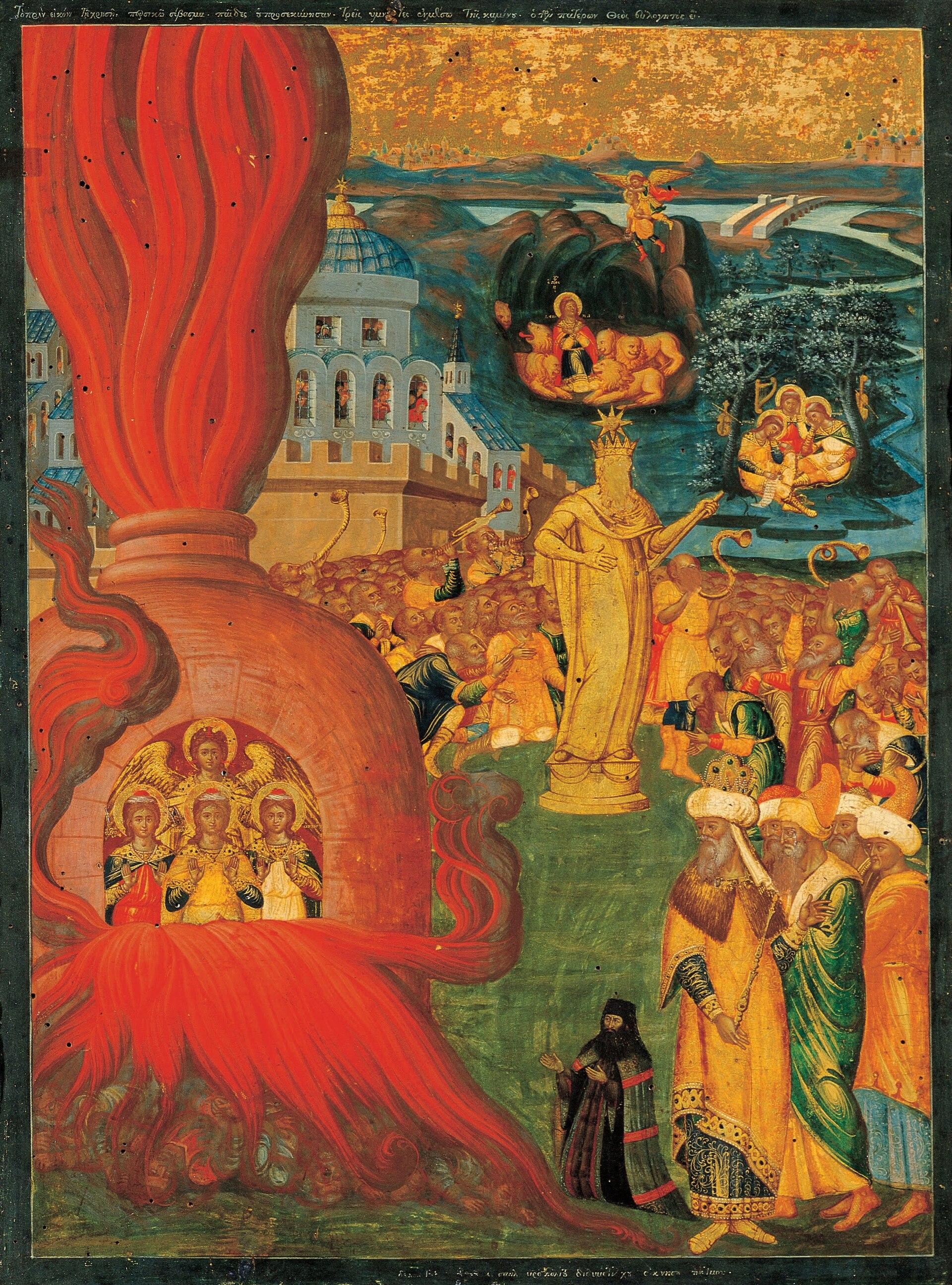
Konstantinos Adrianoupolitis, The Story of Daniel and the Three Youths in the Fiery Furnace, 1725 to 1750. Public domain.
Song of the Three 1 to 68 · Book · Apocrypha, a study resource beside the canon
The Song of the Three
The Song of the Three is one of three Greek additions to Daniel, a prayer and a hymn set between Daniel 3:23 and Daniel 3:24.
"So that the flame streamed forth above the furnace forty and nine cubits" (Song of the Three 24).
And these three men, Shadrach, Meshach, and Abednego, firmly bound, fell into the blazing fiery furnace.
And these three men, Shadrach, Meshach, and Abednego, firmly bound, fell into the blazing fiery furnace.
- Date
- probably the first century BC, as W. H. Bennett dated it (proposed)
- Edition
- The Song of the Three Holy Children in the King James Version Apocrypha, 1769 text (eBible.org); the Berean Standard Bible for the canon
Summary
The Song of the Three gives the words the three young men spoke inside the fire. Azariah confesses the sins of Israel, and then all three call every work of the Lord to bless Him.
- The flame killed the Chaldeans standing near the furnace, Song of the Three 25.
- Azariah asks God to keep His covenant for the sake of Abraham, Isaac and Israel, Song of the Three 11 to 12.
- Azariah calls God righteous in all He has brought on Jerusalem, Song of the Three 4 to 5.
The Book of the Song of the Three
The addition has its own title and its own numbering in the King James Apocrypha.
Its title there is The Song of the Three Holy Children, and it runs to sixty-eight verses.
Its first verse is "And they walked in the midst of the fire, praising God, and blessing the Lord" (Song of the Three 1).
Shadrach, Meshach and Abednego: the scene the song stands in
The Hymn at a Glance
The hymn moves from God on His throne down to the three young men.
The hymn calls on the heavens before the earth, and on Israel before the three young men.
- God enthronedSong of the Three 29 to 34: the three bless God in His temple, on the cherubims, on His throne and in the firmament.
- The heavensSong of the Three 35 to 41: all the works of the Lord, the heavens, the angels, the waters above the heaven, the powers, the sun and moon, the stars.
- The weatherSong of the Three 42 to 51: shower and dew, winds, fire and heat, winter and summer, dews and storms of snow, nights and days, light and darkness, ice and cold, frost and snow, lightnings and clouds.
- The earth and the watersSong of the Three 52 to 59: the earth, the mountains and hills, all that grows, the seas and rivers, the whales, the fowls of the air, the beasts and cattle.
- God's peopleSong of the Three 60 to 65: the children of men, Israel, the priests and servants of the Lord, the souls of the righteous, the holy and humble of heart.
- The threeSong of the Three 66 to 68: Ananias, Azarias and Misael are called by name, and all who worship the Lord bless the God of gods.
Each row gives a group of the hymn and its verses in the King James numbering.
The Song, the Psalms and 1 Maccabees
Azariah's prayer and the hymn each stand beside a psalm, and Mattathias names the three.
Azariah confesses that Israel has no "burnt offering, or sacrifice, or oblation, or incense, or place to sacrifice" left (Song of the Three 15). He asks that "in a contrite heart and an humble spirit" they may be accepted (Song of the Three 16).
The sacrifices of God are a broken spirit; a broken and a contrite heart, O God, You will not despise.David's psalm names the contrite heart as the sacrifice God will not despise, the offering Azariah brings.
Praise the LORD from the earth, all great sea creatures and ocean depths, lightning and hail, snow and clouds, powerful wind fulfilling His word,Like the hymn, Psalm 148 calls the heavens before the earth, and these verses call the sea creatures and the snow, as Song of the Three 50 and 57 do.
Mattathias, dying, named the three among Israel's faithful: "Ananias, Azarias, and Misael, by believing were saved out of the flame" (1 Maccabees 2:59).
Where the Song Came From
W. H. Bennett edited the addition in 1913 and judged its first language and its date.
Bennett's edition stands in R. H. Charles's Apocrypha and Pseudepigrapha. He held that a Hebrew original stood probably behind most of the addition, and certainly behind the Prayer of Azariah.
He reasoned that the addition is later than the Book of Daniel, that is, later than 168 BC.
Who Receives the Song
Five witnesses from Origen to the Westminster divines set the addition's standing.
The churches part over whether the Song belongs to Daniel.
| Who | What they do with the addition |
|---|---|
| Origen, Letter to Africanus, section 2 | says that in the Greek versions of Daniel many verses absent from the Hebrew follow the word bound, beginning with the prayer and song of Ananias, Azarias and Misael |
| Jerome, Preface to Daniel | says the Hebrew Daniel lacks the hymn of the three youths, and sets it in an appendix with an obelus before it |
| The Council of Trent, session 4, 1546 | lists Daniel among the books of the Old Testament, to be received entire with all its parts as the old Latin Vulgate contains them; the Vulgate carries the addition inside Daniel 3 |
| The Church of England, Article VI | names the Song of the Three Children among the other books the Church reads for example of life and instruction of manners, applying them to establish no doctrine |
| The Westminster Confession, 1646, chapter 1, section 3 | holds that the books commonly called Apocrypha are no part of the canon of Scripture |
Books to Read Next
The King James text, Bennett's edition and Origen's letter each open the addition further.
The Song of the Three Holy Children, King James Version Apocrypha
The King James translators · 1611
It gives the whole prayer and hymn in the King James English.
Read it in the Apocrypha readerThe Apocrypha and Pseudepigrapha of the Old Testament, vol. I
R. H. Charles, ed.; the Prayer of Azariah and the Song of the Three Children by W. H. Bennett · 1913
Bennett gives an introduction, a translation and notes on its pages 625 to 637.
Read it free at archive.orgA Letter to Africanus, Ante-Nicene Fathers vol. 4
Origen, tr. Frederick Crombie · 1885 translation
Origen answers the case against the Greek additions to Daniel.
Read it free at New AdventOut of the Midst of the Fire
The three young men name their rescue as the reason for their praise.
In the King James translation, Song of the Three 66 gives their reason: "for he hath delivered us from hell, and saved us from the hand of death".
The King James translation of the next verse reads, "O give thanks unto the Lord, because he is gracious: for his mercy endureth for ever" (Song of the Three 67).
Give thanks to the LORD, for He is good. His loving devotion endures forever.The psalm's first verse gives the same thanks the hymn gives at Song of the Three 67.
Sources
Scripture is the Berean Standard Bible.
- The Song of the Three Holy Children, King James Version Apocrypha, 1769 text (eBible.org USFX edition), public domain.
- 1 Maccabees, from the same eBible.org edition of the King James Apocrypha; public domain.
- W. H. Bennett, The Prayer of Azariah and the Song of the Three Children, in R. H. Charles (ed.), The Apocrypha and Pseudepigrapha of the Old Testament, vol. I, Oxford, 1913, pp. 625 to 637; public domain.
- W. H. Daubney, The Three Additions to Daniel: A Study, Cambridge, 1906; public domain.
- Jerome, Preface to Daniel, tr. W. H. Fremantle, Nicene and Post-Nicene Fathers, second series, vol. 6; public domain.
- Origen, A Letter to Africanus, tr. Frederick Crombie, Ante-Nicene Fathers vol. 4; public domain.
- The Council of Trent, session 4, 8 April 1546, the decree concerning the canonical Scriptures, tr. J. Waterworth.
- The Church of England, Articles of Religion, Article VI, in the Book of Common Prayer of 1863.
- The Westminster Confession of Faith, 1646, chapter 1, section 3.
Keep Studying
Studies7