
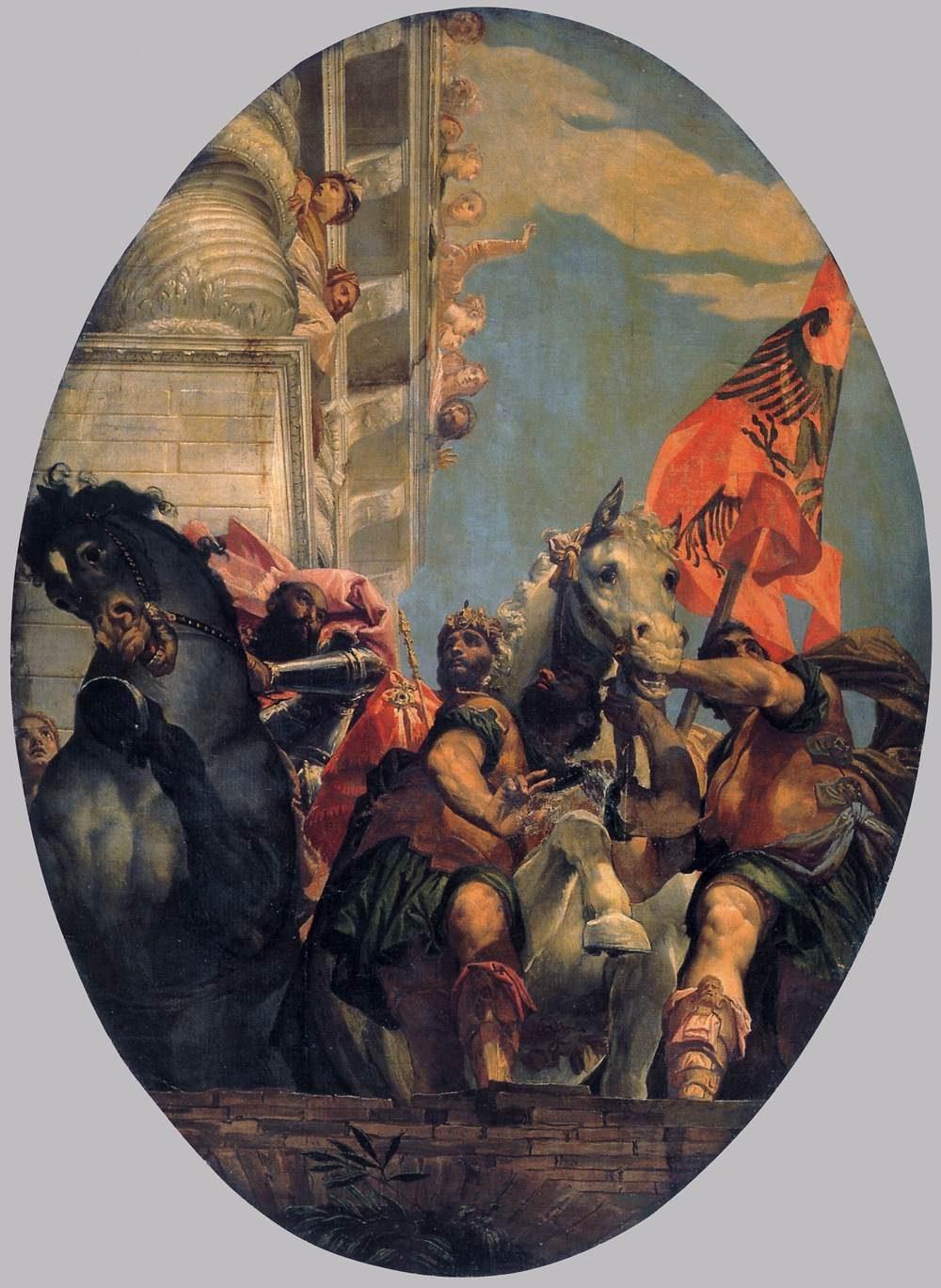
Paolo Veronese, The Triumph of Mordecai, 1556. Public domain.
Esther 2 to 10 · Person · Featured Study
Mordecai
Mordecai was a Benjamite of the exile who sat at the king's gate in Susa.
The man Haman meant to hang was led through Susa on the king's own horse.
For if you remain silent at this time, relief and deliverance for the Jews will arise from another place, but you and your father’s house will perish. And who knows if perhaps you have come to the kingdom for such a time as this?”
For if you remain silent at this time, relief and deliverance for the Jews will arise from another place, but you and your father’s house will perish. And who knows if perhaps you have come to the kingdom for such a time as this?”
- Family
- father: Jair; named in his line: Shimei and Kish; cousin: Esther
- Places
- Susa, Jerusalem
- First named
- Esther 2:5 “…the tribe of Benjamin named Mordecai son of…”
- Last named
- Esther 10:3 “For Mordecai the Jew…”
Summary
Mordecai exposed a plot against the king and would not bow down to Haman. When Haman's decree came, he sent Esther to plead before the king, and he ended the book as its second man.
- Esther 2:11 records that he walked each day before the court of the harem to learn how Esther fared.
- He went only as far as the king's gate in his sackcloth, since the law barred anyone in sackcloth from entering it.
- The text names no wife or child of his own.
Where Mordecai Stands in Scripture
Fifty verses of Esther name him.
The Hebrew name Mordecai stands 60 times in 52 verses. Ezra 2:2 and Nehemiah 7:7 also list a Mordecai among those who came up with Zerubbabel.
Now there was at the citadel of Susa a Jewish man from the tribe of Benjamin named Mordecai son of Jair, the son of Shimei, the son of Kish.His line is traced to the tribe of Benjamin.
His Life, Turn by Turn
His life runs from his seat at the king's gate to the second seat of the empire.
Mordecai moved from sackcloth at the gate to the king's robe and ring.
- Learns of the plot of Bigthan and Teresh and reports itThe king's gateEsther 2:21 to 22
- Will not bow down to HamanThe king's gateEsther 3:2
- Tears his clothes and wails in sackclothThe middle of the cityEsther 4:1
- Sends Esther a copy of the decreeThe city squareEsther 4:8
- Is arrayed in the king's robe and paraded through the squareThe city squareEsther 6:11
- Receives the signet ring taken back from HamanThe palaceEsther 8:2
- Writes the decree for the Jews in the king's nameThe palaceEsther 8:9 to 10
- Goes out in royal blue and white with a gold crownSusaEsther 8:15
- Stands second only to the kingThe empireEsther 10:3
Each turn of his life stands with the verse that records it.
Writes the decree for the Jews in the king's name, Goes out in royal blue and white with a gold crown, Stands second only to the king
His Charge to Esther
His words to Esther in Esther 4:13 to 14 turn the book.
he sent back to her this reply: “Do not imagine that because you are in the king’s palace you alone will escape the fate of all the Jews.His reply answers her fear of the law of the inner court.
John Wesley reads his question in Esther 4:14 as a probability that she had been raised to her honour for that very season. Wesley draws from it a duty for every reader to ask why God has set them where they are.
The study of the book's silence weighs what his words about relief from another place say of God.
The Man at the King's Gate
Commentators read his seat at the king's gate as an office of the court.
In those days, while Mordecai was sitting at the king’s gate, Bigthan and Teresh, two of the king’s eunuchs who guarded the entrance, grew angry and conspired to assassinate King Xerxes.The verse sets him at his post when the plot was laid.
Jamieson, Fausset and Brown hold that sitting at the gate need not mean a porter's place. Officers of state, they note, waited in the outer courts until they were summoned.
Adam Clarke counts Mordecai among the higher officers who came to the gate to receive the king's commands.
A Marduka in the Tablets
Persian-era tablets name a scribe Marduka, and scholars differ on what that proves.
Arthur Ungnad published in 1941 a cuneiform text that names a Marduka, a scribe who visited Susa. The Biblical Archaeology Society dates the text to the middle of the fifth century BC and adds that the name Marduka appears in many texts.
Edwin Yamauchi wrote on Mordecai and the Persepolis tablets in Vetus Testamentum in 1992. By the summary of the Bible Archaeology Report, he counted more than thirty uses of the name in the Persepolis Fortification texts. They may belong to as many as four men. Yamauchi judged it possible that one of them was the biblical Mordecai.
David Clines, in the same journal in 1991, held that a Persian official named Marduka settles nothing about the history of the book. A romance, he argued, may also give its characters real names.
The Circle of Mordecai
Eight people stand around him in the text, from the names of his line to the king.
His line is three names, and his circle is the queen and the court.
| Person | Tie to Mordecai |
|---|---|
| Jair, Shimei and Kish | The three names given for his line, with his tribe of Benjamin |
| Esther | The queen he charged to go to the king for her people |
| Bigthan and Teresh | Two eunuchs of the king, hanged on the gallows once his report had been investigated and found true |
| Haman | The official he would not bow down to |
| Xerxes | The king who took back the signet ring from Haman and presented it to him on the day Haman was hanged |
The Places of His Life
His line left Jerusalem for Babylon, and his own story stands in Susa.
Mordecai's family came from Jerusalem, and his life was spent at the gates and squares of Susa.
- 1Jerusalem, The city from which the exile of his line began. Esther 2:6
- 2Babylon, The kingdom of Nebuchadnezzar, who carried his line into exile.
- 3The citadel of Susa, The royal city where he lived. Esther 2:5
- 4The king's gate, He sat there, and there he would not bow down. Esther 3:2
- 5The city square, Esther's messenger Hathach met him there. Esther 4:6
Not placed: The king's gate (4), The city square (5).
The coasts and rivers are simplified; each place stands at its place page's coordinates.
Five places of his line and his life.
Questions His Life Raises
One question is answered from the text and its commentators.
Why would Mordecai not bow to Haman?Esther 3:2 to 4, with Ellicott, Joseph Benson, Matthew Henry, John Wesley and the Pulpit Commentary
Day after day they warned him, but he would not comply. So they reported it to Haman to see whether Mordecai’s behavior would be tolerated, since he had told them he was a Jew.The verse gives the reason he offered the servants.
Ellicott and Joseph Benson read the bow as divine honour given to a man, which the Persian kings claimed and passed to their favourites. Matthew Henry, in his Concise Commentary, holds that a Jew's religion forbade honours that savoured of idolatry, above all to so wicked a man.
John Wesley and the Pulpit Commentary note that Greeks also refused to prostrate themselves before the Persian kings. Wesley adds that the Athenians put one Timocrates to death for worshipping Darius in that manner.
What the Text Leaves Unsaid
The book ends with him in office and records nothing of his death.
And all of Mordecai’s powerful and magnificent accomplishments, together with the full account of the greatness to which the king had raised him, are they not written in the Book of the Chronicles of the Kings of Media and Persia?The book points beyond itself for the rest of his story.
A Type of Christ
Aphrahat read Mordecai's rescue of his people as a figure of the rescue Jesus won.
Aphrahat wrote in the fourth century, within the Persian empire.
“Mordecai was also persecuted as Jesus was persecuted. Mordecai was persecuted by the wicked Haman; and Jesus was persecuted by the rebellious people. Mordecai by his prayer delivered his people from the hands of Haman; and Jesus by his prayer delivered his people from the hands of Satan. Mordecai was delivered from the hands of his persecutor; and Jesus was rescued from the hands of his persecutors.”
Aphrahat the Persian Sage · DEMONSTRATIONS 21.20 · on Esther 6:4 to 11Patristic
Voices on Mordecai
Jerome wrote on Esther 6:1 to 2.
Jerome (died 420)
Against the Pelagians 3.10
He read the king's sleepless night as the means by which Mordecai's report came to light.
“Sleep was removed from the eyes of Ahasuerus, whom the Seventy call Artaxerxes, that he might turn over the memoirs of his faithful ministers and come on Mordecai, by whose evidence he was delivered from a conspiracy; and that thus Esther might be more acceptable and the whole people of the Jews escape imminent death.”
on Esther 6:1 to 2Patristic
Who Was Carried into Exile?
Commentators give three answers to whom the clause of the captivity names.
He had been carried into exile from Jerusalem by Nebuchadnezzar king of Babylon among those taken captive with Jeconiah king of Judah.The question turns on whom this verse names.
Kish was the captiveThe Pulpit Commentary; Clericus and Baumgarten, in Keil; Albert Barnes
The Pulpit Commentary calls it simplest and most grammatical to read Kish as the man carried away, and adds that the dates lead the same way. Keil reports Clericus and Baumgarten taking Kish for the captive and Mordecai for his great grandson, born in exile. Barnes also traces the line from a Kish carried off by Nebuchadnezzar.
The objection: Keil holds that Hebrew narrative refers such a clause to the chief person of the sentence before it, who is Mordecai.
Mordecai was carried in his forefathersC. F. Keil; Matthew Poole
Keil refers the clause to Mordecai, and holds that it gives his origin and lineage. He reads it to mean that Mordecai, though born in captivity, was carried to Babylon in the persons of his forefathers. Matthew Poole offers the same reading, Mordecai carried in the loins of his parents.
The objection: the Cambridge Bible sees no need for the reading, and holds that the writer simply did not notice the difficulty of the dates.
Mordecai himself was the captiveMatthew Poole; Rambach, in Keil
Matthew Poole also allows that Mordecai was carried away in his own person, and so was a man of more than ordinary years. Keil reckons that he would then have become the king's minister at about 125, and reports that Rambach did not find that age incredible.
The objection: the Pulpit Commentary holds that to read Mordecai as the captive is to give up the identification of the king with Xerxes.
The Good of His People
For Mordecai the Jew was second only to King Xerxes, preeminent among the Jews and highly favored by his many kinsmen, seeking the good of his people and speaking peace to all his countrymen.The book ends on his work for his people.
Sources
Scripture is the Berean Standard Bible.
- Strong's Hebrew lexicon, h4782, with the index of every use.
- John Wesley, Explanatory Notes upon the Old Testament (1765), on Esther 4:14.
- Jamieson, Fausset and Brown, Commentary (1871), on Esther 2:5; Adam Clarke, Commentary on the Bible (1832), on Esther 3:2.
- Arthur Ungnad, Keilinschriftliche Beiträge zum Buch Esra und Ester, Zeitschrift für die alttestamentliche Wissenschaft 58 (1941), 240 to 244.
- Edwin Yamauchi, Mordecai, the Persepolis Tablets, and the Susa Excavations, Vetus Testamentum 42 (1992), 272 to 275, as summarized by the Bible Archaeology Report.
- David J. A. Clines, In Quest of the Historical Mordecai, Vetus Testamentum 41 (1991), 129 to 136, as quoted in a secondary blog.
- Ellicott's Commentary for English Readers; Joseph Benson, Commentary; Matthew Henry, Concise Commentary; the Pulpit Commentary, each on Esther 3:2.
- John Wesley, Explanatory Notes upon the Old Testament (1765), on Esther 3:2.
- Aphrahat the Persian Sage, Demonstrations 21.20.
- Jerome, Against the Pelagians 3.10.
- The Pulpit Commentary; C. F. Keil, Biblical Commentary; Albert Barnes, Notes; Matthew Poole, Annotations; the Cambridge Bible for Schools and Colleges, each on Esther 2:6.
- C. F. Keil, The Books of Ezra, Nehemiah, and Esther, translated by Sophia Taylor (Edinburgh, 1873), pages 335 to 336.
Keep Studying
Read it4
People and groups7
Show the next 1 title
Subjects6