
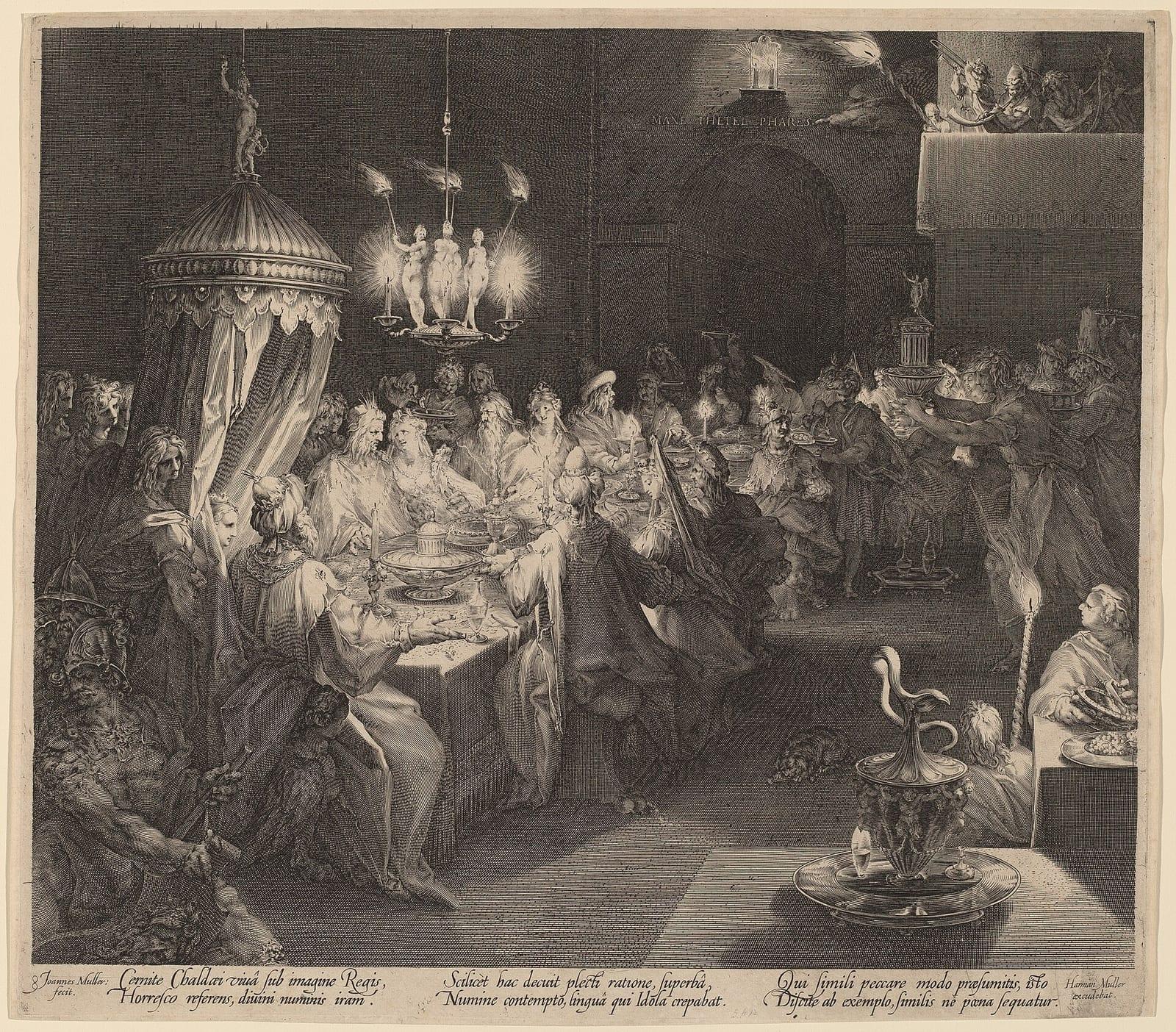
Jan Muller, Belshazzar's Feast, about 1598. CC0.
Daniel 5, Daniel 7:1 and Daniel 8:1 · Person · Featured Study
Belshazzar
Belshazzar was king in Babylon when Daniel saw the visions of chapters 7 and 8.
Daniel told Belshazzar that God held his very breath in His hand.
That very night Belshazzar king of the Chaldeans was slain,
- Family
- father, in Daniel 5: Nebuchadnezzar; father, in the Babylonian inscriptions: Nabonidus
- Places
- Babylon
- First named
- Daniel 5:1 “Later, King Belshazzar held a…”
- Last named
- Daniel 8:1 “…of the reign of King Belshazzar, a vision…”
Summary
Belshazzar ruled in Babylon in Daniel's old age.
- Daniel 5 and the clay records of Babylon name different fathers for him.
- His name stands only in the book of Daniel.
- He made Daniel the third highest ruler in the kingdom.
Where Belshazzar Stands in Scripture
Eight verses of the Berean text name him, all of them in Daniel.
Later, King Belshazzar held a great feast for a thousand of his nobles, and he drank wine with them.His name opens the chapter of his feast.
Six of the eight verses stand in Daniel 5. The other two are Daniel 7:1 and Daniel 8:1.
In the first year of the reign of Belshazzar over Babylon, Daniel had a dream, and visions passed through his mind as he lay on his bed. He wrote down the dream, and this is the summary of his account.The feast, the hand on the wall and Daniel's reading of the writing are told at Belshazzar's Feast.
His Years in Daniel
Daniel names his first year, his third year and the night of his death.
Daniel's last visions under Babylon came in Belshazzar's reign.
- In his first year Daniel dreams of four beasts from the seaBabylonDaniel 7:1
- In his third year Daniel sees the ram and the goatthe citadel of Susa, in the visionDaniel 8:1 to 2
- He drinks from the vessels taken from the temple in Jerusalemthe royal palaceDaniel 5:2
- Daniel is clothed in purple and given a gold chainthe royal palaceDaniel 5:29
- He is slain that very nightBabylonDaniel 5:30
Five turns of his reign in the order Daniel gives them.
His Name Outside Scripture
A cylinder from Ur, a Babylonian poem and a chronicle name him or his office under Nabonidus.
A clay cylinder of Nabonidus found at Ur records his repairs to the temple of the moon god Sin. It ends with a prayer for Belshazzar, his eldest son.
A Babylonian poem known as the Verse Account of Nabonidus says the king entrusted the kingship to his firstborn son and went away himself.
The Nabonidus Chronicle records for the seventh, ninth, tenth and eleventh years of Nabonidus that the king was in Tayma while the prince, his officers and his army were in Akkad.
Robert Dick Wilson argued in 1917 that the evidence fails to show Daniel's statements about Belshazzar to be false.
His House
Daniel names his father, the queen and his wives, and the inscriptions add Nabonidus.
Scripture and the inscriptions give him two fathers, Nebuchadnezzar and Nabonidus.
Generation 1
- NebuchadnezzarCalled his father six times in Daniel 5
- NabonidusHis father in the Babylonian inscriptions
- The queenShe remembered Daniel from the days of his father
Generation 2
- BelshazzarKing of the Chaldeans
- His wives and concubinesThey drank with him from the temple vessels
Belshazzar and four people around him, three named in Daniel and one in the inscriptions.
The Places of His Reign
His story touches Babylon, Susa and the temple in Jerusalem.
He ruled in Babylon, and the vessels he drank from came from Jerusalem.
| Place | What Daniel's text sets there |
|---|---|
| Babylon | The city he ruled as king of the Chaldeans, and where he was slain that very night (Daniel 7:1; Daniel 5:30). |
| Susa | It was a citadel in the province of Elam, where Daniel saw himself in the vision of the third year (Daniel 8:2). |
| Jerusalem | Nebuchadnezzar had carried off its gold and silver vessels, and Belshazzar called for them at his feast (Daniel 5:2). |
What Daniel Leaves Unsaid
The book gives no account of how he came to the throne.
The book never names Belshazzar's mother, and it gives the queen of Daniel 5:10 no name.
It does not say who killed him or how. Daniel 5:30 records only that he was slain that night.
Voices on Belshazzar
Three teachers from the third, eighteenth and nineteenth centuries read his last night.
Hippolytus of Rome (died 235)
Hippolytus of Rome read the reward the king gave Daniel as given in grief.
“For the king, after he heard the writing and its interpretation, was grieved at what was spoken, but he commanded Daniel to be clothed in purple and to be the third position in the kingdom.”
Hippolytus of Rome · Commentary on Daniel 3.18.1 · on Daniel 5:29Patristic
Matthew Henry (1662 to 1714)
Matthew Henry noticed how Daniel came before the king in old age.
“He was now nearly ninety years of age, so that his years, and honours, and former preferments, might have entitled him to a free admission into the king's presence; yet he was willing to be conducted in, as a stranger, by the master of the ceremonies.”
Matthew Henry · Commentary on the Whole Bible · on Daniel 5:13Puritan
Jamieson, Fausset & Brown (1802 to 1910)
Jamieson, Fausset and Brown tied the fall of the city to the king's sacrilege.
“As the capture of the city by Cyrus was not till near daylight, there was no want of time in that eventful night for accomplishing all that is here recorded. The capture of the city so immediately after the prophecy of it (following Belshazzar's sacrilege), marked most emphatically to the whole world the connection between Babylon's sin and its punishment.”
Jamieson, Fausset & Brown · Commentary Critical and Explanatory on the Whole Bible · on Daniel 5:29Reformed
Whose Son Was He?
Readers have explained the word father in Daniel 5 in three ways.
As for you, O king, the Most High God gave your father Nebuchadnezzar sovereignty and greatness, glory and honor.His grandsonJohn Wesley; Jamieson, Fausset and Brown
John Wesley called Belshazzar the grandson of Nebuchadnezzar. Jamieson, Fausset and Brown read the word son as grandson and pointed to Jeremiah 27:7.
All nations will serve him and his son and grandson, until the time of his own land comes; then many nations and great kings will enslave him.The objection: Daniel 5 never uses the word grandson, and the inscriptions name another man as his father.
His son, who reigned after Evil-merodachTheodoret of Cyrus
Theodoret of Cyrus held that Belshazzar was the son of Nebuchadnezzar but did not succeed him at once, since Evil-merodach ruled between them.
The objection: Jerome, following Berosus and Josephus, denied that Belshazzar was Nebuchadnezzar's son.
Of another house, by Berosus and JosephusJerome
Jerome wrote that Belshazzar was not the son of Nebuchadnezzar, as readers commonly imagined, and followed Berosus and Josephus.
The objection: the narrator, the queen, the king and Daniel all speak of Nebuchadnezzar this way in Daniel 5.
Albert Barnes judged the ancient accounts of this king to be so confused that reconciling them was hopeless.
Even Though You Knew All This
Daniel's charge against the king rests on what he already knew of Nebuchadnezzar's humbling.
But you his son, O Belshazzar, have not humbled your heart, even though you knew all this. Instead, you have exalted yourself against the Lord of heaven. The vessels from His house were brought to you, and as you drank wine from them with your nobles, wives, and concubines, you praised your gods of silver and gold, bronze and iron, wood and stone, which cannot see or hear or understand. But you have failed to glorify the God who holds in His hand your very breath and all your ways.Sources
Scripture is the Berean Standard Bible.
- James Strong, Exhaustive Concordance of the Bible (1890), Hebrew and Chaldee dictionary, entries 1112 and 1113.
- Jerome, Commentary on Daniel (about 407), on Daniel 5:1.
- Theodoret of Cyrus, Commentary on Daniel, on Daniel 5:1.
- John Wesley, Explanatory Notes upon the Old Testament (1765), on Daniel 5:1.
- Jamieson, Fausset and Brown, Commentary Critical and Explanatory on the Whole Bible (1871), on Daniel 5:1, 5:2 and 5:29.
- Albert Barnes, Notes, Explanatory and Practical, on the Old and New Testaments (1832 to 1869), on Daniel 5:1.
- Hippolytus of Rome, Commentary on Daniel, on Daniel 5:29.
- Matthew Henry, Commentary on the Whole Bible (1710), on Daniel 5:13.
- The Nabonidus Cylinder from Ur, translated by Paul-Alain Beaulieu, on Livius.org.
- The Verse Account of Nabonidus, column ii, lines 5 to 6, translated by A. Leo Oppenheim (ANET, 1950), on Livius.org.
- The Nabonidus Chronicle (ABC 7), column ii, lines 5, 10, 19 and 23, translated by A. K. Grayson, on Livius.org.
- Robert Dick Wilson, Studies in the Book of Daniel (New York, Putnam, 1917), Introduction, p. viii.
Keep Studying
Read it4
People and groups4