
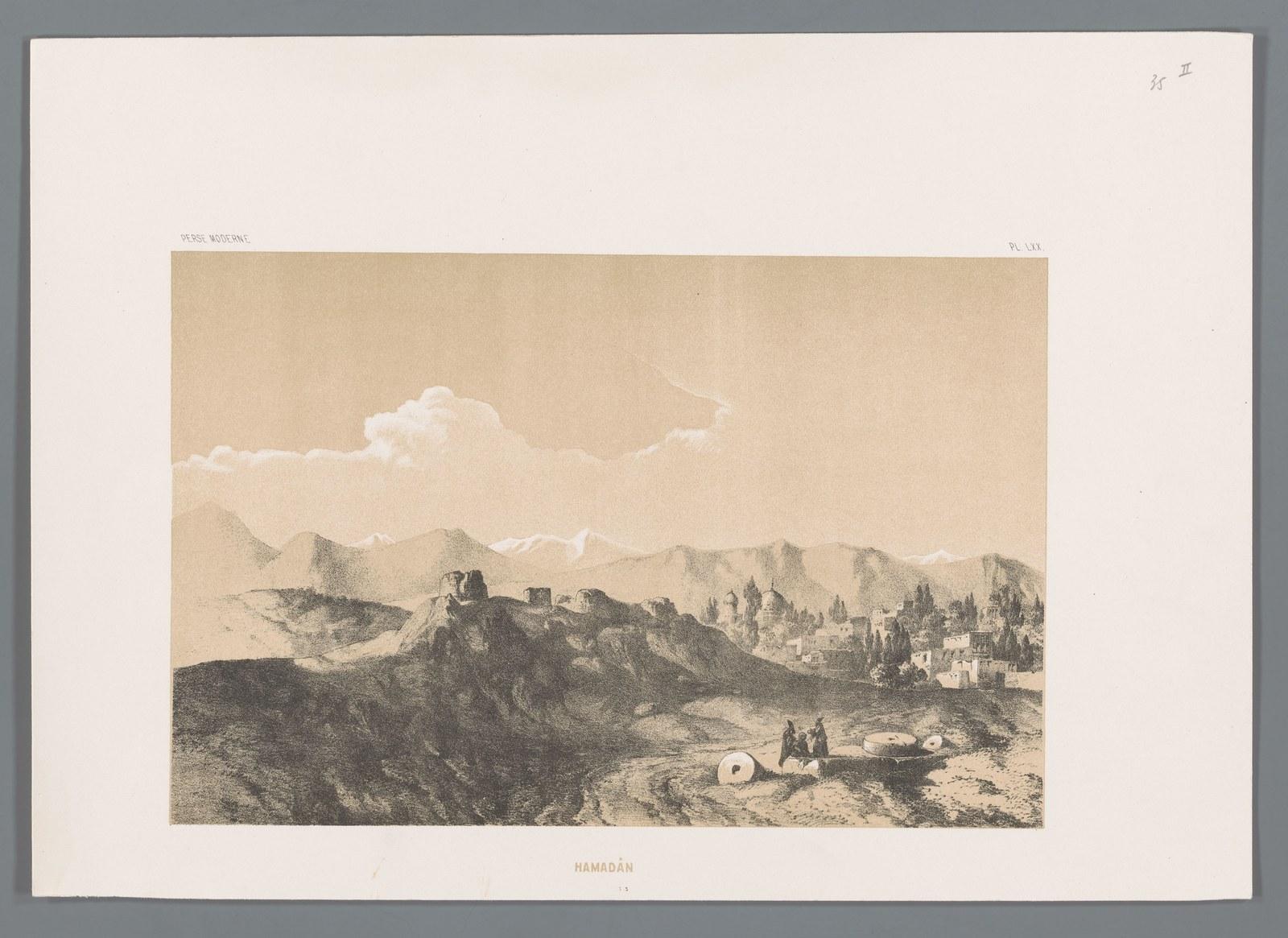
Eugène Flandin, Hamadân, Perse moderne, plate 70. Public domain (CC0).
Isaiah 13:17 and Daniel 8:20 · Group · Featured Study
Media
A people of the land Adam Clarke placed near the Caspian Sea, with Assyria to its south.
The two-horned ram that you saw represents the kings of Media and Persia.
- Began
- Genesis 10:2 names Madai among the sons of Japheth
Herodotus wrote that Deioces built Ecbatana as seven circles of walls, one inside the next.
Summary
The Medes ruled a kingdom of their own before Persia, and Greek and Babylonian writers tell how it rose and how it ended. In Scripture their name runs from the table of nations to the crowd at Pentecost. Two prophets name them against Babylon, and Daniel's ram carries them in its horns.
- Herodotus counts 128 years of Median rule in Asia beyond the Halys.
- Jamieson, Fausset and Brown placed their royal city where Hamadan stands, at the foot of the Elwund range.
- Darius I put a Median rebel, Phraortes, to death at Ecbatana.
Where Media Stands in Scripture
One Hebrew name serves for a land and for the people who lived in it.
Strong's dictionary glosses Madai as a country of central Asia. The King James Version renders the name as Madai, Medes and Media.
Persia, the empire that took in the Medes, is taught at Persia, and Cyrus at Cyrus, the LORD's Anointed.
Ecbatana and Its Neighbours
The royal city of the Medes stood in the mountains east of Nineveh and Babylon.
Ecbatana in Media lay east of Nineveh on the Tigris and of Babylon on the Euphrates.
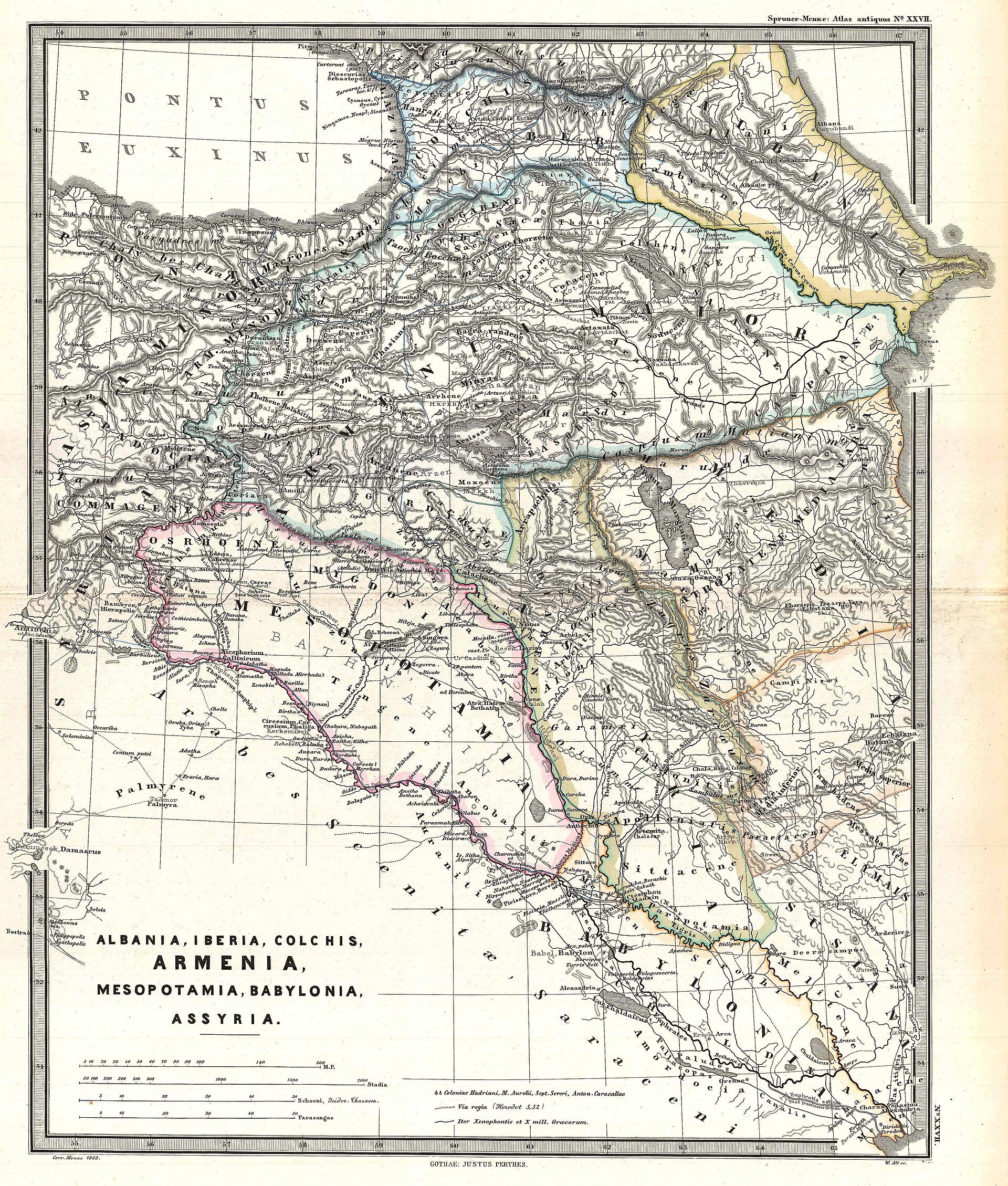
- 1Ecbatana, The fortress of the province of Media Ezra 6:2
- 2Nineveh, The Medes and the king of Babylon besieged it for three months, by the Babylonian chronicle Nahum 1:1
- 3Babylon, Its fall at their hands is foretold in Jeremiah 51 Jeremiah 51:28
Base map: Albania, Iberia, Colchis, Armenia, Mesopotamia, Babylonia, Assyria, Karl von Spruner and Theodor Menke, Atlas Antiquus, plate XXVII (Gotha: Justus Perthes, 1865), public domain. Places with a place page stand at its coordinates and the others at the point cited for each, set on the plate by Babylon and Ecbatana, as the plate prints them.
The map marks three cities, each with a verse that names it, on Spruner's plate of 1865, which prints Ecbatana with the name Achmetha beside it.
The Medes in Scripture, in Order
Each of these verses names Madai, the Medes or Media.
Five verses that name the Medes, in the order of the canon.
- GenesisMadai stands among the sons of JaphethGenesis 10:2
- 2 KingsThe king of Assyria settles exiles of Israel in the cities of the Medes2 Kings 17:6
- EstherMordecai's deeds are written in the chronicles of the kings of Media and PersiaEsther 10:2
- IsaiahMedia is called to lay siege beside ElamIsaiah 21:2
- JeremiahAll the kings of Media stand in a list of kings beside Zimri and ElamJeremiah 25:25
Three come from the Law and the histories and two from the prophets.
The Kingdom of the Medes
The Babylonian chronicles and Herodotus tell of the Median kingdom at its height and at its end.
A Babylonian chronicle tells that the Medes encamped against Assur in 614 to 613 BC, and that the king of Akkad and Cyaxares made an alliance there. The fall of Nineveh that followed is taught at The Fall of Nineveh.
The Nabonidus Chronicle records that the army of Astyages rebelled against him and handed him over to Cyrus, king of Anshan, in the year it dates 550 to 549 BC. Cyrus then took silver and gold from Ecbatana, the royal city.
Astyages in HerodotusHerodotus, Histories 1.130
Herodotus gives Astyages a reign of thirty-five years, after which the Medes had to bow before the Persians.
What the Text Leaves Unsaid
Scripture leaves two things about the Medes unnamed.
Second Kings leaves the towns of Media where the northern tribes were placed without a name.
Jeremiah speaks of the kings of the Medes and names no king among them.
The Medes Against Babylon
Two prophets name the Medes as the people stirred up against Babylon.
Behold, I will stir up against them the Medes, who have no regard for silver and no desire for gold.Sharpen the arrows! Fill the quivers! The LORD has aroused the spirit of the kings of the Medes, because His plan is aimed at Babylon to destroy her, for it is the vengeance of the LORD—vengeance for His temple.Voices on Media
Matthew Henry wrote on Isaiah 13:17 in 1710.
Matthew Henry (1662 to 1714)
Henry read the verse as a word on the ransom the Medes would refuse.
“All that men have they would give for their lives, but the Medes shall not regard silver; it is blood they thirst for, not gold; no man's riches shall with them be the ransom of his life.”
Matthew Henry · Commentary on the Whole Bible · on Isaiah 13:17Puritan
Which Horn Is Media?
Readers differ on whether the two horns of Daniel's ram are two peoples or two royal lines.
Then I lifted up my eyes and saw a ram with two horns standing beside the canal. The horns were long, but one was longer than the other, and the longer one grew up later.Media and Persia, the shorter horn and the longerEphrem the Syrian, Matthew Henry, Adam Clarke
Ephrem the Syrian referred the longer horn to the Persians, whose power was superior to that of the Medes. Adam Clarke read the shorter horn as Media, the more ancient kingdom, and Matthew Henry made the kingdoms of Media and Persia the two horns.
The objection: Theodoret counted the horns by reigns, since the empire passed from Cyrus to his sons and then to another line.
Two royal linesTheodoret of Cyrus
Theodoret, in his Commentary on Daniel, tied the two horns to the reign of Cyrus, who passed the empire to his sons, and to Darius son of Hystaspes, who came after Cambyses.
The objection: Clarke read the higher horn that came up last as Persia rising over the older kingdom of Media.
Books to Read Next
Herodotus in Godley's translation is in the public domain and free to read.
The Histories, book 1
Herodotus, translated by A. D. Godley · 1920
Godley's translation gives the Median kings from Deioces to Astyages.
Read at the Perseus Digital LibrarySources
Scripture is the Berean Standard Bible.
- James Strong, Exhaustive Concordance of the Bible, Hebrew dictionary, entries 4074 to 4077.
- Herodotus, Histories 1.98 and 1.130, translated by A. D. Godley.
- The Fall of Nineveh Chronicle (ABC 3), years 12 and 14, the translation at Livius.
- The Nabonidus Chronicle (ABC 7), column ii, the sixth year, the translation at Livius.
- The Behistun inscription of Darius I, column II, sections 24 and 32, the translation at Livius.
- Wikipedia, Ecbatana, coordinates.
- Adam Clarke, Commentary on the Bible (1832), on Acts 2:9 and Daniel 8:3.
- Jamieson, Fausset and Brown, Commentary Critical and Explanatory on the Whole Bible (1871), on Ezra 6:2.
- Matthew Henry, Commentary on the Whole Bible (1710), on Isaiah 13:17 and Daniel 8:3.
- Ephrem the Syrian, Commentary on Daniel 8:3.
- Theodoret of Cyrus, Commentary on Daniel 8:3.
Keep Studying
Read it4
People and groups6