
Daniel 5:22
in Daniel 5But you his son, O Belshazzar, have not humbled your heart, even though you knew all this.
BSB
The same verse in ASV and KJV ▾
ASV
And thou his son, O Belshazzar, hast not humbled thy heart, though thou knewest all this,
KJV
And thou his son, O Belshazzar, hast not humbled thine heart, though thou knewest all this;
⋯
This verse in Daniel 5
Commentary
7 notes on this verseThis site's exposition
hast not humbled thine heart
on Daniel 5:22-23
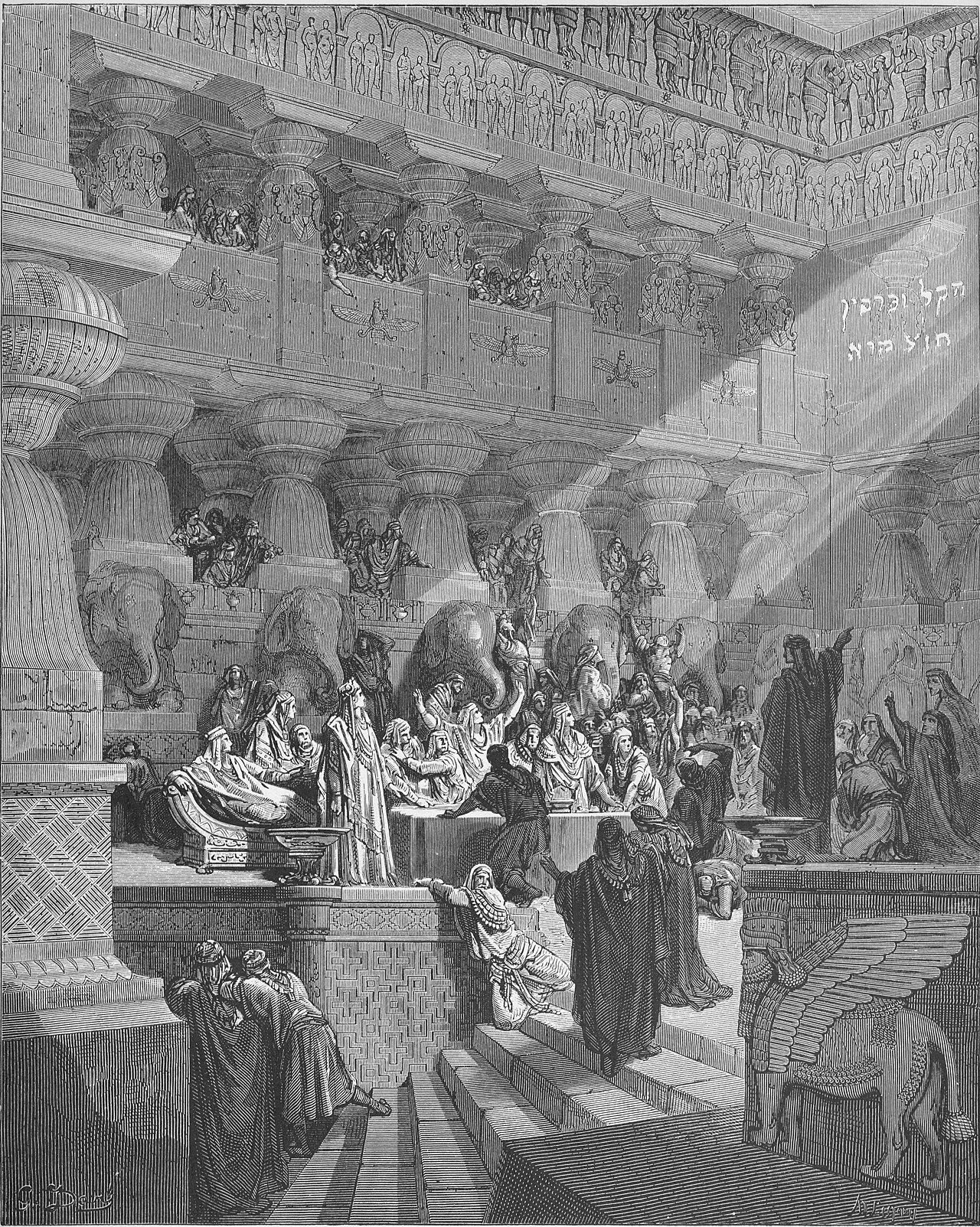
Daniel turns from the grandfather's history to the grandson's guilt directly, thou his son, O Belshazzar, hast not humbled thine heart, though thou knewest all this, making plain that Belshazzar's sin is not ignorance but refusal to learn from a lesson he had every means of knowing. The charge against him is stated in full: lifting himself against the Lord of heaven, drinking from the temple vessels, and praising gods of silver, gold, brass, iron, wood and stone which see not, nor hear, nor know, set directly against the God in whose hand his very breath lies. Wesley and JFB both mark the closing clause, and whose are all thy ways hast thou not glorified, as the verdict's real center, since the charge is finally not the vessels but the refusal to honor the God who gives him life and rule.
The record, by era
The Church Fathers2 voices
Verses 22, 23. "'Thou too, his son, O Belshazzar, hast not humbled thine heart, even though thou knewest all these things, but hast lifted thyself up against the ruler of heaven...'" Because thy great-grandfather, he says, lifted up his heart and hardened his spirit in pride, he therefore was put down from his royal throne and his glory was taken away, and so on (Jer. 4).
And after saying these things he added the following, at once rebuking the king and not receiving his face so that having heard this the king would be afraid and so that he who committed trespasses might immediately recognize them. And so it says, "And you his son, Belshazzar, you have not humbled your heart before God; do you not know all these things? And you have been exalted against the Lord God of heaven and have brought the vessels of his house before you and you and your magistrates and your mistresses and your concubines drank wine from them, and you have praised golden and silver and bronze and iron and wooden and stone gods, which do not see and which do not hear and which do not understand, and God, of whom your breath is in his hand and all your ways are as well, you have not glorified him. On account of this the fingers of a hand have been sent from his face and he ordered this writing: 'Mane, Thekel, Fares.' This is the interpretation of the phrase: 'Mane,' God has measured your kingdom and ended it, 'Thekel,' it has been weighed in the balance and been found wanting, 'Fares,' your kingdom is divided and has been given to the Medes and Persians." [Daniel 5:22-28]
The Puritans and the Awakening2 voices
And thou his son, O Belshazzar,....
Note, It is a great offence to God if our hearts be not humbled before him to comply both with his precepts and with his providences, humbled by repentance, obedience, and patience; nay, he expects from the greatest of men that their hearts should be humbled before him, by an acknowledgment that, great as they are, to him they are accountable.
The Nineteenth Century1 voice
Hast not humbled thine heart - These judgments and mercies have had no good effect upon thee.
1 more voice on this verse
The Nineteenth Century1 voice
A commentator
Albert Barnes1798–1870
Notes, Explanatory and Practical, on the Old and New Testaments (1832-1869)
proposed
And thou his son, O Belshazzar, hast not humbled thine heart ... - As thou shouldst have done in remembrance of these events. The idea is, that we ought to derive valuable lessons from what has taken place in past times; that, from the events which have occurred in history, we should learn what God approves and what he disapproves; that we should avoid the course which has subjected others to his displeasure, and which has brought his judgments upon them.
The words behind it
12 Hebrew wordsEvery Hebrew word of this verse in the order it stands, with what it means and the door to its own study. The last column counts the times a word stands in the whole Bible: the rarer the word, the more the places it appears belong together.
| Hebrew | Sound | Meaning | Word study | In the Bible |
|---|---|---|---|---|
| וְאַ֤נְתְּ | veantah | and you | H607 → | 15 times |
| בְּרֵהּ֙ | bereh | son his | H1247 → | 19 times |
| בֵּלְשַׁאצַּ֔ר | beleshatzar | O Belshazzar | H1113 → | 7 times |
| לָ֥א | la' | not | H3809 → | 82 times |
| הַשְׁפֵּ֖לְתְּ | hashpelet | you have brought low | H8214 → | 4 times |
| לִבְבָ֑ךְ | livakh | heart your | H3825 → | 7 times |
| כָּל־ | kol- | as to | ||
| קֳבֵ֕ל | kovel | because | H6903 → | 29 times |
| דִּ֥י | di | that | H1768 → | 345 times |
| כָל־ | khol- | all | H3606 → | 82 times |
| דְּנָ֖ה | denah | this | H1836 → | 58 times |
| יְדַֽעְתָּ׃ | yeda'ta | you knew | H3046 → | 47 times |
וְאַ֤נְתְּand you
veantahH607 →15 times
בְּרֵהּ֙son his
berehH1247 →19 times
בֵּלְשַׁאצַּ֔רO Belshazzar
beleshatzarH1113 →7 times
לָ֥אnot
la'H3809 →82 times
הַשְׁפֵּ֖לְתְּyou have brought low
hashpeletH8214 →4 times
לִבְבָ֑ךְheart your
livakhH3825 →7 times
כָּל־as to
kol-
קֳבֵ֕לbecause
kovelH6903 →29 times
דִּ֥יthat
diH1768 →345 times
כָל־all
khol-H3606 →82 times
דְּנָ֖הthis
denahH1836 →58 times
יְדַֽעְתָּ׃you knew
yeda'taH3046 →47 times
A shaded row is a word that stands 400 times or fewer in the Bible.
The walk
8 stopsEach card is a verse this one points to, and under it the verses that one points to in turn. Where several paths arrive at the same place, that place is listed first: the text keeps returning to it.
Through
James 4:6But He gives us more grace. This is why it says: “God opposes the proud, but gives grace to the humble.”
it leads to
- Matthew 23:12
For whoever exalts himself will be humbled, and whoever humbles himself will be exalted.
- Proverbs 3:34
He mocks the mockers, but gives grace to the humble.
- 1 Peter 5:5
Young men, in the same way, submit yourselves to your elders. And all of you, clothe yourselves with humility toward one another, because, “God opposes the proud, but gives grace to the humble.”
- Matthew 23:12
Through
James 4:17Anyone, then, who knows the right thing to do, yet fails to do it, is guilty of sin.
it leads to
- John 9:41
“If you were blind,” Jesus replied, “you would not be guilty of sin. But since you claim you can see, your guilt remains.”
- John 13:17
If you know these things, you will be blessed if you do them.
- John 15:22
If I had not come and spoken to them, they would not be guilty of sin. Now, however, they have no excuse for their sin.
- 2 Peter 2:21
It would have been better for them not to have known the way of righteousness than to have known it and then to turn away from the holy commandment passed on to them.
- Luke 12:47–48
That servant who knows his master’s will but does not get ready or follow his instructions will be beaten with many blows.
- John 9:41
Where this verse is studied
On this page
Studies4
About Daniel
This page draws on Adam Clarke, Commentary on the Bible; Albert Barnes, Notes, Explanatory and Practical, on the Old and New Testaments (1832-1869); Hippolytus of Rome, Commentary on Daniel 3.17.5-6; Jamieson, Fausset, and Brown, Commentary Critical and Explanatory on the Whole Bible; Jerome, St. Jerome, Commentary on Daniel, CHAPTER FIVE; John Gill, Exposition of the Old Testament (1748-1763); John Wesley, Explanatory Notes upon the Old Testament and Matthew Henry, Commentary on the Whole Bible.