
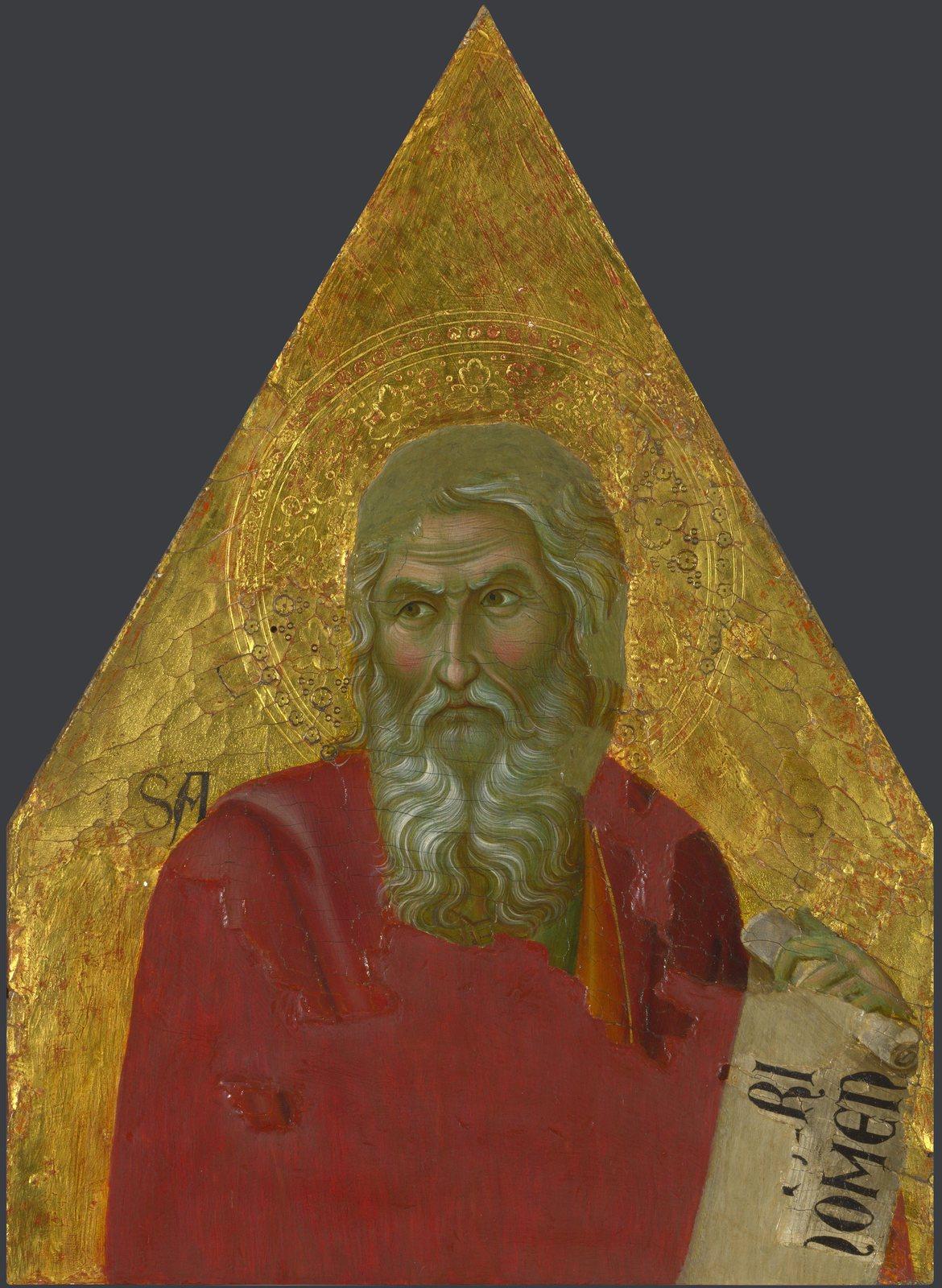
Ugolino di Nerio, Isaiah, 1325 to 1328. Public domain.
Isaiah 1, 40 and 44 · Debate · Featured Study
The Unity and Date of Isaiah
Isaiah is read as one prophet's book, as two books joined at chapter 40, or as three.
In two verses of John 12, Isaiah is named for words from chapter 53 and from chapter 6.
Isaiah said these things because he saw Jesus’ glory and spoke about Him.
Isaiah said these things because he saw Jesus’ glory and spoke about Him.
- The question
- Did Isaiah son of Amoz write the whole book that bears his name in the eighth century BC, or did later prophets write chapters 40 to 66?
- The texts
- Isaiah 1:1, Isaiah 44:28, Isaiah 45:1, John 12:38 to 41
Summary
The site's tradition holds that Isaiah son of Amoz wrote the whole book. Critics since the eighteenth century have given its later chapters to prophets of the exile and after. The readings divide over whether Isaiah foresaw Cyrus or a later prophet wrote of him.
- Sefaria dates the Babylonian Talmud from AD 450 to 550.
- Driver's Introduction came out in New York in 1891.
- Hezekiah's reign is the last that Isaiah's first verse names.
The Texts Behind the Question
The book opens in the reigns of four kings of Judah and later names a king of Persia.
This is the vision concerning Judah and Jerusalem that Isaiah son of Amoz saw during the reigns of Uzziah, Jotham, Ahaz, and Hezekiah, kings of Judah.The heading gives the span of Isaiah's ministry.
who says of Cyrus, ‘My shepherd will fulfill all that I desire,’ who says of Jerusalem, ‘She will be rebuilt,’ and of the temple, ‘Let its foundation be laid.’”A king of Persia is named here, by his own name.
In Isaiah 39 Hezekiah hears that his treasures and some of his descendants will be carried to Babylon. Isaiah 40 opens with comfort for Jerusalem, whose forced labor is complete.
Where the New Testament Names Isaiah
Twenty-two verses of the New Testament name Isaiah, all in the Gospels, Acts and Romans.
The New Testament names Isaiah when it quotes six passages from chapters 1 to 39 and seven from chapters 40 to 66.
| The passage in Isaiah | Where the New Testament quotes it by Isaiah's name |
|---|---|
| Isaiah 1:9 stands in chapters 1 to 39. | Romans 9:29 quotes the words “we would have become like Sodom.” |
| Isaiah 6:9 to 10 stands in chapters 1 to 39. | Matthew 13:14 to 15, John 12:39 to 40 and Acts 28:25 to 27 quote the words “understand with their hearts.” |
| Isaiah 9:1 to 2 stands in chapters 1 to 39. | Matthew 4:14 to 16 quotes the words “have seen a great light.” |
| Isaiah 10:22 to 23 stands in chapters 1 to 39. | Romans 9:27 to 28 quotes the words “like the sand of the sea.” |
| Isaiah 11:10 stands in chapters 1 to 39. | Romans 15:12 quotes the words “the Root of Jesse.” |
| Isaiah 29:13 stands in chapters 1 to 39. | Matthew 15:7 to 9 and Mark 7:6 to 7 quote the words “honor Me with their lips.” |
| Isaiah 40:3 to 5 stands in chapters 40 to 66. | Matthew 3:3, Mark 1:2 to 3, Luke 3:4 to 6 and John 1:23 quote the words “prepare the way for the Lord.” |
| Isaiah 42:1 to 4 stands in chapters 40 to 66. | Matthew 12:17 to 21 quotes the words “a bruised reed He will not break.” |
| Isaiah 53:1 stands in chapters 40 to 66. | Romans 10:16 and the Gospel of John quote the words “who has believed our message.” |
| Isaiah 53:4 stands in chapters 40 to 66. | Matthew 8:17 quotes the words “He took on our infirmities.” |
| Isaiah 53:7 to 8 stands in chapters 40 to 66. | Acts 8:28 to 33 quotes the words “He did not open His mouth.” |
| Isaiah 61:1 to 2 stands in chapters 40 to 66. | Luke 4:17 to 19 quotes the words “to preach good news to the poor.” |
| Isaiah 65:1 stands in chapters 40 to 66. | Romans 10:20 quotes the words “I revealed Myself to those who did not ask for Me.” |
Isaiah 40:3 to 5 stands in chapters 40 to 66., Isaiah 42:1 to 4 stands in chapters 40 to 66., Isaiah 53:1 stands in chapters 40 to 66., Isaiah 53:4 stands in chapters 40 to 66., Isaiah 53:7 to 8 stands in chapters 40 to 66., Isaiah 61:1 to 2 stands in chapters 40 to 66., Isaiah 65:1 stands in chapters 40 to 66.
Each Reading Stated
One reading is ancient, and the other two belong to modern criticism.
One prophet, Isaiah son of AmozSirach; Josephus; Albert Barnes; John Wesley
Sirach 48 praises Isaiah, who saw what should come to pass at the last and comforted those who mourned in Zion. Josephus, in Antiquities 11.1.2, writes that Cyrus learned of his task by reading the book Isaiah left behind him.
The Talmud, in Bava Batra 15a, names Hezekiah and his colleagues as the writers of Isaiah. Albert Barnes reads the first verse as the title of the entire book, since it takes in the whole prophetic life of the prophet.
A second prophet in the exile wrote chapters 40 to 66S. R. Driver; George Adam Smith
Joseph Addison Alexander records that after the middle of the eighteenth century Doderlein and Eichhorn gave the entire latter part of Isaiah to another writer.
S. R. Driver gives three independent lines of argument for an author near the close of the Babylonian captivity. First, the people the prophet addresses in person are the exiles in Babylonia. Second, the literary style of chapters 40 to 66 is very different from Isaiah's. Third, their ideas of God are larger and fuller: He is the Creator, the First and the Last, the Incomparable One.
George Adam Smith judged that the bulk of chapters 40 to 66 was composed in Babylonia during the exile, with portions from before it. Franz Delitzsch, in the edition translated in 1890, allowed that discourses of later prophets stand intermixed with Isaiah's in the book as it now exists.
Three parts: a third author for chapters 56 to 66Bernhard Duhm
Bernhard Duhm's commentary on Isaiah first appeared in 1892. He holds chapters 56 to 66 to be a third writing, shown by its form and its content to be the work of one writer, whom he calls Tritojesaia for short.
The Dates the Readings Give
The book dates its visions by the kings of Judah, and its readers date the chapters on Cyrus.
The traditional readings set the naming of Cyrus long before his reign, and Driver sets the chapters in his lifetime.
| What happens | The date given | Who gives it |
|---|---|---|
| Isaiah sees the Lord on His throne. | It is the year King Uzziah died. | Isaiah 6:1 |
| Sennacherib attacks Judah. | It is the fourteenth year of Hezekiah's reign. | Isaiah 36:1 |
| Isaiah names Cyrus. | Not far from 150 years before Cyrus took the throne, about 550 BC | Albert Barnes |
| Isaiah foretells the temple's rebuilding. | 140 years before the temple was demolished | Josephus |
| Chapters 40 to 66 open. | Between 549 and 538 BC | S. R. Driver |
The Oldest Witnesses to the Book
A scroll found at Qumran in 1947 carries the book.
The Israel Museum dates the Great Isaiah Scroll to about 125 BC and counts all 66 chapters in its 54 columns.
The museum writes that modern scholarship reads the book as an anthology of two principal compositions.
What the Book Leaves Unsaid
Two later writings tell how Isaiah died, and the book is silent on it.
In Yevamot 49b, the Talmud tells that King Manasseh tried Isaiah as a false witness. He set Isaiah 6:1 and Isaiah 55:6 against the words of Moses, both as the prophet's own sayings. Isaiah was swallowed by a cedar, and Manasseh's servants sawed through it.
In the Ascension of Isaiah, as Charles translated it in 1900, Manasseh saws him in sunder with a wooden saw.
They were stoned, they were sawed in two, they were put to death by the sword. They went around in sheepskins and goatskins, destitute, oppressed, and mistreated.Hebrews gives no names to those it counts.
Where the Site's Tradition Stands
The tradition rests on John 12:38 to 41.
The site's own tradition is Wesleyan-Pentecostal, and it gives all sixty-six chapters to the eighth-century prophet. In Isaiah 41 the LORD makes the telling of things to come the test that sets Him apart from the idols.
How the Teachers Read It
Wesley wrote on Cyrus, and Barnes on the scene of chapter 40.
For Wesley, the name given long before Cyrus lived settled the dispute between God and the idols.
Barnes reads Isaiah 40 as a vision whose scene is laid in Babylon near the close of the captivity.
The Readings Weighed
Every reading has its objector.
The ancient witnesses read one book, and modern critics divided it.
| Reading | Held by | Tradition | Representative work |
|---|---|---|---|
| The prophet of chapter 1 also wrote chapters 40 to 66. | Sirach; Josephus; Barnes; Wesley | Jewish and Christian tradition | Albert Barnes, Notes on Isaiah |
| A prophet of the exile wrote chapters 40 to 66. | S. R. Driver; George Adam Smith | Critical scholarship | George Adam Smith, The Book of Isaiah, volume 2 (1890) |
| A third author wrote chapters 56 to 66. | Bernhard Duhm | Critical scholarship | Duhm, Das Buch Jesaia (1892) |
Against the first reading1 paragraph
Driver holds that the chapters speak of Jerusalem as ruined and deserted and of a return close at hand, and that by the analogy of prophecy their author lived in the time he describes.
Against the second reading1 paragraph
Barnes holds that none but God, or one He inspired, could have named the deliverer so long before. If Isaiah delivered the prophecy, he writes, it proves that Isaiah was inspired.
Against the third reading1 paragraph
The Great Isaiah Scroll runs from chapter 1 to chapter 66 as one book, and the Israel Museum writes that by the time it was copied the book was already regarded as a single composition.
Books to Read Next
Driver's case and George Adam Smith's are free to read.
An Introduction to the Literature of the Old Testament
S. R. Driver · 1891
Driver sets out the case for an author of the exile, with the dates of the chapters on Cyrus.
Read at the Internet ArchiveThe Book of Isaiah, volume 2
George Adam Smith · 1890
Smith surveys chapters 40 to 66 and weighs which parts come from before the exile.
Read at the Internet ArchiveIsaiah Saw His Glory
John ends his account of the unbelief that met Jesus with the prophet's name.
Sources
Scripture is the Berean Standard Bible.
- S. R. Driver, An Introduction to the Literature of the Old Testament (New York: Scribner, 1891), pages 223 and following.
- George Adam Smith, The Book of Isaiah, volume 2, chapters 40 to 66 (The Expositor's Bible; London: Hodder and Stoughton, 1890)
- Franz Delitzsch, Biblical Commentary on the Prophecies of Isaiah, volume 2, translated from the fourth edition (Edinburgh: T. and T. Clark, 1890), page 132.
- Bernhard Duhm, Das Buch Jesaia, second edition, which records the first edition of 1892.
- Flavius Josephus, Antiquities of the Jews, book 11, chapter 1, section 2, translated by William Whiston.
- Sirach 48:22 to 25, the King James Version with the Apocrypha.
- Babylonian Talmud, Bava Batra 15a and Yevamot 49b, William Davidson edition, on Sefaria, with Sefaria's index records.
- The Ascension of Isaiah, translated by R. H. Charles (London: Adam and Charles Black, 1900), chapter 5.
- Joseph Addison Alexander, Commentary on the Prophecies of Isaiah, new and revised edition, volume 1 (Edinburgh, preface dated 1865), Introduction.
- The Israel Museum, The Digital Dead Sea Scrolls, The Great Isaiah Scroll.
- Albert Barnes, Notes, Explanatory and Practical, on Isaiah 1:1, 40:1 and 44:28.
- John Wesley, Explanatory Notes upon the Old Testament (1765), on Isaiah 44:28.
Keep Studying
Read it4
Studies6
People and groups3
Subjects1