
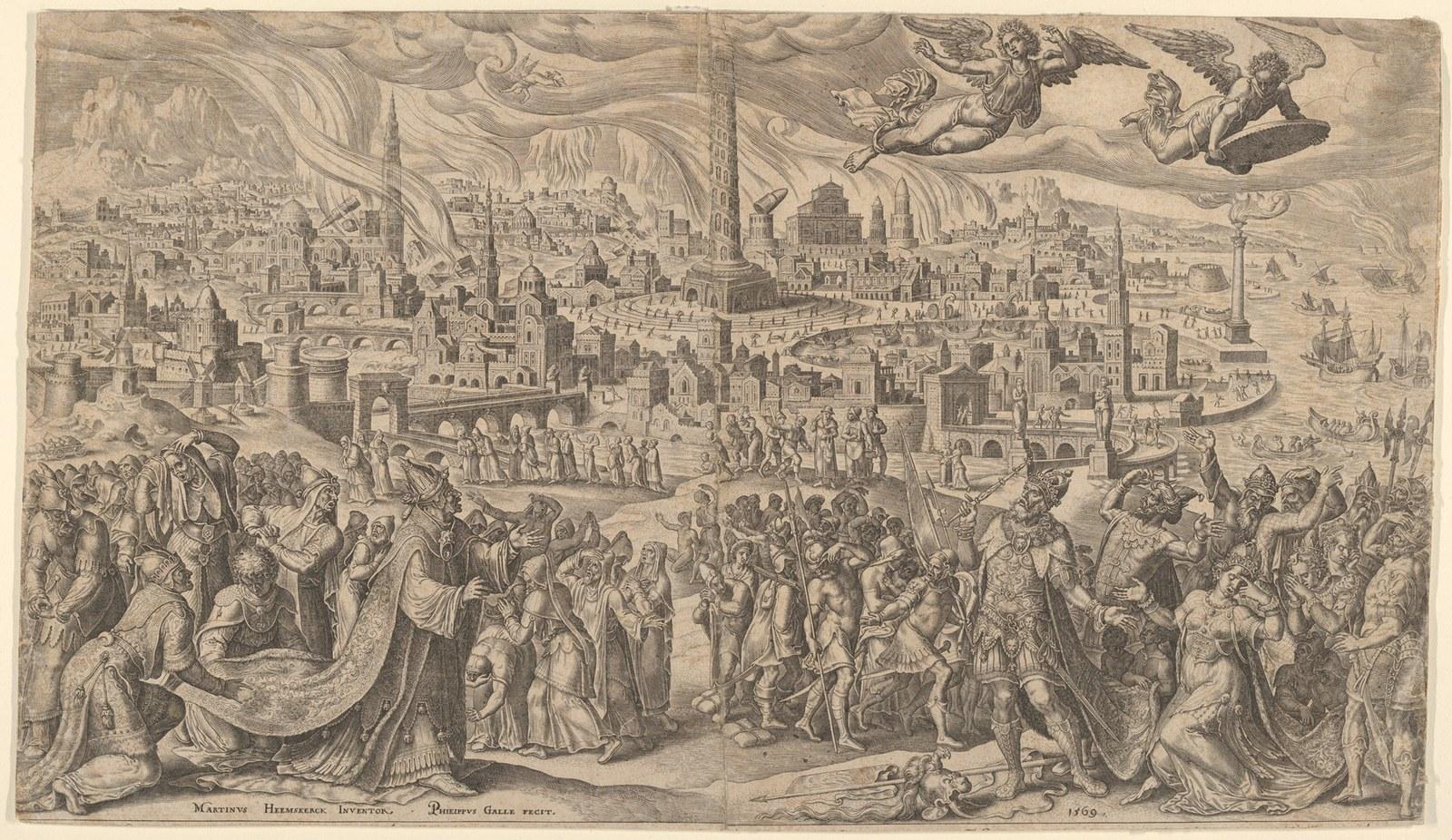
Philips Galle after Maarten van Heemskerck, The Fall of Babylon, 1569. Public domain.
Daniel 5:30 to 31 and Jeremiah 51 · Story · Featured Study
The Fall of Babylon in 539 BC
The capital of the Chaldean kingdom fell to Cyrus, king of Persia.
That very night Belshazzar king of the Chaldeans was slain, and Darius the Mede received the kingdom at the age of sixty-two.
- Where
- Babylon
- Who
- Cyrus the Great, Belshazzar, Daniel
- When
- October 539 BC, by the Nabonidus Chronicle
Isaiah named Cyrus as the LORD's anointed long before Babylon fell to him.
Summary
The Persian army took Babylon in October 539 BC. Babylonian tablets tell of that month. Two Greek writers tell of it too, and so does the Book of Daniel. Isaiah and Jeremiah had named the Medes and Cyrus long before.
- Ezra dates the return of the exiles from the first year of Cyrus (Ezra 1:1).
- Herodotus and Xenophon tell of a river drawn off and a festival inside the walls.
- Readers have named four different men as Darius the Mede.
What Scripture Says of the Night
Daniel gives the end of the kingdom in a word on the wall, and Jeremiah gives the city taken from end to end.
PERES means that your kingdom has been divided and given over to the Medes and Persians.”The kingdom's end is announced on the night it comes.
One courier races to meet another, and messenger follows messenger, to announce to the king of Babylon that his city has been captured from end to end.Jeremiah saw the city taken while its king waited for the news.
Look, here come the riders, horsemen in pairs.” And one answered, saying: “Fallen, fallen is Babylon! All the images of her gods lie shattered on the ground!”Isaiah heard the cry long before the city fell.
Read Belshazzar's Feast, the story of the writing on the wall
The Month Babylon Fell
A Babylonian chronicle gives the days of the fall one by one.
The Nabonidus Chronicle is a Babylonian record of the events of each year of King Nabonidus. Its third column covers his seventeenth year, the year Babylon fell.
Sippar fell first, then the army entered Babylon, and Cyrus came last.
- Cyrus fights the army of Akkad at Opis on the TigrisThe month Tashritu
- Sippar is taken without a battleThe 14th day of the month
- Ugbaru, governor of Gutium, and the army of Cyrus enter Babylon without battleThe 16th day of the month
- Nabonidus is captured in BabylonAfter the army's entry
- Cyrus himself enters3 Arahsamna, 29 October 539 BC
- New officers are set over the cityAfter Cyrus enters
- Ugbaru diesThe night of 11 Arahsamna
The entries of column iii in A. K. Grayson's translation, with D. J. Wiseman's one Julian date.
Four Accounts of One Month
A chronicle, a royal cylinder and two Greek writers each tell how the city was taken.
The Nabonidus ChronicleColumn iii, lines 12 to 22, tr. A. K. Grayson
The chronicle adds that troops from Gutium surrounded the gates of Esagil, a temple of Babylon, until the end of the month. It records that the rites of the temples went on without a break.
The Cyrus CylinderLines 12, 17 and 32, tr. after M. Cogan
The Cyrus Cylinder is an inscription in Cyrus's own name, written after he took Babylon. It says Marduk, the god of Babylon, called out the name of Cyrus and made him enter Babylon without fighting or battle.
In line 32 Cyrus says he gathered the inhabitants of the lands and returned them to their dwellings.
HerodotusHistories 1.191, tr. A. D. Godley, 1920
Herodotus wrote that Cyrus drew off the Euphrates by a canal until its channel could be forded. His men entered the city along the riverbed.
He adds that the people in the middle of the city were dancing and celebrating a holiday and knew nothing of it.
XenophonCyropaedia 7.5, tr. Walter Miller, 1914
Xenophon wrote that Cyrus dug a great trench around the city and opened it to the river on a festival night. All Babylon drank and revelled through that night.
In his account Gadatas and Gobryas led the troops to the palace, and their men overpowered the king.
The Prophecies That Named the Conqueror
Isaiah and Jeremiah named the Medes and Cyrus, and Jeremiah spoke of the river dried and the feast.
Behold, I will stir up against them the Medes, who have no regard for silver and no desire for gold.Isaiah named the Medes long before they came against Babylon.
This is what the LORD says to Cyrus His anointed, whose right hand I have grasped to subdue nations before him, to disarm kings, to open the doors before him, so that the gates will not be shut:Barnes notes that this was spoken not less than one hundred and fifty years before Cyrus took Babylon.
Sharpen the arrows! Fill the quivers! The LORD has aroused the spirit of the kings of the Medes, because His plan is aimed at Babylon to destroy her, for it is the vengeance of the LORD—vengeance for His temple.Jeremiah ties the city's fall to the LORD's vengeance for His temple.
A drought is upon her waters, and they will be dried up. For it is a land of graven images, and the people go mad over idols.The drought falls on the waters that defended the city.
John Wesley, on Jeremiah 50:38, read the drought as a plain reference to the river Cyrus diverted. He adds that others took it as a threat of want of rain.
While they are flushed with heat, I will serve them a feast, and I will make them drunk so that they may revel; then they will fall asleep forever and never wake up, declares the LORD.John Wesley read this feast as the night of Daniel 5.
Jeremiah 51:11, Jeremiah 50:38, Jeremiah 51:39
Nabonidus and Belshazzar
Babylonian texts name Nabonidus as the last king and Belshazzar as the son who held the kingship in Babylon.
A clay cylinder of Nabonidus from Ur prays for Belshazzar, his eldest son. The Verse Account of Nabonidus says the king entrusted the kingship to his firstborn.
D. J. Wiseman writes that Nabonidus had fled the day before the army entered Babylon and was probably captured and died in exile.
The Word Spoken Through Jeremiah
Ezra ties the first year of Cyrus to the word the LORD spoke through Jeremiah.
But when seventy years are complete, I will punish the king of Babylon and that nation, the land of the Chaldeans, for their guilt, declares the LORD, and I will make it an everlasting desolation.The seventy years end with Babylon's own punishment.
In the first year of Cyrus king of Persia, to fulfill the word of the LORD spoken through Jeremiah, the LORD stirred the spirit of Cyrus king of Persia to send a proclamation throughout his kingdom and to put it in writing as follows:The return from exile starts from this proclamation.
And he cried out in a mighty voice: “Fallen, fallen is Babylon the great! She has become a lair for demons and a haunt for every unclean spirit, every unclean bird, and every detestable beast.Revelation carries the cry of Isaiah 21:9 beyond 539 BC.
Voices on the Fall of Babylon
Jerome, John Wesley and Albert Barnes read the prophets beside the fall.
How this text has been taught3 voices, from the fifth century to the nineteenth
John Wesley, on Jeremiah 51:57, read the drunken princes as a plain allusion to the king and his thousand lords at their wine on the night the city was taken.
Albert Barnes, on Isaiah 45:1, notes that the Septuagint, the Greek translation of the Old Testament, gives the words as To Cyrus, my Christ.
Who Was Darius the Mede?
Daniel 5:31 names Darius the Mede as the one who received the kingdom.
So Daniel prospered during the reign of Darius and the reign of Cyrus the Persian.This is the verse Wiseman reads as naming one king.
Hippolytus of Rome, in his Commentary on Daniel, wrote that Darius the Mede was called Ahasuerus.
Cyaxares II, the uncle of CyrusAlbert Barnes; Jamieson, Fausset and Brown
Albert Barnes, on Daniel 5:31, held that Cyrus took the city in the name of Darius, or Cyaxares, his uncle. Jamieson, Fausset and Brown name him Cyaxares II, son of Astyages, and cite Xenophon's Cyropaedia.
The objection: H. H. Rowley, as Wiseman reports, showed that Darius the Mede could not be identified with Cyaxares.
Gubaru, the governorJ. C. Whitcomb, Darius the Mede, 1959, as D. J. Wiseman reports it
Wiseman reports that J. C. Whitcomb took Darius as a title of Gubaru, governor of Babylon.
The objection, which Wiseman states: Gubaru is nowhere in the cuneiform texts connected with the name Darius.
Cyrus himselfD. J. Wiseman, Notes on Some Problems in the Book of Daniel, 1965
Wiseman held that Daniel 6:28 can be translated with even in place of and. Then Darius and Cyrus are one king under two names.
The objection: Daniel 9:1 calls Darius the son of Xerxes and a Mede by descent, and Cyrus was a Persian.
A figure of later memoryS. R. Driver, the Cambridge Bible, on Daniel 5:31
Driver judged that the figure of Darius the Mede must be the result of some historical confusion.
The objection: the book gives Darius a reign, a father and a people, as a king of record.
The Gates Opened Before Him
“I will go before you and level the mountains; I will break down the gates of bronze and cut through the bars of iron.The promise of gates broken open stands over the night the city fell.
In his first year Cyrus let the exiles of Judah go home to build the house of the LORD.
Sources
Scripture is the Berean Standard Bible.
- The Nabonidus Chronicle (ABC 7), column iii, lines 12 to 22, tr. A. K. Grayson with changes, Livius.org.
- The Cyrus Cylinder, lines 12, 17 and 32, tr. after Mordechai Cogan, The Context of Scripture II (2003), Livius.org.
- Herodotus, Histories 1.191, tr. A. D. Godley, Loeb Classical Library, 1920.
- Xenophon, Cyropaedia 7.5, tr. Walter Miller, Loeb Classical Library, 1914.
- The Nabonidus Cylinder from Ur; the Verse Account of Nabonidus ii.5 to 6 (after ANET), Livius.org.
- D. J. Wiseman, Some Historical Problems in the Book of Daniel, in Notes on Some Problems in the Book of Daniel (Tyndale Press, 1965), pp. 9 to 16.
- S. R. Driver, The Book of Daniel, Cambridge Bible for Schools and Colleges, on Daniel 5:31.
- Albert Barnes, Notes on Isaiah and on Daniel; John Wesley, Explanatory Notes upon the Old Testament (1765); Jamieson, Fausset and Brown (1871); Hippolytus of Rome, Commentary on Daniel 3.19; Jerome, Commentary on Isaiah.
- Philips Galle after Maarten van Heemskerck, The Fall of Babylon, engraving, 1569, The Metropolitan Museum of Art 65.587.8, public domain (CC0)
Keep Studying
Read it5
Studies4
People and groups8
Places3
Doctrines2
Subjects7
Go further2