
Daniel 1:6
in Daniel 1Among these young men were some from Judah: Daniel, Hananiah, Mishael, and Azariah.
BSB
The same verse in ASV and KJV ▾
ASV
Now among these were, of the children of Judah, Daniel, Hananiah, Mishael, and Azariah.
KJV
Now among these were of the children of Judah, Daniel, Hananiah, Mishael, and Azariah:
⋯
This verse in Daniel 1
Commentary
6 notes on this verseNow among these - There were no doubt several noble youths from other provinces: but the four mentioned here were Jews, and are supposed to have all been of royal extraction.
This site's exposition
children of Judah
on Daniel 1:6-7
Among the children of Judah brought in stand the four the book will follow, Daniel, Hananiah, Mishael, and Azariah, each carrying a name that confesses the God of Israel in some form of El or Jah. The prince of the eunuchs renames every one of them after the gods of Babylon, Belteshazzar honoring Bel by the bench's reading, an act of empire as old as conquest itself. Clarke and Henry both read the renaming as Babylon's claim on the men's very identity, the first assault the narrative records, quieter than the meat and wine but aimed at the same surrender.
The record, by era
The Church Fathers2 voices
So here he informs us of the king's generosity in providing them with nourishment that was not of an ordinary kind fit for captives and slaves; instead, he gave orders for them to share in the king's table. Shortly afterward he mentions their self-control and …
And Scripture says, "And the king told Ashpenaz the chief of the eunuchs to bring in some of those from the sons of the captivity of Israel and from the seed of the king and from the princes, young men, who have no blemish, who are beautiful in appearance and are understanding in all wisdom, being well versed in knowledge, disposed to prudence, and who have in themselves the strength to stand in the house of the king, and to teach them the letters and the tongue of the Chaldeans. And the king appointed them on that very day to be nourished from the table of the king and from the wine which he drank in order for them to be nourished three years, and after these things to stand before the king. And there was among them from the sons of Judah, Daniel and Hanniah, Mishael, and Azariah." [Daniel 1:3-7] It is necessary that those who love learning to not read these things cursorily, but to prepare the mind for the things that lie before us. For the divine writings do not idly preach to us, but their admonition is meant for us and also the blessing of these prophets and the demonstration of all the things which are spoken by them are for us as well. For when Hezekiah king of Judah was sick unto death, then "Isaiah the prophet came to him and told him 'Set in order your sons and your daughters and your father's house, for you will die and you will not live.'" [2 Kings 20:1, also see Isaiah 38:1] Having been grieved at this word, "Hezekiah turned his face to the wall and prayed to the Lord saying, 'Lord remember me just as I have walked before you in truth and in faith and with a full heart and I have done what is pleasing in your presence.' And Hezekiah wept with great weeping." [2 Kings 20:1-3] After this occurred, Isaiah was sent to him a second time and he said to him, "The Lord the God of David your father says this, 'I have heard your prayer and have seen your tears. […]
The Puritans and the Awakening1 voice
Now among these were of the children of Judea, Among those youths that were selected from the rest, and brought up in the above manner, and for the above purposes, who were of the tribe of Judah, and very likely of the house of David, and of royal descent, were the four following persons: Daniel, Hananiah, Mishael, and Azariah; who are particularly mentioned, because they were the most famous and renowned of them, and are concerned in the subsequent history and account of facts: their names are expressive and significant: Daniel signifies "God is my Judge"; Hananiah may be interpreted "God is gracious to me"; Mishael is by some thought to be the same as Michael, "he who is God", or "as God"; and by others, "asked of God", by his mother, as Samuel was by Hannah, so Saadiah interprets it; and Azariah may be explained, "God is my help", or "helps me".
The Nineteenth Century1 voice
A commentator
Albert Barnes1798–1870
Notes, Explanatory and Practical, on the Old and New Testaments (1832-1869)
proposed
Now among these were of the children of Judah - That is, these were a part of those who were selected. They are mentioned because they became so prominent in the transactions which are subsequently recorded in this book, and because they evinced such extraordinary virtue in the development of the principles in which they had been trained, and in the remarkable trials through which they were called to pass. It does not appear that they are mentioned here particularly on account of any distinction of birth or rank, for though they were among the noble and promising youth of the land, yet it is clear that others of the same rank and promise also were selected, Dan 1:3. The phrase “the children of Judah” is only another term to denote that they were Hebrews. They belonged to the tribe, or the kingdom of Judah. Daniel - This name (דניאל dânı̂yê'l) means properly “judge of God;” that is, one who acts as judge in the name of God. Why this name was given to him is not known. We cannot, however, fail to be struck with its appropriateness, as the events of his life showed. Nor is it known whether he belonged to the royal family, or to the nobles of the land, but as the selection was made from that class it is probable. Those who were at first carried into captivity were selected exclusively from the more elevated classes of society, and there is every reason to believe that Daniel belonged to a family of rank and consequence. The Jews say that he was of the royal family, and was descended from Hezekiah, and cite his history in confirmation of the prophecy addressed by Isaiah to that monarch, “Of thy sons which shall issue from thee, which thou shalt beget, shall they take away; and they shall be eunuchs in the palace of the king of Babylon,” Isa 39:7. […]
The words behind it
8 Hebrew wordsEvery Hebrew word of this verse in the order it stands, with what it means and the door to its own study. The last column counts the times a word stands in the whole Bible: the rarer the word, the more the places it appears belong together.
| Hebrew | Sound | Meaning | Word study | In the Bible |
|---|---|---|---|---|
| וַיְהִ֥י | vayhi | and he was | H1961 → | 3559 times |
| בָהֶ֖ם | vahem | among <the> them | ||
| מִבְּנֵ֣י | mibenei | from [the] people of | H1121 → | 4930 times |
| יְהוּדָ֑ה | yehudah | Judah | H3063 → | 819 times |
| דָּנִיֵּ֣אל | daniyel | Daniel | H1840 → | 24 times |
| חֲנַנְיָ֔ה | chananyah | Hananiah | H2608 → | 29 times |
| מִֽישָׁאֵ֖ל | mishael | Mishael | H4332 → | 7 times |
| וַעֲזַרְיָֽה׃ | vaazaryah | and Azariah | H5838 → | 49 times |
וַיְהִ֥יand he was
vayhiH1961 →3559 times
בָהֶ֖םamong <the> them
vahem
מִבְּנֵ֣יfrom [the] people of
mibeneiH1121 →4930 times
יְהוּדָ֑הJudah
yehudahH3063 →819 times
דָּנִיֵּ֣אלDaniel
daniyelH1840 →24 times
חֲנַנְיָ֔הHananiah
chananyahH2608 →29 times
מִֽישָׁאֵ֖לMishael
mishaelH4332 →7 times
וַעֲזַרְיָֽה׃and Azariah
vaazaryahH5838 →49 times
A shaded row is a word that stands 400 times or fewer in the Bible.
The walk
8 stopsEach card is a verse this one points to, and under it the verses that one points to in turn. Where several paths arrive at the same place, that place is listed first: the text keeps returning to it.
Through
Matthew 24:15So when you see standing in the holy place ‘the abomination of desolation,’ described by the prophet Daniel (let the reader understand),
it leads to
- Daniel 9:27
And he will confirm a covenant with many for one week, but in the middle of the week he will put an end to sacrifice and offering. And on the wing of the temple…
Reached by 2 separate paths from here.
- Daniel 12:11
And from the time the daily sacrifice is abolished and the abomination of desolation set up, there will be 1,290 days.
Reached by 2 separate paths from here.
- Daniel 11:31
His forces will rise up and desecrate the temple fortress. They will abolish the daily sacrifice and set up the abomination of desolation.
Reached by 2 separate paths from here.
- Mark 13:14
So when you see the abomination of desolation standing where it should not be (let the reader understand), then let those who are in Judea flee to the mountains.
- Luke 21:20
But when you see Jerusalem surrounded by armies, you will know that her desolation is near.
- Daniel 9:27
Through
Ezekiel 14:14then even if these three men—Noah, Daniel, and Job—were in it, their righteousness could deliver only themselves, declares the Lord GOD.
it leads to
- Jeremiah 15:1
Then the LORD said to me: “Even if Moses and Samuel should stand before Me, My heart would not go out to this people. Send them from My presence, and let them go.
- Ezekiel 14:20
then as surely as I live, declares the Lord GOD, even if Noah, Daniel, and Job were in it, they could not deliver their own sons or daughters. Their righteousness could deliver only themselves.
- Ezekiel 28:3
Behold, you are wiser than Daniel; no secret is hidden from you!
- Jeremiah 15:1
Where this verse is studied
On this page
About Daniel
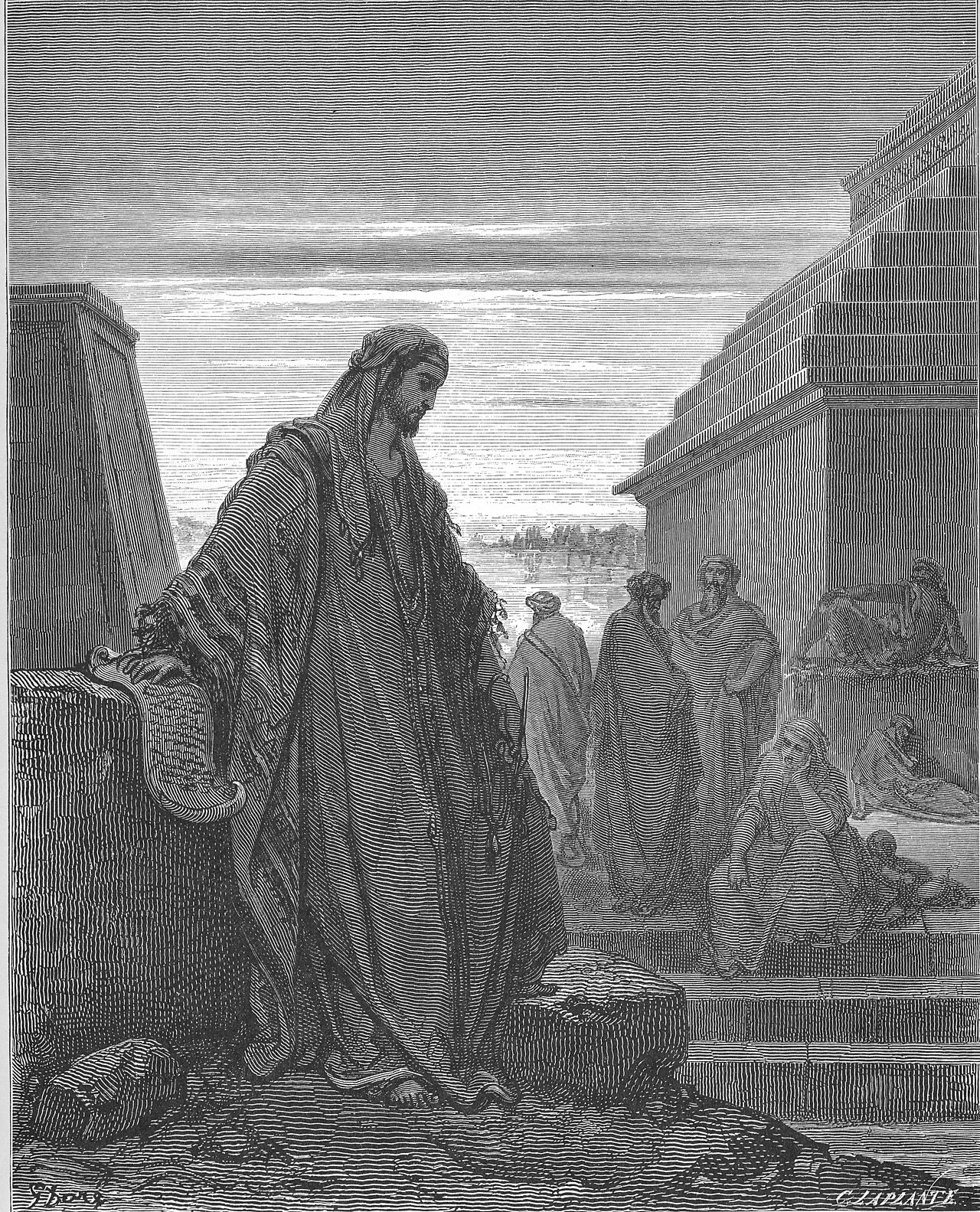
Who and where
2 names in this verse with a page on the site.
- PersonPatriarchsJudahJacob's fourth son who pledges himself for Benjamin; the tribe that carries the scepter to Shiloh (49:10) and the line to Christ (…
- PersonBabylonian Exile (6th century BCE)DanielExilic prophet and Judean court official serving under Nebuchadnezzar, Belshazzar, Darius the Mede, and Cyrus; traditionally named…
This page draws on Adam Clarke, Commentary on the Bible; Albert Barnes, Notes, Explanatory and Practical, on the Old and New Testaments (1832-1869); Hippolytus of Rome, Commentary on Daniel 1.7.1-10.1; John Gill, Exposition of the Old Testament (1748-1763); Matthew Henry, Commentary on the Whole Bible and Theodoret of Cyrus, COMMENTARY ON DANIEL 1:5-6.