
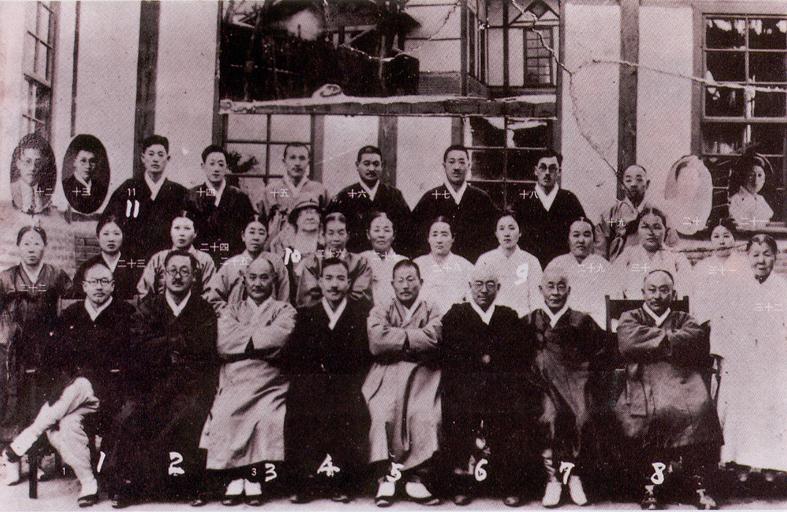
The officers of Sanjeonghyeon Church, 1937. Public domain.
Korea, 1897 to 1944 · Person · Featured Study
Ju Gi-cheol
He led Sanjeonghyeon Church in Pyongyang from 1936 and died in prison for refusing the shrine.
- Born
- 25 November 1897, at Ungcheon in South Gyeongsang
- Died
- 21 April 1944, in Pyongyang prison
- Family
- wife: An Gap-su; wife: Oh Jeong-mo
- Places
- Ungcheon, Busan, Masan, Pyongyang
Told to bow before the gods of Japan's state religion, one pastor chose the police cells.
But even if He does not, let it be known to you, O king, that we will not serve your gods or worship the golden statue you have set up.”
Summary
Ju Gi-cheol was a Presbyterian pastor in Korea under Japanese rule. In the late 1930s the police pressed the churches to bow at the Shinto shrines. His church's General Assembly gave way. He held the bow to be idolatry and refused it. He was arrested four times, and the last arrest held him until his death.
- Two entries in the Encyclopedia of Korean Culture date his arrests and his last sermon in two ways.
- As a child he was called Ju Gi-bok. He also led the Gyeongnam presbytery as its moderator.
- His second wife, Oh Jeong-mo, kept his church's members together after the police closed it.
The Command He Kept
The first commandment and the answer of the three men in Babylon stand behind his refusal.
Daniel Adams writes that Ju's conservative reading of the Bible led him to refuse to bow before the shrines, and that to bow could only be idolatry. The question of this life is what a pastor owes when the state orders a rite his church calls worship of another god.
You shall have no other gods before Me.This is the commandment the shrine question turned on for him.
Do not fear what you are about to suffer. Look, the devil is about to throw some of you into prison to test you, and you will suffer tribulation for ten days. Be faithful even unto death, and I will give you the crown of life.The word to a church facing prison speaks to his long years under arrest.
The Life in Order
The dates stand on the Encyclopedia of Korean Culture, and where another witness differs it is named.
Four arrests fell in the last six years of his life.
- 25 November 1897BirthThe encyclopedia
- March 1916Osan schoolThe encyclopedia
- 1920Call to the ministryThe encyclopedia
- 30 December 1925OrdinationThe encyclopedia
- 1926 to 1931First chargeThe encyclopedia
- July 1936SanjeonghyeonThe encyclopedia
- Spring 1938First arrestThe encyclopedia
- August 1938 to January 1939Second arrestThe encyclopedia
- Mid-October 1939 to 20 April 1940Third arrestThe encyclopedia
- September 1940Fourth arrestThe encyclopedia; Yun Jeong-ran gives July
- 21 April 1944DeathThe encyclopedia
Each step of the life stands with its witness, and a second witness is named where the dates differ.
Spring 1938, August 1938 to January 1939, Mid-October 1939 to 20 April 1940, September 1940, 21 April 1944
From Ungcheon to Pyongyang Prison
A pastor of the south took the leading pulpit of Pyongyang two years before the shrine question broke.
He was born in a farming family of Ungcheon, on the south coast near Masan, and he went to church with his eldest brother from Christmas 1910. A talk by the writer Yi Gwang-su drew him north to the Osan school at Jeongju. He began at the Christian college in Seoul and left within a year.
In September 1920 he heard the revivalist Kim Ik-du at Munchang Church in Masan and decided to become a minister. He studied at the Presbyterian seminary in Pyongyang from March 1922. Choryang Church in Busan called him in 1926, and he taught at the presbytery's Bible institute, where Son Yang-won was among his students.
His first wife, An Gap-su, died in 1933, and in 1935 he married Oh Jeong-mo, a deacon of the Masan church he was then serving. Sanjeonghyeon Church in Pyongyang called him in July 1936.
The demand to bow at the shrine had already put the old Christian schools of Pyongyang at risk of closing. He was held in the spring of 1938 and again from August. Released at Daegu at the end of January 1939, he came back too weak to preach alone, and the American missionary Charles Bernheisel took the evening services.
In October 1939 the police pressed the Pyongyang presbytery to bar from the pulpit any minister or elder who refused the shrine. He kept preaching and was taken again that month. On 20 September 1940 the police arrested those who refused the shrine across the country, and he was held from then until his death.
He was moved to the prison's sick ward on 13 April 1944. His wife saw him for the last time on 21 April, and he died that night at about nine, aged 47.
The Shrine Question
The police pressed the bow on the churches, and the Presbyterian Assembly gave way.
In February 1938 the police set a policy to press shrine worship on the churches. The 27th General Assembly of the Presbyterian Church accepted it that September, and one encyclopedia entry gives the 10th as the day.
He was in police custody when the Assembly met. The resolution was the Assembly's act under police pressure, and Ju and others refused it. His church at Sanjeonghyeon held out with him until the police settled its case in 1940.
In Their Own Words
Two passages of his sermons stand in English beside two sayings from prison that a cellmate and his wife carried out.
Ju Gi-cheol (1897 to 1944)
Giuk Choe, "Ju, Gi-Cheol (1897-1944)", Journal of Korean American Ministries and Theology 6 (2014), page 30, quoting his sermon "My Prayer: Five Supplications" in KIATS, ed., Ju Gi-Cheol: Essential Writings (Seoul: KIATS, 2008), pages 157 to 170, in note 16; the KIATS book was not opened
Sword, do you wait for me
“I shall give, I shall give this small life to the Lord. Sword, do you wait for me! I shall go forth to you.”
Presbyterian
About this saying1 paragraph
His last sermon, of 1939 or 1940, carries these lines, as Giuk Choe quotes them in 2014 from the KIATS edition of his writings.
Ju Gi-cheol
Giuk Choe, "Ju, Gi-Cheol (1897-1944)", Journal of Korean American Ministries and Theology 6 (2014), page 31, quoting his sermon "A Prayer towards the Cross" in KIATS, ed., Ju Gi-Cheol: Essential Writings (Seoul: KIATS, 2008), pages 52 to 53, in note 19; the KIATS book was not opened
The road of the cross
“Let us remember that the road we walk is not the one that people of the world take. The road of the cross! That is our road.”
Presbyterian
About this saying1 paragraph
Giuk Choe quotes this in 2014 from his sermon "A Prayer towards the Cross" and gives no year for it.
Ju Gi-cheol
Bruce F. Hunt, "Korean Martyrs: Part I", Reformed Bulletin of Missions IV, number 2 (Orthodox Presbyterian Church), October 1968, page 17, his prayer in the cell as Kim Yangsun reported it
Hurry up and take him away
“Lord, don't leave this weak Choo, Kichul too long, but hurry up and take him away”
Presbyterian
About this saying1 paragraph
Kim Yangsun, who shared his prison cell and was later released, reported that he often prayed so, and Bruce Hunt printed the prayer in 1968.
Ju Gi-cheol
Bruce F. Hunt, "Korean Martyrs: Part I", Reformed Bulletin of Missions IV, number 2 (Orthodox Presbyterian Church), October 1968, page 17, his words at his wife's last visit to the prison, as she reported them
This is my house
“Where will I go? This is my house”
Presbyterian
About this saying1 paragraph
In April 1944 a prison guard suggested that his wife take him home to die, and he answered so, by her account as Hunt gives it in 1968.
The People Around Him
The encyclopedia names the men who shaped him and the people who stood with him.
Most of his ties run through the churches of Masan and Pyongyang.
| Person | Tie to Ju | The witness |
|---|---|---|
| Kim Ik-du | His preaching in 1920 turned Ju toward the ministry. | The encyclopedia |
| Yi Gi-seon | He arranged Ju's first marriage and later refused the shrine with him. | The encyclopedia |
| Oh Jeong-mo | His second wife, the last to see him alive. | The encyclopedia |
| Cho Man-sik | An elder of Sanjeonghyeon, who sits with him in the photograph of 1937. | The photograph of 1937 |
| Charles Bernheisel | The missionary who preached in his place. | The encyclopedia |
| Son Yang-won | His student at the Gyeongnam Bible Institute. | The encyclopedia |
The Places of His Life
His life ran from the south coast to Pyongyang, and his arrests took him to Daegu.
He served in the south for ten years and in Pyongyang for eight.
| Place | What the witnesses say | The witness |
|---|---|---|
| Ungcheon | His birthplace, now part of Changwon. | The encyclopedia |
| Jeongju | Home of the Osan school. | The encyclopedia |
| Busan | Choryang Church, his first charge as pastor. | The encyclopedia |
| Masan | Munchang Church, where he was renewed, and the church he served before Pyongyang. | The encyclopedia |
| Pyongyang | The seminary, Sanjeonghyeon Church and the prison. | The encyclopedia |
| Daegu | Its police station held him in his second arrest. | The encyclopedia |
What He Refused
His last sermon asked for strength to face death and gave his family and his church to God.
He preached his last sermon, a prayer in five parts, before his final arrest. Daniel Adams, in 2009, gives its first two heads in English as "Help me defeat the power of death; help me to endure long suffering". The third gives his aging mother, his wife, his children and his church members to the Lord, the fourth asks to live and die righteously, and the fifth commits his soul to Jesus.
Adams writes that on its face the last sermon shows conservative theology and Confucian family values. He adds that the prison and the death were read as "the most radical form of protest against the Japanese government".
The Republic of Korea awarded him the Order of Merit for National Foundation after his death in 1963, by Kim Seung-tae's entry, and declared him an Honoured Patriot on 10 July 1968, by Adams's account. Seoul's National Military Cemetery holds a stone to his memory.
Read Daniel the Prophet, whose friends refused the golden statue
How the Key Verse Was Taught
Cyprian and Matthew Henry read the answer of the three men to the king.
Cyprian (died 258)
Epistle LV
Cyprian wrote of the verse to Christians facing death in the third century.
“They believed that they might escape according to their faith, but they added, ‘and if not,’ that the king might know that they could also die for the God they worshipped. For this is the strength of courage and of faith, to believe and to know that God can deliver from present death, and yet not to fear death nor to give way, that faith may be the more mightily proved. The uncorrupted and unconquered might of the Holy Spirit broke forth by their mouth, so that the words which the Lord in His Gospel spoke are seen to be true: ‘But when they shall seize you, take no thought what ye shall speak; for it shall be given you in that hour what ye shall speak. For it is not ye that speak, but the Spirit of your Father which speaketh in you.’”
on Daniel 3:18Patristic
Matthew Henry (1662 to 1714)
Commentary on the Whole Bible
Matthew Henry set the refusal beside the rescue from the furnace.
“And truly, all things considered, the saving of them from this sinful compliance was as great a miracle in the kingdom of grace as the saving of them out of the fiery furnace was in the kingdom of nature.”
on Daniel 3:18Puritan
What the Witnesses Leave Open
The arrests and the last sermon are each dated in more than one way.
The dates of the arrestsKim Seung-tae and Yun Jeong-ran in the Encyclopedia of Korean Culture
Kim Seung-tae's entry of 2023 gives the four dates the table of the life follows: spring 1938, August 1938, mid-October 1939 and September 1940.
Yun Jeong-ran's entry on his wife, Oh Jeong-mo, gives an arrest in March 1939 over the affair of the Nongu society, and a last arrest in July 1940 that cost him his ministry.
The date of the last sermonYun Jeong-ran; Daniel Adams
Yun Jeong-ran calls it "My Prayer in Five Parts" and places it at Sanjeonghyeon after his release from the arrest of March 1939 and before the arrest of July 1940. Adams places it before his final imprisonment and gives no date.
Books to Read Next
Encyclopedia of Korean Culture, the entry on Ju Gi-cheol
Kim Seung-tae · 2023
The entry dates each arrest and lists the Korean studies of his life.
Read the entry free, in KoreanKorean Preaching from a Western Perspective
Daniel J. Adams, Journal of Korean American Ministries and Theology 2 · 2009
Adams gives the five heads of the last sermon in English.
Read the article free at Biblical StudiesWhat Ju Gi-cheol Left
He left a church that refused the shrine with him.
Sources
Scripture is the Berean Standard Bible.
- The Holy Bible, Berean Standard Bible (read 2026)
- Kim Seung-tae, "Ju Gi-cheol" (주기철), Encyclopedia of Korean Culture, written 2023, revised 2 December 2024.
- Son Seung-ho's entry "Son Yang-won" (손양원) in the same encyclopedia, revised 17 September 2025.
- Yun Jeong-ran, "Oh Jeong-mo" (오정모), Encyclopedia of Korean Culture.
- Daniel J. Adams, "Korean Preaching from a Western Perspective", Journal of Korean American Ministries and Theology 2 (Spring 2009), pages 43 to 52.
- Giuk Choe, "Ju, Gi-Cheol (1897-1944)", Journal of Korean American Ministries and Theology 6, Twelve Influential Early Korean Preachers (Columbia Theological Seminary, 2014), pages 30 and 31, quoting his sermons in KIATS, ed., Ju Gi-Cheol: Essential Writings (Seoul: KIATS, 2008); the KIATS book was not opened.
- Bruce F. Hunt, "Korean Martyrs: Part I", Reformed Bulletin of Missions IV, number 2 (Committee on Foreign Missions, Orthodox Presbyterian Church), October 1968, page 17.
- Cyprian, Epistle 55, on Daniel 3:18.
- Matthew Henry, Commentary on the Whole Bible (1710), on Daniel 3:18.
Keep Studying
People and groups5
Trials of life1