
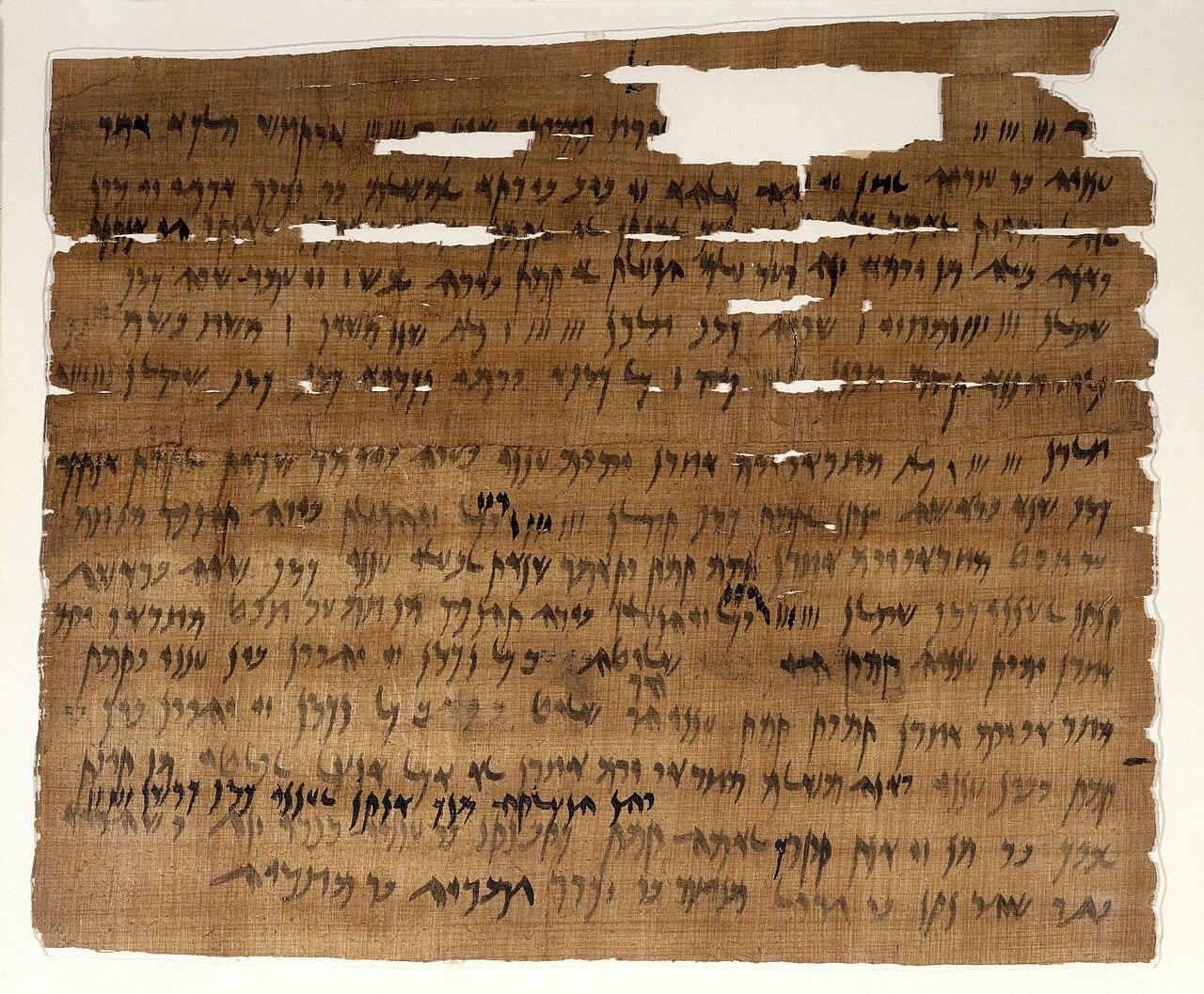
Marriage document in Aramaic, 449 BC. No known copyright restrictions.
Daniel 2:4 and Daniel 7:28 · Subject · Featured Study
The Aramaic Chapters of Daniel
From the astrologers' answer to the king in Daniel 2:4 to the end of chapter 7, the book of Daniel is in Aramaic.
Thus ends the matter. As for me, Daniel, my thoughts troubled me greatly, and my face turned pale. But I kept the matter to myself.”
- Books
- Daniel, Ezra, Jeremiah
- Hold in memory
- Jeremiah 10:11
Jerome noted that these chapters are written in Hebrew letters but in the Chaldee language.
Summary
The language of the book of Daniel changes twice, at Daniel 2:4 and at Daniel 8:1. The rest of the Old Testament holds about three chapters of Aramaic in Ezra, one verse in Jeremiah and two words in Genesis.
- Chapters 2 and 7, at the two ends, both tell of four kingdoms.
- Readers give three reasons for the change of language.
- Scholars weigh the Aramaic when they argue over the book's date.
Where the Aramaic Begins
The Aramaic begins in a conversation at Nebuchadnezzar's court.
Then the astrologers answered the king in Aramaic, “O king, may you live forever! Tell your servants the dream, and we will give the interpretation.”The Hebrew word that announces the change is aramit. Strong's dictionary glosses it in Aramean, and the older English versions render it in Syriac.
John Wesley and Adam Clarke both noted that the Chaldee part runs to the end of chapter 7.
Daniel 8:1 returns to Hebrew.
Six Chapters in Pairs
The Aramaic chapters pair off from the ends toward the middle.
The six Aramaic chapters pair 2 with 7, 3 with 6 and 4 with 5, and two judgments on kings stand at the centre.
| Chapter | Rung | What the chapter tells | Its pair |
|---|---|---|---|
| Daniel 2 | A | Four kingdoms in the king's dream of a statue | Daniel 7 |
| Daniel 3 | B | God delivers the three men who would not bow | Daniel 6 |
| Daniel 4 | C | God humbles Nebuchadnezzar | Daniel 5 |
| Daniel 5 | C′ | God judges Belshazzar | Daniel 4 |
| Daniel 6 | B′ | God delivers Daniel from the lions | Daniel 3 |
| Daniel 7 | A′ | Four beasts that are four kings, in Daniel's vision | Daniel 2 |
Why the Language Changes
Keil, Haupt and the Jewish Encyclopedia each explain the two languages in a different way.
A word about the nationsC. F. Keil; Jamieson, Fausset and Brown; Adam Clarke
C. F. Keil held in 1872 that the first part, on the world power, is written in Chaldee. He held that the second part, on the kingdom of God, is written in Hebrew, the language of the people of God. Adam Clarke held that the Chaldeans had a particular interest in the history and prophecies of chapters 2 to 7.
“In it the course, character, and crisis of the Gentile power are treated; whereas, in the other parts, which are in Hebrew, the things treated apply more particularly to the Jews and Jerusalem.”
Jamieson, Fausset & Brown · Commentary Critical and Explanatory on the Whole Bible · on Daniel 2:4Reformed
The objection: Paul Haupt and, later, Louis Hartman and Alexander Di Lella explained the two languages by translation instead.
The trace of a translationPaul Haupt; Louis Hartman and Alexander Di Lella
The Jewish Encyclopedia reports that Paul Haupt supposed Daniel was first written in Hebrew, that parts of it were lost and that those parts were supplied from an Aramaic translation. Gerhard Hasel reports that Hartman and Di Lella held the reverse in 1978, that the whole book was first written in Aramaic and its Hebrew parts are translations.
The objection: Keil and Jamieson, Fausset and Brown found the division to follow the subject of each part.
The Chaldeans' speech carried onThe Jewish Encyclopedia; Kranichfeld, as Keil reports him
The Jewish Encyclopedia of 1901 to 1906 says the author begins in Hebrew and, when the sages speak Aramaic to the king, continues his history in Aramaic to the end of chapter 7. Keil reports that Kranichfeld held the conversation with the Chaldeans to have been in Aramaic from the first.
The objection: Keil answered that chapter 8, dated under Belshazzar, is written in Hebrew.
The Aramaic and the Date
Rowley and Kitchen read the Aramaic of Daniel for its date and reached different answers.
H. H. Rowley held in 1929 that the Aramaic of Daniel is not Babylonian Aramaic and is probably from Palestine. K. A. Kitchen answered in 1965 that the book's date cannot be decided on linguistic grounds alone.
Their readings and the rest of the argument over the book's date are set out at The Dating of Daniel.
Aramaic in the Old Testament
Four books of the Old Testament hold Aramaic.
Daniel's six chapters are the longest Aramaic passage in the Old Testament.
| Passage | What stands in Aramaic |
|---|---|
| Genesis 31:47 | Laban's name for the heap of witness, two words |
| Ezra 4:8 to 6:18 and Ezra 7:12 to 26 | From the letter against Jerusalem to King Artaxerxes to the appointing of the priests, and Artaxerxes' letter to Ezra |
| Jeremiah 10:11 | One verse about gods who did not make the heavens and the earth |
| Daniel 2:4 to 7:28 | Six chapters of stories and visions at the courts of Babylon and of Darius the Mede |
The Gods of the Nations
Thus you are to tell them: “These gods, who have made neither the heavens nor the earth, will perish from this earth and from under these heavens.”Sources
Scripture is the Berean Standard Bible.
- James Strong, Exhaustive Concordance of the Bible (1890), Hebrew and Chaldee dictionary, entry 762.
- J. E. H. Thomson, Aramaic Language, in the International Standard Bible Encyclopedia (1915)
- Tony Garland, A Testimony of Jesus Christ: commentary on Daniel, Introduction, Structure, reporting A. Lenglet, La structure litteraire de Daniel 2 to 7, Biblica 53 (1972)
- C. F. Keil, Biblical Commentary on the Book of the Prophet Daniel, translated by M. G. Easton (Edinburgh, T. and T. Clark, 1872), Introduction, p. 19.
- The Jewish Encyclopedia (1901 to 1906), Aramaic Language among the Jews, by Richard Gottheil and Wilhelm Bacher.
- Gerhard Hasel, New Light on the Book of Daniel from the Dead Sea Scrolls (1992), reprinted in Bible and Spade (2012), reporting Hartman and Di Lella (1978)
- H. H. Rowley, The Aramaic of the Old Testament (Oxford University Press, 1929), pp. 155 to 156.
- K. A. Kitchen, The Aramaic of Daniel, in D. J. Wiseman, ed., Notes on Some Problems in the Book of Daniel (London, Tyndale Press, 1965), p. 79.
- Jerome, Commentary on Daniel, on Daniel 2:4.
- John Wesley, Explanatory Notes upon the Old Testament (1765), on Daniel 2:4.
- Adam Clarke, Commentary on the Bible (1832), on Daniel 2:4 and 8:1.
- Jamieson, Fausset and Brown, Commentary Critical and Explanatory on the Whole Bible (1871), on Daniel 2:4.
Keep Studying
Read it5
Studies1
People and groups6
Go further1
Doctrines1