
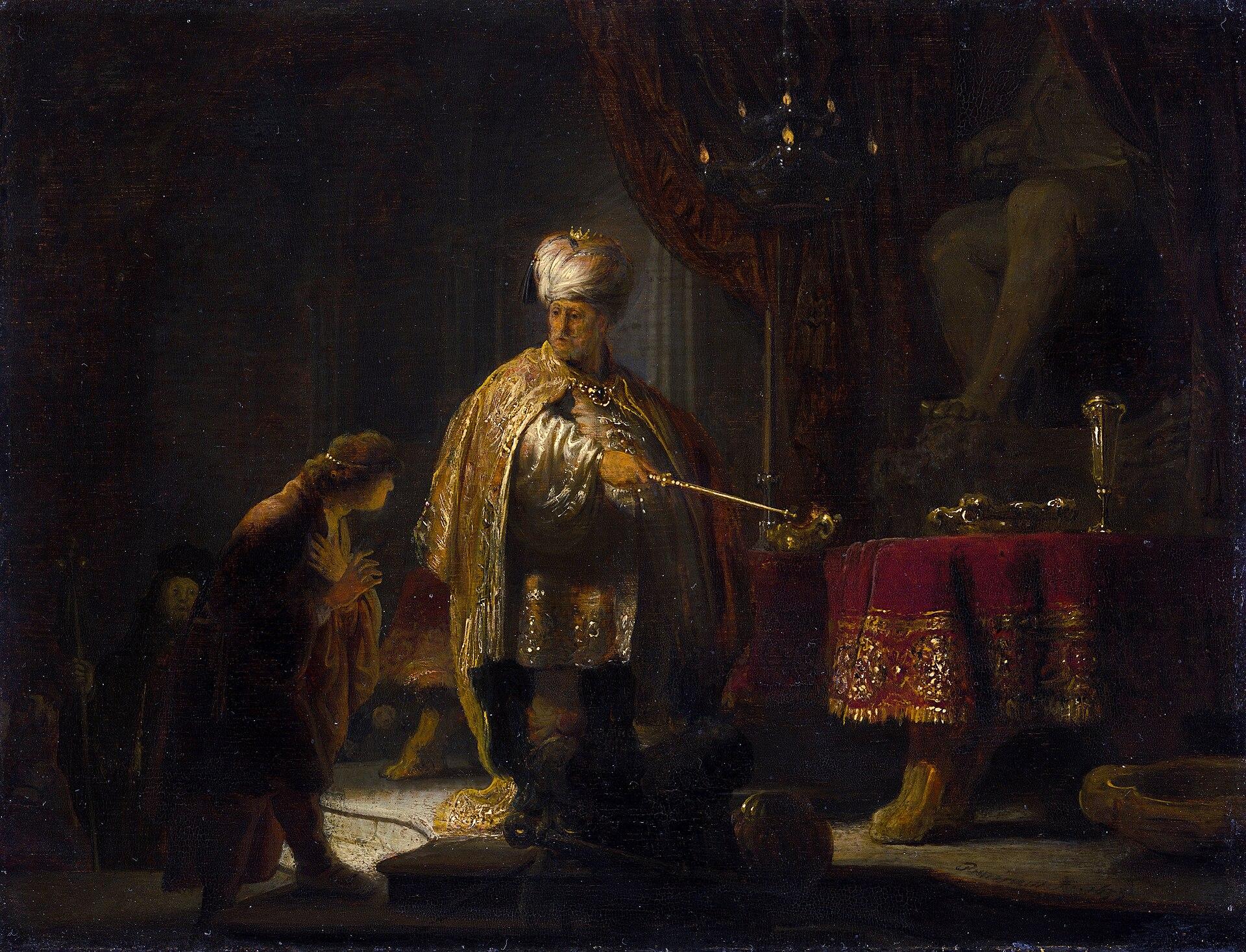
Rembrandt, Daniel and Cyrus before the Idol Bel, 1633. Public domain.
Bel and the Dragon 1 to 42 · Book · Apocrypha, a study resource beside the canon
Bel and the Dragon
Bel and the Dragon is one of three Greek additions to Daniel, forty-two verses in which Daniel exposes an idol, kills a dragon and lives through a second lions' den.
“Announce and declare to the nations; lift up a banner and proclaim it; hold nothing back when you say, ‘Babylon is captured; Bel is put to shame; Marduk is shattered, her images are disgraced, her idols are broken in pieces.’
- Date
- about 136 BC, as T. Witton Davies dated it (proposed)
- Edition
- Bel and the Dragon in the King James Version Apocrypha, 1769 text (eBible.org); the Berean Standard Bible for the canon
When the dragon was dead, the people of Babylon rose against Cyrus and said, "The king is become a Jew."
Summary
Bel and the Dragon is one chapter holding three tales. In the first two, Daniel shows the people of Babylon that the gods they worship do not live.
- The seven lions of the den were given two carcases and two sheep each day, Bel 32.
- The angel set Habakkuk back in his own place at once after the meal, Bel 39.
- Habakkuk told the angel that he had never seen Babylon and did not know where the den was, Bel 35.
The Book of Bel and the Dragon
Daniel is honoured above all the new king's friends, Bel 2.
The book begins, "And king Astyages was gathered to his fathers, and Cyrus of Persia received his kingdom" (Bel 1).
In the Book of Daniel, the kingdom of Babylon passed to Darius the Mede on the night Belshazzar was slain (Daniel 5:30 to 31).
The Book at a Glance
The idol, the dragon and the den follow one another.
Bel and the Dragon gives twenty-two of its forty-two verses to the test of the idol.
- BelBel 1 to 22: ashes strewn on the temple floor show the footsteps of the priests who eat the idol's food by night.
- The dragonBel 23 to 27: the king bids Daniel worship a living dragon, and Daniel feeds it lumps of pitch, fat and hair until it bursts.
- The lions' denBel 28 to 42: Daniel is cast to the lions, fed in the den, and drawn out alive on the seventh day.
Each row gives a tale and its verses in the King James numbering.
Bel, Daniel 6 and Habakkuk
The den and the prophet of the last tale both have counterparts in the Hebrew Scriptures.
The den of Daniel 6 belongs to the reign of King Darius. The den of the Greek book comes under Cyrus, and Daniel stays in it six days (Bel 31).
So the king gave the order, and they brought Daniel and threw him into the den of lions. The king said to Daniel, “May your God, whom you serve continually, deliver you!”Here Darius himself gives the order, where in Bel 30 the people force Cyrus to hand Daniel over.
The book's Habakkuk is a prophet "in Jewry" who has made pottage for the reapers (Bel 33). The angel of the Lord carries him to Babylon by the hair of his head and sets him over the den (Bel 36).
This is the burden that Habakkuk the prophet received in a vision:The Greek book's Habakkuk shares his name and his calling with the prophet of this book.
The Septuagint, the Greek Old Testament, heads the book as an extract from a prophecy of Habakkuk, son of Jesus (Daubney, 1906).
Where the Book Came From
T. Witton Davies edited the book in 1913 and judged its first language and its date.
Witton Davies's edition stands in R. H. Charles's Apocrypha and Pseudepigrapha. He wrote that the book was first written almost certainly in Hebrew, and that none of the Hebrew has survived.
He set the Hebrew text in the reign of Antiochus VII Sidetes, from 139 to 128 BC, at about 136 BC. He reasoned that the Greek must be later.
He wrote that modern scholars dated the Book of Daniel at about 160 BC. His date for Daniel stands on one side of a debate over the age of the Book of Daniel.
Who Receives the Book
Six witnesses from Origen to the Synod of Jerusalem set the book's standing.
The churches of the West divide over Bel and the Dragon, and the Synod of Jerusalem receives it as Scripture.
| Who | What they do with the book |
|---|---|
| Origen, Letter to Africanus, section 2 | says the history of Bel and the Dragon stands at the end of the book and is absent from the Hebrew copy of Daniel |
| Jerome, Preface to Daniel | calls the tales the fables of Bel and the Dragon, says the Hebrew Daniel lacks them, and sets them in an appendix with an obelus before them |
| The Council of Trent, session 4, 1546 | lists Daniel among the books of the Old Testament, to be received entire with all its parts as the old Latin Vulgate contains them; the Vulgate numbers Bel as Daniel 14 |
| The Church of England, Article VI | names Bel and the Dragon among the other books the Church reads for example of life and instruction of manners, applying them to establish no doctrine |
| The Westminster Confession, 1646, chapter 1, section 3 | holds that the books commonly called Apocrypha are no part of the canon of Scripture |
| The Synod of Jerusalem, 1672, the Confession of Dositheus | names the History of the Dragon among the genuine parts of Scripture |
Books to Read Next
The King James text and the Oxford edition of 1913 open the book further, and Herodotus describes its city.
Bel and the Dragon, King James Version Apocrypha
The King James translators · 1611
It gives the whole book in the King James English.
Read it in the Apocrypha readerThe Apocrypha and Pseudepigrapha of the Old Testament, vol. I
R. H. Charles, ed.; Bel and the Dragon by T. Witton Davies · 1913
It gives an introduction, a translation and notes on its pages 652 to 664.
Read it free at archive.orgThe History of Herodotus, vol. 1
Herodotus, tr. G. C. Macaulay · 1890 translation
He describes Babylon and its great temple in chapters 181 and 183 of his first book.
Read it free at archive.orgThe God Who Remembers
Habakkuk brought a dinner, and Daniel answered with a prayer.
In the King James translation, Daniel's answer reads, "Thou hast remembered me, O God: neither hast thou forsaken them that seek thee and love thee" (Bel 38).
Those who know Your name trust in You, for You, O LORD, have not forsaken those who seek You.The psalm says of the LORD what Daniel says in the den, that He does not forsake those who seek Him.
Sources
Scripture is the Berean Standard Bible.
- Bel and the Dragon, King James Version Apocrypha, 1769 text (eBible.org USFX edition), public domain.
- T. Witton Davies, Bel and the Dragon, in R. H. Charles (ed.), The Apocrypha and Pseudepigrapha of the Old Testament, vol. I, Oxford, 1913, pp. 652 to 664; public domain.
- W. H. Daubney, The Three Additions to Daniel: A Study, Cambridge, 1906; public domain.
- Herodotus, The History, book 1, chapters 181 and 183, tr. G. C. Macaulay; public domain.
- Jerome, Preface to Daniel, tr. W. H. Fremantle, Nicene and Post-Nicene Fathers, second series, vol. 6; public domain.
- Origen, A Letter to Africanus, tr. Frederick Crombie, Ante-Nicene Fathers vol. 4; public domain.
- The Council of Trent, session 4, 8 April 1546, the decree concerning the canonical Scriptures, tr. J. Waterworth.
- The Church of England, Articles of Religion, Article VI, in the Book of Common Prayer of 1863.
- The Westminster Confession of Faith, 1646, chapter 1, section 3.
- The Synod of Jerusalem, 1672, the Confession of Dositheus, question 3.