
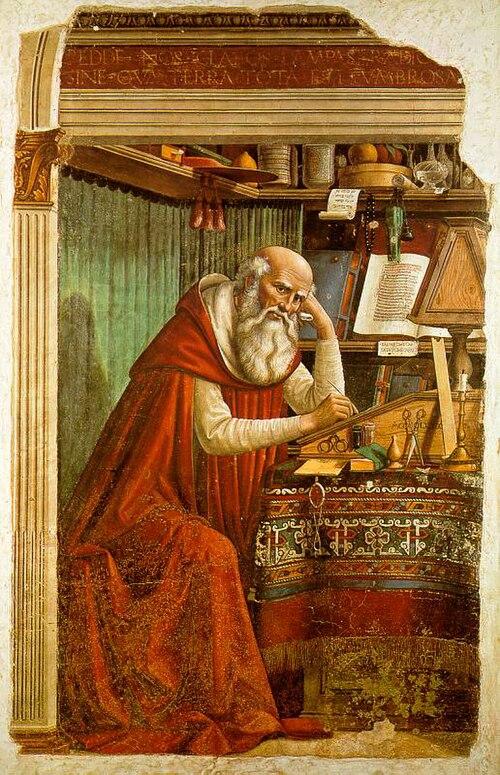
Domenico Ghirlandaio, Saint Jerome in His Study, 1480. Public domain.
Daniel 1:1, Daniel 10:1 and Matthew 24:15 · Subject · Featured Study
The Dating of Daniel
Daniel sets its scenes from the third year of Jehoiakim to the third year of Cyrus, and readers since Porphyry have argued over when the book was written.
Jesus named the prophet Daniel as the one who described the abomination of desolation.
In the third year of the reign of King Belshazzar, a vision appeared to me, Daniel, subsequent to the one that had appeared to me earlier.
In the third year of the reign of King Belshazzar, a vision appeared to me, Daniel, subsequent to the one that had appeared to me earlier.
- Books
- Daniel, Matthew
- Hold in memory
- Daniel 12:4
Summary
One reading holds that Daniel wrote the book in Babylon and Persia in the sixth century BC. A second, which Jerome reports from Porphyry, gives it a later date.
- From chapter 7 on, Daniel tells his visions in the first person.
- Both sides weigh its Greek and Persian words, its Aramaic and the copies found at Qumran.
- The two readings date the book about four centuries apart.
The Book's Own Dates
Daniel dates its scenes by the years of the kings of Judah, Babylon and Persia.
In the third year of the reign of Jehoiakim king of Judah, Nebuchadnezzar king of Babylon came to Jerusalem and besieged it.In the third year of Cyrus king of Persia, a message was revealed to Daniel, who was called Belteshazzar. The message was true, and it concerned a great conflict. And the understanding of the message was given to him in a vision.The book also dates the visions of chapters 7 and 8 by the first and third years of Belshazzar.
The Two Readings, Question by Question
Three questions, each answered by a holder on each side.
The two readings part over who wrote the book and what its words and its Aramaic show.
| Question | Daniel wrote it in the sixth century BC | A later author wrote it in Judea |
|---|---|---|
| Who wrote it? | Daniel himself, who tells the visions in his own name; E. B. Pusey | A later author in Judea; Porphyry, as Jerome reports |
| What do the Greek and Persian words show? | The book's date cannot be decided on linguistic grounds alone; K. A. Kitchen | The Persian words presuppose the empire well established, and the Greek words demand a date after Alexander conquered Palestine in 332 BC; S. R. Driver |
| What does the Aramaic show? | A date in the sixth to fourth century can be neither excluded dogmatically nor called proven; K. A. Kitchen | It is not Babylonian Aramaic, is not earlier than the fourth century and probably comes from Palestine; H. H. Rowley |
Porphyry and Jerome
Jerome's commentary preserves Porphyry's argument.
Jerome reports that Porphyry wrote his twelfth book against the prophecy of Daniel.
In the prologue to his Commentary on Daniel, Jerome writes that Porphyry denied the book was written by the man named in its title. Porphyry held that someone living in Judea in the time of Antiochus Epiphanes composed it.
The Earliest Witnesses
Copies of Daniel survive from Qumran, and Josephus reports the book shown to Alexander.
Gerhard Hasel counted no fewer than eight manuscripts of Daniel from three of the eleven caves at Qumran.
Frank Moore Cross dated the oldest, the copy called 4QDan-c, to the late second century BC. A radiocarbon study published in 2025 gave it a range of 230 to 160 BC.
Josephus records that the book of Daniel was shown to Alexander the Great. He reports that Alexander took himself to be the Greek of whom Daniel wrote.
Voices on the Date
Three teachers of the early church and the eighteenth century wrote on prophecy and its fulfilment.
John Chrysostom (died 407)
John Chrysostom wrote on the Gospels' foretelling of the fall of Jerusalem.
“Observe this economy of the Holy Spirit in this, that John wrote nothing of all this, that he might not seem to be writing a history after the event; for he survived sometime the taking of Jerusalem. But these who died before it, and saw nothing of it, these write it, that the power of prophecy may shine manifestly forth.”
John Chrysostom · Catena Aurea by Aquinas · on Matthew 24:15Patristic
Theodoret of Cyrus (died 458)
Theodoret of Cyrus commented on the date that opens Daniel 8.
“Now, it is not without purpose that he indicates the time: it is to inform us that long before these things happened, he received foreknowledge of them from the God of all.”
Theodoret of Cyrus · Commentary on Daniel 8:1 · on Daniel 8:1Patristic
Matthew Henry (1662 to 1714)
Matthew Henry commented on the order to seal the book in Daniel 12:4.
“Those things of God which are now dark and obscure will hereafter be made clear, and easy to be understood. Truth is the daughter of time. Scripture prophecies will be expounded by the accomplishment of them; therefore they are given, and for that explication they are reserved.”
Matthew Henry · Commentary on the Whole Bible · on Daniel 12:4Puritan
When Was Daniel Written?
Two readings, each with its holders, its works and the strongest objection to it.
By Daniel, in Babylon and PersiaE. B. Pusey, Robert Dick Wilson, K. A. Kitchen and John Gill
This reading accepts the book's own account of its author. E. B. Pusey argued in 1864 that a book written under another man's name would be a forgery, so the book is either divine or an imposture.
Robert Dick Wilson argued in 1917 that the evidence does not show Daniel's account of Belshazzar to be false. John Gill placed the siege of Daniel 1:1 at the close of Jehoiakim's third year and the start of his fourth, the first year of Nebuchadnezzar in Jeremiah 25:1. Gill, Albert Barnes and Jamieson, Fausset and Brown identified Darius the Mede with Cyaxares.
The objection: Driver held that two of the Greek names, psalterion and symphonia, could not have reached Babylon around 550 BC.
In Judea, after AlexanderPorphyry, S. R. Driver and H. H. Rowley
This reading holds that the book was composed after Alexander's conquest. Porphyry argued it, as Jerome reports, and S. R. Driver held in 1894 that it was probably written in Palestine under the persecution of Antiochus Epiphanes, in 168 or 167 BC.
Driver read Daniel 11 as passing from four Persian kings and Alexander to the kings of Antioch and of Egypt, and most fully of all to Antiochus Epiphanes in verses 21 to 45. He noted that verses 40 to 45 do not agree with what is known of the closing events of Antiochus's life.
Driver set four facts of history beside the language. The Hebrew canon places the book among the Writings, near Esther. Jesus son of Sirach, writing about 200 BC, names Isaiah, Jeremiah, Ezekiel and the Twelve and is silent about Daniel. Driver judged the siege of Daniel 1:1 highly improbable, as Kings is silent about it. He also found no room for a Darius the Mede, as every other authority makes Cyrus the successor of Nabonidus.
The objection: the copies from Qumran come within about half a century of the date this reading gives, by Eugene Ulrich's reckoning.
Seal the Book
Near its close the book gives Daniel an order about the book itself.
But you, Daniel, shut up these words and seal the book until the time of the end. Many will roam to and fro, and knowledge will increase.”Sources
Scripture is the Berean Standard Bible.
- Jerome, Commentary on Daniel, Prologue, translated by Gleason L. Archer (Baker, 1958), p. 15.
- S. R. Driver, An Introduction to the Literature of the Old Testament, fifth edition (Edinburgh, T. and T. Clark, 1894), pp. 466 to 470 and 476.
- John Gill, Exposition of the Old Testament (1748 to 1763), on Daniel 1:1 and 5:31.
- Albert Barnes, Notes (1832 to 1869), and Jamieson, Fausset and Brown (1871), on Daniel 5:31.
- E. B. Pusey, Daniel the Prophet: Nine Lectures (Oxford, Parker, 1864), Lecture I, p. 1.
- Robert Dick Wilson, Studies in the Book of Daniel (New York, Putnam, 1917), Introduction, p. viii.
- Josephus, Antiquities of the Jews 11.8.5, translated by William Whiston.
- Gerhard Hasel, New Light on the Book of Daniel from the Dead Sea Scrolls (1992), reprinted in Bible and Spade (2012), quoting F. M. Cross (1961) and E. Ulrich (1987)
- M. Popović and others, Dating ancient manuscripts using radiocarbon and AI-based writing style analysis, PLOS ONE 20 (6), e0323185 (2025)
- K. A. Kitchen, The Aramaic of Daniel, in D. J. Wiseman, ed., Notes on Some Problems in the Book of Daniel (London, Tyndale Press, 1965), p. 79.
- H. H. Rowley, The Aramaic of the Old Testament (Oxford University Press, 1929), pp. 155 to 156.
- John Chrysostom, on Matthew 24:15, in Thomas Aquinas, Catena Aurea.
- Theodoret of Cyrus, Commentary on Daniel, on Daniel 8:1.
- Matthew Henry, Commentary on the Whole Bible (1710), on Daniel 12:4.
Keep Studying
Read it4
Studies6
People and groups8