
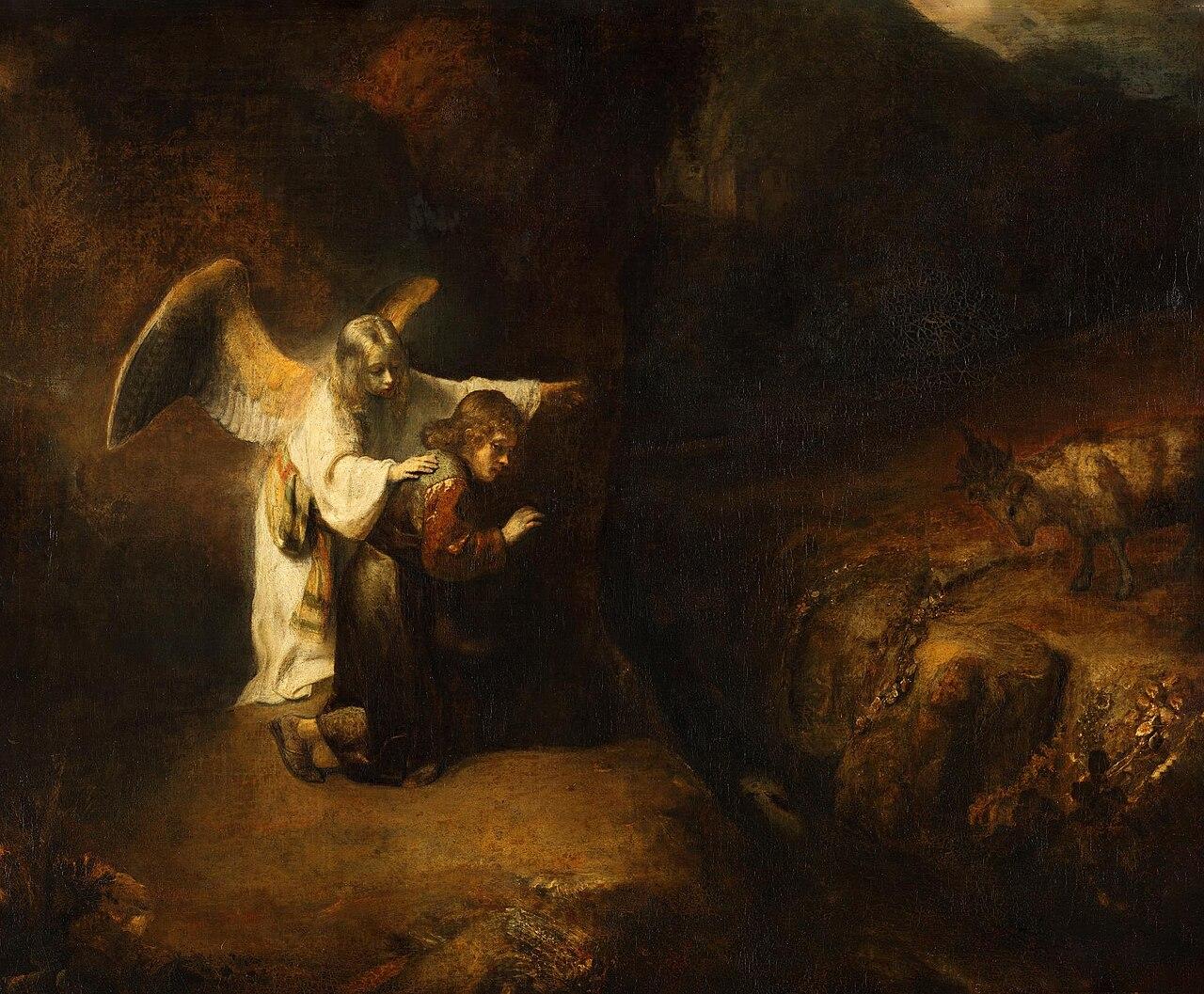
Willem Drost, The Vision of Daniel, 1650. Public domain.
Daniel 8 to 9 and Luke 1 · Person · Featured Study
Gabriel
Gabriel is the angel Scripture names in Daniel and in Luke, God's messenger in the exile and before the birth of Jesus.
He instructed me and spoke with me, saying: “O Daniel, I have come now to give you insight and understanding.
- Places
- Susa, Jerusalem, Nazareth
- First named
- Daniel 8:16 “…the banks of the Ulai: “Gabriel, explain the…”
- Last named
- Luke 1:26 “…month, God sent the angel Gabriel to a…”
Gabriel told Zechariah that he stands in the presence of God and was sent to bring him good news.
Summary
Gabriel came to Daniel in the exile. He explained a vision and brought the message of the seventy weeks. Centuries later he came to Zechariah in the temple and to Mary in Nazareth. He told each of them of a son to come.
- Hebrew and Greek give the name in four verses, two in Daniel and two in Luke.
- His four errands fall in the exile and in the months before the births of John and Jesus.
- Readers part over whether he is the unnamed messenger of Daniel 10.
Where Scripture Names Gabriel
A voice names him first by a canal in Elam, and he names himself to Zechariah in the temple.
And I heard the voice of a man calling from between the banks of the Ulai: “Gabriel, explain the vision to this man.”The first time Scripture names him.
while I was still praying, Gabriel, the man I had seen in the earlier vision, came to me in swift flight about the time of the evening sacrifice.Daniel knows him from the earlier vision.
“I am Gabriel,” replied the angel. “I stand in the presence of God, and I have been sent to speak to you and to bring you this good news.He names himself to Zechariah.
In the sixth month, God sent the angel Gabriel to a town in Galilee called Nazareth,Luke names him as God's messenger to Mary.
Luke 1:19, Luke 1:26
His Four Errands
Each errand brings a message about times God has set.
Gabriel explains a vision, answers a prayer, foretells a forerunner and announces the Son of the Most High.
- Daniel 8:15 to 26Beside the Ulai Canal, in a vision of SusaThe meaning of the ram and the goat, a vision of the time of the endDaniel 8:17
- Daniel 9:20 to 27Daniel at prayer, at the time of the evening sacrificeThe answer to Daniel's prayer: seventy weeks decreed for his peopleDaniel 9:24
- Luke 1:11 to 20The temple, at the altar of incenseA son for Zechariah and Elizabeth, to be named JohnLuke 1:13
- Luke 1:26 to 38Nazareth in GalileeA son for Mary, to be named JesusLuke 1:31
Each errand stands with its verses, in the order Scripture gives them.
Gabriel in Later Tradition
Jewish writings after Daniel, the rabbis and the Qur'an each remember Gabriel in their own terms.
1 Enoch, in R. H. Charles's translation, calls Gabriel one of the holy angels, set over Paradise, the serpents and the cherubim, and in another place over all the powers.
The rabbi Shimon ben Lakish held that the names of the angels Michael, Raphael and Gabriel came back with Israel from the exile in Babylon. The Babylonian Talmud reads the man clothed in linen of Ezekiel 9 and 10 as Gabriel.
In Islam he is Jibril, honoured as the angel of revelation. The Qur'an names him in three verses.
Sent from the Presence of God
Gabriel's words to Daniel and to Zechariah show how God's answers come.
At the beginning of your petitions, an answer went out, and I have come to tell you, for you are highly precious. So consider the message and understand the vision:The answer went out as Daniel began to pray.
And now you will be silent and unable to speak until the day this comes to pass, because you did not believe my words, which will be fulfilled at their proper time.”The sign shows that Gabriel's word will stand.
Voices on Gabriel
Tertullian, Bede and Theophylact wrote on his errands to Zechariah and Mary.
Tertullian (died 220)
On the Flesh of Christ
Tertullian pointed to the announcement to Mary as a plain witness to the birth of Jesus in the flesh.
“Clearly enough is the nativity announced by Gabriel. But what has he to do with the Creator's angel? The conception in the virgin's womb is also set plainly before us.”
on Luke 1:26Patristic
Bede (died 735)
Catena Aurea by Aquinas
Bede drew from Luke 1:19 the two sides of an angel's service.
“Here we must remark, that the angel testifies, that he both stands before God, and is sent to bring good tidings to Zacharias.”
on Luke 1:19Patristic
Theophylact of Ohrid (died 1107)
Commentary on Luke
Theophylact read Gabriel's naming of himself as Zechariah's assurance that the message came from God.
“This is why the Angel also tells him of his rank: ‘I am Gabriel,’ standing before God, not a deceiving demon, but an Angel of God.”
on Luke 1:19Patristic
Is the Man in Linen of Daniel 10 Gabriel?
Daniel's last vision brings a man clothed in linen and a speaker who was opposed by the prince of Persia, and neither is named.
I lifted up my eyes, and behold, there was a certain man dressed in linen, with a belt of fine gold from Uphaz around his waist.The readings below try to name this figure.
However, the prince of the kingdom of Persia opposed me for twenty-one days. Then Michael, one of the chief princes, came to help me, for I had been left there with the kings of Persia.The speaker tells of his delay and of Michael's help.
Gabriel againAlbert Barnes and Jane Hamon
Barnes held that every circumstance points to the messenger of the Ulai and of the seventy weeks. Jane Hamon reads the chapter the same way.
“In Daniel 10 we see Daniel's prayers fueling a heavenly battle in which Gabriel is sent with a prophetic message but is delayed until Michael, the archangel, comes and fights this Persian principality.”
Jane Hamon · Resisting the Prince Of Persia · on Daniel 10:12 to 13Charismatic
The objection: Daniel names Gabriel twice before and does not name him here.
The Son of God, with Gabriel as the speakerEllicott, John Gill and Matthew Henry
Ellicott and John Gill take the man in linen, dressed as a high priest, to be the Son of God before His incarnation, and Ellicott compares Revelation 1:13. Gill and Matthew Henry hold that the one who then touches Daniel and speaks is Gabriel.
The objection: the text gives no sign that the one Daniel sees and the one who speaks are two persons.
An unnamed angel of the highest rankJamieson, Fausset and Brown
Jamieson, Fausset and Brown read him as an angel of the highest order, since in Daniel 8:16 a voice commands Gabriel, and they take that voice to be his.
The objection: the voice of Daniel 8:16 is not described, so tying it to the man in linen rests on inference.
Sources
Scripture is the Berean Standard Bible.
- Strong's dictionary, H1403 and G1043, from the STEP Bible lexicon.
- 1 Enoch 20:7 and 40:9, translated by R. H. Charles, The Book of Enoch (SPCK, London, 1917)
- Genesis Rabbah 48:9, the saying of Reish Lakish (Rabbi Shimon ben Lakish), Hebrew and The Sefaria Midrash Rabbah (2022)
- Babylonian Talmud, Yoma 77a, on Ezekiel 9:11 and 10:2, William Davidson Edition.
- The Qur'an 2:97, 2:98 and 66:4, Arabic text and the English of M. Pickthall.
- Ellicott's Commentary for English Readers, Albert Barnes's Notes, John Gill's Exposition and Jamieson, Fausset and Brown, on Daniel 10:5 and 10:11.
- Tertullian, On the Flesh of Christ; Bede in the Catena Aurea of Thomas Aquinas; Theophylact of Ohrid, Commentary on Luke; Jane Hamon, Resisting the Prince of Persia (2026)
Keep Studying
Read it4
People and groups8
Symbols1
Doctrines5
Go further8