
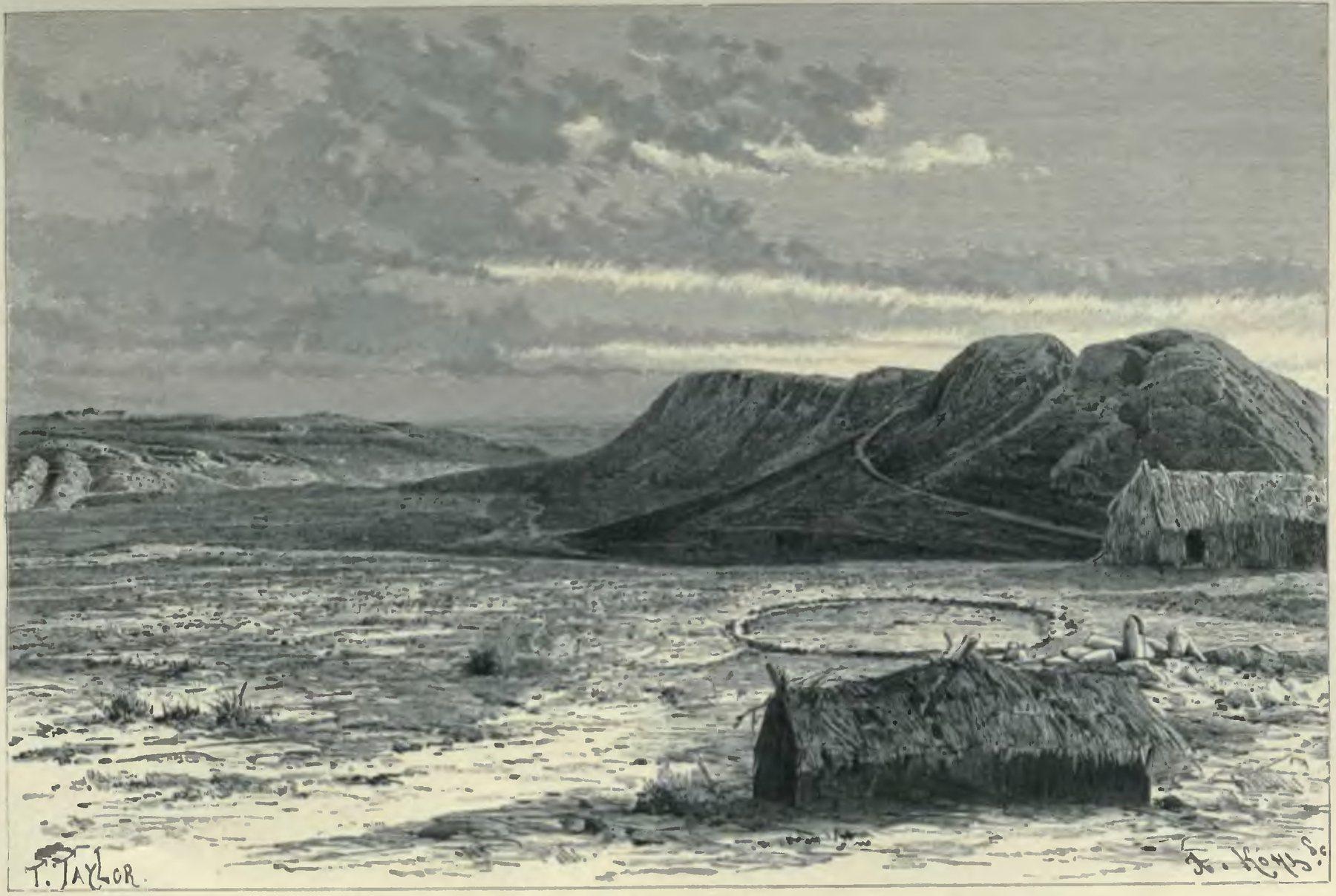
T. Taylor and F. Kohl, The Citadel of Susa, 1888. Public domain.
Nehemiah 1:1, Esther 1:2 and Daniel 8:2 · Place · Featured Study
Susa
Susa was a royal city of the Persian kings in the province of Elam, on the site of the modern town of Shush in Iran.
These are the words of Nehemiah son of Hacaliah: In the month of Chislev, in the twentieth year, while I was in the citadel of Susa,
- Today
- Shush, Iran
- Region
- Elam, east of the Tigris
- Site
- 32.189, 48.258
- First named
- Ezra 4:9 “…and Babylon, the Elamites of Susa,”
- Last named
- Daniel 8:2 “…myself in the citadel of Susa, in the…”
Nehemiah was in the citadel of Susa when he heard that the wall of Jerusalem was broken down.
Summary
Nehemiah served the king in its citadel. Esther became queen in its palace. Daniel saw himself there in a vision. Greek writers put it at the end of the king's road and among the places where the king spent part of each year. British and French diggers found the palace of Darius I in its mounds.
- Esther names Susa in seventeen of the nineteen verses that carry its name.
- The palace was built of materials brought from across the empire.
- Commentators part over whether Daniel stood in the citadel himself.
The Citadel of Susa
The Hebrew name Shushan stands in nineteen verses of Nehemiah, Esther and Daniel.
Strong's dictionary glosses Shushan as a place in Persia, and the Berean text calls it the citadel of Susa. Daniel sets it in the province of Elam.
From Rehum the commander, Shimshai the scribe, and the rest of their associates—the judges and officials over Tripolis, Persia, Erech and Babylon, the Elamites of Susa,It is the one verse outside Nehemiah, Esther and Daniel that names the people of Susa.
Susa on Spruner's Plate
Spruner's atlas sets Susa in Susiana, east of the Tigris and south of the hills of Elymais.
Susa lay east of the Tigris, about four degrees of longitude from Babylon.
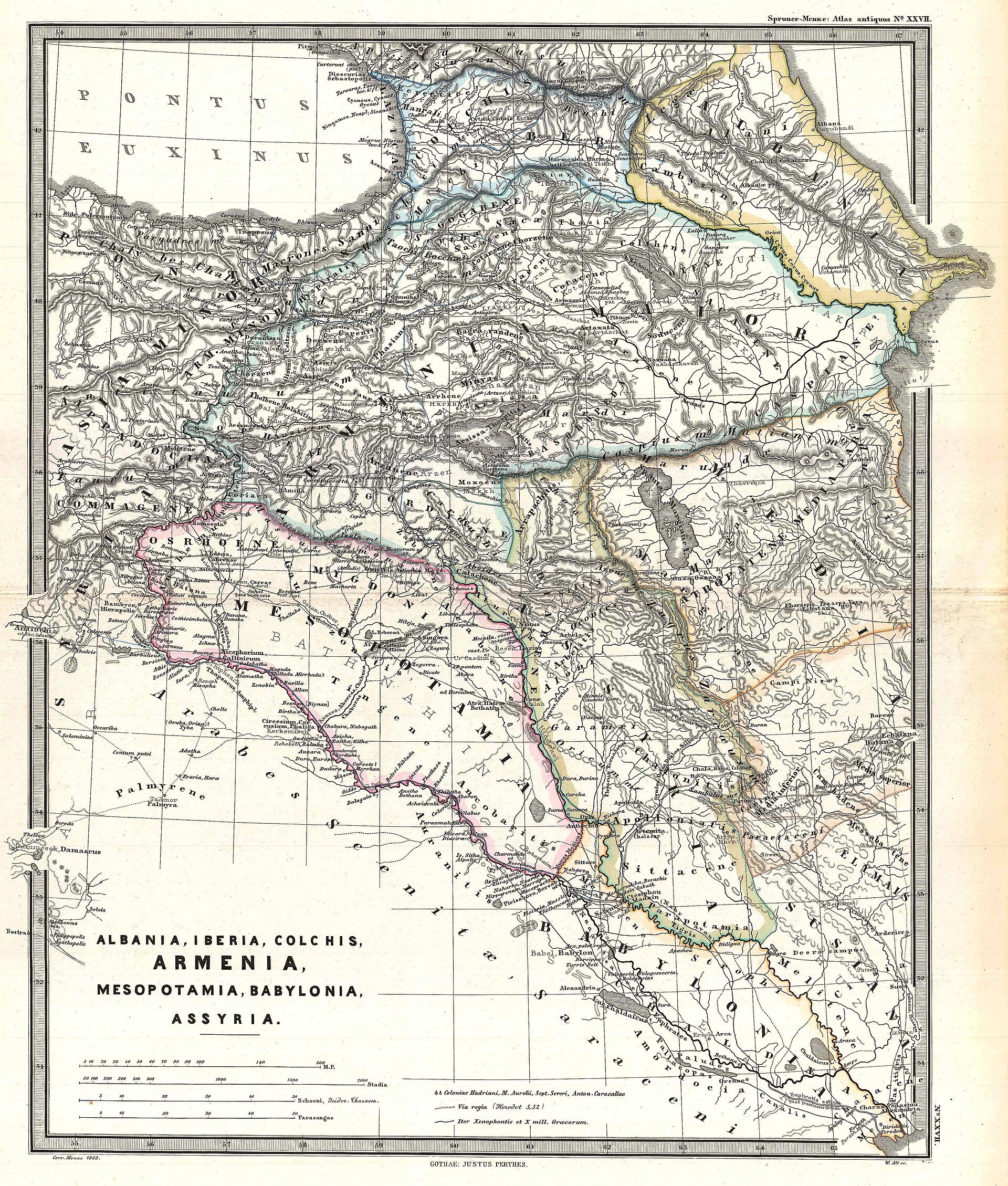
- Located: the site is known
- Probable: the Ulai Canal (OpenBible score 743 of 1,000)
- 1Susa, The citadel of Nehemiah 1:1 Nehemiah 1:1
- 2The Ulai Canal, The water beside which Daniel saw himself in his vision Daniel 8:2
- 3Babylon, The capital of Belshazzar, in whose third year Daniel saw the vision set at Susa Daniel 8:1
Base map: Albania, Iberia, Colchis, Armenia, Mesopotamia, Babylonia, Assyria, Karl von Spruner and Theodor Menke, Atlas Antiquus, plate XXVII (Gotha: Justus Perthes, 1865), public domain. Places with a place page stand at its coordinates and the others at the point cited for each, set on the plate by Babylon and Susa, as the plate prints them.
Three places, each with its verse; one ring carries OpenBible's identification score. The plate's legend marks the royal road of Herodotus 5.52 as Via regia.
Susa in Scripture, in Order
Each of these verses names Susa or its people.
Eight verses that name Susa, in the order of the canon.
- NehemiahNehemiah is in the citadel in the month of ChislevNehemiah 1:1
- EstherXerxes sits on his royal throne in the citadelEsther 1:2
- EstherA seven-day feast is held in the garden court of the palaceEsther 1:5
- EstherMordecai, a Jew of the tribe of Benjamin, lives at the citadelEsther 2:5
- EstherYoung women are gathered at the citadel under the care of HegaiEsther 2:8
- EstherThe number of those killed in the citadel is reported to the kingEsther 9:11
- EstherThe Jews of Susa gather again on the fourteenth of AdarEsther 9:15
- DanielDaniel sees himself in the citadel in a visionDaniel 8:2
Esther gives six of the eight.
Esther, Daniel
The Road and the Seasons
Two Greek writers set Susa on the king's road and in the king's year.
The Palace the Excavators Found
Three missions dug at Susa between 1851 and 1911.
William Kennett Loftus dug at Susa with Colonel Fenwick Williams in 1851 and 1852. He wrote that Williams had found a palace of the ancient Persian monarchs, with bell-shaped column bases. His Travels and Researches in Chaldaea and Susiana names a chapter The Great Palace of Darius at Susa.
Marcel and Jane Dieulafoy led a French mission there from 1884 to 1886, and objects they found now stand in the Louvre. Jacques de Morgan dug at Susa from 1897 to 1911, and his mission found the stele of Hammurabi's laws there in 1901 and 1902.
An inscription of Darius I from Susa, called DSf, lists what the peoples of the empire brought to his palace: cedar from Lebanon, gold from Lydia and Bactria, and ivory from Kush, India and Arachosia.
Hangings of white and blue linen were fastened with cords of fine white and purple material to silver rings on the marble pillars. Gold and silver couches were arranged on a mosaic pavement of porphyry, marble, mother-of-pearl, and other costly stones.Jamieson, Fausset and Brown held that the palace dug out at Susa was the very building this verse describes.
What the Text Leaves Unsaid
Scripture leaves the city's plan unmeasured and Daniel's grave unnamed.
Scripture gives no measure of the citadel and no plan of the palace.
It records no death or burial of Daniel. Benjamin of Tudela was shown a sepulchre of Daniel in front of one of the synagogues of Shushan, and he describes a coffin hung by an iron chain from the middle of a bridge.
From Confusion to Joy
Esther gives the same city two days, one of dismay and one of gladness.
The couriers left, spurred on by the king’s command, and the edict was issued in the citadel of Susa. Then the king and Haman sat down to drink, but the city of Susa was in confusion.Mordecai went out from the presence of the king in royal garments of blue and white, with a large gold crown and a purple robe of fine linen. And the city of Susa shouted and rejoiced.The edict of Esther 8 reached the city that the edict of Esther 3 had thrown into confusion.
Voices on Susa
Albert Barnes set the feast of Esther 1 among the feasts of the Persian kings.
Albert Barnes (1798 to 1870)
Barnes gave the scale of a Persian royal table.
“Feasts on this extensive scale were not unusual in the East. Cyrus is said on one occasion to have feasted ‘all the Persians.’ Even ordinarily, the later Persian monarchs entertained 15,000 persons at their table.”
Albert Barnes · Notes, Explanatory and Practical, on the Old and New Testaments (1832-1869) · on Esther 1:5Evangelical
Was Daniel at Susa?
Readers differ on whether Daniel stood at Susa in body or only in the vision.
And in the vision I saw myself in the citadel of Susa, in the province of Elam. I saw in the vision that I was beside the Ulai Canal.In body, on the king's businessAlbert Barnes and Adam Clarke
Albert Barnes judged the most natural reading to be that Daniel was there himself, and pointed to Daniel 8:27, where he got up and went about the king's business. Adam Clarke held that Susa was Daniel's ordinary residence, and that from there he saw himself in vision on the banks of the Ulai.
The objection: John Gill, below, reads the verse as placing Daniel at Susa in the vision alone.
In the vision onlyJohn Gill
John Gill held that Daniel was at Susa not in reality but only as it seemed to him in the vision, as Ezekiel in Babylon was carried in visions to Jerusalem.
The objection: Barnes reads Daniel 8:27 as showing Daniel in the service of the king when the vision ended.
Daniel's life in the courts of Babylon and Persia is taught at Daniel the Prophet.
Books to Read Next
Each of the three works has a free copy to read.
Travels and Researches in Chaldaea and Susiana
William Kennett Loftus · 1857
Loftus tells the first digging at Susa and the finding of the palace and its columns.
Read at the Internet ArchiveÀ Suse, journal des fouilles, 1884 to 1886
Jane Dieulafoy · 1888
Jane Dieulafoy kept the journal of the French mission, with engravings of the mounds.
Read at the Internet ArchiveThe Itinerary of Benjamin of Tudela
Benjamin of Tudela, translated by Marcus Nathan Adler · 1907
Benjamin describes Shushan on pages 74 and 75.
Read at Project GutenbergIf I Perish, I Perish
Esther set her own life on a fast kept by the Jews of the city.
“Go and assemble all the Jews who can be found in Susa, and fast for me. Do not eat or drink for three days, night or day, and I and my maidens will fast as you do. After that, I will go to the king, even though it is against the law. And if I perish, I perish!”On the third day she stood in the inner court of the palace, Esther 5:1 records.
Sources
Scripture is the Berean Standard Bible.
- James Strong, Exhaustive Concordance of the Bible (1890), Hebrew and Chaldee dictionary, entries 7800 and 7801, and the verses that carry them.
- OpenBible.info, Bible-Geocoding-Data, ancient.jsonl, entries Susa (Shush, score 1000) and Ulai (the Ulai canal, score 743)
- Wikipedia, Susa, the sections Location and History.
- William Kennett Loftus, Travels and Researches in Chaldaea and Susiana, New York, Robert Carter and Brothers, 1857, pp. 349, 353, 356 and 367, and the contents, chapter 28.
- Musée du Louvre, collection records AOD 480 (Susa, mission of Marcel Dieulafoy, 1884 to 1886) and Sb 8 (the Code of Hammurabi, found at Susa by the mission of Jacques de Morgan, 1901 to 1902)
- Darius I, the foundation charter of the palace at Susa (DSf), lines 29 to 51, in the Livius translation.
- Herodotus, Histories 5.52.6 to 5.54.1, translated by A. D. Godley.
- Xenophon, Cyropaedia 8.6.22, translated by Walter Miller.
- The Itinerary of Benjamin of Tudela, translated by Marcus Nathan Adler, 1907, pp. 74 to 75.
- Jane Dieulafoy, À Suse, journal des fouilles, 1884 to 1886, Paris, Librairie Hachette, 1888.
- Jamieson, Fausset and Brown, Commentary Critical and Explanatory on the Whole Bible (1871), on Esther 1:3.
- Albert Barnes, Notes, Explanatory and Practical, on the Old and New Testaments (1832 to 1869), on Esther 1:5.
- Albert Barnes, Notes, Explanatory and Practical, on the Old and New Testaments (1832 to 1869), on Daniel 8:2.
- Adam Clarke, Commentary on the Bible (1832), on Daniel 8:2.
- John Gill, Exposition of the Old Testament (1748 to 1763), on Daniel 8:2.
- Karl von Spruner and Theodor Menke, Atlas Antiquus, plate XXVII, Gotha, Justus Perthes, 1865.
Keep Studying
Read it6
Studies3
People and groups8