
Daniel 5:25
in Daniel 5Now this is the inscription that was written: MENE, MENE, TEKEL, PARSIN.
BSB
The same verse in ASV and KJV ▾
ASV
And this is the writing that was inscribed: MENE, MENE, TEKEL, UPHARSIN.
KJV
And this is the writing that was written, MENE, MENE, TEKEL, UPHARSIN.
⋯
This verse in Daniel 5
Commentary
7 notes on this verseVerses 25-28. "This is the inscription which has been set up: MANE, THECEL, PHARES. And this is the interpretation of the sentence: 'MANE' means that God has numbered thy kingdom and brought it to an end. 'THECEL' means it has been weighed in the scales and has been found deficient (Vulg.: thou hast been weighed and hast been found...). 'PHARES' means that thy kingdom has been removed and given to the Medes and Persians."
This site's exposition
the part of the hand sent
on Daniel 5:24-25
The writing itself is given in Aramaic weights and measures, MENE, MENE, TEKEL, UPHARSIN, terms Keil identifies as a mina, a mina, a shekel, and half-minas or divisions, ordinary units of commercial weighing turned into a sentence on a kingdom. The bench notes the words were likely legible to the wise men as vocabulary and unreadable only as meaning, which is why Daniel's contribution is interpretation rather than decipherment, reading a message hidden in plain words rather than in a foreign script.
The record, by era
The Church Fathers1 voice
And after saying these things he added the following, at once rebuking the king and not receiving his face so that having heard this the king would be afraid and so that he who committed trespasses might immediately recognize them. And so it says, "And you his son, Belshazzar, you have not humbled your heart before God; do you not know all these things? And you have been exalted against the Lord God of heaven and have brought the vessels of his house before you and you and your magistrates and your mistresses and your concubines drank wine from them, and you have praised golden and silver and bronze and iron and wooden and stone gods, which do not see and which do not hear and which do not understand, and God, of whom your breath is in his hand and all your ways are as well, you have not glorified him. On account of this the fingers of a hand have been sent from his face and he ordered this writing: 'Mane, Thekel, Fares.' This is the interpretation of the phrase: 'Mane,' God has measured your kingdom and ended it, 'Thekel,' it has been weighed in the balance and been found wanting, 'Fares,' your kingdom is divided and has been given to the Medes and Persians." [Daniel 5:22-28]
The Puritans and the Awakening2 voices
And this is the writing that was written,.... They are such and such letters, and so to be read, as follows: MENE, MENE, TEKEL, UPHARSIN; which are Chaldee words, and may be literally rendered, "he hath numbered, he hath numbered"; that is, God hath certainly, perfectly, and exactly numbered; "he hath weighed", God hath weighed thee, Belshazzar; "and they divide the kingdom"; that is, the Medes and Persians, as appears from the following interpretation:
The Chaldean wise men, because they knew not that there is but one God only, could not understand who this He should be, and for that reason (some think) the writing puzzled them. (1.) Mene; that is repeated, for the thing is certain-- Mene, mene; that signifies, both in Hebrew and Chaldee, He has numbered and finished, which Daniel explains thus (
quarantine:debris (2026-07-29) — unbalanced-parens
The Nineteenth Century2 voices
A commentator
Albert Barnes1798–1870
Notes, Explanatory and Practical, on the Old and New Testaments (1832-1869)
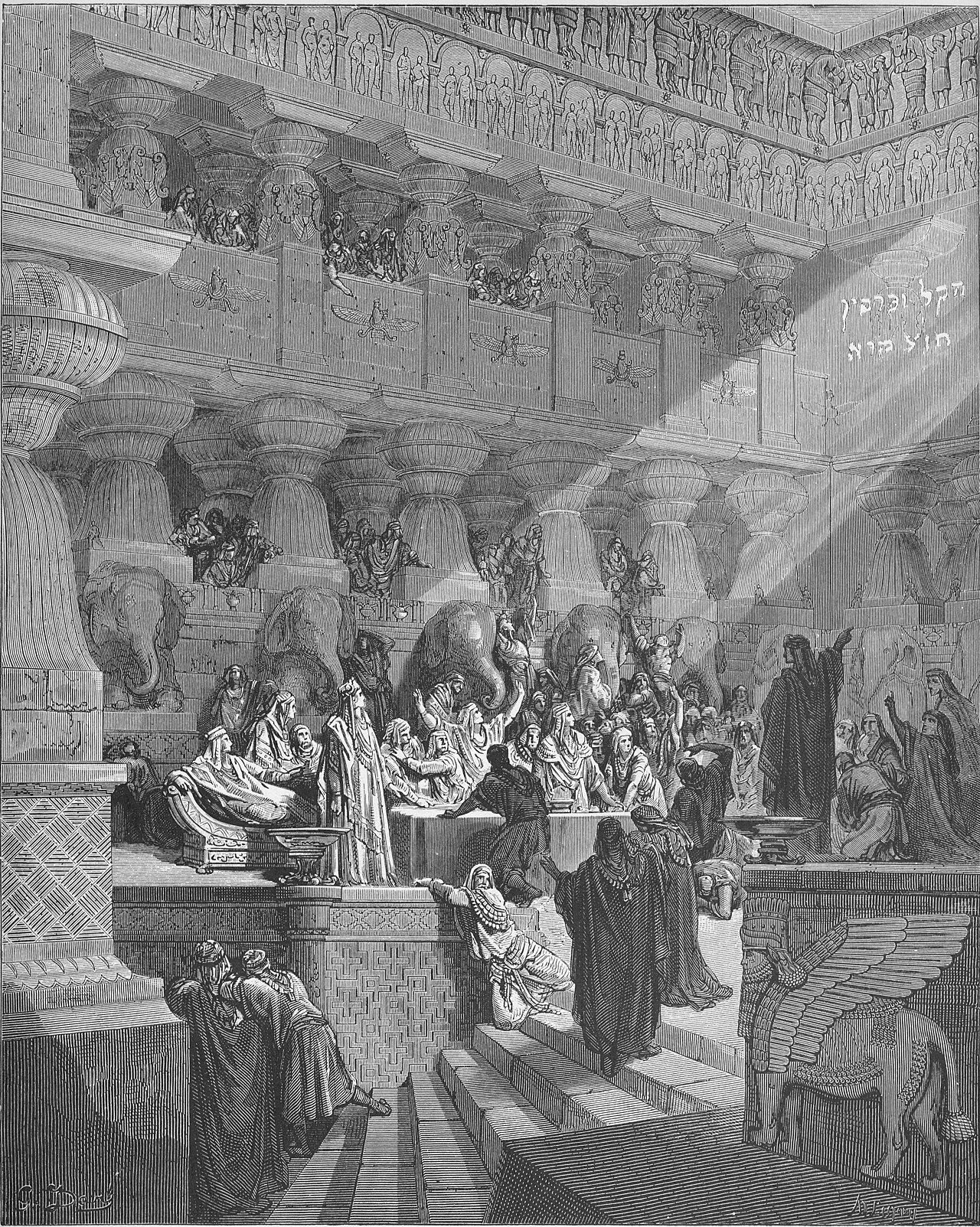
And this is the writing that was written - The Babylonians, it would seem, were unacquainted with the “characters” that were used, and of course unable to understand the meaning. See Dan 5:8. The first thing, therefore, for Daniel to do was to read the writing, and this he was able to do without difficulty, probably, as already remarked, because it was in the ancient Hebrew character - a character quite familiar to him, though not known to the Babylonians, whom Belshazzar consulted.
And this is the writing - Had the words been written in the Chaldean character, every wise man there, every one that could read the alphabet of his own language, could have read and interpreted them. Let it be observed, - 1. That the character which we now call Hebrew is the Chaldean character. 2. That the true Hebrew character is that which we call the Samaritan. 3. Daniel could easily read this, for it was the character used by the Jews previously to the Babylonish captivity. 4. It appears that it was simply on account of the strangeness of the character that the Chaldeans could not read it. I shall set down the words in both characters, by which the least learned reader may see that it was quite possible that one might be well known, while the other might be unintelligible. In ancient times, no doubt, these letters differed more from each other than they appear to do now; for we know that the Samaritan on ancient coins, though radically the same, differs very much from that now used in printing. It should be observed, that each word stands for a short sentence; מנא mene signifies Numeration; תקל tekel, Weighing; and פרש peres, Division. And so the Arabic translates them mokeeson, measured; mewzonon, weighed; mokesoomon, divided. All the ancient Versions, except the Syriac, read the words simply Mene, Tekel, Phares, as they are explained in the following verses; without the repetition of Mene, and without the conjunction ו vau and plural termination, ין in, in Peres.
The words behind it
8 Hebrew wordsEvery Hebrew word of this verse in the order it stands, with what it means and the door to its own study. The last column counts the times a word stands in the whole Bible: the rarer the word, the more the places it appears belong together.
| Hebrew | Sound | Meaning | Word study | In the Bible |
|---|---|---|---|---|
| וּדְנָ֥ה | udenah | and this | H1836 → | 58 times |
| כְתָבָ֖א | khetava' | [is] writing the | H3792 → | 12 times |
| דִּ֣י | di | which | H1768 → | 345 times |
| רְשִׁ֑ים | reshim | it was inscribed | H7560 → | 7 times |
| מְנֵ֥א | mene' | mene | H4484 → | 3 times |
| מְנֵ֖א | mene' | mene | H4484 → | 3 times |
| תְּקֵ֥ל | tekel | teqel | H8625 → | 3 times |
| וּפַרְסִֽין׃ | ufarsin | and pharsin | H6537 → | 3 times |
וּדְנָ֥הand this
udenahH1836 →58 times
כְתָבָ֖א[is] writing the
khetava'H3792 →12 times
דִּ֣יwhich
diH1768 →345 times
רְשִׁ֑יםit was inscribed
reshimH7560 →7 times
מְנֵ֥אmene
mene'H4484 →3 times
מְנֵ֖אmene
mene'H4484 →3 times
תְּקֵ֥לteqel
tekelH8625 →3 times
וּפַרְסִֽין׃and pharsin
ufarsinH6537 →3 times
A shaded row is a word that stands 400 times or fewer in the Bible.
Where this verse is studied
On this page
Studies4
About Daniel
This page draws on Adam Clarke, Commentary on the Bible; Albert Barnes, Notes on the Book of Daniel; Albert Barnes, Notes, Explanatory and Practical, on the Old and New Testaments (1832-1869); Carl Friedrich Keil, Biblical Commentary on the Book of Daniel; Hippolytus of Rome, Commentary on Daniel 3.17.5-6; Jerome, St. Jerome, Commentary on Daniel, CHAPTER FIVE; John Gill, Exposition of the Old Testament (1748-1763) and Matthew Henry, Commentary on the Whole Bible.