
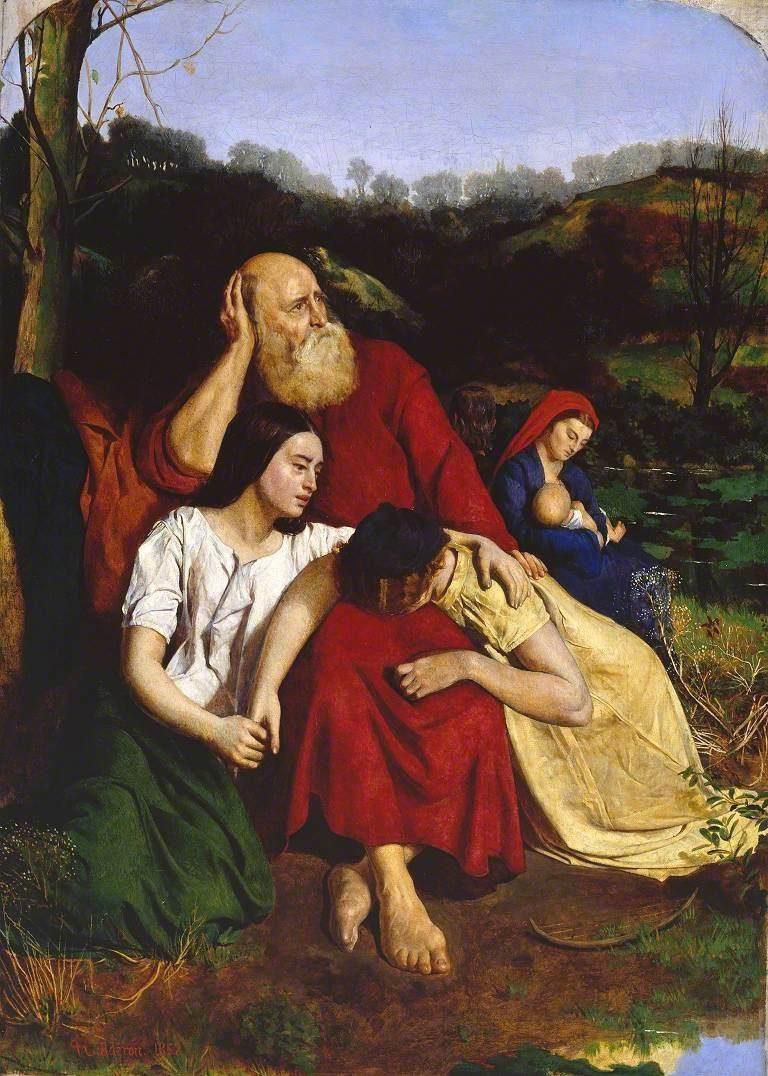
Philip Hermogenes Calderon, By the Waters of Babylon, 1852. Public domain.
Jeremiah 29 · Subject · Featured Study
The Letter to the Exiles
Jeremiah 29 gives the full text of one letter, written in Jerusalem.
King Zedekiah's own envoys to Nebuchadnezzar carried Jeremiah's letter to Babylon.
Seek the prosperity of the city to which I have sent you as exiles. Pray to the LORD on its behalf, for if it prospers, you too will prosper.”
Seek the prosperity of the city to which I have sent you as exiles. Pray to the LORD on its behalf, for if it prospers, you too will prosper.”
- Book
- Jeremiah
- Hold in memory
- Jeremiah 29:7
Summary
Jeremiah's letter told the exiles in Babylon to build houses, plant gardens, marry and pray for their new city. It warned them against their own prophets.
- Clay tablets show Judeans farming and paying taxes in Babylonia in the following decades.
- A later Jewish prayer for the government draws on its words.
- Commentators hear a play on words in the curse on two false prophets.
A Letter from Jerusalem
The letter went to the elders, priests, prophets and people that Nebuchadnezzar had taken to Babylon.
It was sent after King Jeconiah, the queen mother, the officials and the craftsmen had gone into exile (Jeremiah 29:2).
The letter was entrusted to Elasah son of Shaphan and Gemariah son of Hilkiah, whom Zedekiah king of Judah sent to King Nebuchadnezzar in Babylon. It stated:“Build houses and settle down. Plant gardens and eat their produce. Take wives and have sons and daughters. Take wives for your sons and give your daughters in marriage, so that they too may have sons and daughters. Multiply there; do not decrease.The Letter in Order
The letter moves from counsel to warning, to promise, and to judgment.
The letter tells the exiles to settle, warns them against their prophets, and ends with the answer to Shemaiah.
- Jeremiah 29:1 to 3Who sent the letter, who received it and who carried it.Jeremiah 29:1
- Jeremiah 29:4 to 7Build houses, plant gardens, marry, and seek the prosperity of the city.Jeremiah 29:4
- Jeremiah 29:8 to 9Do not be deceived by the prophets and diviners among you.Jeremiah 29:8
- Jeremiah 29:10 to 14When Babylon's seventy years are complete, the LORD will bring you back.Jeremiah 29:10
- Jeremiah 29:15 to 19The king and the people left in Jerusalem will be like rotten figs, so bad they cannot be eaten.Jeremiah 29:17
- Jeremiah 29:20 to 23Two prophets who speak lies will be handed to Nebuchadnezzar.Jeremiah 29:20
- Jeremiah 29:24 to 29Shemaiah writes to the priest Zephaniah, who reads his letter to Jeremiah.Jeremiah 29:29
- Jeremiah 29:30 to 32The LORD will punish Shemaiah and his descendants, and he will not see the good.Jeremiah 29:31
Eight parts of Jeremiah 29 in order, each with its verses.
Jeremiah 29:24 to 29, Jeremiah 29:30 to 32
Seek the Prosperity of the City
Commentators read the charge in Jeremiah 29:7, and a later Jewish prayer drew on it.
The Pulpit Commentary tells the exiles, in its note, to take an interest in the welfare of the city. Keil and Delitzsch add that in seeking its welfare the exiles furthered their own.
Albert Barnes wrote that to live as conspirators would have degraded their whole moral nature.
The Encyclopaedia Judaica, under Government, Prayer for the, traces the Jewish prayer for the government to Jeremiah's letter and to the Mishnah, Avot 3:2. In J. Kulp's translation that saying reads, “pray for the welfare of the government.”
Judeans in Babylonian Records
The tablets come from Babylonia in the century after the letter.
L. E. Pearce and C. Wunsch published 103 such tablets in 2014, in Documents of Judean Exiles and West Semites in Babylonia. S. Gross, reviewing the book in the Ancient Jew Review, dates them from about 572 to 477 BC.
Some were written at a place the tablets call Al-Yahudu. Cornell University's report on the book says they hold hundreds of Judean names formed with the name of the LORD.
The editors write that the Judeans had to “till the land and build houses, pay taxes, and render services to the king.”
The Curse and the Fire
Two names in the chapter carry plays on Hebrew words.
Because of them, all the exiles of Judah who are in Babylon will use this curse: ‘May the LORD make you like Zedekiah and Ahab, whom the king of Babylon roasted in the fire!’Albert Barnes hears a play on words here: the curse is qelâlâh (קללה), and roasted is qâlâh (קלה). The Cambridge Bible adds Kolaiah, the name of Ahab's father in Jeremiah 29:21.
Shemaiah is called the Nehelamite. The Pulpit Commentary says the name may come from a family or a place, and Ellicott's Commentary allows a play on halam, the Hebrew word for dreamer.
Who Were the Envoys?
Jeremiah 29:3 gives the fathers' names of the two men who carried the letter.
Keil and Delitzsch say the two envoys are not further known.
The Cambridge Bible thinks Elasah was probably a brother of Ahikam son of Shaphan, who had protected Jeremiah. It says Gemariah's father was perhaps Hilkiah, the high priest of Josiah's day. Ellicott's Commentary holds both.
Deeds, Seals and Clay Impressions: Shaphan's family in Jeremiah
A Future and a Hope
Jeremiah 29:11 follows the word on the seventy years, in the middle of the letter.
For I know the plans I have for you, declares the LORD, plans to prosper you and not to harm you, to give you a future and a hope.Matthew Henry on the Letter
Henry wrote on the letter as Scripture and on the exiles' new home.
Matthew Henry (1662 to 1714)
“The word of God written is as truly given by inspiration of God as his word spoken was; and this was the proper way of spreading the knowledge of God's will among his children scattered abroad.”
Matthew Henry · Commentary on the Whole Bible · on Jeremiah 29:1Puritan
“If the earth be the Lord's, then, wherever a child of God goes, he does not go off his Father's ground. Patria est ubicunque bene est--That place is our country in which we are well off. If things be not as they have been, instead of fretting at that, we must live in hopes that they will be better than they are.”
Matthew Henry · Commentary on the Whole Bible · on Jeremiah 29:5 to 6Puritan
Books to Read Next
Two older commentaries read the letter verse by verse.
Biblical Commentary on the Old Testament: Jeremiah
Carl Friedrich Keil and Franz Delitzsch · 1857 to 1878
It reads the envoys, the charge to seek the city's welfare and the fate of the two prophets.
Read it free at BibleHubNotes, Explanatory and Practical, on the Old and New Testaments
Albert Barnes · 1832 to 1869
Barnes dates the embassy and explains the play on the curse and the fire.
Read it free at BibleHubThe Letter Quoted Back
Shemaiah's protest quotes the letter's own words.
For he has sent to us in Babylon, claiming: Since the exile will be lengthy, build houses and settle down; plant gardens and eat their produce.’”The exiles were asked to make a home in the land of their captors and to wait for the LORD's time.
Sources
Scripture is the Berean Standard Bible.
- Carl Friedrich Keil and Franz Delitzsch, Biblical Commentary on the Old Testament (1857 to 1878), on Jeremiah 29; public domain.
- The Cambridge Bible for Schools and Colleges, on Jeremiah 29; public domain.
- The Pulpit Commentary, on Jeremiah 29; public domain.
- Ellicott's Commentary for English Readers, on Jeremiah 29; public domain.
- Albert Barnes, Notes, Explanatory and Practical (1832 to 1869), on Jeremiah 29.
- Encyclopaedia Judaica, Government, Prayer for the.
- Mishnah, Avot 3:2, translated by J. Kulp (Mishnah Yomit), cite-only.
- L. E. Pearce and C. Wunsch, Documents of Judean Exiles and West Semites in Babylonia in the Collection of David Sofer, CUSAS 28 (CDL Press, 2014), cite-only.
- S. Gross, review of Pearce and Wunsch, Ancient Jew Review, 18 February 2015, cite-only.
- Cornell Chronicle, report on the publication of the Al-Yahudu tablets, 6 January 2015.
- Matthew Henry, Commentary on the Whole Bible (1710), on Jeremiah 29:1 and 29:5 to 6.