
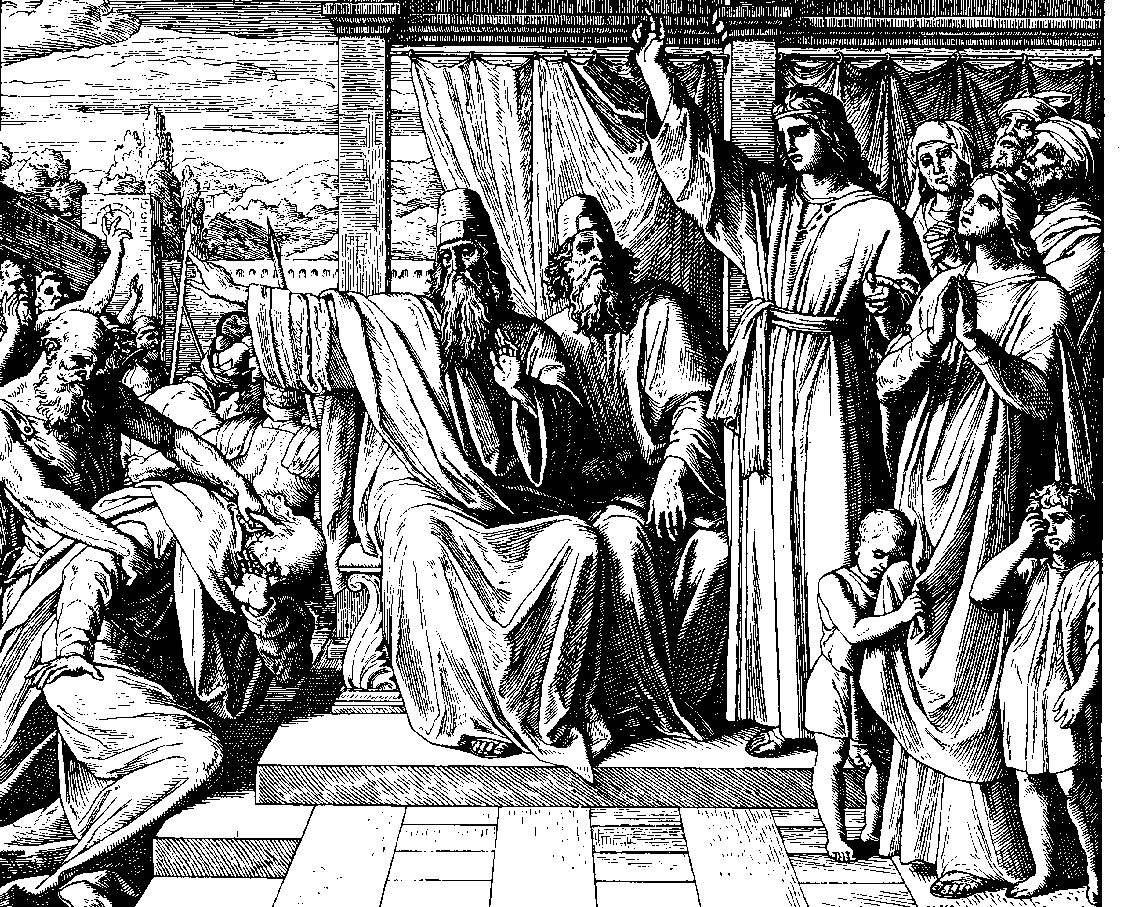
Julius Schnorr von Carolsfeld, woodcut for Die Bibel in Bildern, 1851 to 1860. Public domain.
Susanna 1 to 64 · Book · Apocrypha, a study resource beside the canon
Susanna
Susanna is one of three Greek additions to Daniel, a tale of sixty-four verses in which the young Daniel saves a woman falsely accused.
A lone witness is not sufficient to establish any wrongdoing or sin against a man, regardless of what offense he may have committed. A matter must be established by the testimony of two or three witnesses.
- Date
- about 95 to 80 BC, as D. M. Kay dated it (proposed)
- Edition
- Susanna in the King James Version Apocrypha, 1769 text (eBible.org); the Berean Standard Bible for the canon
The elders told the young Daniel to sit down among them, since God had given him the honour of an elder.
Summary
Susanna is a tale of a wife in Babylon who would rather die than sin against the Lord. Near its end her parents, her husband and all her kindred praise God for her.
- Susanna's maids went out at the privy doors and did not see the elders hidden in the garden, Susanna 18.
- Jerome wrote that the churches of his day read Daniel in the Greek version of Theodotion.
- Susanna's parents were righteous and taught her according to the law of Moses, Susanna 3.
The Book of Susanna
The tale names its family and its judges before the trial begins.
Joacim was a rich Jew of Babylon, and the Jews came to his house because he was the most honoured of them (Susanna 1 to 4). His wife Susanna, the daughter of Chelcias, feared the Lord.
The tale's judges hold court in that house, and all who have suits in law come to them there (Susanna 6). Of such judges the tale says "that wickedness came from Babylon from ancient judges, who seemed to govern the people" (Susanna 5).
The Tale at a Glance
Four scenes run from Joacim's house to the day the verdict turned.
Susanna gives thirty-seven of its sixty-four verses to the day of the trial.
- The householdSusanna 1 to 6: Joacim, his wife Susanna, and the two elders made judges that year.
- The gardenSusanna 7 to 27: the elders watch Susanna, threaten her when she is alone, and cry out against her when she refuses.
- The assemblySusanna 28 to 41: the elders lay their hands on her head and testify, and the people condemn her to death.
- Daniel's judgmentSusanna 42 to 64: Susanna prays, Daniel questions the elders apart, and they die by the law of Moses.
Each row gives a scene and its verses in the King James numbering.
Susanna and the Book of Daniel
The tale's young Daniel and Susanna's prayer can each be read beside a chapter of Daniel.
Condemned, Susanna cried out to the "everlasting God, that knowest the secrets, and knowest all things before they be" (Susanna 42).
He reveals the deep and hidden things; He knows what lies in darkness, and light dwells with Him.Daniel 2:22 gives God the knowledge of hidden things that Susanna's prayer appeals to.
Where the Tale Came From
Two scholars of the early twentieth century wrote on the tale's origin and its Greek texts.
Kay's edition stands in R. H. Charles's Apocrypha and Pseudepigrapha. He wrote that the tale grew out of the Pharisees' dispute with the Sadducees under Alexander Jannaeus, about 95 to 80 BC. He held that it was first written in Hebrew.
The tale survives in two Greek forms, the version of Theodotion and the Septuagint. The Septuagint is the old Greek translation of the Old Testament, and a manuscript of its Daniel was found in Cardinal Chigi's library at Rome and first printed in 1772 (Daubney, 1906).
Kay wrote that the tale's later joining to Daniel is the main cause of the differences between Theodotion's version and the Septuagint.
Who Receives the Tale
Six witnesses from Origen to the Synod of Jerusalem set the tale's standing.
The churches of the West divide over Susanna, and the Synod of Jerusalem receives it as Scripture.
| Who | What they do with the tale |
|---|---|
| Origen, Letter to Africanus, section 2 | says the history of Susanna is found in every Church of Christ in the Greek copy, and is absent from the Hebrew |
| Jerome, Preface to Daniel | says the Hebrew Daniel lacks the history of Susanna, and sets the tale in an appendix with an obelus before it |
| The Council of Trent, session 4, 1546 | lists Daniel among the books of the Old Testament, to be received entire with all its parts as the old Latin Vulgate contains them; the Vulgate numbers Susanna as Daniel 13 |
| The Church of England, Article VI | names the Story of Susanna among the other books the Church reads for example of life and instruction of manners, applying them to establish no doctrine |
| The Westminster Confession, 1646, chapter 1, section 3 | holds that the books commonly called Apocrypha are no part of the canon of Scripture |
| The Synod of Jerusalem, 1672, the Confession of Dositheus | names the History of Susanna among the genuine parts of Scripture |
Books to Read Next
The King James text, Kay's edition and Hippolytus's notes each open the tale further.
Susanna, King James Version Apocrypha
The King James translators · 1611
It gives the whole tale in the King James English.
Read it in the Apocrypha readerThe Apocrypha and Pseudepigrapha of the Old Testament, vol. I
R. H. Charles, ed.; Susanna by D. M. Kay · 1913
Kay gives an introduction, a translation and notes on its pages 638 to 651.
Read it free at archive.orgFragments from the Scriptural Commentaries of Hippolytus
Hippolytus of Rome, tr. S. D. F. Salmond · 1886 translation
His notes on Susanna follow those on Daniel and on the Song of the Three Children.
Read it free at New AdventThe Tale in Later Readers
A church father and a playwright each took up the tale.
Hippolytus of Rome wrote notes on the tale's verses. On Susanna 7 he read the tale as a figure: "Susannah prefigured the Church; and Joacim, her husband, Christ".
In The Merchant of Venice, act 4, scene 1, Shylock cries "A Daniel come to judgment!"
Later in the scene, Gratiano turns the words on Shylock with "A second Daniel, a Daniel, Jew!"
Sources
Scripture is the Berean Standard Bible.
- Susanna, King James Version Apocrypha, 1769 text (eBible.org USFX edition), public domain.
- D. M. Kay, Susanna, in R. H. Charles (ed.), The Apocrypha and Pseudepigrapha of the Old Testament, vol. I, Oxford, 1913, pp. 638 to 651; public domain.
- W. H. Daubney, The Three Additions to Daniel: A Study, Cambridge, 1906; public domain.
- Jerome, Preface to Daniel, tr. W. H. Fremantle, Nicene and Post-Nicene Fathers, second series, vol. 6; public domain.
- Origen, A Letter to Africanus, tr. Frederick Crombie, Ante-Nicene Fathers vol. 4; public domain.
- Hippolytus of Rome, Fragments from the Scriptural Commentaries of Hippolytus, tr. S. D. F. Salmond, Ante-Nicene Fathers vol. 5, 1886, On Susannah; public domain.
- The Council of Trent, session 4, 8 April 1546, the decree concerning the canonical Scriptures, tr. J. Waterworth.
- The Church of England, Articles of Religion, Article VI, in the Book of Common Prayer of 1863.
- The Westminster Confession of Faith, 1646, chapter 1, section 3.
- The Synod of Jerusalem, 1672, the Confession of Dositheus, question 3.
- William Shakespeare, The Merchant of Venice, act 4, scene 1; public domain.
Keep Studying
People and groups1
Doctrines1
Places1