
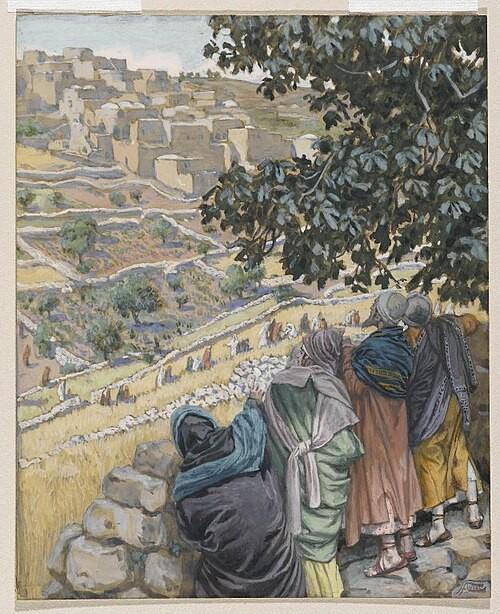
James Tissot, The Disciples Eat Wheat on the Sabbath, 1886 to 1894. Public domain.
Hosea 6:6 · Doctrine · Featured Study
I Desire Mercy, Not Sacrifice
Hosea 6:6 is the verse Jesus quoted twice in Matthew, and Samuel, David, Isaiah, Amos and Micah said the same in their own words.
Hosea spoke the verse to a people whose loyalty vanished like the early dew.
For I desire mercy, not sacrifice, and the knowledge of God rather than burnt offerings.
- First taught
- 1 Samuel 15:22 “But Samuel declared: “Does the LORD delight in…”
- Fullest statement
- Micah 6:8 “He has shown you, O man, what is…”
Summary
This study asks what the prophet set above sacrifice. It also asks why Jesus sent the Pharisees to learn it.
- Ten passages of the canon set something the LORD wants above the altar.
- The law of Leviticus 1 to 7 names six offerings for the altar.
- Readers have read the saying in four ways, each with its holder.
The Verse in Hosea 6
The saying stands in a chapter of repentance spoken and forgotten.
Come, let us return to the LORD. For He has torn us to pieces, but He will heal us; He has wounded us, but He will bind up our wounds.The chapter opens with the people's own words, which Hosea 6:4 tests.
What shall I do with you, O Ephraim? What shall I do with you, O Judah? For your loyalty is like a morning mist, like the early dew that vanishes.The LORD's question shows how long their loyalty lasted.
The loyalty of Hosea 6:4 and the mercy of Hosea 6:6 are one Hebrew word, chesed, and the verse pairs it with the knowing of God.
Before the word for burnt offerings the Hebrew has a preposition that the Berean renders rather than, so the second half of the verse states a preference. Hosea 6:7 then gives the charge that Israel had broken the covenant like Adam.
Hesed, the LORD's Loving Devotion: the word through the canon
The Saying Across the Canon
The passages run from the history of Samuel through the Psalms, the Proverbs and the Prophets to the Gospels.
Each step names what the LORD prefers to sacrifice.
- What the text sets above sacrifice
- Obedience to the LORD's voice.
- What the text sets above sacrifice
- Ears the LORD has opened.
- What the text sets above sacrifice
- A broken and a contrite heart.
- What the text sets above sacrifice
- Doing righteousness and justice.
- What the text sets above sacrifice
- Learning to do right, seeking justice and defending the fatherless and the widow.
- What the text sets above sacrifice
- Mercy and the knowledge of God.
- What the text sets above sacrifice
- Justice and righteousness rolling on like a river.
- What the text sets above sacrifice
- Acting justly, loving mercy and walking humbly with God.
- What the text sets above sacrifice
- Mercy, in the words of Hosea, twice.
- What the text sets above sacrifice
- Loving God with all the heart and the neighbour as oneself.
In the order of the books.
Amos 5, Micah 6, Jesus to the Pharisees, The scribe to Jesus
The Two Times Jesus Quoted It
Matthew records the verse on the lips of Jesus twice.
But go and learn what this means: ‘I desire mercy, not sacrifice.’ For I have not come to call the righteous, but sinners.”Jesus answers His questioners from Scripture.
If only you had known the meaning of ‘I desire mercy, not sacrifice,’ you would not have condemned the innocent.Jesus ties the verse to His word on the Lord of the Sabbath that follows.
The first time, Jesus had called Matthew from the tax booth and was eating at his house with many tax collectors and sinners (Matthew 9:9 to 11). The second time, His hungry disciples were picking heads of grain on the Sabbath (Matthew 12:1). Jesus set beside them David eating the consecrated bread and the priests at work in the temple (Matthew 12:3 to 5).
Jerome wrote that Jesus went to the feasts of sinners to teach and to give spiritual food to the guests.
The Offerings the Law Commanded
Leviticus gives the law of each offering of the altar.
This is the law of the burnt offering, the grain offering, the sin offering, the guilt offering, the ordination offering, and the peace offering,The prophets who set mercy above sacrifice spoke under this law.
Albert Barnes, on Matthew 9:13, read the saying in the light of that law. God had appointed and commanded the sacrifices, so the saying cannot mean that He opposed them.
The Voices
Three teachers from the fourth century to the eighteenth explain the saying in their own words.
Ambrose of Milan (died 397)
Ambrose of Milan, writing in a letter of 397, joined the verse to repentance.
“For the Word of God Himself tells us that He prefers the performance of His commandments to the offering of sacrifice. God proclaims this, Moses declares it to the people, Paul preaches it to the Gentiles. Do that which you understand is most profitable for the time. ‘I prefer mercy,’ it is said, ‘rather than sacrifice.’ Are they not, then, rather Christians in truth who condemn their own sin, than they who think to defend it? ‘The just is an accuser of himself in the beginning of his words.’”
Ambrose of Milan · Letter 51:15 · on Hosea 6:6 to 7Patristic
Augustine of Hippo (died 430)
Augustine, preaching on Micah 6:8, named the offering the LORD looks for.
“You ask what you should offer: offer yourself. For what else does the Lord seek of you but you? Because of all earthly creatures he has made nothing better than you, he seeks yourself from yourself, because you have lost yourself.”
Augustine of Hippo · SERMON 48:2 · on Micah 6:8Patristic
Matthew Henry (1662 to 1714)
Matthew Henry gave the verse a rule for the Christian's conduct.
“Our Saviour quotes this to show that moral duties are to be preferred before rituals whenever they come in competition, and to justify himself in eating with publicans and sinners, because it was in mercy to the souls of men, and in healing on the sabbath day, because it was in mercy to the bodies of men, to which the ceremony of singularity in eating and the sabbath-rest must give way, Matt. ix.”
Matthew Henry · Commentary on the Whole Bible · on Hosea 6:6Puritan
How the Saying Has Been Read
Four readings of what the saying asks stand among the fathers and the commentators.
The word not compares two goodsJohn Gill; John Wesley; Albert Barnes
John Gill read the first half of the verse by its second, the one rather than the other, and John Wesley's note gives the words rather than sacrifice. Albert Barnes, on Matthew 9:13, held the same.
God never needed the offeringsIrenaeus; Theodoret of Cyrus
Irenaeus, in Against Heresies, book 4, wrote that God needed no oblation and required it for the sake of the one who offers it. He set 1 Samuel 15:22 beside the people who thought God was to be propitiated by sacrifices while they neglected righteousness.
Theodoret of Cyrus read the LORD's words as a concession to His people.
“Whereas I [the Lord] have no need of sacrifices, I accept them out of considerateness for the limitations of your way of thinking. These two things, on the contrary, I do require: the right disposition toward me and lovingkindness toward the neighbor, these also being …”
Theodoret of Cyrus · Commentary on Hosea 6:6–7 · on Hosea 6:6 to 7Patristic
When mercy and a rite meet, mercy goes firstMatthew Henry; John Wesley
Matthew Henry held this reading in his commentary. John Wesley, on Matthew 12:7, wrote that acts of mercy come before every ceremonial institution when the two interfere, because the institutions are means of religion and love is its end.
Mercy toward God or toward the neighbourJamieson, Fausset and Brown
Jamieson, Fausset and Brown took the mercy of the verse as piety in general, of which mercy or charity toward others is a branch.
Books to Read Next
Two older commentaries read Hosea 6 verse by verse.
Commentary on the Whole Bible
Matthew Henry · 1710
Henry explains the morning mist and the mercy of Hosea 6 together.
Read it free at BibleHubExplanatory Notes upon the Old Testament
John Wesley · 1765
Wesley gives each phrase of Hosea 6 a short note.
Read it free at BibleHubNear the Kingdom
A scribe's answer in Mark 12 holds the saying in its widest form.
and to love Him with all your heart and with all your understanding and with all your strength, and to love your neighbor as yourself, which is more important than all burnt offerings and sacrifices.”Jesus' reply to this answer follows in the next verse.
When Jesus saw that the scribe had answered wisely, He told him that he was not far from the kingdom of God (Mark 12:34). The prophet's saying asks the reader to seek the LORD with loyal love and to know Him, above every gift the hands can bring.
Sources
Scripture is the Berean Standard Bible.
- The Hebrew text of Hosea 6:6, word by word, with Strong's numbers.
- The commentators' notes on Hosea 6, Matthew 9 and 12, 1 Samuel 15, Micah 6 and Amos 5.
- Matthew Henry, Commentary on the Whole Bible (1710), on Hosea 6:6 and Matthew 12:7.
- John Wesley, Explanatory Notes upon the Old Testament (1765), on Hosea 6:6; Explanatory Notes upon the New Testament (1755), on Matthew 12:7.
- John Gill, Exposition of the Old Testament, on Hosea 6:6.
- Albert Barnes, Notes, Explanatory and Practical, on Matthew 9:13.
- Jerome, Commentary on Matthew, on Matthew 9:13.
- Augustine of Hippo, Sermon 48:2, on Micah 6:8.
- Ambrose of Milan, Letter 51:15 (397)
- Irenaeus, Against Heresies 4.17.1.
- Theodoret of Cyrus, Commentary on Hosea, on Hosea 6:6 to 7.
- Jamieson, Fausset and Brown, Commentary Critical and Explanatory on the Whole Bible (1871), on Hosea 6:6.
Keep Studying
Read it4
Values1
People and groups3