
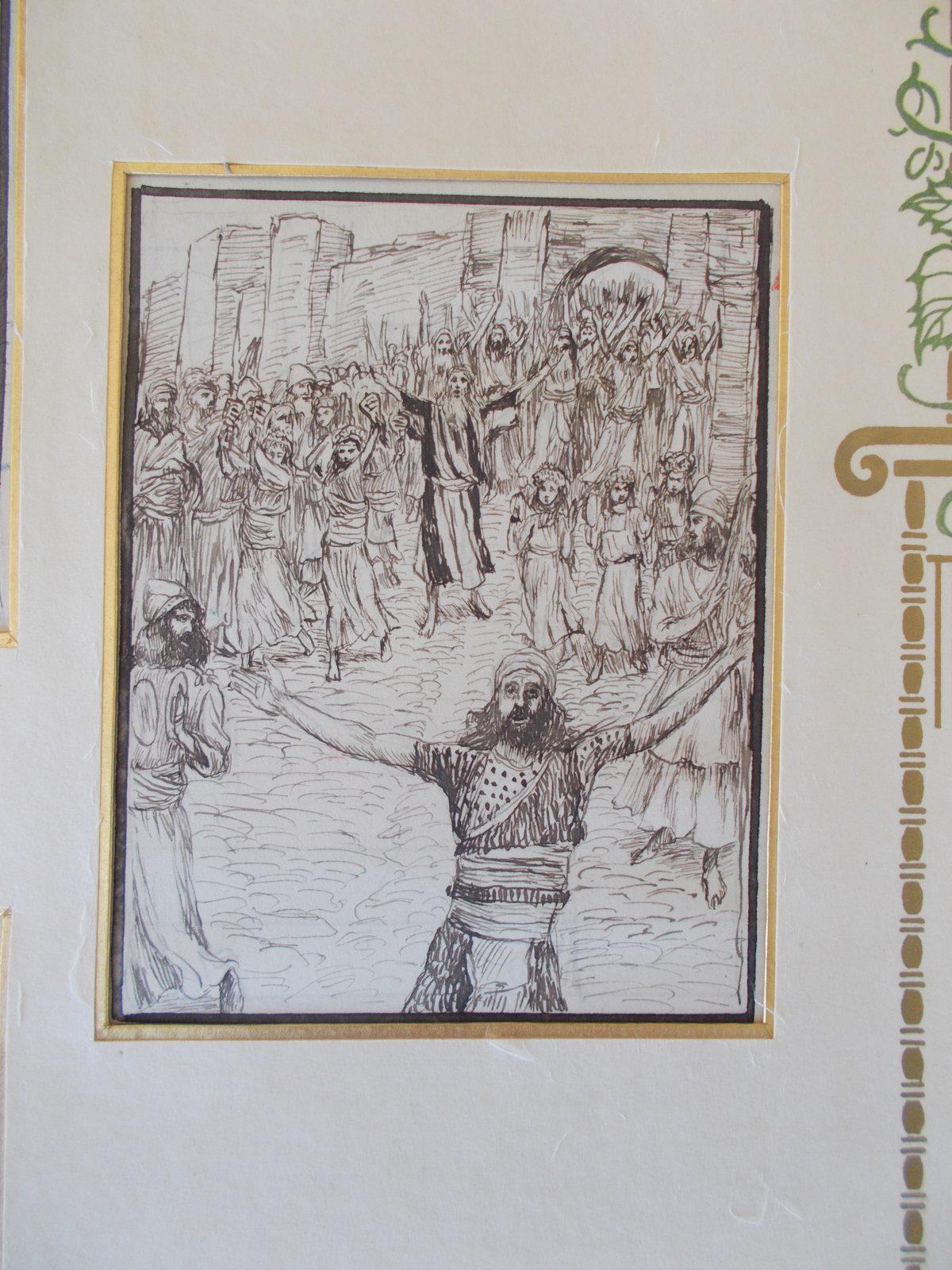
James Tissot, Saul Prophesies with the Prophets, about 1900. Public domain.
1 Samuel · Group · Featured Study
The sons of the prophets
Companies of prophets stood under Samuel at Ramah and around Elijah and Elisha. The books of Kings call them the sons of the prophets.
When Saul prophesied among the prophets, a man of Gibeah asked, “And who is their father?”
After that you will come to Gibeah of God, where the Philistines have an outpost. As you approach the city, you will meet a group of prophets coming down from the high place, preceded by harps, tambourines, flutes, and lyres, and they will be prophesying.
After that you will come to Gibeah of God, where the Philistines have an outpost. As you approach the city, you will meet a group of prophets coming down from the high place, preceded by harps, tambourines, flutes, and lyres, and they will be prophesying.
- Began
- First met as a group of prophets at Gibeah of God (1 Samuel 10:5)
Summary
The sons of the prophets were bands of prophets who lived and worshipped under a leading prophet. Samuel led one at Ramah, and Elisha led them at Gilgal and the Jordan.
- First Samuel calls them a group of prophets and shows Samuel standing at their head at Naioth in Ramah.
- The phrase sons of the prophets first stands in the story of Ahab's wars and stands in ten verses of the books of Kings.
- Fifty of them stood by the Jordan when Elijah was taken up.
- Commentators from Wesley to Barnes have called them schools of the prophets.
A Group of Prophets at Gibeah of God
Saul meets the first company on the day Samuel anointed him king.
When Saul and his servant arrived at Gibeah, a group of prophets met him. Then the Spirit of God rushed upon him, and he prophesied along with them. All those who had formerly known Saul and saw him prophesying with the prophets asked one another, “What has happened to the son of Kish? Is Saul also among the prophets?”The sign comes true at Gibeah, and Saul's old neighbours wonder at him.
he sent messengers to capture him. But when they saw the group of prophets prophesying, with Samuel leading them, the Spirit of God came upon them, and Saul’s messengers also began to prophesy.This is the one verse that sets Samuel over a company of prophets.
The words for the group1 Samuel 10:5; 1 Samuel 19:20; 2 Kings 2:3
The three Hebrew names for the prophets' companies, each with a verse where it stands.
| Hebrew | Where | The Berean words |
|---|---|---|
| chebel nebi'im (h2256) | 1 Samuel 10:5 | a group of prophets |
| lahaqat hannebi'im (h3862) | 1 Samuel 19:20 | the group of prophets |
| bene hannebi'im (h1121) | 2 Kings 2:3 | the sons of the prophets |
In 1 Samuel 19:20 the Hebrew says Samuel was standing as chief over them.
Where the Companies Lived
Six places in the hill country and the Jordan valley hold a company of prophets in 1 Samuel and 2 Kings.
The key gives each place with what happens there and its verse.
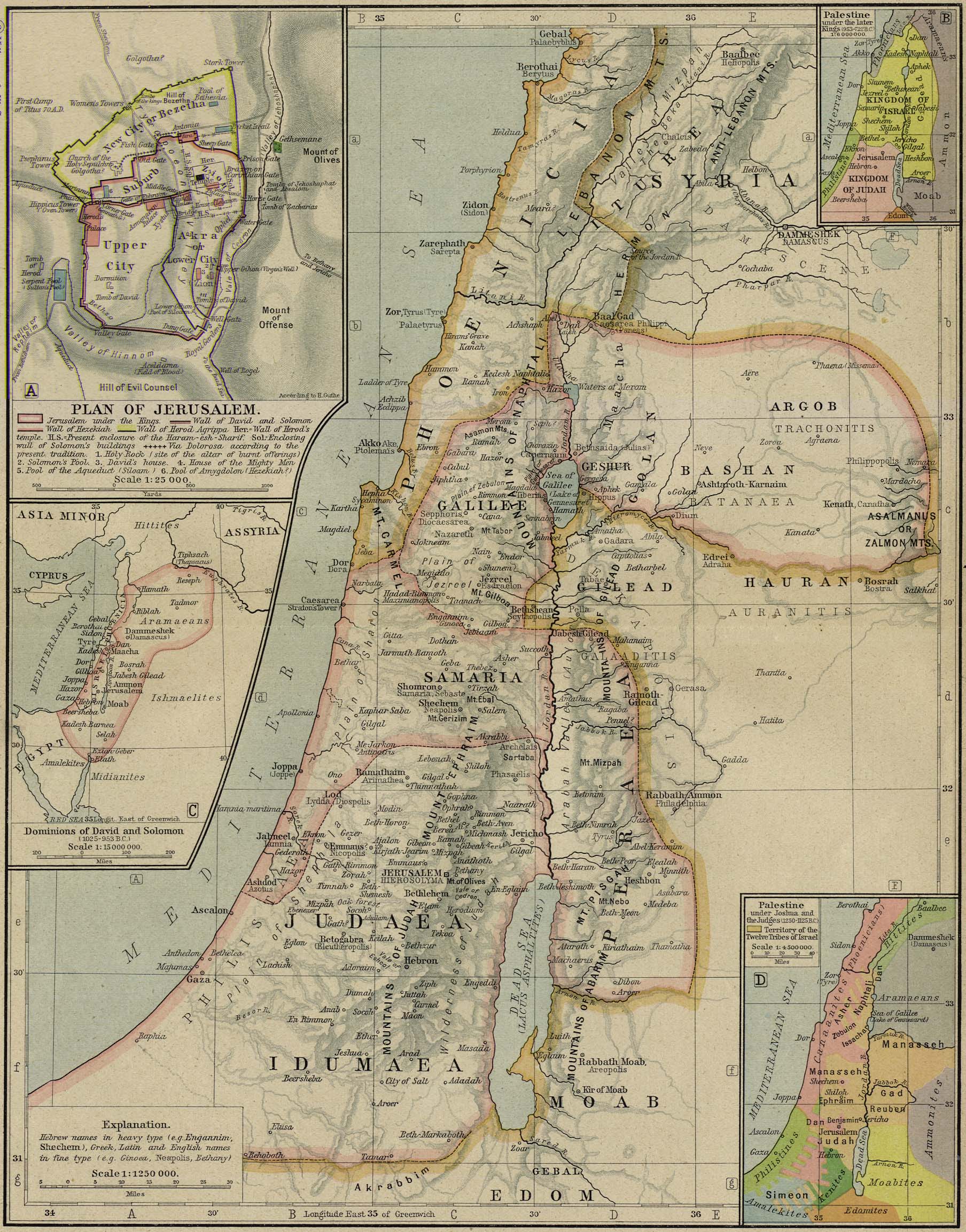
- Located: the site is known
- Identified: the point stands for an area, or is rounded
- 1Gibeah, Musicians come down from the high place, prophesying, 1 Samuel 10:10
- 2Ramah, Saul's messengers are caught up in the prophesying, 1 Samuel 19:18 to 20
- 3Bethel, The sons of the prophets come out to Elisha, 2 Kings 2:3
- 4Jericho, A company lives in the city, and Elisha stays there, 2 Kings 2:18
- 5The Jordan, Fifty stand at a distance, and later they cut beams there, 2 Kings 2:7
- 6Gilgal, Elisha makes a pot of poisoned stew safe to eat, 2 Kings 4:41
Base map: Reference map of ancient Palestine, Rand McNally reference map (1926), public domain. Each place stands at its place page's coordinates, set on the plate by Jerusalem and Damascus, as the plate prints them.
From Samuel to Elisha
The record runs from Saul's first days as king to the anointing of Jehu.
Ten texts in the order of the canon, each with what the prophets' companies do there.
- 1 Samuel 10:5 to 13A group with harps and tambourines meets Saul, and he prophesies with them
- 1 Samuel 19:18 to 24The group at Naioth prophesies, and so do Saul's messengers and Saul himself
- 1 Kings 20:35 to 36One of the sons of the prophets asks a companion to strike him
- 2 Kings 2:3 to 5Companies at Bethel and Jericho tell Elisha his master will be taken
- 2 Kings 2:15They bow to Elisha after the Jordan parts
- 2 Kings 4:1 to 7A widow of one of them is saved from her creditor by the oil
- 2 Kings 4:38 to 41They sit before Elisha through a famine
- 2 Kings 5:22Gehazi invents two young men of the sons of the prophets
- 2 Kings 6:1 to 7Their meeting place is too small, and the axe head floats at the Jordan
- 2 Kings 9:1 to 4One of them anoints Jehu king at Ramoth-gilead
2 Kings 4:38 to 41, 2 Kings 5:22, 2 Kings 6:1 to 7, 2 Kings 9:1 to 4
When the sons of the prophets who were facing him from Jericho saw what had happened, they said, “The spirit of Elijah rests on Elisha.” And they went to meet him and bowed down to the ground before him.The company accepts Elisha as its new head.
Now the sons of the prophets said to Elisha, “Please take note that the place where we meet with you is too small for us. Please let us go to the Jordan, where each of us can get a log so we can build ourselves a place to live there.” “Go,” said Elisha.The company outgrew its meeting place in Elisha's time.
Henry on the company that bowed to ElishaCommentary on the Whole Bible, on 2 Kings 2:15
Matthew Henry comments on the company's choice.
“They were trained up in the schools; Elisha was taken from the plough; yet when they perceived that God was with him, and that this was the man whom he delighted to honour, they readily submitted to him as their head and father, as the people to Joshua when Moses was dead, Josh. i.”
Matthew Henry · Commentary on the Whole Bible · on 2 Kings 2:15Puritan
Schools of the Prophets
The text calls them a group, a company and sons, and later readers called them schools.
Albert Barnes, on the phrase's first use, takes it to mean schools or colleges where young men were educated for the prophetic office.
Jamieson, Fausset and Brown give the same reading for the group at Gibeah.
“The company of prophets were, doubtless, the pupils at this seminary, which had probably been instituted by Samuel, and in which the chief branches of education taught were a knowledge of the law, and of psalmody with instrumental music, which is called ‘prophesying’ (here and in 1Ch 25:1, 7).”
Jamieson, Fausset & Brown · Commentary Critical and Explanatory on the Whole Bible · on 1 Samuel 10:5Reformed
The text itself describes men who sat before Elisha and met with him in one place.
When Elisha returned to Gilgal, there was a famine in the land. As the sons of the prophets were sitting at his feet, he said to his attendant, “Put on the large pot and boil some stew for the sons of the prophets.”Elisha feeds the men through the famine, as the next verses tell.
Barnes on the place where they metNotes, Explanatory and Practical, on 2 Kings 6:1
Barnes, on 2 Kings 6:1, reads the meeting place as the place where the company sat to hear Elisha, and he has Elisha visiting the schools in circuit.
Prophets in the Northern Kingdom
The companies of Kings stand in Israel, the northern kingdom, in the days of Ahab and his sons.
for when Jezebel had slaughtered the prophets of the LORD, Obadiah had taken a hundred prophets and hidden them, fifty men per cave, providing them with food and water.)Jezebel's persecution is the setting of the companies in Kings.
John Wesley explains why the companies mattered in the northern kingdom.
“In the kingdom of Judah they had priest and Levites, and the temple service. The want of these in the kingdom of Israel, God graciously made up by these colleges, where men were trained up and employed, in the exercises of religion, and whither good people resorted, to solemnize the appointed feasts, with prayer and hearing, tho' they had not conveniencies for sacrifice.”
John Wesley · Explanatory Notes upon the Old Testament · on 2 Kings 2:3Evangelical
What the Text Leaves Unsaid
The founding of the companies is left unrecorded, and so is any tie to Samuel beyond Naioth.
Their rule of life, their course of study and the age at which a man joined are left unrecorded.
One wife of a son of the prophets appears in 2 Kings 4:1, and the households of the rest are left unrecorded.
Is Saul Also Among the Prophets?
Twice the Spirit came on Saul among the prophets, and the saying became a proverb.
So Saul went to Naioth in Ramah. But the Spirit of God came upon even Saul, and he walked along prophesying until he came to Naioth in Ramah. Then Saul stripped off his robes and also prophesied before Samuel. And he collapsed and lay naked all that day and night. That is why it is said, “Is Saul also among the prophets?”The Spirit overruled the king who came to seize David.
Matthew Henry finds a New Testament namesake for this Saul.
“Though this school of the prophets was near his father's house, yet he had never associated with them, nor shown them any respect, perhaps had sometimes spoken slightly of them; and now to see him prophesying among them was a surprise to them, as it was long after when his namesake, in the New Testament, preached that gospel which he had before persecuted, Acts ix.”
Matthew Henry · Commentary on the Whole Bible · on 1 Samuel 10:11 to 12Puritan
Peter later gave the phrase to the crowd at Solomon's Colonnade.
And you are sons of the prophets and of the covenant God made with your fathers when He said to Abraham, ‘Through your offspring all the families of the earth will be blessed.’Peter names his hearers heirs of the prophets and of God's promise to Abraham.
Voices on the Prophets' Companies
John Wesley (1703 to 1791)
Explanatory Notes upon the Old Testament
Why Samuel stood over them
“And whereas some might falsely pretend to those raptures; or the devil might transform himself into an angel of light, Samuel's presence and judgment was necessary to prevent and to detect such impostures.”
on 1 Samuel 19:20Evangelical
What prophesying meant at GibeahJohn Wesley, Explanatory Notes upon the Old Testament, on 1 Samuel 10:5
Wesley wrote that the word prophesying is given “also to preaching, and to the making or singing of psalms, or songs of praise to God.”
Amos, called from the flockAmos 7:14 to 15
“I was not a prophet,” Amos replied, “nor was I the son of a prophet; rather, I was a herdsman and a tender of sycamore-fig trees. But the LORD took me from following the flock and said to me, ‘Go, prophesy to My people Israel.’Amos sets himself apart from the prophetic companies of his day.
Schools, or Disciples Around a Father
Readers differ on whether the companies were schools for training prophets or disciples gathered round one prophet.
Schools where prophets were trainedAlbert Barnes on 1 Kings 20:35; Jamieson, Fausset and Brown on 1 Samuel 10:5; John Wesley on 2 Kings 2:3
On this reading Samuel founded a seminary, and Elisha later kept training houses in several towns.
The objection is the text's own vocabulary of a group, a company and sons.
Disciples gathered round a prophetJamieson, Fausset and Brown on Amos 7:14
On this reading a son of the prophets is a disciple of a prophet, and the leading prophet is called father, as Elisha called Elijah.
As Elisha watched, he cried out, “My father, my father, the chariots and horsemen of Israel!” And he saw Elijah no more. So taking hold of his own clothes, he tore them in two.Elisha calls his master father, the title this reading gives the head of a company.
Jamieson, Fausset and Brown gloss the prophet's son of Amos 7:14 as a disciple.
The objection is that Elisha went among the companies as their teacher, which the first reading calls a school.
Books to Read Next
Commentary on the Whole Bible, volume 2
Matthew Henry · 1710
Henry reads the companies in 1 Samuel and 2 Kings verse by verse.
Free at the Christian Classics Ethereal LibraryExplanatory Notes upon the Old Testament
John Wesley · 1765
Wesley's notes on 1 Samuel 10 and 2 Kings 2 explain what the companies did.
Free at the Christian Classics Ethereal LibraryA Company Under the Word
Samuel and Elisha each had a company around him, and the text keeps the companies' members nameless.
When Saul came to them as a persecutor, the Spirit came on him too.
Sources
Scripture is the Berean Standard Bible.
- The Hebrew words of the verses with their Strong's numbers.
- The count of the phrase in the Berean text.
- Albert Barnes, Notes, Explanatory and Practical, on the Old and New Testaments (1832 to 1869), on 1 Kings 20:35 and 2 Kings 6:1.
- Jamieson, Fausset and Brown, Commentary Critical and Explanatory on the Whole Bible (1871), on 1 Samuel 10:5 and Amos 7:14.
- John Wesley, Explanatory Notes upon the Old Testament (1765), on 1 Samuel 10:5, 1 Samuel 19:20 and 2 Kings 2:3.
- Matthew Henry, Commentary on the Whole Bible (1710), on 1 Samuel 10:11 to 12, 1 Kings 20:35, 2 Kings 2:15 and Amos 7:14 to 15.
Keep Studying
Studies4
People and groups8
Symbols1
Church history1
Doctrines1