
1 Samuel 31:10
in 1 Samuel 31They put his armor in the temple of the Ashtoreths and hung his body on the wall of Beth-shan.
BSB
The same verse in ASV and KJV ▾
ASV
And they put his armor in the house of the Ashtaroth; and they fastened his body to the wall of Beth-shan.
KJV
And they put his armour in the house of Ashtaroth: and they fastened his body to the wall of Beth–shan.
⋯
This verse in 1 Samuel 31
Commentary
7 notes on this verseAnd they put his armour in the house of Ashtaroth,.... A temple dedicated to their deities, called by this name; of which See Gill on Jdg 2:13; Nothing was more common with the Gentiles than to place in their temples the arms they took from their enemies, as is strongly expressed by Homer (i) and Virgil (k); and indeed the Jews did the same, as appears by the sword of Goliath being laid up in the tabernacle, 1Sa 21:
This site's exposition
came to strip the slain
on 1 Samuel 31:8-10
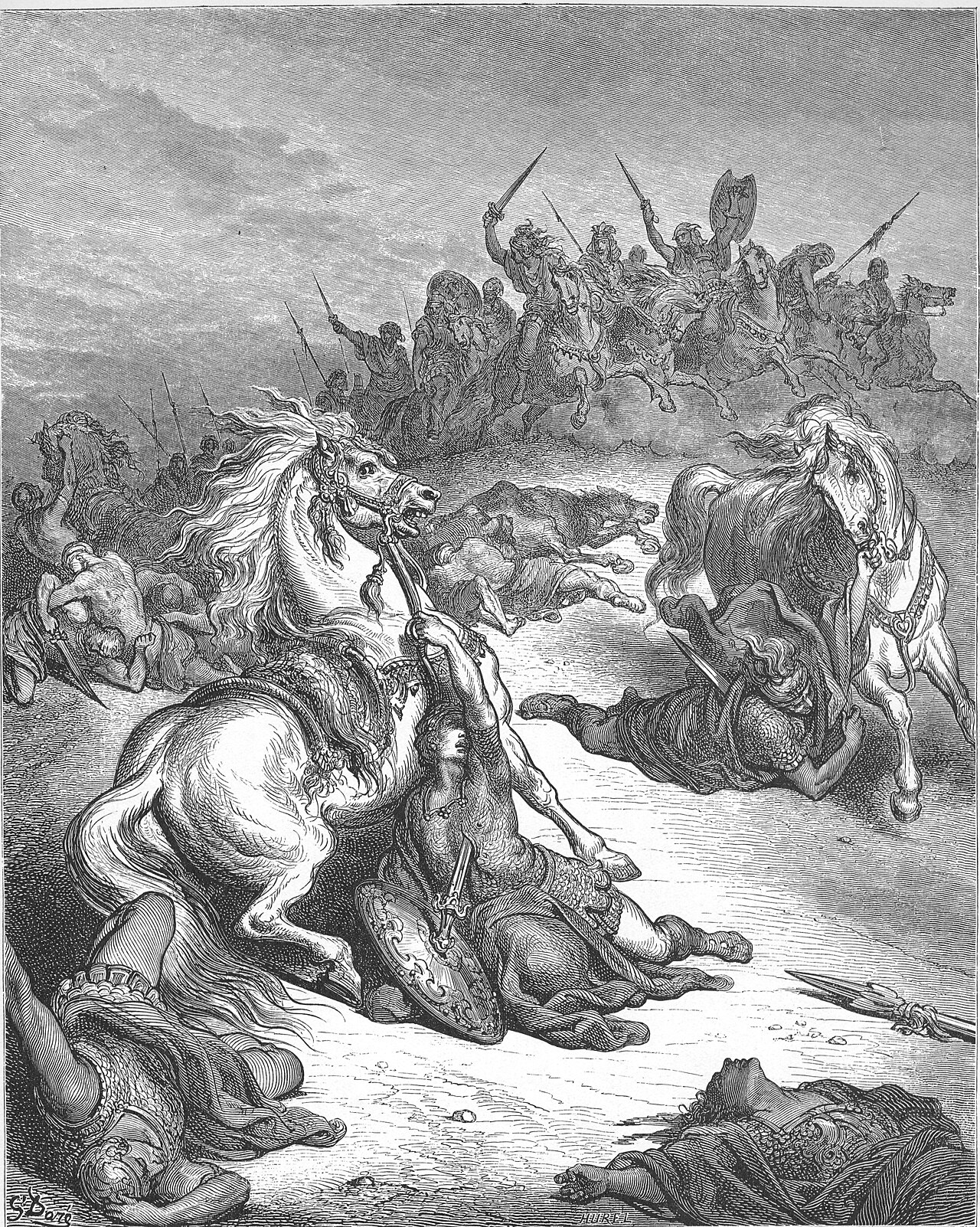
The Philistines strip Saul as David once stripped Goliath, and cut off his head as David cut off the head of Gath's own champion; the roles have reversed since chapter seventeen, and the head that once stood higher than any man in Israel is carried through Philistine territory as a trophy. Samuel's own text says only the house of their idols; Chronicles names it plainly, that they fastened his head in the temple of Dagon, the same god who had fallen on his face before the ark at Ashdod and now receives Israel's anointed in triumph. The armour goes to the house of Ashtaroth and the body to the wall of Beth-shan, and the cry raised at Shiloh, the glory is departed, reaches its full picture here in a king hung up for a god that could not stand on its own threshold.
The record, by era
The Puritans and the Awakening2 voices
There was also a special providence of God, in taking away Jonathan, (who of all Saul's sons, seems to have been the fairest for the crown) for preventing divisions, which might have happened amongst the people concerning the successor: David's way to the crown being by this means made the more clear.
10 (though it is omitted here), that they fastened his head in the temple of Dagon. Thus did they ascribe the honour of their victory, not as they ought to have done to the real justice of the true God, but to the imaginary power of their false gods, and by this respect paid to pretended deities shame those who give not the praise of their achievements to the living God.
The Nineteenth Century3 voices
They put his armor in the house of Ashtaroth - As David had done in placing the sword of Goliath in the tabernacle. We have already seen that it was common for the conquerors to consecrate armor and spoils taken in war, to those who were the objects of religious worship. They fastened his body to the wall - Probably by means of iron hooks; but it is said, 2Sa 21:12, that these bodies were fastened in the Street of Beth-shan.
A commentator
Jamieson, Fausset & Brown1802–1910
Commentary Critical and Explanatory on the Whole Bible (1871)
proposed
to the wall-- (2Sa 21:12) --"the street" of Beth-shan. The street was called from the temple which stood in it. And they had to go along it to the wall of the city (see Jos 17:11).
quarantine:debris (2026-07-29) — starts-lowercase
A commentator
Albert Barnes1798–1870
Notes, Explanatory and Practical, on the Old and New Testaments (1832-1869)
proposed
In the house of Ashtaroth - This was doubtless the famous temple of Venus in Askelon mentioned by Herodotus as the most ancient of all her temples. Hence, the special mention of Askelon 2Sa 1:20. The placing Saul’s armour as a trophy in the temple of Ashtaroth was a counterpart to the placing Goliath’s sword in the tabernacle 1Sa 21:9. In 1Ch 10:10 it is added that they “fastened Saul’s head in the temple of Dagon,” probably either in Gaza Jdg 16:21, or in Ashdod 1Sa 5:1-3. This was, perhaps, in retaliation for the similar treatment of Goliath’s head 1Sa 17:54. The variations seem to imply that both this narrative and that in 1Ch 10:1-14 are compiled from a common and a fuller document.
How the passage was read
What the Jewish commentators add
On the verses either side of this one
About him. Meaning the same as עָלָיו [about him], i.e., about Shaul.
This section is reception history: how the passage was read and kept in the Jewish tradition. Where a reading parts from an essential of the Christian faith, the section says so at that point.
Texts and citation data: Sefaria; each excerpt follows its version’s licence. 5 further sources are cited on this chapter that carry no English text this site may quote or only restate the verse.
The words behind it
11 Hebrew wordsEvery Hebrew word of this verse in the order it stands, with what it means and the door to its own study. The last column counts the times a word stands in the whole Bible: the rarer the word, the more the places it appears belong together.
| Hebrew | Sound | Meaning | Word study | In the Bible |
|---|---|---|---|---|
| וַיָּשִׂ֙מוּ֙ | vaiyasimu | and they put | H7760 → | 584 times |
| אֶת־ | ʾet- | <obj.> | H853 → | 10935 times |
| כֵּלָ֔יו | kelav | armor his | H3627 → | 325 times |
| בֵּ֖ית | beit | [the] house of | H1004 → | 2046 times |
| עַשְׁתָּר֑וֹת | ashtarot | Ashtaroth | H6252 → | 12 times |
| וְאֶת־ | veet | and <obj.> | H853 → | 10935 times |
| גְּוִיָּתוֹ֙ | geviyato | corpse his | H1472 → | 13 times |
| תָּקְע֔וּ | takeu | they fixed | H8628 → | |
| בְּחוֹמַ֖ת | bechomat | on [the] wall of | H2346 → | 133 times |
| בֵּ֥ית | beit | Beth | H1052 → | 18 times |
| שָֽׁן׃ | shan | Shan | H1052 → | 18 times |
וַיָּשִׂ֙מוּ֙and they put
vaiyasimuH7760 →584 times
אֶת־<obj.>
ʾet-H853 →10935 times
כֵּלָ֔יוarmor his
kelavH3627 →325 times
בֵּ֖ית[the] house of
beitH1004 →2046 times
עַשְׁתָּר֑וֹתAshtaroth
ashtarotH6252 →12 times
וְאֶת־and <obj.>
veetH853 →10935 times
גְּוִיָּתוֹ֙corpse his
geviyatoH1472 →13 times
תָּקְע֔וּthey fixed
takeuH8628 →
בְּחוֹמַ֖תon [the] wall of
bechomatH2346 →133 times
בֵּ֥יתBeth
beitH1052 →18 times
שָֽׁן׃Shan
shanH1052 →18 times
A shaded row is a word that stands 400 times or fewer in the Bible.
The walk
8 stopsEach card is a verse this one points to, and under it the verses that one points to in turn. Where several paths arrive at the same place, that place is listed first: the text keeps returning to it.
Through
1 Samuel 7:3Then Samuel said to all the house of Israel, “If you are returning to the LORD with all your hearts, then rid yourselves of the foreign gods and Ashtoreths among you, prepare your hearts…
it leads to
- Luke 4:8
But Jesus answered, “It is written: ‘Worship the Lord your God and serve Him only.’”
- Deuteronomy 13:4
You are to follow the LORD your God and fear Him. Keep His commandments and listen to His voice; serve Him and hold fast to Him.
- Matthew 4:10
“Away from Me, Satan!” Jesus declared. “For it is written: ‘Worship the Lord your God and serve Him only.’”
- Deuteronomy 6:13
Fear the LORD your God, serve Him only, and take your oaths in His name.
- Isaiah 55:7
Let the wicked man forsake his own way and the unrighteous man his own thoughts; let him return to the LORD, that He may have compassion, and to our God, for He will freely…
- Luke 4:8
Through
Judges 2:13for they forsook Him and served Baal and the Ashtoreths.
it leads to
- Judges 10:6
And again the Israelites did evil in the sight of the LORD. They served the Baals, the Ashtoreths, the gods of Aram, Sidon, and Moab, and the gods of the Ammonites and Philistines. Thus…
- Judges 10:6
Through
1 Samuel 21:9The priest replied, “The sword of Goliath the Philistine, whom you killed in the Valley of Elah, is here; it is wrapped in a cloth behind the ephod. If you want, you may take…
it leads to
- 1 Samuel 17:2
Saul and the men of Israel assembled and camped in the Valley of Elah, arraying themselves for battle against the Philistines.
- 1 Samuel 17:2
Through
Joshua 17:11Within Issachar and Asher, Manasseh was assigned Beth-shean, Ibleam, Dor (that is, Naphath), Endor, Taanach, and Megiddo, each with their surrounding settlements.
it leads to
- 1 Chronicles 7:29
And along the borders of Manasseh were Beth-shean, Taanach, Megiddo, and Dor, together with their villages. The descendants of Joseph son of Israel lived in these towns.
- 1 Chronicles 7:29
About 1 Samuel
This page draws on Adam Clarke, Commentary on the Bible; Albert Barnes, Notes, Explanatory and Practical, on the Old and New Testaments (1832-1869); Jamieson Fausset and Brown, Commentary Critical and Explanatory on the Whole Bible; Jamieson, Fausset & Brown, Commentary Critical and Explanatory on the Whole Bible; John Gill, Exposition of the Old Testament (1748-1763); John Wesley, Explanatory Notes upon the Old Testament and Matthew Henry, Commentary on the Whole Bible.