
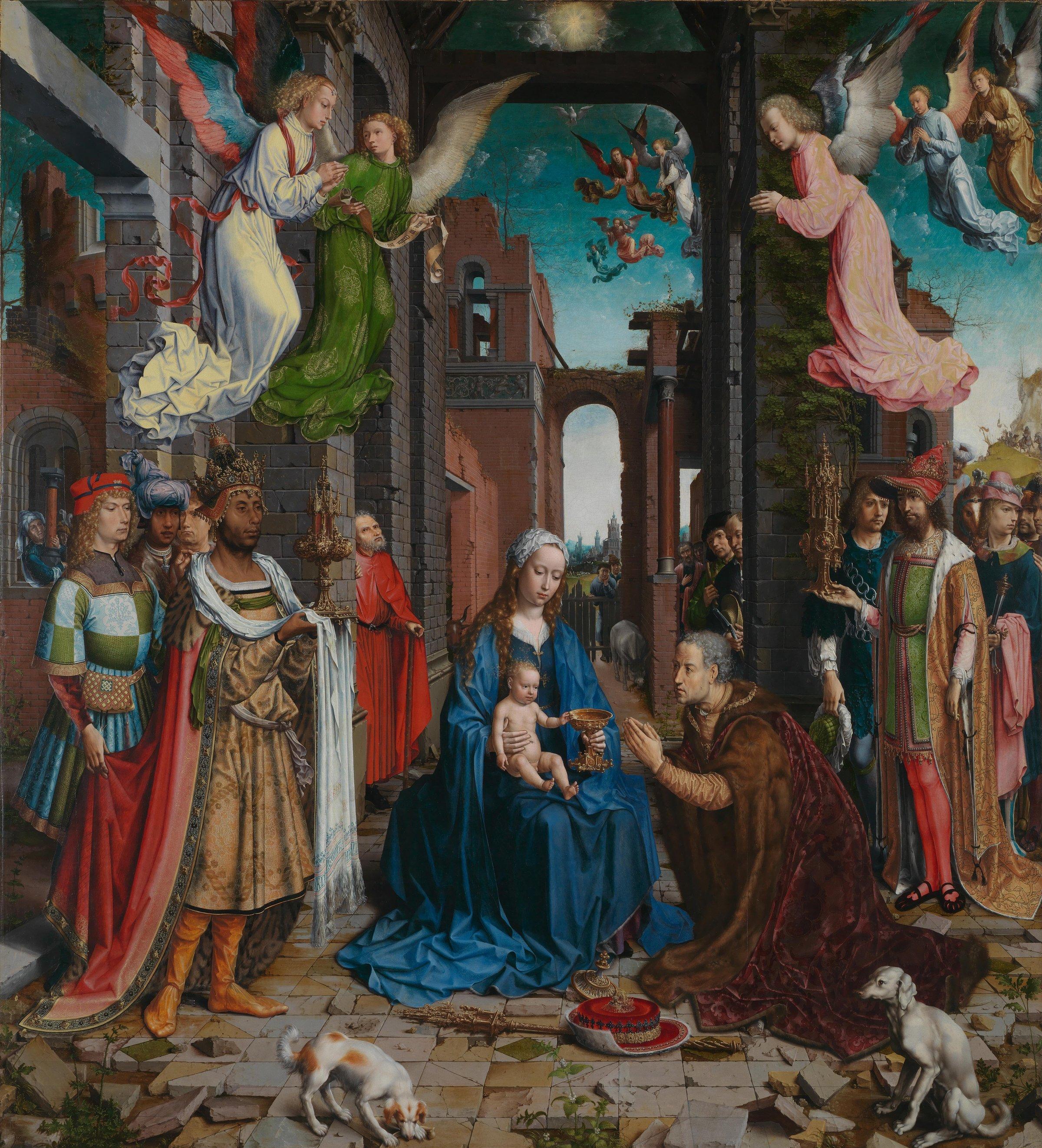
Jan Gossaert, Adoration of the Magi, 1510 to 1515. Public domain.
Psalm 2:12 · Passage · Featured Study
Kiss the Son
The last verse of Psalm 2 tells the kings of the earth to kiss the Son, lest He be angry.
The old versions of the verse divide over two Hebrew words.
Kiss the Son, lest He be angry and you perish in your rebellion, when His wrath ignites in an instant. Blessed are all who take refuge in Him.
- The passage
- Psalm 2:1 to 3, Psalm 2:6 to 7, Psalm 2:10 to 12, Proverbs 31:1 to 2, 1 Samuel 10:1
- Books
- Psalms, Proverbs, 1 Samuel
- Hold in memory
- Psalm 2:12, Psalm 2:11
Summary
Psalm 2 closes with counsel to the rulers who rose against the LORD and His Anointed. Its last verse joins a kiss to a warning. Its word for son is the Aramaic one.
- J. J. Stewart Perowne notes that Gesenius and De Wette also render son, with no doctrinal reason to favour it.
- Franz Delitzsch writes that an Arabic expositor would render it: Kiss a son, and such a son!
- Perowne rests the psalm's witness to the Messiah on its whole scope.
The Counsel to the Kings
In the last three verses the psalmist speaks to the rulers of the earth.
Therefore be wise, O kings; be admonished, O judges of the earth.The counsel opens with a call to wisdom.
Perowne reads these verses as the poet's counsel to the rebels, given after he has heard the words of the LORD and of His Anointed. He takes the kiss as an act of homage.
The study of the messianic psalms sets Psalm 2 beside the other psalms the New Testament quotes of Jesus.
The Words of the Clause
The first two Hebrew words of the verse are the verb to kiss and the noun son.
The verse uses the Aramaic form of the word for son.
| Where it stands | Hebrew | Gloss |
|---|---|---|
| The first word of Psalm 2:12 | נַשְּׁקוּ־ | kiss |
| The second word of Psalm 2:12 | בַ֡ר | the son |
| The word for son in Psalm 2:7 | בְּנִ֥י | my son |
| The word for son in Proverbs 31:2 | בַּר־ | son of |
Who May Be Angry
The warning after the kiss leaves its subject unnamed in the Hebrew.
Perowne allows either subject. The LORD may be the one who is angry, as He is the one in whom the last line finds refuge, yet he sees no objection to taking the Son.
Delitzsch grants that a Christian reader naturally hears the Son, as in Revelation 6:16. He still refers the anger to the LORD, because the Old Testament always calls the coming day of wrath the day of God's wrath.
The two readers also weigh the word the Berean text renders in an instant. Perowne takes it of time, soon; Delitzsch prefers easily, or suddenly.
How the Old Versions Read It
Delitzsch sorts the old versions by the sense each gives to bar. The Septuagint is the old Greek translation, and the Targum an Aramaic paraphrase.
Only one old version reads son.
| Version | The sense it gives | Its words |
|---|---|---|
| The Septuagint and the Targum | discipline | receive instruction, in the Targum |
| The Old Latin and the Vulgate | discipline | apprehendite disciplinam, in the Vulgate |
| Aquila, Symmachus and Jerome's own translation | pure, purely | adorate pure, worship in purity |
| The Syriac | son | kiss the son |
| The King James and the Berean text | son | Kiss the Son |
The Kiss of Homage
Both commentators read the kiss by the kiss Samuel gave Saul.
Then Samuel took a flask of oil, poured it on Saul’s head, kissed him, and said, “Has not the LORD anointed you ruler over His inheritance?Here the kiss is a sign given to a new ruler.
Voices on the Counsel
Matthew Henry and Peter Chrysologus wrote on the fear the counsel asks for.
Peter Chrysologus (died 450)
SERMON 80
Peter Chrysologus names what that fear keeps a man in.
“He who remains in the fear of God remains in holiness.”
on Psalm 2:11Patristic
Matthew Henry (1662 to 1714)
Commentary on the Whole Bible
Henry joins the fear of Psalm 2:11 to the joy beside it.
“Our salvation must be wrought out with fear and trembling, Phil. ii. We ought to rejoice in the setting up of the kingdom of Christ, but to rejoice with trembling, with a holy awe of him, a holy fear for ourselves, lest we come short, and a tender concern for the many precious souls to whom his gospel and kingdom are a savour of death unto death.”
on Psalm 2:11Puritan
Son, Purity or Discipline
Readers have taken bar as a son, as purity and as discipline, and each reading has its holders.
Kiss the SonThe Syriac; Aben-Ezra, Gesenius and De Wette, as Perowne reports them; Franz Delitzsch
Delitzsch reasons from Psalm 2:7. The LORD has owned His Anointed as His Son, so bar here denotes the unique Son, the Son of God.
Against this reading, Perowne names the one objection of weight: bar is the Aramaic form, found outside Daniel and Ezra only once more, in Proverbs 31:2. He answers it with Pusey's judgment that the form is old Phoenician.
Worship in purityAquila, Symmachus and Jerome's translation; Hupfeld, as Delitzsch reports him
Jerome rendered the clause adorate pure. Perowne quotes his defence: he had written worship the Son in his commentary, but in the translation he chose purely, so as not to seem a violent interpreter or give occasion to Jewish calumny.
Against this reading, Delitzsch holds that bar as an adverb meaning purely cannot be supported from the language.
Lay hold of disciplineThe Septuagint, the Targum and the Vulgate
These versions take bar as discipline and the verb as an act of taking hold, so the kings are told to receive instruction.
Against this reading, Perowne finds the sense of cleaving or laying hold unsupported by usage, and Delitzsch writes that the verb in this stem means to kiss and never anything else.
Books to Read Next
Both works are in the public domain, and each has a free copy to read.
The Book of Psalms: A New Translation, with Introductions and Notes, Explanatory and Critical
J. J. Stewart Perowne · 1876
Perowne's long note on the clause stands on pages 96 to 97.
Read at the Internet ArchiveBiblical Commentary on the Psalms, volume 1
Franz Delitzsch, translated by Francis Bolton · 1880
Delitzsch weighs the versions and the subject of the anger on pages 97 to 99.
Read at the Internet ArchiveRejoice with Trembling
Delitzsch, after Aben-Ezra, reads the kiss as the homage owed to the Son, following the call to submit to the LORD.
Serve the LORD with fear, and rejoice with trembling.This is the call to submit that Delitzsch sets before the kiss.
Sources
Scripture is the Berean Standard Bible.
- King James Version, Psalm 2:12.
- The Hebrew of Psalm 2:12, Psalm 2:7 and Proverbs 31:2 with Strong's numbers.
- J. J. Stewart Perowne, The Book of Psalms, from the third London edition, Warren F. Draper, 1876, vol. 1, pp. 95 to 97.
- Franz Delitzsch, Biblical Commentary on the Psalms, translated by Francis Bolton, T. and T. Clark, 1880, vol. 1, pp. 97 to 99.
- Matthew Henry, Commentary on the Whole Bible (1710), on Psalm 2:11.
- Peter Chrysologus, Sermon 80, on Psalm 2:11.
Keep Studying
Subjects1
Church history1
Go further1
Symbols1