
1 Samuel 18:11
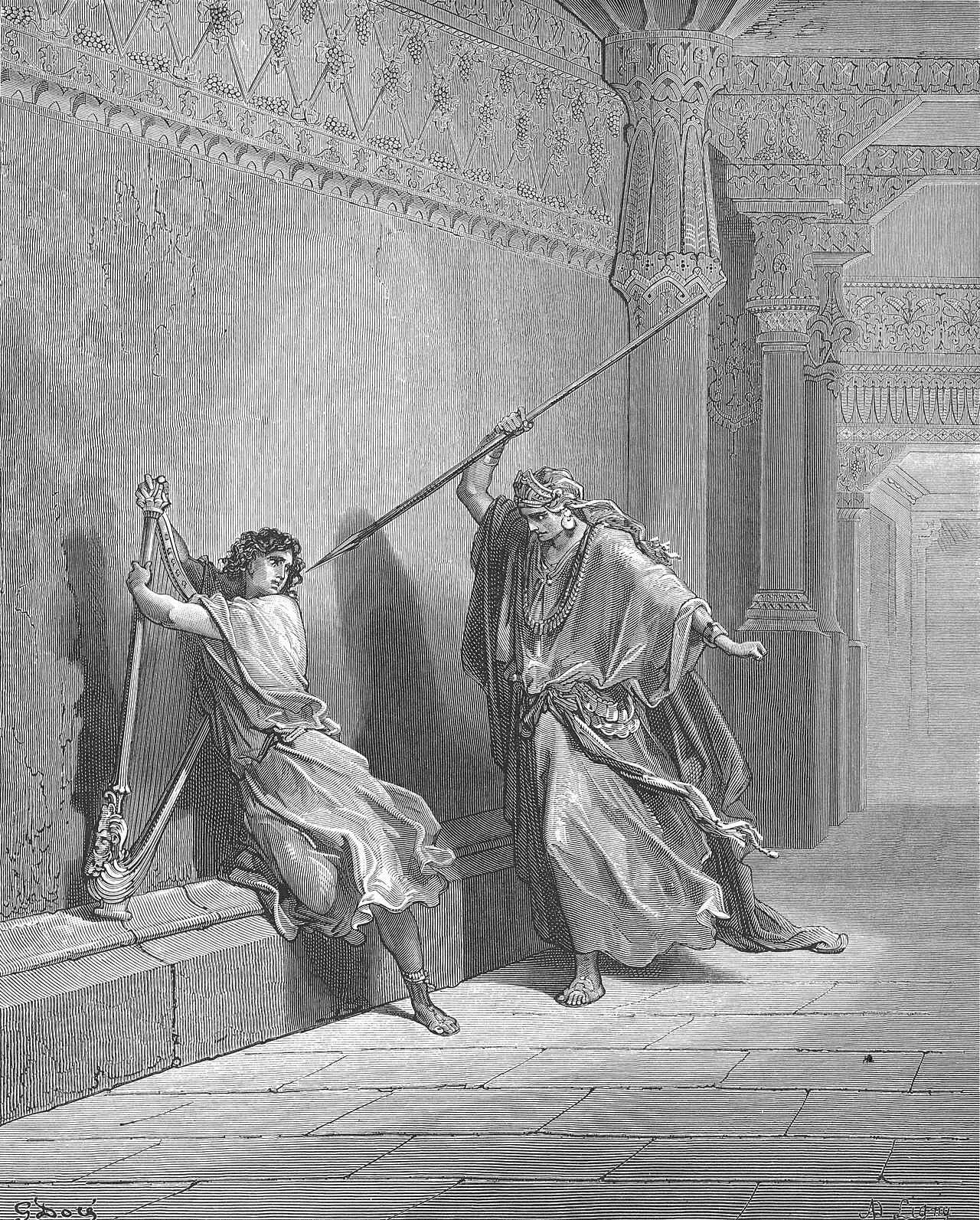
in 1 Samuel 18and he hurled it, thinking, “I will pin David to the wall.” But David eluded him twice.
BSB
The same verse in ASV and KJV ▾
ASV
and Saul cast the spear; for he said, I will smite David even to the wall. And David avoided out of his presence twice.
KJV
And Saul cast the javelin; for he said, I will smite David even to the wall with it. And David avoided out of his presence twice.
⋯
This verse in 1 Samuel 18
Commentary
7 notes on this verseSaul cast the javelin - The javelin or spear was the emblem of regal authority; kings always had it at hand, and in ancient monuments they are always represented with it. In ancient times, says Justin, kings used a spear instead of a diadem: Per ea tempora reges hastas pro diademate habebant, Hist. lib. xliii. And as spears were the emblems of supreme power, hence they were reputed as attributes of the Divinity, and were worshipped as representatives of the gods.
This site's exposition
The next day a spirit of distress sent from God came upon Saul
on 1 Samuel 18:10-11
The spirit of distress from God comes upon Saul a second time, following 16:14, and the text does not soften the phrase. Wesley reads it as permission, God allowing what He does not author, while Clarke notes an old tradition of outright possession behind the words "he prophesied" here. The spear appears in Saul’s hand and stays there, hurled at David again at 19:10 and at Jonathan at 20:33.
This site's exposition
I will pin David to the wall
Adam Clarke notes that a king kept his spear at hand as the sign of his rule, and Justin records that early kings held a spear in place of a crown. Saul hurls the sign of the king at the servant who played the harp for him. The harp and the spear stand in one house.
The record, by era
The Medieval Church1 voice
And David turned away from his face a second time. And Christ fled from the hearts of the impious, who never deserts pious hearts without resting in them. But it is not added in vain a second time. For at first David went away and …
The Puritans and the Awakening3 voices
No life is thought too precious to be sacrificed to malice. If a grateful sense of the great service David had done to the public could not assuage Saul's fury, yet one would think he should have allowed himself to consider the kindness David was now doing him, in relieving him, as no one else could, against the worst of troubles.
) was a plain evidence that he was far from such a thought. However, he really stood in awe of him, as Herod feared John, Mark vi. Saul was sensible that he had lost the favourable presence of God himself, and that David had it, and for this reason he feared him.
quarantine:debris (2026-07-29) — leading-punctuation+unbalanced-parens
And Saul cast the javelin,....
How the passage was read
What the Jewish commentators add
I will strike Dovid and the wall. I will strike one blow so, that the spear will pierce Dovid and the wall. 2 Shaul wanted to strike Dovid in a manner that it would appear that it was unintentional.
1 more on this passage, in their own words ▾
And he raved. [Literally 'he prophesied'] but Targum renders, 'and he raved.' A prophet and a madman speak in unintelligible hints.
This section is reception history: how the passage was read and kept in the Jewish tradition. Where a reading parts from an essential of the Christian faith, the section says so at that point.
Texts and citation data: Sefaria; each excerpt follows its version’s licence. 5 further sources are cited on this chapter that carry no English text this site may quote or only restate the verse.
The words behind it
12 Hebrew wordsEvery Hebrew word of this verse in the order it stands, with what it means and the door to its own study. The last column counts the times a word stands in the whole Bible: the rarer the word, the more the places it appears belong together.
| Hebrew | Sound | Meaning | Word study | In the Bible |
|---|---|---|---|---|
| וַיָּ֤טֶל | vaiyatel | and he threw | H2904 → | |
| שָׁאוּל֙ | shaul | Saul | H7586 → | 402 times |
| אֶֽת־ | ʾet- | <obj.> | H853 → | 10935 times |
| הַחֲנִ֔ית | hachanit | the spear | H2595 → | 47 times |
| וַיֹּ֕אמֶר | vaiyomer | and he said | H559 → | 5305 times |
| אַכֶּ֥ה | ʾakeh | I will strike | H5221 → | 499 times |
| בְדָוִ֖ד | vedavid | <on> David | H1732 → | 999 times |
| וּבַקִּ֑יר | uvakir | and <on> the wall | H7023 → | 75 times |
| וַיִּסֹּ֥ב | vaiyiso | and he went around | H5437 → | 161 times |
| דָּוִ֛ד | david | David | H1732 → | 999 times |
| מִפָּנָ֖יו | mipanav | from before him | H6440 → | 2123 times |
| פַּעֲמָֽיִם׃ | paamayim | two times | H6471 → | 118 times |
וַיָּ֤טֶלand he threw
vaiyatelH2904 →
שָׁאוּל֙Saul
shaulH7586 →402 times
אֶֽת־<obj.>
ʾet-H853 →10935 times
הַחֲנִ֔יתthe spear
hachanitH2595 →47 times
וַיֹּ֕אמֶרand he said
vaiyomerH559 →5305 times
אַכֶּ֥הI will strike
ʾakehH5221 →499 times
בְדָוִ֖ד<on> David
vedavidH1732 →999 times
וּבַקִּ֑ירand <on> the wall
uvakirH7023 →75 times
וַיִּסֹּ֥בand he went around
vaiyisoH5437 →161 times
דָּוִ֛דDavid
davidH1732 →999 times
מִפָּנָ֖יוfrom before him
mipanavH6440 →2123 times
פַּעֲמָֽיִם׃two times
paamayimH6471 →118 times
A shaded row is a word that stands 400 times or fewer in the Bible.
The walk
8 stopsEach card is a verse this one points to, and under it the verses that one points to in turn. Where several paths arrive at the same place, that place is listed first: the text keeps returning to it.
Through
Isaiah 54:17No weapon formed against you shall prosper, and you will refute every tongue that accuses you. This is the heritage of the servants of the LORD, and their vindication is from Me,” declares the…
it leads to
- Romans 8:28–39
And we know that God works all things together for the good of those who love Him, who are called according to His purpose.
- Isaiah 54:15
If anyone attacks you, it is not from Me; whoever assails you will fall before you.
- John 10:28–30
I give them eternal life, and they will never perish. No one can snatch them out of My hand.
- Isaiah 50:8
The One who vindicates Me is near. Who will dare to contend with Me? Let us confront each other! Who has a case against Me? Let him approach Me!
- Romans 8:1
Therefore, there is now no condemnation for those who are in Christ Jesus.
- Romans 8:28–39
Through
Luke 4:30But Jesus passed through the crowd and went on His way.
it leads to
- John 10:39
At this, they tried again to seize Him, but He escaped their grasp.
- John 8:59
At this, they picked up stones to throw at Him. But Jesus was hidden and went out of the temple area.
- John 10:39
Through
John 8:59At this, they picked up stones to throw at Him. But Jesus was hidden and went out of the temple area.
it leads to
- John 11:8
“Rabbi,” they replied, “the Jews just tried to stone You, and You are going back there?”
- John 11:8
Where this verse is studied
On this page
About 1 Samuel
Who and where
1 name in this verse with a page on the site.
This page draws on Adam Clarke, Commentary on the Bible; Bede, Commentary on Samuel; John Gill, Exposition of the Old Testament (1748-1763); John Wesley, Explanatory Notes upon the Old Testament and Matthew Henry, Commentary on the Whole Bible.