
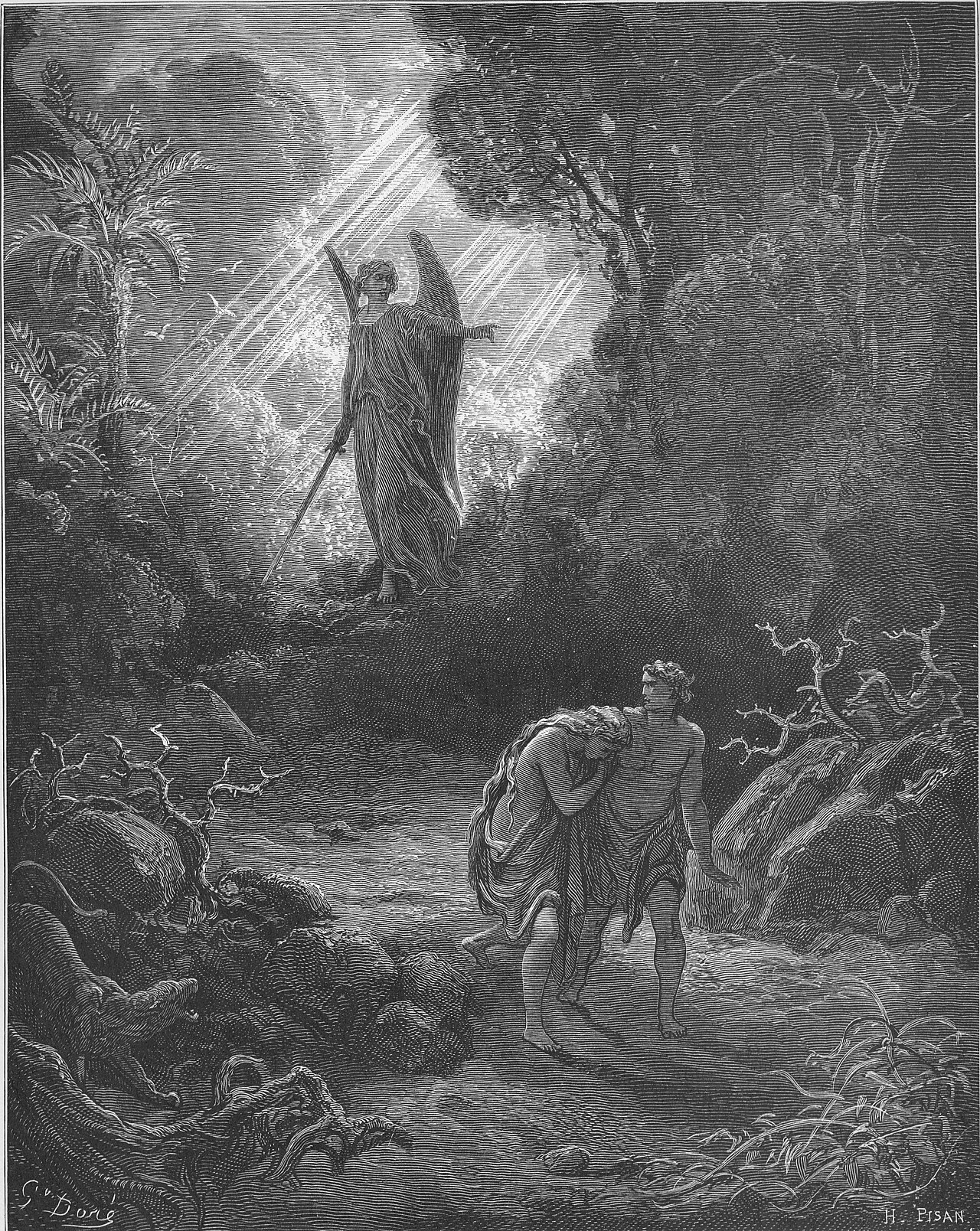
Genesischapter 3
24 verses · Moses, by tradition · 15th to 13th century BC · The Law
And I will put enmity between you and the woman, and between your seed and her seed. He will crush your head, and you will strike his heel.”
Introduction
Moses, by tradition, The Law, Genesis Overview.
This chapter was written for Israel in the wilderness, and tradition gives it to Moses. Its first hearers lived among nations whose shrines and crowns were decorated with serpents and who sought hidden knowledge through magic. It explains how the world came to be as they knew it, full of pain, labour, shame and death. It is told as a narrative with four speakers, and much of it moves by question and answer. Listen for the questions, who asks them and why, and for the one promise set inside a sentence of judgment. The rest of the Bible reads its hope from that promise.
Context
- Who
- Israel in the wilderness, surrounded by nations whose shrines were full of serpents
- What
- An account of the first sin, the questions God puts to the guilty, the sentences He passes and the expulsion from the garden.
- Where
- The garden in Eden, at the tree in its middle, and then outside it on its east side.
- When
- Before any dated history; no date is given, and the chapter stands in the account that opens at Genesis 2:4.
- Why
- To explain why death, pain and toil mark human life, and to give the first promise of a rescuer.
Historical context
The chapter belongs to the same section as Genesis 2 and it turns on four speakers, the serpent, the woman, the man and God. The narrative moves from the tree to the hiding, then to the questions God asks, and then to the sentences he passes.
Show the rest of the historical context, 4 more paragraphs
The serpent carried weight in that world. In Egypt the cobra reared on Pharaoh's crown as a protecting goddess, and in Canaan serpents coiled around fertility figures that have been dug up by the hundreds. Genesis puts the serpent under a curse and on its belly.
The offer made to the woman is an offer of secret wisdom, that she would be like God, knowing good and evil. Knowledge the gods were holding back, available for a price, was the standing claim of the magic and the divination of the ancient world.
The sentences fall on the two places life was lived. The woman is told of pain in childbearing and strain in her marriage, and the man is told of thorns and sweat in ground that resists him, which in Canaan meant rain-fed farming and hunger after a bad season.
The chapter ends with cherubim and a flaming sword guarding the way back. Winged guardian figures standing on either side of a doorway are what archaeologists find at the gates of Assyrian and Canaanite temples, and they are what God later tells Israel to work into the tabernacle curtain.
Significance
Israel learned that the ruin of the world came of a choice made against a clear word, and that God came looking for the guilty and clothed them before he sent them out.
Show the rest of the significance, 1 more paragraph
In the promise that the woman's offspring would crush the serpent's head they were given the first thread of the rescue they were living inside.
This chapter in Jewish lifeWhat this chapter is in Jewish life and reading.
What is done
This chapter is heard inside the opening portion of the annual cycle, in the same sitting as the creation account and the garden (src/lib/hebraic/readings.ts). The portion carries it on to the generations of Adam and the days of Noah, so the fall is read as one step in a long reading. The card above carries the portion and the prophetic reading set beside it.
How it is read
Radak is the one commentator on this chapter whose English the corpus holds, in the translation of Eliyahu Munk, HaChut Hameshulash, licensed CC-BY. He reads the woman's answer to the serpent as a misquotation she made herself. God had forbidden the eating of the tree, and she added the touching of it, which Radak calls "an addition which had been altogether her own" (Radak on Genesis 3:2:1). He reads her thought as a kindness on God's part, that God kept them from touching the tree as a guard against eating from it. His second comment is on the spelling of the word for naked in the tenth verse, which he reads as a lengthened syllable (Radak on Genesis 3:10:1).
Rashi comments on twenty one of the twenty four verses of this chapter, and the corpus holds the text of none of them, because the licence Sefaria reports for that English version keeps it out. They run from Rashi on Genesis 3:1:1 on the serpent to Rashi on Genesis 3:24:1 on the turning sword, and they are cited and linked here. Ibn Ezra on Genesis 3:23:1, on the sending out of the garden, is cited the same way.
The reading of the fifteenth verse is the point where this chapter meets the Christian reading most directly. This site records that the Targums read the seed of the woman of the days of King Messiah, with the head of the serpent crushed at the end. The holders are Targum Pseudo-Jonathan and Targum Neofiti on Genesis 3:15 (src/components/book/guides/genesis/GenesisGuide.tsx, the Jewish tradition section). A modern Jewish reading takes the verse of the standing enmity between people and snakes. The older Jewish reading and the Christian one meet at the same verse, and this site reports both with their holders.
What the rabbis say
The corpus records forty places where the Midrash and the Talmud cite this chapter, thirty under Midrash and ten under Talmud. It carries the locator for each one with no text, so the references stand here and the sayings are read at the source.
Bereshit Rabbah is the heaviest of them, and it reads this chapter through from the woman's answer to the sending out. The locators are 19:3 and 19:4 on the second verse, 19:6 on the seventh, and 19:9 and 19:10 on the eleventh. It reads the thirteenth verse at 20:10, the eighteenth at 21:1, the twentieth at 20:11 and the twenty third at 21:7. It reads the serpent at 85:2 across the seam of the chapters. Aggadat Bereshit reads the sixth verse at 50:4, the twelfth at 11:2 and 62:2, the fourteenth at 79:5, the fifteenth at 83:1, the seventeenth at 53:3 and the twenty first at 43:1.
Eikhah Rabbah reads the question God puts to the man at 1:1, which sets the first hiding in the garden beside the mourning over Jerusalem. Devarim Rabbah reads the serpent's promise at 5:10, and Yalkut Shimoni on Torah at 856:1. Bamidbar Rabbah reads the sixteenth verse at 9:7 and 10:2, the twenty second at 13:3 and the twenty fourth at 23:13.
The Talmud is cited at Berakhot 3b:3 on the serpent and at Berakhot 40a:14 on the sewing of the leaves. The Jerusalem Talmud reads the woman's answer at Sotah 7:1:3, and Avodah Zarah 8a:7 reads the return to the dust. Avot DeRabbi Natan carries five of the ten, at 39:3 on the serpent, 1:6 on the sixth verse, 34:6 and 37:9 on the eighth, and 1:7 on the curse of the serpent.
Sources: Radak, Radak on Genesis 3:2:1 and 3:10:1, in HaChut Hameshulash, translated by Eliyahu Munk, CC-BY, about 1200; Rashi and Ibn Ezra, their twenty two comments on Genesis 3, cited by reference; the licence Sefaria reports for the English versions keeps the text out of the corpus; Targum Pseudo-Jonathan and Targum Neofiti, on Genesis 3:15, as this site records them at src/components/book/guides/genesis/GenesisGuide.tsx; The Midrash and the Talmud, the forty locators on Genesis 3 in scripts/data/sources/sefaria/genesis/3.json; MannaFest, the annual cycle table at src/lib/hebraic/readings.ts, 2026.
The heads below are this chapter's scenes. The numbered points under each are its verses.
The Serpent's Question
Genesis 3:1-3
more crafty than any beast of the field: The serpent's first words are a question about what God said. He widens the one command of Genesis 2:16 and 17 into a ban on every tree in the garden. The woman answers by adding to it, that they must not touch it either. The same attack on God's words meets Jesus in the wilderness, and He answers three times with what is written, at Matthew 4:4, 7 and 10.
Genesis 3:1
WE understand, of course, that this verse refers to "that old serpent, called the devil, and Satan." The Samaritan Version reads, instead of the word, "serpent," "deceiver," or "liar." If this is not the genuine reading, it nevertheless certainly declares a Truth of God. That old deceiver, of whom our Lord Jesus said to the Jews. "When he speaks a lie, he speaks of his own: for he is a liar, and the father of it," was "more subtle than any beast of the field which the Lord God had made."
Charles Spurgeon · written before 1892 · The Metropolitan Tabernacle Pulpit, Sermon No. 2707: “An Antidote to Satan's Devices” (lightly modernized text, CCEL edition)Particular Baptist
1 more voice on this verseWhat preachers and commentators have said about this verse, in their own words.
Genesis 3:1
“Though Moses makes no mention of this wicked spirit--giving only the history of the visible world--yet in the fuller discoveries of the Gospel, it is distinctly intimated that Satan was the author of the plot (Joh 8:44; Re 20:2). more subtile--Serpents are proverbial for wisdom (Mt 10:16).”
Jamieson, Fausset & Brown · Commentary Critical and Explanatory on the Whole Bible (1871)reformed
ConnectionsStrong's H5175
The grant at Genesis 2:16 was to eat freely from every tree of the garden. The woman's answer drops both freely and every. Jamieson, Fausset and Brown saw in her wording that the serpent's question had already left its mark on her.
Genesis 3:2
“But there is reason to think that she had already received an injurious impression; for in using the words "lest ye die," instead of "ye shall surely die" [Ge 2:17], she spoke as if the tree had been forbidden because of some poisonous quality of its fruit.”
Jamieson, Fausset & Brown · Commentary Critical and Explanatory on the Whole Bible (1871)reformed
or touch it: God's command at Genesis 2:17 said nothing about touching the tree, and the woman adds it. She also drops the word surely. Bonaventure traced the serpent's method in the garden: a test by a question, a push by an assurance, a lure by a promise.
Genesis 3:3
“The manner in which the devil proceeded in the temptation was of great cunning, because he proceeded by testing, impelling, and enticing. For he conducted his test through questioning, he impelled through assurance, and he enticed through promise.”
Bonaventure · written before 1257 · Breviloquium, Part 3, Chapter 2patristic
Genesis 3:4-5
The serpent contradicts God flatly. He then tells the woman why God gave the command, that God knows what the fruit will do. The promise is opened eyes and a likeness to God in knowing good and evil. Jesus names this speaker a liar and the father of lies at John 8:44.
Genesis 3:4
“Let us learn, therefore, that the temptations of the Devil are full of guile. Of the things that he promised, scarcely one of them seems to be true. He contrived falsehoods, as we can see if we read elsewhere: 'And the serpent said to the woman, you shall not die.' [ Gen 3:4 ] Here we have one falsehood, for man, who followed the promises of the serpent, is subject to death.”
Ambrose of Milan · written before 397 · On Paradise, 13.61-67patristic
2 more voices on this verse
Genesis 3:4
“Ye shall not surely die - Here the father of lies at once appears; and appears too in flatly contradicting the assertion of God. The tempter, through the nachash, insinuates the impossibility of her dying, as if he had said, God has created thee immortal, thy death therefore is impossible; and God knows this, for as thou livest by the tree of life, so shalt thou get increase of wisdom by the tree of knowledge.”
Adam Clarke · Commentary on the Bible (1810-1826)evangelical
Genesis 3:4
"It is not so sure as you are made to believe it is." Thus Satan endeavours to shake that which he cannot overthrow, and invalidates the force of divine threatenings by questioning the certainty of them; and, when once it is supposed possible that there may be falsehood or fallacy in any word of God, a door is then opened to downright infidelity.
Matthew Henry · Commentary on the Whole Bible (1707-1721)puritan
you will be like God: The Hebrew is kelohim, and the older English put it as gods in the plural. Adam Clarke argued for the singular, like God, and noted that the Syriac alone among the versions reads it so. Genesis 1:27 had already made man in the image of God.
Genesis 3:5
“Your eyes shall be opened - Your understanding shall be greatly enlightened and improved; and ye shall be as gods, כאלהים kelohim, like God, so the word should be translated; for what idea could our first parents have of gods before idolatry could have had any being, because sin had not yet entered into the world? The Syriac has the word in the singular number, and is the only one of all the versions which has hit on the true meaning.”
Adam Clarke · Commentary on the Bible (1810-1826)evangelical
good for food: The fruit is good for food, pleasing to the eyes, and desirable for wisdom. The same three appetites stand at 1 John 2:16, the desires of the flesh, the desires of the eyes, and the pride of life. She saw, she took, she ate, she gave. Adam ate with her, and Romans 5:14 calls him a pattern of the One to come.
Genesis 3:6
“That the Lord then was manifestly coming to His own things, and was sustaining them by means of that creation which is supported by Himself, and was making a recapitulation of that disobedience which had occurred in connection with a tree, through the obedience which was [exhibited by Himself when He hung] upon a tree, [the effects] also of that deception being done away with, by which that virgin Eve, who was already espoused to a man, was unhappily misled,-was happily announced, through means of the truth [spoken] by the angel to the Virgin Mary, who was [also espoused] to…”
Irenaeus · written before 202 · Against Heresies 5.19.1patristic
they knew that they were naked: The promise was opened eyes, and their eyes were opened. What they saw was their own nakedness. The serpent's word at verse 5 came true, and the knowledge it gave them was shame. They made their own coverings out of fig leaves sewn together.
Genesis 3:7
“And the eyes of them both were opened,.... Not of their bodies, but of their minds; not so as to have an advanced knowledge of things pleasant, profitable, and useful, as was promised and expected, but of things very disagreeable and distressing.”
1 more voice on this verse
Genesis 3:7
“The eyes of them both were opened - They now had a sufficient discovery of their sin and folly in disobeying the command of God; they could discern between good and evil; and what was the consequence? Confusion and shame were engendered, because innocence was lost and guilt contracted. Let us review the whole of this melancholy business, the fall and its effects.”
Adam Clarke · Commentary on the Bible (1810-1826)evangelical
Hiding from God Among the Trees
Genesis 3:8-10
the voice of the LORD God walking in the garden: The man and his wife hide among the trees when they hear the LORD God in the garden. God calls and asks where the man is. The man answers that he heard, that he was afraid, and that he hid himself because he was naked. He never names the tree.
Genesis 3:8
“The voice of the Lord - The voice is properly used here, for as God is an infinite Spirit, and cannot be confined to any form, so he can have no personal appearance. It is very likely that God used to converse with them in the garden, and that the usual time was the decline of the day, לרוח היום leruach haiyom, in the evening breeze; and probably this was the time that our first parents employed in the more solemn acts of their religious worship, at which God was ever present.”
Adam Clarke · Commentary on the Bible (1810-1826)evangelical
1 more voice on this verse
Genesis 3:8
“What does 'walking' mean in reference to God, who is everywhere? In my opinion God may be said to walk wherever throughout Scripture the presence of God is implied, when we hear that He sees all things and ' the eyes of the Lord are upon the just.' [ Ps 33:16 ] We read, too, that Jesus knew their thoughts and we read: ' Why do you harbor evil thoughts in your hearts?' [ Luke 6:8: Matt 9:4 ] When we reflect, therefore, on these statements, we have a knowledge of God in the act of walking.”
Ambrose of Milan · written before 397 · On Paradise, 14.68-70patristic
ConnectionsLeviticus 26:12
called out to the man: The man hides among the trees, and God calls out. Ambrose of Milan heard the question as a reproof, asking from what state of grace the man had fallen. The LORD asks Cain the same kind of question at Genesis 4:9.
Genesis 3:9
“What then does he mean by "Adam, where art thou?" Does he not mean "in what circumstance" are you; not, "in what place?" It is therefore not a question but a reproof. From what condition of goodness, beatitude and grace, he means to say, have you fallen into this state of misery? You have forsaken eternal life. You have entombed yourself in the ways of sin and death.”
Ambrose of Milan · written before 397 · On Paradise, 14.70patristic
John Gill noted that the man had heard the same voice in the garden before, and then it gave him pleasure. Fear is new in this verse. Matthew Henry read it as a man with no covering fit to appear before God, and pointed to the righteousness of Christ as the covering that serves.
Genesis 3:10
“And he said, I heard thy voice in the garden,.... The voice of thy Word, as the Targums of Onkelos and Jonathan: this was not the true cause of his hiding himself; he had heard his voice in the garden before, when it did not strike him with terror, but gave him pleasure: and I was afraid, because I was naked.”
2 more voices on this verse
Genesis 3:10
“I was afraid, because I was naked - See the immediate consequences of sin. 1. Shame, because of the ingratitude marked in the rebellion, and because that in aiming to be like God they were now sunk into a state of the greatest wretchedness. 2. Fear, because they saw they had been deceived by Satan, and were exposed to that death and punishment from which he had promised them an exemption. How worthy is it of remark that this cause continues to produce the very same effects!”
Adam Clarke · Commentary on the Bible (1810-1826)evangelical
Genesis 3:10
“Adam was afraid, because he was naked; not only unarmed, and therefore afraid to contend with God, but unclothed, and therefore afraid so much as to appear before him. We have reason to be afraid of approaching to God if we be not clothed and fenced with the righteousness of Christ, for nothing but this will be armour of proof and cover the shame of our nakedness.”
Matthew Henry · Commentary on the Whole Bible (1707-1721)puritan
Genesis 3:11-13
God asks the man who told him he was naked, and whether he has eaten from the tree. The man answers by naming the woman, and behind her the God who gave her to him. The woman answers by naming the serpent, who deceived her. Both of them finish the same way, by saying that they ate.
Genesis 3:11
“Where could you have got the knowledge of this, he says, and be covered in such confusion, unless you have been so intemperate as to despise my command? Notice, dearly beloved, the excess of God's goodness, how, in this manner of one friend communing with another and remonstrating with him over transgression of his instructions, he enters into dialog with Adam. "'Who told you that you are naked unless you have eaten from that one tree I told you not to eat from?'" Even the phrase, "that one tree," bears a slight nuance: Surely I didn't inhibit your enjoyment?”
John Chrysostom · written before 407 · Commentary (church-history corpus)patristic
1 more voice on this verse
Genesis 3:11
“I commanded thee to the contrary." Sin appears most plain and most sinful in the glass of the commandment, therefore God here sets it before Adam; and in it we should see our faces. The question put to the woman was, What is this that thou hast done?”
Matthew Henry · Commentary on the Whole Bible (1707-1721)puritan
Jamieson, Fausset and Brown set two readings side by side. With Calvin, the words blame God for the gift of the woman, and with M'Knight, Adam ate out of love for her, unwilling to outlive her. Either way, he ate, and he says so.
Genesis 3:12
“And the man said, etc. - We have here some farther proofs of the fallen state of man, and that the consequences of that state extend to his remotest posterity. 1. On the question, Hast thou eaten of the tree? Adam is obliged to acknowledge his transgression; but he does this in such a way as to shift off the blame from himself, and lay it upon God and upon the woman!”
Adam Clarke · Commentary on the Bible (1810-1826)evangelical
The woman answered the LORD God by naming the serpent that deceived her, and she said that she ate. Paul twice says Eve was deceived, at 2 Corinthians 11:3 and 1 Timothy 2:14. Matthew Henry held that the serpent's craft did not clear the woman of her sin.
Genesis 3:13
“That fault is pardonable which is followed by an admission of guilt. The woman, therefore, is not to be despaired of, who did not keep silent before God, but who preferred to admit her sin-the woman on whom was passed a sentence that was salutary. It is good to suffer condemnation for our sins and to be scourged for our crimes, provided we are scourged along with other men. Hence, Cain, because he wanted to deny his guilt, was judged unworthy to be punished in his sin.”
Ambrose of Milan · written before 397 · On Paradise, 14.71-15.73patristic
1 more voice on this verse
Genesis 3:13
“Sin deceives us, and, by deceiving, cheats us. It is by the deceitfulness of sin that the heart is hardened. (2.) That though Satan's subtlety drew us into sin, yet it will not justify us in sin: though he is the tempter, we are the sinners; and indeed it is our own lust that draws us aside and entices us, Jam. i.”
Matthew Henry · Commentary on the Whole Bible (1707-1721)puritan
Curses on Serpent, Woman, and Ground
On your belly will you go: The serpent is sentenced first, with no question put to him. Adam Clarke reads that order as the tempter's own: he has no one to blame, so the sentence begins with him. The belly and the dust are the posture of a beaten enemy, all the days of his life. Isaiah 65:25 keeps dust as the serpent's food in the restored creation, and Revelation 12:9 names him the ancient serpent, the devil and Satan.
Genesis 3:14
“And the Lord God said unto the serpent - The tempter is not asked why he deceived the woman; he cannot roll the blame on any other; self-tempted he fell, and it is natural for him, such is his enmity, to deceive and destroy all he can. His fault admits of no excuse, and therefore God begins to pronounce sentence on him first. And here we must consider a twofold sentence, one on Satan and the other on the agent he employed.”
Adam Clarke · Commentary on the Bible (1810-1826)evangelical
1 more voice on this verse
Genesis 3:14
“From being a model of grace and elegance in form, it has become the type of all that is odious, disgusting, and low [LE CLERC, ROSENMULLER]; or the curse has converted its natural condition into a punishment; it is now branded with infamy and avoided with horror; next, on the spiritual serpent, the seducer.”
Jamieson, Fausset & Brown · Commentary Critical and Explanatory on the Whole Bible (1871)reformed
ConnectionsLeviticus 11:42
your seed and her seed: The LORD sets enmity between the serpent and the woman, and between the two lines of seed that run from them. Her seed will crush the serpent's head, and the serpent will strike his heel. Spurgeon called this the first gospel sermon ever preached on earth. The word seed is the one Paul presses at Galatians 3:16, where the promise runs to one descendant who is Christ, and Galatians 4:4 says God sent His Son, born of a woman.
Genesis 3:15
He has therefore, in His work of recapitulation, summed up all things, both waging war against our enemy, and crushing him who had at the beginning led us away captives in Adam, and trampled upon his head, as thou canst perceive in Genesis that God said to the serpent, "And I will put enmity between thee and the woman, and between thy seed and her seed; He shall be on the watch for thy head, and thou on the watch for His heel."
Irenaeus · written before 202 · Against Heresies 5.21.1patristic
3 more voices on this verse
Genesis 3:15
“I will put enmity between thee and the woman - This has been generally supposed to apply to a certain enmity subsisting between men and serpents; but this is rather a fancy than a reality. It is yet to be discovered that the serpentine race have any peculiar enmity against mankind, nor is there any proof that men hate serpents more than they do other noxious animals.”
Adam Clarke · Commentary on the Bible (1810-1826)evangelical
Genesis 3:15
“THIS IS THE FIRST gospel sermon that was ever delivered upon the surface of this earth. It was memorable discourse indeed, with Jehovah himself for the preacher, and the whole human race and the prince of darkness for the audience. It must be worthy of our heartiest attention. Is it not remarkable that this great gospel promise should have been delivered so soon after the transgression?”
Genesis 3:15
“Thus, fatal shall be the stroke which Satan shall receive from Christ, though it is probable he did not at first understand the nature and extent of his doom.”
Jamieson, Fausset & Brown · Commentary Critical and Explanatory on the Whole Bible (1871)reformed
ConnectionsGalatians 3:16, Galatians 4:4, Genesis 4:25, gospel in genesis, Isaiah 53:10, protoevangelium, Revelation 12:17, Revelation 12:9, Romans 16:20
your pain in childbirth: What is increased for the woman is the pain of childbirth. The Hebrew says the verb for increase twice, and Adam Clarke read it as sorrow multiplied by sorrow, through conception, pregnancy and the birth itself. Her desire will be for her husband, and he will rule over her. The same two words for desire and rule stand together again at Genesis 4:7, where sin's desire is toward Cain and he is told to rule over it.
Genesis 3:16
“Unto the woman he said,.... The woman receives her sentence next to the serpent, and before the man, because she was first and more deeply in the transgression, and was the means of drawing her husband into it.”
1 more voice on this verse
Genesis 3:16
“Unto the woman he said - She being second in the transgression is brought up the second to receive her condemnation, and to hear her punishment: I will greatly multiply, or multiplying I will multiply; i.e., I will multiply thy sorrows, and multiply those sorrows by other sorrows, and this during conception and pregnancy, and particularly so in parturition or child-bearing. And this curse has fallen in a heavier degree on the woman than on any other female.”
Adam Clarke · Commentary on the Bible (1810-1826)evangelical
Genesis 3:17-18
cursed is the ground because of you: The curse falls on the ground the man stands on. Spurgeon's sermon on this verse traces it there, glancing off the man onto the soil under his feet. Work stood before this at Genesis 2:15; what is added here is resistance, thorns and thistles, and toil for every meal. Lamech names his son Noah at Genesis 5:29 for the ground the LORD has cursed, and God says at Genesis 8:21 that He will never again curse it because of man.
Genesis 3:17
“Unto Adam he said - The man being the last in the transgression is brought up last to receive his sentence: Because thou hast hearkened unto the voice of thy wife - “thou wast not deceived, she only gave and counseled thee to eat; this thou shouldst have resisted;” and that he did not is the reason of his condemnation.”
Adam Clarke · Commentary on the Bible (1810-1826)evangelical
1 more voice on this verse
Genesis 3:17
“The two sentences seem to have a certain similarity, yet in that similarity there is a great difference. There is a difference in the way a person eats of the earth, as the serpent is related to have done and the manner in which this is recorded of the man: 'In sadness shall you eat.' That very phrase 'in sadness' makes the precise difference. Note how important this difference is.”
Ambrose of Milan · written before 397 · On Paradise, 15.75patristic
Both thorns and thistles: Adam's food came from garden trees. Adam Clarke read the plants of the field as the common ground outside the garden, where food would be raised by labor. Ambrose of Milan traced a climb in these verses, from the serpent's dust to herbs and then to bread.
Genesis 3:18
“Thorns also and thistles, etc. - Instead of producing nourishing grain and useful vegetables, noxious weeds shall be peculiarly prolific, injure the ground, choke the good seed, and mock the hopes of the husbandman; and thou shalt eat the herb of the field - thou shalt no longer have the privilege of this garden of delights, but must go to the common champaign country, and feed on such herbs as thou canst find, till by labor and industry thou hast raised others more suitable to thee and more comfortable.”
Adam Clarke · Commentary on the Bible (1810-1826)evangelical
2 more voices on this verse
Genesis 3:18
“There, too, is that distinction between the serpent who is said to eat the earth and Adam, to whom God said: ' You shall eat in sadness the herbs of the field.' [ Gen 3:18 ] We may note here a certain gradation. When we eat the earth, it seems that we are in a sort of warfare. when we eat the herbs, there is a certain advance. when finally, we eat bread, then our life of trial has reached it terminus.”
Ambrose of Milan · written before 397 · On Paradise, 15.76-77patristic
Genesis 3:18
“THIS was not the penalty which might have been pronounced upon Adam. This curse does not fall directly on him— it glances obliquely and falls upon the ground whereon he stands—"Cursed is the ground for your sake." It is not from materialism that a curse comes upon the spirit of man, but it is from the erring spirit that the curse falls upon the material creation.”
Charles Spurgeon · written before 1892 · The Metropolitan Tabernacle Pulpit, Sermon No. 2299: “Thorns and Thistles” (lightly modernized text, CCEL edition)Particular Baptist
By the sweat of your brow: Bread now comes by the sweat of the man's brow. The ground he was taken from takes him back. Dust you are is a sentence carried out across a lifetime. Genesis 5 is the record of it, a genealogy of long lives closing name after name with the words and then he died, first of Adam at Genesis 5:5.
Genesis 3:19
“Now, certainly nothing else is raised than that which is sown; and nothing else is sown than that which decays in the ground; and it is nothing else than the flesh which is decayed in the ground. For this was the substance which God's decree demolished, "Earth you are, and to earth shall you return;" Genesis 3:19 because it was taken out of the earth.”
Tertullian · written before 220 · On the Resurrection of the Fleshpatristic
ConnectionsGenesis 3:15
Driven Out, Guarded by Flame
the mother of all the living: Adam names his wife Eve right after the sentence of death. The verse gives his own reason for the name: she would be mother to everyone who lives. She is named for the living she will bear, on the day the sentence fell.
Genesis 3:20
“See the precision of Sacred Scripture, how it didn't pass over even this detail, but taught us that Adam named his wife as well. "He called his wife Eve, which means life," the text says, you see, "because she was the mother of all the living" that is to say, she is the source of all those who will come from her, the root and foundation of the future race.”
John Chrysostom · written before 407 · Commentary (church-history corpus)patristic
4 more voices on this verse
Genesis 3:20
“And Adam called his wife’s name Eve; because she was the mother of all living - A man who does not understand the original cannot possibly comprehend the reason of what is said here. What has the word Eve to do with being the mother of all living?”
Adam Clarke · Commentary on the Bible (1810-1826)evangelical
Genesis 3:20
“And Adam called his wife's name Eve,.... Whom he had before named "Ishah", a woman, because taken from him the man, Gen 2:23 and now gives her a new name upon this scene of things, which had taken place; which is derived not from "Chavah", to "show forth", to "declare"; as if she was called so, because of her discourse with the serpent, being loquacious and talkative, and telling everything she knew, according to some Jewish writers (g); but from "Chayah, to live", as the reason given in the text shows.”
Genesis 3:20
“The woman who initiated transgression was called "Life," because she was responsible for the succession of those who came to birth and sinned. She thus became mother of the righteous and unrighteous alike. Each one of us shows himself to be just or willfully renders himself disobedient.”
Clement of Alexandria · written before 215 · The Stromata Book 3patristic
Genesis 3:20
“What I possess is flesh, not earth, even although of the flesh it is said: "Dust you are, and unto dust shall you return." In these words there is the mention of the origin, not a recalling of the substance. The privilege has been granted to the flesh to be nobler than its origin, and to have happiness aggrandized by the change wrought in it.”
Tertullian · written before 220 · On the Resurrection of the Fleshpatristic
garments of skin: The LORD God makes garments of skin for the man and his wife and clothes them himself. Skin comes off an animal, so something died. Their own fig leaves at verse 7 were the work of their hands; this clothing is God's work, and He puts it on them.
Genesis 3:21
“It is said that God made those miserable garments with which the first man was clothed after he had sinned. "For God made skin tunics and clothed Adam and his wife." Therefore, those were tunics of skin taken from animals. For with such as these, it was necessary for the sinner to be dressed. It says, "with skin tunics," which are a symbol of the mortality that he received because of his skin and of his frailty that came from the corruption of the flesh.”
Origen of Alexandria · written before 253 · HOMILIES ON LEVITICUS 6.2.7patristic
3 more voices on this verse
Genesis 3:21
“God made coats of skins - It is very likely that the skins out of which their clothing was made were taken off animals whose blood had been poured out as a sin-offering to God; for as we find Cain and Abel offering sacrifices to God, we may fairly presume that God had given them instructions on this head; nor is it likely that the notion of a sacrifice could have ever occurred to the mind of man without an express revelation from God.”
Adam Clarke · Commentary on the Bible (1810-1826)evangelical
Genesis 3:21
“The beasts whose skins they were, must be slain; slain before their eyes to shew them what death is. And probably 'tis supposed they were slain for sacrifice, to typify the great sacrifice which in the latter end of the world should be offered once for all. Thus the first thing that died was a sacrifice, or Christ in a figure.”
John Wesley · Explanatory Notes upon the Old Testament (1765)evangelical
Genesis 3:21
“God made coats of skins--taught them to make these for themselves. This implies the institution of animal sacrifice, which was undoubtedly of divine appointment, and instruction in the only acceptable mode of worship for sinful creatures, through faith in a Redeemer (Heb 9:22).”
Jamieson, Fausset & Brown · Commentary Critical and Explanatory on the Whole Bible (1871)reformed
ConnectionsGenesis 22:8, Genesis 3:7, Isaiah 61:10, Revelation 7:14
Genesis 3:22-23
the man has become like one of Us: The man is sent out so that he will not reach the tree of life and live forever. That is the reason verse 22 gives. Verse 23 gives the place he is sent to, the ground he was taken from, and the work there is his. The sentence of verse 19 holds.
Genesis 3:22
“And how will that statement of the Lord stand, after the sin of the first man: "Behold, Adam is become like one of us, knowing good and evil?" For he must not to be thought to have been such before the sin that he was wholly ignorant of good. Otherwise, it must be admitted that he was created like an irrational and senseless animal; and this is quite absurd and foreign to the Catholic faith. No, rather, according to the pronouncement of the most wise Solomon, "God made man right," that is, to enjoy continually the knowledge of good alone.”
John Cassian · written before 435 · CONFERENCES 13.12.1-2patristic
3 more voices on this verse
Genesis 3:22
“Behold, the man is become as one of us, to know good and evil - See what he has got, what advantages, by eating forbidden fruit! This is said to humble them, and to bring them to a sense of their sin and folly, that seeing themselves thus wretchedly deceived by following the devil's counsel, they might henceforth pursue the happiness God offers, in the way he prescribes.”
John Wesley · Explanatory Notes upon the Old Testament (1765)evangelical
Genesis 3:22
“And God said, Behold, the man is become as one of us--not spoken in irony as is generally supposed, but in deep compassion. The words should be rendered, "Behold, what has become [by sin] of the man who was as one of us"!”
Jamieson, Fausset & Brown · Commentary Critical and Explanatory on the Whole Bible (1871)reformed
Genesis 3:22
“Behold, the man is become as one of us - On all hands this text is allowed to be difficult, and the difficulty is increased by our translation, which is opposed to the original Hebrew and the most authentic versions. The Hebrew has היה hayah, which is the third person preterite tense, and signifies was, not is. The Samaritan text, the Samaritan version, the Syriac, and the Septuagint, have the same tense.”
Adam Clarke · Commentary on the Bible (1810-1826)evangelical
ConnectionsStrong's H5769
to work the ground: The man is sent back to the ground he was taken from, with the work of Genesis 2:15 still his, now outside the garden. John Wesley weighed what God might justly have done and found mercy in the sentence, which sent him to a place of toil. Cain is driven farther still at Genesis 4:14.
Genesis 3:23
“God now sends him "to work the earth from which he had been taken, " [ Gen. 3:23 ] so that he who had been harmed by the ease in the Garden might be benefited by toil on the earth.”
Ephrem the Syrian · written before 373 · Commentary (church-history corpus)patristic
2 more voices on this verse
Genesis 3:23
"And then, lest Adam stretch forth his hand to the tree of life and live forever, God dismissed him from paradise." It is well put, "he dismissed," and not "he excluded," so that he might seem to be drawn down by the weight of his own sins to a place that suits him. A bad man generally experiences this when he begins to live among good men, if he is unwilling to change for the better.
Augustine of Hippo · written before 430 · TWO BOOKS ON GENESIS AGAINST THE MANICHAEANS 2.22.34patristic
Genesis 3:23
“Now, although Adam was by reason of his condition under law subject to death, yet was hope preserved to him by the Lord's saying, "Behold, Adam is become as one of us;" that is, in consequence of the future taking of the man into the divine nature. Then what follows? "And now, lest he put forth his hand, and take also of the tree of life, (and eat), and live for ever." Inserting thus the particle of present time, "And now," He shows that He had made for a time, and at present, a prolongation of man's life.”
Tertullian · written before 220 · Against Marcion Book IIpatristic
on the east side of the Garden of Eden: Cherubim are stationed on the east side of the garden. A whirling sword of flame turns there with them. Both guard one thing, the way back to the tree of life. Cherubim stand next over the mercy seat at Exodus 25:18 to 22, and Revelation 22:14 gives the right to that tree back to those who wash their robes.
Genesis 3:24
“So he drove out the man - Three things are noted here: 1. God’s displeasure against sinful man, evidenced by his expelling him from this place of blessedness; 2. Man’s unfitness for the place, of which he had rendered himself unworthy by his ingratitude and transgression; and, 3. His reluctance to leave this place of happiness. He was, as we may naturally conclude, unwilling to depart, and God drove him out. He placed at the east - מכדם mikkedem, or before the garden of Eden, before what may be conceived its gate or entrance; Cherubims, הכרבים hakkerubim, The cherubim.”
Adam Clarke · Commentary on the Bible (1810-1826)evangelical
1 more voice on this verse
Genesis 3:24
“He might justly have chased him out of the world, Job xviii, 18, but he only chased him out of the garden: he might justly have cast him down to hell, as the angels that sinned were, when they were shut out from the heavenly paradise, 2 Pet. ii, 4, but man was only sent to till the ground out of which he was taken. He was only sent to a place of toil, not to a place of torment.”
John Wesley · Explanatory Notes upon the Old Testament (1765)evangelical
ConnectionsExodus 25:18, Ezekiel 47:12, Revelation 22:2, Strong's H3742
How this psalm is built
The form: A narrative of the fall and its effects, closing with the man driven out, as Clarke classes it.
The patterns in this chapter
| Device | What it does | Where to see it |
|---|---|---|
| The three sentences, passed in the order of the transgression | God speaks to each of the three in turn and the order is deliberate. Adam Clarke reads the serpent as sentenced first with no question put to him, since he was self-tempted and had no one left to blame. The woman is sentenced second, as second in the transgression, and the man last, as last in it. Each sentence is spoken to one hearer and names what that hearer will now live with.Adam Clarke, Commentary on the Bible, 1832, on Genesis 3:14, 3:16 and 3:17. | Genesis 3:14, Genesis 3:16, Genesis 3:17 |
| The head and the heel | Verse 15 sets two strokes against each other in two limbs, one at the head and one at the heel, and the two are not equal. Jamieson, Fausset and Brown read the stroke Satan receives from Christ as fatal, and hold it probable that he did not at first understand the nature and extent of his doom.Jamieson, Fausset & Brown, Commentary Critical and Explanatory on the Whole Bible, 1871, on Genesis 3:15. | Genesis 3:15 |
| The opened eyes, promised and then reported | The serpent's promise at verse 5 comes back as a report at verse 7 in the same words. John Gill reads the opening as of their minds rather than their bodies, and holds that what they came to know was things very disagreeable and distressing, in place of the pleasant and useful knowledge the serpent had promised. This site's published exposition states the same turn, that their eyes were opened and what they saw was their own nakedness.John Gill, Exposition of the Old Testament (1748-1763), on Genesis 3:7. | Genesis 3:5, Genesis 3:7 |
| The name Eve, given on the day of the sentence | The name at verse 20 is built on the Hebrew verb to live, and it is given immediately after a sentence of death. John Gill derives it from Chayah, to live, for the reason the verse itself gives, and records that some Jewish writers instead derived it from a verb meaning to show forth or declare. Adam Clarke notes that the reason for the name is visible only to a reader who has the Hebrew in front of him.John Gill, Exposition of the Old Testament (1748-1763), on Genesis 3:20. | Genesis 3:20 |
The debate over the enmity of verse 15
18 more paragraphs on the patterns
Adam Clarke opens the question by closing one answer. He records that the enmity has generally been supposed to mean a standing hostility between men and serpents, and he holds that reading a fancy rather than a reality, since the serpentine race shows no peculiar enmity to mankind and men hate serpents no more than they hate other noxious animals (Commentary on the Bible, 1832, on Genesis 3:15). The objection to his position is that the first half of the verse does speak of the serpent as a creature that goes on its belly, which Jamieson, Fausset and Brown read as a real change in the animal, from a model of grace and elegance in form to a thing avoided with horror.
Jamieson, Fausset and Brown read the verse on two levels at once. They take the curse first on the animal, whose natural condition is converted into a punishment, and then on the spiritual serpent, the seducer, and they hold the stroke Satan receives from Christ to be fatal. The objection is that the verse itself names neither Satan nor Christ, which Jamieson, Fausset and Brown themselves grant at verse 1 when they note that Moses gives only the history of the visible world.
Charles Spurgeon reads the verse as a sermon rather than as a curse. He calls it the first gospel sermon ever delivered on the surface of the earth, with Jehovah Himself for the preacher and the whole human race and the prince of darkness for the audience, and he marks how soon after the transgression it comes (The Metropolitan Tabernacle Pulpit, Sermon No. 1326: Christ the Conqueror of Satan, 1876). The objection is that the promise is spoken to the serpent, so what the man and the woman made of it the text leaves open.
This site's published exposition reads the seed of the verse with Galatians 3:16, where Paul presses the word to one descendant who is Christ, and this site's published dossier for Genesis carries the same line forward to Genesis 49:10 under its entry on the seed promise.
The debate over the garments of skin
Three of the pool's voices read an institution of sacrifice into verse 21. Adam Clarke holds the skins very likely to have come from animals offered as a sin offering. Jamieson, Fausset and Brown state that the clothing implies the institution of animal sacrifice, which was undoubtedly of divine appointment, and instruction in the only acceptable mode of worship for sinful creatures, citing Hebrews 9:22. John Wesley holds that the beasts were slain before the pair's eyes to show them what death is, and that they were probably slain for sacrifice, to typify the great sacrifice offered once for all, so that the first thing that died was Christ in a figure.
The strongest objection is the plainest. The verse records a making of garments and a clothing of the pair, and it records no altar, no offering and no instruction. Wesley's own wording concedes the point when he writes that it is probably supposed they were slain for sacrifice. This site's published exposition keeps to what the verse carries, that skin comes off an animal and so something died, and that the clothing is God's work where the fig leaves of verse 7 were the pair's own.
The debate over verse 22
Adam Clarke holds that the verse has been made harder by the English. He states that the Hebrew verb is preterite and should read was rather than is, that the Samaritan text, the Samaritan version, the Syriac and the Septuagint agree, and that the received translation is opposed to the original and to the most authentic versions (Commentary on the Bible, 1832, on Genesis 3:22). The objection is that the change rests on a form that can be read more than one way, and that no version carries the whole sentence as Clarke reconstructs it.
Jamieson, Fausset and Brown reach nearly the same sense by a different road. They hold that the words are not spoken in irony, as is generally supposed, but in deep compassion, and they render the line as a lament over what has become of the man who was as one of Us. The objection is that the compassion is read into the tone rather than out of the words.
John Wesley keeps the received reading and takes the sentence as said to humble the pair, so that seeing themselves deceived by following the devil's counsel they might pursue the happiness God offers in the way He prescribes. The objection is that this makes the line an address to the man, while the chapter reports it as speech within God.
The New Testament's use
The New Testament reads this chapter more often than it reads any other chapter of Genesis, and this site's published exposition records the places.
Jesus names the speaker of verses 4 and 5 the father of lies at John 8:44. Paul reads the man of verse 6 at Romans 5:14 as a pattern of the One to come. John lists the three appetites of verse 6 at 1 John 2:16 in the same order the verse gives them. Paul presses the seed of verse 15 at Galatians 3:16 to one descendant who is Christ, and this site's published dossier records Romans 16:20, where the God of peace crushes Satan under the feet of the church. Revelation 12:9 names the ancient serpent the devil and Satan. Revelation 22:14 gives the right to the tree of life, barred at verse 24, to those who wash their robes. The cherubim stationed at verse 24 stand next over the mercy seat at Exodus 25:18 to 22.
What the chapter claims and what is contested
What the text says is that a promise was given at verse 15 before any sentence was passed on the man or the woman, and that it was given in the course of the sentence on the serpent.
What is confirmed is the reading the New Testament itself makes of it. Paul takes the seed as one descendant at Galatians 3:16, and this site's published exposition and dossier both record that reading with the passage that carries it.
What is contested is how much of the verse the first hearers could have understood, and whether the enmity named in it is a fact about animals, about the human race, or about two lines of descent. The three positions above divide on exactly that, and the chapter leaves the serpent's master unnamed, which is the fact each of them has to account for.
Keep studying
Studies27
Show the next 6 titles
Show the next 6 titles
Words12
Sources for this chapter
The summary
Jamieson, Fausset & Brown, Commentary Critical and Explanatory; John Wesley, Notes on the Old Testament and Matthew Henry, Complete Commentary.
The form and classifications
Adam Clarke and Charles Spurgeon.
The exposition
Adam Clarke, Commentary on the Bible; Ambrose of Milan; Bonaventure, Breviloquium, Part 3, Chapter 2; Charles Spurgeon; Jamieson, Fausset & Brown, Commentary Critical and Explanatory on the Whole Bible; John Calvin, Commentary on Genesis; John Gill; John Wesley, Explanatory Notes upon the Old Testament and Matthew Henry, Commentary on the Whole Bible.