
Genesis 3:24
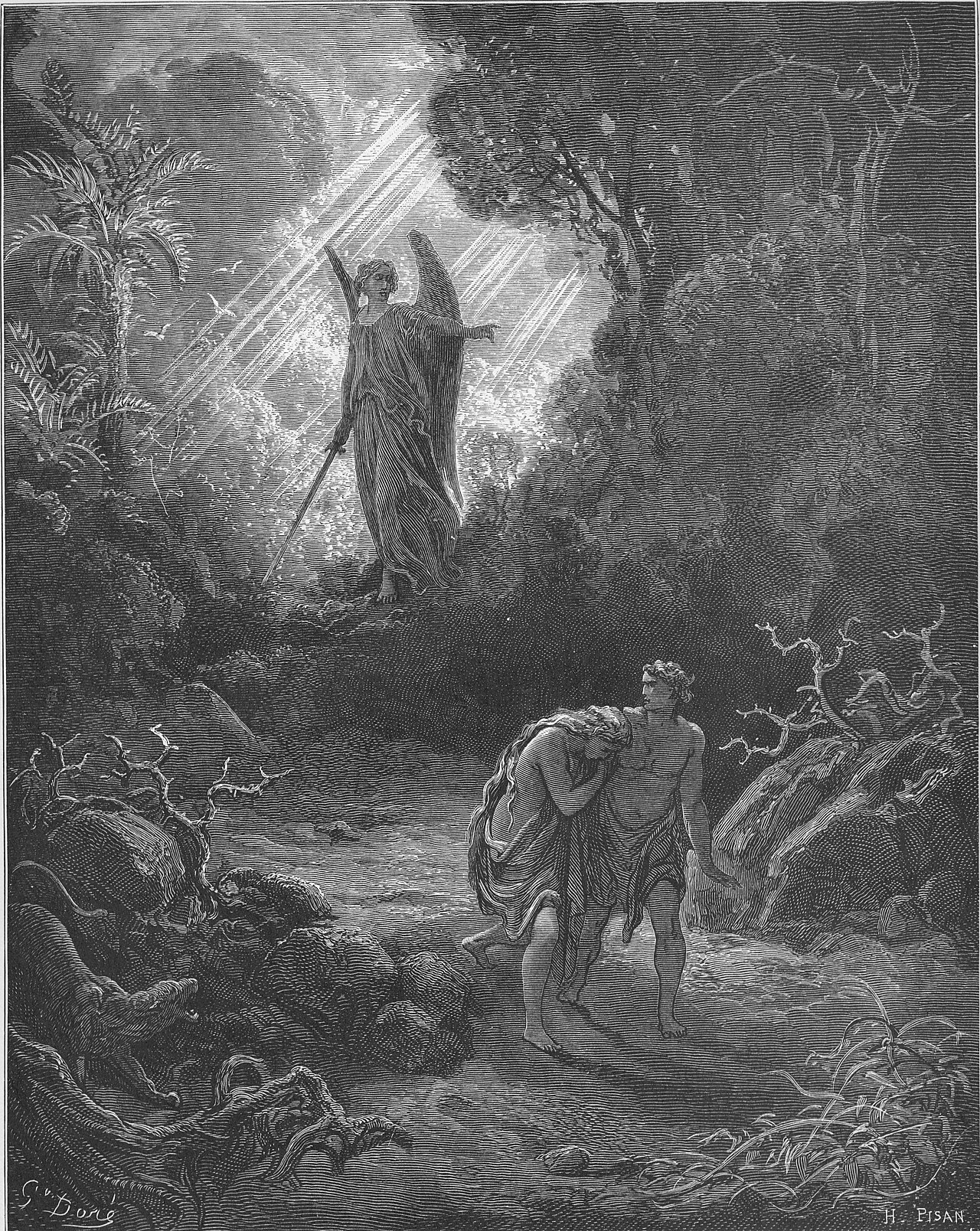
in Genesis 3So He drove out the man and stationed cherubim on the east side of the Garden of Eden, along with a whirling sword of flame to guard the way to the tree of life.
BSB
The same verse in ASV and KJV ▾
ASV
So he drove out the man; and he placed at the east of the garden of Eden the Cherubim, and the flame of a sword which turned every way, to keep the way of the tree of life.
KJV
So he drove out the man; and he placed at the east of the garden of Eden Cherubims, and a flaming sword which turned every way, to keep the way of the tree of life.
⋯
This verse in Genesis 3
Commentary
15 notes on this verseSo he drove out the man - Three things are noted here: 1. God’s displeasure against sinful man, evidenced by his expelling him from this place of blessedness; 2. Man’s unfitness for the place, of which he had rendered himself unworthy by his ingratitude and transgression; and, 3. His reluctance to leave this place of happiness. He was, as we may naturally conclude, unwilling to depart, and God drove him out. He placed at the east - מכדם mikkedem, or before the garden of Eden, before what may be conceived its gate or entrance; Cherubims, הכרבים hakkerubim, The cherubim.
This site's exposition
on the east side of the Garden of Eden
Cherubim are stationed on the east side of the garden, and a whirling sword of flame turns there with them. Both guard one thing, the way back to the tree of life. Revelation 22:14 gives the right to that tree back to those who wash their robes.
The record, by era
The Church Fathers5 voices
A commentator
Augustine of HippoTWO BOOKS ON GENESIS AGAINST THE MANICHAEANS 2.23.35 · Written before 430.
proposed
"God placed cherubim and a flaming sword that moves"—this could be said in the one word movable—"to guard the way to the tree of life." Those who translate the Hebrew words in Scripture say that "cherubim" means in Latin "the fullness of knowledge." The flaming, movable sword means temporal punishments, because times move in their continual variety. It is called flaming because every tribulation burns somehow or other. But it is one thing to be burned until consumed, another to be burned until purified.
Throughout martyrdom Jesus is with you to show you the way to the paradise of God and how you may pass through the cherubim and the flaming sword that turns every way and guards the way to the tree of life. For both, even if they guard the way to pass through to the tree of life, guard it so that no one unworthy may turn that way to pass through to the tree of life. The flaming sword will hold fast those who have built upon the foundation that is laid, Jesus Christ, with wood, hay or straw, and the wood of denial, if I may call it that, which catches fire very easily and burns all the more. But the cherubim will receive those who by nature cannot be held by the flaming sword, because they have built with nothing that can catch fire. They will escort them to the tree of life and to all the trees God planted in the east and made to grow out of the ground.
At his departure from Paradise it says that God "caused a cherub and a sharp revolving sword to go round, to the east of the Garden of Eden, to protect the way to the Tree of Life.
Blessed is he who was pierced and so removed the sword from the entry to paradise.
Then, so that we may learn how great was the distance he moved him from the garden, Sacred Scripture teaches us this further fact in the words, "The Lord God drove Adam out and situated him opposite the garden of delight." [ Gen 3:24 ] Notice how each of the events proved an occasion of loving kindness on the part of the common Lord of all, and each example of punishment abounds with goodness. I mean, the expulsion was not the sole mark of love and goodness: there was also his location opposite the garden so that he might have unending anguish in recollecting from what heights he had fallen and cast himself into such depths. Yet even if the sight of it was the cause of unbearable pain, it was nevertheless an occasion of no little benefit: the constant sight proved to be an encouragement for this grieving man to carefulness in the future lest he fall into the same sin again. Such, after all, is the habit of human nature by and large: since, while we are in a position to enjoy good things, we don't know how to use them as we ought, we come to our senses with the loss of these things by learning through experience and gaining a sense of our own indifference. In this way we are taught by the change of fortunes from what heights we have fallen and with what troubles we have tortured ourselves. And so the instruction that the one who had lost his place there should dwell nearby and opposite the garden was a sign of deep concern in order that he might have the constant reminder from the sight of it and feel a sense of loss from it and never presume to eat from the tree through lusting after life while finding himself outside.
8 more voices on this verse
The Church Fathers1 voice
(Verse 24.) And Adam was cast out, and he made him dwell opposite the paradise of pleasure. And he established Cherubim and a flaming sword, which turned to guard the way to the tree of life. There is much more meaning in the Hebrew than is understood here. For it says: And Adam was cast out, no doubt by the Lord: And he made him dwell before the paradise of pleasure, Cherubim, and a flaming sword, which turned, and guarded the way to the tree of life.
The Medieval Church3 voices
And he drove Adam out and placed before the paradise of delight the cherubim and the flaming sword, which turned every way to guard the way to the tree of life.
The second Adam, Jesus Christ, points out that through the water of the bath of rebirth, the flickering flame—by which the cherubim guardian blocked the entry into paradise when the first Adam was expelled—would be extinguished.
That remedy ought to have had efficacy first upon those who believed in Christ, and by believing hoped, and by hoping loved; and on this account He ought to have descended to the nether regions immediately for their liberation.
The Puritans and the Awakening3 voices
He might justly have chased him out of the world, Job xviii, 18, but he only chased him out of the garden: he might justly have cast him down to hell, as the angels that sinned were, when they were shut out from the heavenly paradise, 2 Pet. ii, 4, but man was only sent to till the ground out of which he was taken. He was only sent to a place of toil, not to a place of torment.
He might justly have chased him out of the world, Job xviii, 18, but he only chased him out of the garden: he might justly have cast him down to hell, as the angels that sinned were, when they were shut out from the heavenly paradise, 2 Pet. ii, 4, but man was only sent to till the ground out of which he was taken. He was only sent to a place of toil, not to a place of torment.
So he drove out the man,....
The Nineteenth Century1 voice
A commentator
Jamieson, Fausset & Brown1802–1910
Commentary Critical and Explanatory on the Whole Bible (1871)
proposed
placed . . . cherbim--The passage should be rendered thus: "And he dwelt between the cherubim at the East of the Garden of Eden and a fierce fire, or Shekinah, unfolding itself to preserve the way of the tree of life." This was the mode of worship now established to show God's anger at sin and teach the mediation of a promised Saviour as the way of life, as well as of access to God.
quarantine:debris (2026-07-29) — starts-lowercase
The words behind it
18 Hebrew wordsEvery Hebrew word of this verse in the order it stands, with what it means and the door to its own study. The last column counts the times a word stands in the whole Bible: the rarer the word, the more the places it appears belong together.
| Hebrew | Sound | Meaning | Word study | In the Bible |
|---|---|---|---|---|
| וַיְגָ֖רֶשׁ | vaygaresh | and he drove out | H1644 → | 46 times |
| אֶת־ | ʾet- | <obj.> | H853 → | 10935 times |
| הָֽאָדָ֑ם | haadam | the man | H120 → | 551 times |
| וַיַּשְׁכֵּן֩ | vaiyashken | and he caused to dwell | H7931 → | 129 times |
| מִקֶּ֨דֶם | mikedem | from east | H6924 → | 87 times |
| לְגַן־ | legan- | of [the] garden of | H1588 → | 42 times |
| עֵ֜דֶן | ʾeden | Eden | H5731 → | 16 times |
| אֶת־ | ʾet- | <obj.> | H853 → | 10935 times |
| הַכְּרֻבִ֗ים | hakeruvim | the cherubim | H3742 → | |
| וְאֵ֨ת | veet | and <obj.> | H853 → | 10935 times |
| לַ֤הַט | lahat | [the] flame of | H3858 → | |
| הַחֶ֙רֶב֙ | hacherev | the sword | H2719 → | 413 times |
| הַמִּתְהַפֶּ֔כֶת | hamithapekhet | <the> whirling | H2015 → | 94 times |
| לִשְׁמֹ֕ר | lishmor | to guard | H8104 → | 468 times |
| אֶת־ | ʾet- | <obj.> | H853 → | 10935 times |
| דֶּ֖רֶךְ | derekh | [the] way of | H1870 → | 707 times |
| עֵ֥ץ | ʾetz | [the] tree of | H6086 → | 328 times |
| הַֽחַיִּֽים׃ ס | hachaiyim | <the> life | H2416 → | 498 times |
וַיְגָ֖רֶשׁand he drove out
vaygareshH1644 →46 times
אֶת־<obj.>
ʾet-H853 →10935 times
הָֽאָדָ֑םthe man
haadamH120 →551 times
וַיַּשְׁכֵּן֩and he caused to dwell
vaiyashkenH7931 →129 times
מִקֶּ֨דֶםfrom east
mikedemH6924 →87 times
לְגַן־of [the] garden of
legan-H1588 →42 times
עֵ֜דֶןEden
ʾedenH5731 →16 times
אֶת־<obj.>
ʾet-H853 →10935 times
הַכְּרֻבִ֗יםthe cherubim
hakeruvimH3742 →
וְאֵ֨תand <obj.>
veetH853 →10935 times
לַ֤הַט[the] flame of
lahatH3858 →
הַחֶ֙רֶב֙the sword
hacherevH2719 →413 times
הַמִּתְהַפֶּ֔כֶת<the> whirling
hamithapekhetH2015 →94 times
לִשְׁמֹ֕רto guard
lishmorH8104 →468 times
אֶת־<obj.>
ʾet-H853 →10935 times
דֶּ֖רֶךְ[the] way of
derekhH1870 →707 times
עֵ֥ץ[the] tree of
ʾetzH6086 →328 times
הַֽחַיִּֽים׃ ס<the> life
hachaiyimH2416 →498 times
A shaded row is a word that stands 400 times or fewer in the Bible.
The walk
7 stopsEach card is a verse this one points to, and under it the verses that one points to in turn. Where several paths arrive at the same place, that place is listed first: the text keeps returning to it.
Through
Hebrews 1:7Now about the angels He says: “He makes His angels winds, His servants flames of fire.”
it leads to
- Psalms 104:4
He makes the winds His messengers, flames of fire His servants.
- Hebrews 1:14
Are not the angels ministering spirits sent to serve those who will inherit salvation?
Reached by 2 separate paths from here.
- 2 Kings 6:17
Then Elisha prayed, “O LORD, please open his eyes that he may see.” And the LORD opened the eyes of the young man, and he saw that the hills were full of horses and…
Reached by 2 separate paths from here.
- Ezekiel 1:13–14
In the midst of the living creatures was the appearance of glowing coals of fire, or of torches. Fire moved back and forth between the living creatures; it was bright, and lightning flashed out…
- Psalms 104:4
Through
Psalms 104:4He makes the winds His messengers, flames of fire His servants.
it leads to
- 2 Kings 2:11
As they were walking along and talking together, suddenly a chariot of fire with horses of fire appeared and separated the two of them, and Elijah went up into heaven in a whirlwind.
Reached by 2 separate paths from here.
- Hebrews 1:7
Now about the angels He says: “He makes His angels winds, His servants flames of fire.”
- Psalms 148:8
lightning and hail, snow and clouds, powerful wind fulfilling His word,
- 2 Kings 2:11
Where this verse is studied
On this page
Studies41
On this verse
On this chapter
Show the next 6 titles
About Genesis
Who and where
1 name in this verse with a page on the site.
This page draws on 15 works. Open the list of works
This page draws on Adam Clarke, Commentary on the Bible; Augustine of Hippo, TWO BOOKS ON GENESIS AGAINST THE MANICHAEANS 2.23.35; Bede, Commentary on Genesis (Hexaemeron); Bede, Homilies on the Gospels 1.12; Bonaventure, Breviloquium; Ephrem the Syrian, Commentary (church-history corpus); Ephrem the Syrian, HYMNS ON PARADISE 2.1; Jamieson, Fausset & Brown, Commentary Critical and Explanatory on the Whole Bible; Jerome, Hebrew Questions on Genesis; John Chrysostom, Commentary (church-history corpus); John Gill, Exposition of the Old Testament; John Gill, Exposition of the Old Testament (1748-1763); John Wesley, Explanatory Notes upon the Old Testament; Matthew Henry, Commentary on the Whole Bible and Origen of Alexandria, EXHORTATION TO MARTYRDOM 36.