
Genesis 3:7
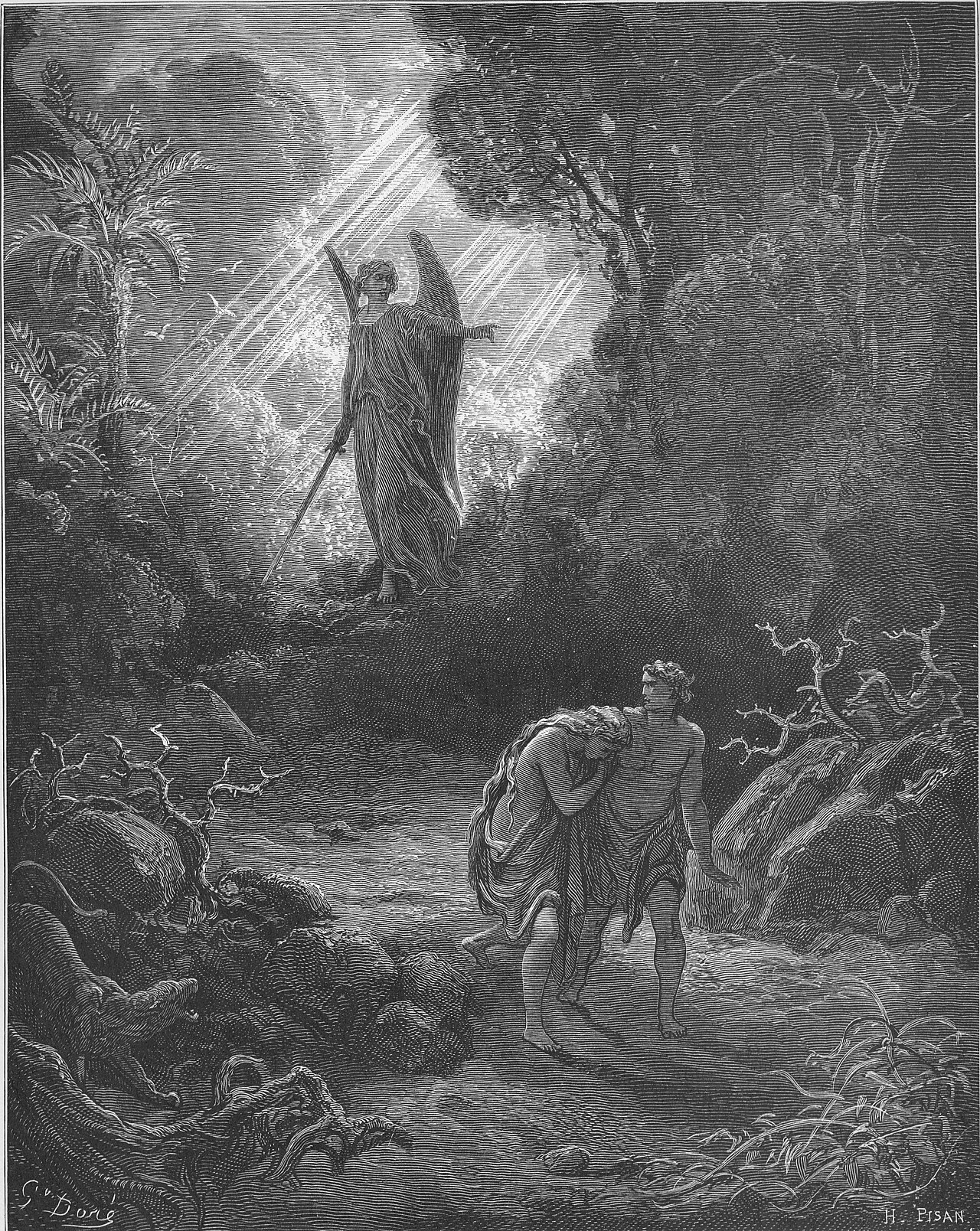
in Genesis 3And the eyes of both of them were opened, and they knew that they were naked; so they sewed together fig leaves and made coverings for themselves.
BSB
The same verse in ASV and KJV ▾
ASV
And the eyes of them both were opened, and they knew that they were naked; and they sewed fig-leaves together, and made themselves aprons.
KJV
And the eyes of them both were opened, and they knew that they were naked; and they sewed fig leaves together, and made themselves aprons.
⋯
This verse in Genesis 3
Commentary
22 notes on this verseAnd the eyes of them both were opened,.... Not of their bodies, but of their minds; not so as to have an advanced knowledge of things pleasant, profitable, and useful, as was promised and expected, but of things very disagreeable and distressing.
This site's exposition
they knew that they were naked
The promise was opened eyes, and their eyes were opened. What they saw was their own nakedness. The serpent's word at verse 5 came true, and the knowledge it gave them was shame. They made their own coverings out of fig leaves sewn together.
The record, by era
The Church Fathers5 voices
A commentator
Augustine of HippoON THE LITERAL INTERPRETATION OF GENESIS 11.4.6 · Written in the 5th century.
proposed
If someone asks, therefore, why God allowed man to be tempted when he foreknew that man would yield to the tempter, I cannot sound the depths of divine wisdom, and I confess that the solution is far beyond my powers. There may be a hidden reason, made known only to those who are better and holier than I, not because of their merits but simply by the grace of God. But insofar as God gives me the ability to understand or allows me to speak, I do not think that a man would deserve great praise if he had been able to live a good life for the simple reason that nobody tempted him to live a bad one. For by nature he would have it in his power to will not to yield to the tempter, with the help of him, of course, "who resists the proud and gives his grace to the humble." Why, then, would God not allow a man to be tempted, although he foreknew he would yield? For the man would do the deed by his own free will and thus incur guilt, and he would have to undergo punishment according to God's justice to be restored to right order. Thus God would make known his will to a proud soul for the instruction of the saints in ages to come. For wisely he uses even bad wills of souls when they perversely abuse their nature, which is good.
It was not in order to see outward things that "their eyes were opened," because they could see such things already. It was in order that they might see the difference between the good they had lost and the evil into which they had fallen. That is why the tree is called the tree of the knowledge of good and evil. They had been forbidden to touch it because if they did it would bring on the experience of this distinction. It takes the experience of the pains of sickness to open our eyes to the pleasantness of health.
The eyes of sense were then opened, which they had done well to keep shut, that they might not be distracted and hindered from seeing with the eyes of the mind. It was those eyes of the mind which in consequence of sin, as I imagine, were then closed. To that time they had enjoyed the delight of beholding God and his paradise. This twofold kind of vision in us was familiar to our Savior, who said, "For judgment I have come into this world, that those who see not might see and that those who see might be made blind"—meaning by "the eyes that see not" the eyes of the mind, which are enlightened by his teaching; and "the eyes that see," meaning the eyes of sense, which his words render blind.
Once Eve had enticed Adam and gotten him to eat, Scripture says that "the eyes of the two of them were opened and they knew that they were naked."
A commentator
Philoxenus of Mabbug13 Ascetic Discourses, Discourse 10 -- On Gluttony · Written before 523.
proposed
The Enemy did not contend against the heads of our race with fornication, or with avarice, or with vain-glory, or with the adornment of apparel, or with envy and pride, or with any of the other passions, but only with the lust of the belly, …
15 more voices on this verse
The Church Fathers5 voices
As soon as our first parents had disobeyed God's commandment, they were immediately deprived of divine grace and were ashamed of their nakedness. They covered themselves with fig leaves, which perhaps were the first thing noticed by the troubled pair. The parts covered remained unchanged except that previously they occasioned no shame. They felt for the first time a movement of disobedience in their flesh, as though the punishment were meant to fit the crime of their own disobedience to God. The fact is that the soul, which had taken perverse delight in its own liberty and disdained the service of God, was now deprived of its original mastery over the body. Because it had deliberately deserted the Lord who was over it, it no longer bent to its will the servant below it, being unable to hold the flesh completely in subjection as would always have been the case, if only the soul had remained subject to God. From this moment on, then, the flesh began to lust against the spirit. With this rebellion we are born, just as we are doomed to die and because of the first sin to bear, in our members and vitiated nature, either the battle with or defeat by the flesh.
It wasn't the eating from the tree that opened their eyes: they could see even before eating. Instead the eating from this tree was the symptom of their disobedience and the breaking of the command given by God; and through their guilt they consequently divested themselves of the glory surrounding them, rendering themselves unworthy of such wonderful esteem. Hence Scripture takes up the point in its customary way with the words, "They both ate. Their eyes were opened, and they realized they were naked." Because of the fall they were stripped of grace from above, and they felt the sense of their obvious nakedness so that through the shame that overcame them they might know precisely what peril they had been led into by breaking the Lord's command.
I know that some at this point might accuse the Lawgiver and assert that the law is the cause of the fall. We absolutely must oppose that argument. We must plainly argue and demonstrate that God gave the law not because he hated humanity or wanted to mark our nature with shame but because he loved us and cared for us. In order that you learn that the law was given as a means to help, listen to the words of Isaiah: "He gave the law in our support." One who pursues hatred does not give help. Again the prophet declares, "Your word is the lamp guiding my steps and the light for my paths." But one who pursues hatred does not dispel the darkness with his lamp, nor does he provide light to one who is wandering. Solomon says, "The command of the law is the lamp, the light, the life, the reproach and the rule." So the law is not only a help, not only a lamp but also light and life. Therefore these things are not for those who pursue hatred, not for those who will to be lost, but for those who hold out and lift up their hand.
A commentator
John ChrysostomCommentary (church-history corpus) · Written in the 5th century.
proposed
Consider, I ask you dearly beloved, what height they had fallen from and how the devil's advice had cast them into a deep abyss. Whereas, you see, they had been clothed in such glory, now they stitch together fig leaves and make themselves skirts. This is the advantage to be gained from the devil's deceit, this is the scope of his advice not merely to fail to provide greater benefits but to render us naked and devoid of those we have. Since therefore such a pretext of eating led to disobedience, Scripture accordingly says, "They ate, and their eyes were opened," referring not to the eyes of the senses but to their mental awareness. You see once they disobeyed what had been commanded, they were now made to become aware of things that previously they had no awareness of on account of the benevolence of the Lord shown to them. So when you hear that "Their eyes were opened," understand it in the sense that he saw to it that they would now experience their nakedness and the loss of the glory they enjoyed before eating. To be sure that this is the way with Scripture, listen to what it says elsewhere as well: when Sarah's maid ran away from service and got lost, she flung her child down next to a log and from a distance she thought about his approaching demise in these words, "God opened the eyes" [ Gen 21:19 ] of Hagar, not because she could not see before then but because he awakened her mind. Do you see that the word "opened" refers not to our bodily eyes but to mental awareness? We would make the same point in regard to the other question that arises at this stage. That is, they ask, Why was it called the tree of the knowledge of good and evil? There are, you see, many people bent on controversy who endeavor to maintain that after eating from the tree Adam had knowledge to discriminate between good and evil an opinion of the utmost absurdity.
A commentator
Augustine of HippoTWO BOOKS ON GENESIS AGAINST THE MANICHAEANS 2.15.23 · Written in the 5th century.
proposed
Then they saw that they were naked by perverted eyes. Their original simplicity, signified by the term nakedness, now seemed to be something to be ashamed of. And so that they might no longer be simple, they made aprons for themselves from the leaves of the fig tree, as if to cover their private parts, that is, to cover their simplicity, of which that cunning pride was ashamed. The leaves of the fig tree signify a certain itching, if this is correctly said in the case of incorporeal things, which the mind suffers in wondrous ways from the desire and pleasure of lying. As a result those who love to joke are even called "salty" in Latin. For in jokes pretense plays a primary role.
The Medieval Church4 voices
WHO EATS. AND THE EYES OF BOTH WERE OPENED. "To what? If not to lusting after each other, to the penalty of sin conceived in the flesh's own death, so that now the body would not only be an animal one, which, if they kept …
And indeed, the fig tree sometimes in Scriptures insinuates the sweetness of heavenly love, whence it is written: "He who keeps the fig tree eats its fruit; and he who guards his master will be honored" (Prov. XXVII); but because our first parents, confused by …
The man and the woman immediately after their fault felt the penalty of rebellion and shame in the flesh; and therefore to cover their shameful parts they made for themselves loincloths.
When they realized that they were naked, they sewed fig leaves together and made loincloths for themselves. "The rational soul felt shame about the bestial movement in the members of its body, and it instilled this shame, not only because it felt this sensation where …
The Puritans and the Awakening1 voice
Now see here, First, What a dishonour and disquietment sin is; it makes mischief wherever it is admitted, sets men against themselves disturbs their peace, and destroys all their comforts. Sooner or later, it will have shame, either the shame of true repentance, which ends in glory, or that shame and everlasting contempt to which the wicked shall rise at the great day.
The Nineteenth Century1 voice
The eyes of them both were opened - They now had a sufficient discovery of their sin and folly in disobeying the command of God; they could discern between good and evil; and what was the consequence? Confusion and shame were engendered, because innocence was lost and guilt contracted. Let us review the whole of this melancholy business, the fall and its effects.
Modern Voices4 voices
A commentator
GK ChestertonWine When It Is Red (All Things Considered) · Written before 1936.
proposed
If it is not true that a divine being fell, then we can only say that one of the animals went entirely off its head. In neither case can we really argue very much from the body of man simply considered as the body of …
The mediæval mind turned centrally upon the pivot of Free Will. In their social system the mediævals were too much PARTI-PER-PALE, as their heralds would say, too rigidly cut up by fences and quarterings of guild or degree.
Did he expect to find a fossil Eve with a fossil apple inside her? Did he suppose that the ages would have spared for him a complete skeleton of Adam attached to a slightly faded fig-leaf? ...
A man and woman are put in a garden on condition that they do not eat one fruit: they eat it, and lose their joy in all the fruits of the earth.
The words behind it
13 Hebrew wordsEvery Hebrew word of this verse in the order it stands, with what it means and the door to its own study. The last column counts the times a word stands in the whole Bible: the rarer the word, the more the places it appears belong together.
| Hebrew | Sound | Meaning | Word study | In the Bible |
|---|---|---|---|---|
| וַתִּפָּקַ֙חְנָה֙ | vatipakachnah | and they were opened | H6491 → | 20 times |
| עֵינֵ֣י | ʾeinei | [the] eyes of | H5869 → | 887 times |
| שְׁנֵיהֶ֔ם | sheneihem | both of them | H8147 → | 768 times |
| וַיֵּ֣דְע֔וּ | vaiyedeu | and they knew | H3045 → | 945 times |
| כִּ֥י | ki | that | H3588 → | 4482 times |
| עֵֽירֻמִּ֖ם | ʾeirumim | [were] naked | H5903 → | 10 times |
| הֵ֑ם | hem | they | H1992 → | 553 times |
| וַֽיִּתְפְּרוּ֙ | vaiyitperu | and they sewed together | H8609 → | |
| עֲלֵ֣ה | ʾaleh | leafage of | H5929 → | |
| תְאֵנָ֔ה | teenah | a fig tree | H8384 → | |
| וַיַּעֲשׂ֥וּ | vaiyaasu | and they made | H6213 → | 2628 times |
| לָהֶ֖ם | lahem | for <the> themselves | ||
| חֲגֹרֹֽת׃ | chagorot | loin coverings | H2290 → |
וַתִּפָּקַ֙חְנָה֙and they were opened
vatipakachnahH6491 →20 times
עֵינֵ֣י[the] eyes of
ʾeineiH5869 →887 times
שְׁנֵיהֶ֔םboth of them
sheneihemH8147 →768 times
וַיֵּ֣דְע֔וּand they knew
vaiyedeuH3045 →945 times
כִּ֥יthat
kiH3588 →4482 times
עֵֽירֻמִּ֖ם[were] naked
ʾeirumimH5903 →10 times
הֵ֑םthey
hemH1992 →553 times
וַֽיִּתְפְּרוּ֙and they sewed together
vaiyitperuH8609 →
עֲלֵ֣הleafage of
ʾalehH5929 →
תְאֵנָ֔הa fig tree
teenahH8384 →
וַיַּעֲשׂ֥וּand they made
vaiyaasuH6213 →2628 times
לָהֶ֖םfor <the> themselves
lahem
חֲגֹרֹֽת׃loin coverings
chagorotH2290 →
A shaded row is a word that stands 400 times or fewer in the Bible.
The walk
8 stopsEach card is a verse this one points to, and under it the verses that one points to in turn. Where several paths arrive at the same place, that place is listed first: the text keeps returning to it.
Through
Genesis 3:5“For God knows that in the day you eat of it, your eyes will be opened and you will be like God, knowing good and evil.”
it leads to
- Ezekiel 28:2
“Son of man, tell the ruler of Tyre that this is what the Lord GOD says: Your heart is proud, and you have said, ‘I am a god; I sit in the seat of…
- 2 Thessalonians 2:4
He will oppose and exalt himself above every so-called god or object of worship. So he will seat himself in the temple of God, proclaiming himself to be God.
- 2 Corinthians 11:13–15
For such men are false apostles, deceitful workers, masquerading as apostles of Christ.
- 2 Corinthians 4:4
The god of this age has blinded the minds of unbelievers so they cannot see the light of the gospel of the glory of Christ, who is the image of God.
- Genesis 2:17
but you must not eat from the tree of the knowledge of good and evil; for in the day that you eat of it, you will surely die.”
- Ezekiel 28:2
Through
Genesis 2:25And the man and his wife were both naked, and they were not ashamed.
it leads to
- Genesis 3:10–11
“I heard Your voice in the garden,” he replied, “and I was afraid because I was naked; so I hid myself.”
- Romans 10:11
It is just as the Scripture says: “Anyone who believes in Him will never be put to shame.”
- Jeremiah 17:13
O LORD, the hope of Israel, all who abandon You will be put to shame. All who turn away will be written in the dust, for they have abandoned the LORD, the fountain of…
- Genesis 3:10–11
Where this verse is studied
On this page
Studies25
On this verse
On this chapter
Show the next 6 titles
About Genesis
This page draws on 21 works. Open the list of works
This page draws on Adam Clarke, Commentary on the Bible; Augustine of Hippo, ON THE LITERAL INTERPRETATION OF GENESIS 11.4.6; Augustine of Hippo, City of God 14.17; Augustine of Hippo, City of God 13.13; Augustine of Hippo, TWO BOOKS ON GENESIS AGAINST THE MANICHAEANS 2.15.23; Bede, Commentary on Genesis (Hexaemeron); Bede, Homilies on the Gospels 1.17; Bonaventure, Breviloquium, Part 3, Chapter 4; Ephrem the Syrian, Commentary (church-history corpus); GK Chesterton, Wine When It Is Red (All Things Considered); GK Chesterton, A Miscellany of Men, The Mediæval Villain (1912); GK Chesterton, All Things Considered, Science and Religion (1908); GK Chesterton, All Things Considered, Fairy Tales (1908); John Calvin, Commentary on Genesis; John Chrysostom, HOMILIES ON GENESIS 16.14; John Chrysostom, SERMONS ON GENESIS 8; John Chrysostom, Commentary (church-history corpus); John Gill, Exposition of the Old Testament (1748-1763); Matthew Henry, Commentary on the Whole Bible; Origen of Alexandria, AGAINST CELSUS 7.39 and Philoxenus of Mabbug, 13 Ascetic Discourses, Discourse 10 -- On Gluttony.