
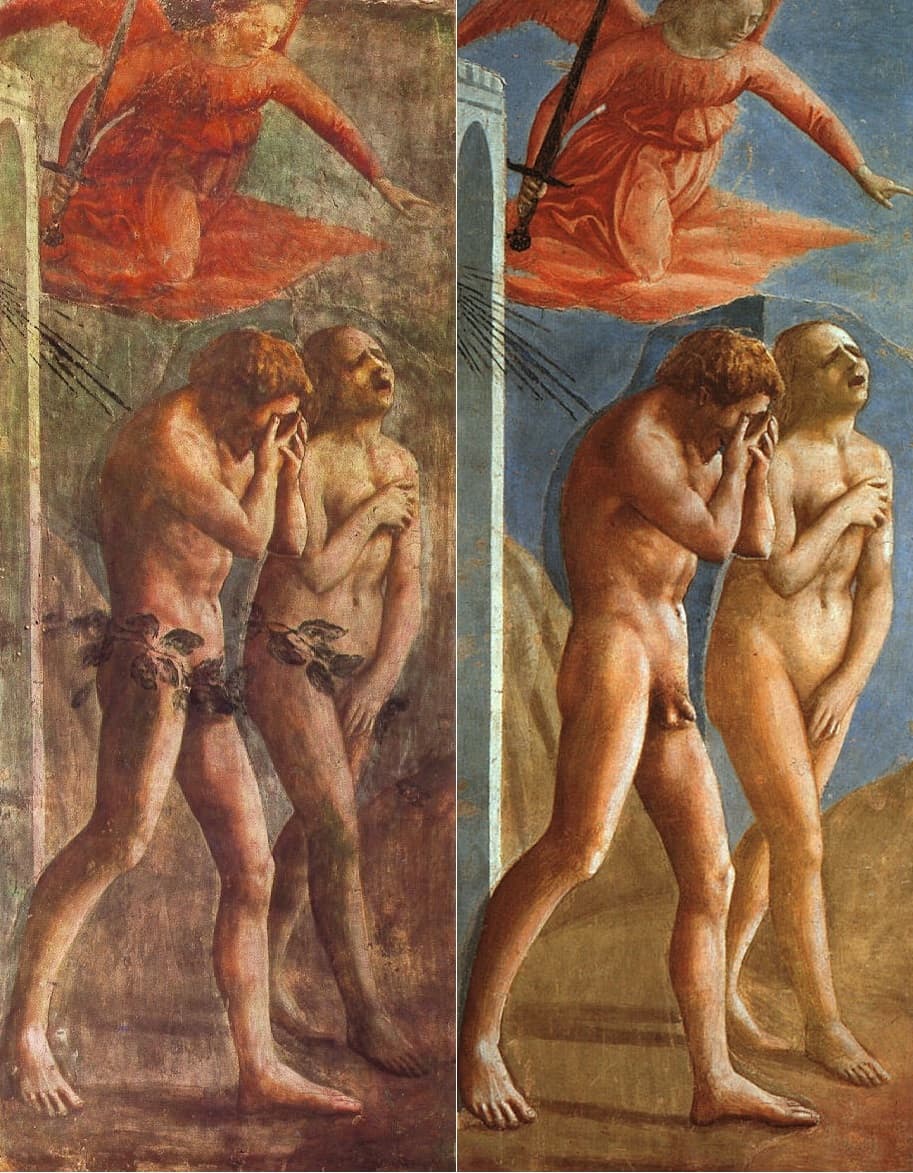
Genesis 3:7 to 21 · Passage · Shame and Guilt
They Knew They Were Naked
Genesis 3:7 to 21 records the first hour of human shame, from the opened eyes to the garments of skin.
The first question God asks in Scripture is put to a man hiding from Him among the trees of the garden.
And the eyes of both of them were opened, and they knew that they were naked; so they sewed together fig leaves and made coverings for themselves.
- The passage
- Genesis 3:7 to 21
- Book
- Genesis
- Hold in memory
- Genesis 3:21
Summary
The LORD God came looking for the man and the woman who had hidden from Him among the trees. He heard each of them out before He spoke, and His judgment carried a promise inside it. The passage teaches that God answers the shame of sin by seeking the sinner out and covering him.
- Shame entered with the first sin, and the man and the woman covered themselves with fig leaves (Genesis 3:7).
- The man named fear as the reason he hid, so shame before God shows itself as dread of His presence (Genesis 3:10).
- The man blamed the woman and the woman blamed the serpent, yet each said, “I ate” (Genesis 3:12 to 13).
- The covering that lasted was the one the LORD God made, the garments of skin He put on them (Genesis 3:21).
After They Ate
The account runs from the fig leaves to the questions in the garden.
This study reads the verses that follow the first sin in Eden. It belongs to the trial of shame and guilt, because it is the first account in Scripture of people hiding from God after a wrong.
The question it answers is what sin changed in Adam and Eve and what their Maker did for them. It gives the passage in order, the four questions God asked, the Hebrew words for their nakedness and their clothing, and the teachers who have taught it from Tertullian to Matthew Henry. It sets out two questions readers still argue over, what the opened eyes mean and whether the garments of skin point to a sacrifice.
Genesis 2:25 closes the account of the garden with the words "the man and his wife were both naked, and they were not ashamed."
Then the man and his wife heard the voice of the LORD God walking in the garden in the breeze of the day, and they hid themselves from the presence of the LORD God among the trees of the garden.The leaves did not end their fear, since in the next scene they hide from God Himself.
The LORD God walking in the garden is the first scene in Scripture of God present with people on the earth.
“I heard Your voice in the garden,” he replied, “and I was afraid because I was naked; so I hid myself.”Adam's own answer explains Genesis 3:8, and fear comes first in it.
When the LORD God asked about the tree, the man laid the fault on "The woman whom You gave me", and the woman laid it on the serpent (Genesis 3:12 to 13). Each of them still said, "I ate."
The Questions God Asked
Four questions in Genesis 3:9 to 13 come between the hiding and the curses.
Each question the LORD God asked came closer to the act the man and the woman had hidden.
| Verse | The question | What it asked |
|---|---|---|
| Genesis 3:9 | "Where are you?" | The place of a man who had hidden himself |
| Genesis 3:11 | "Who told you that you were naked?" | How the man came to know his nakedness |
| Genesis 3:11 | "Have you eaten from the tree of which I commanded you not to eat?" | Whether the man had broken the one command |
| Genesis 3:13 | "What is this you have done?" | What the woman had done |
Judgment, Promise and Garments
The curses, the promise of the seed, Eve's name and the garments follow the questions.
The serpent and the ground were cursed, pain in childbirth fell to the woman, and toil until he returned to the dust fell to the man (Genesis 3:14 to 19). Within the curse on the serpent He promised that the woman's seed would crush its head (Genesis 3:15).
And the LORD God made garments of skin for Adam and his wife, and He clothed them.It closes the passage with the covering God gave after the judgment.
The LORD God then banished the man from the Garden of Eden and stationed cherubim to guard the way to the tree of life (Genesis 3:23 to 24).
The Hebrew of Nakedness and Covering
Two words for nakedness and two for clothing tie the passage together.
The word for naked in Genesis 2:25 is arom (H6174). In Genesis 3:7, Genesis 3:10 and Genesis 3:11 it is eyrom (H5903), which Strong's dictionary glosses "nudity" and counts 10 times. Deuteronomy 28:48 uses it of a people who would serve their enemies "in famine, thirst, nakedness, and destitution."
The coverings the man and the woman sewed were chagorot (H2290), a word Strong's glosses "a belt (for the waist)". The garments the LORD God made were kotnot, the plural of kuttonet (H3801), "a shirt". Genesis 37:3 uses the same word of Joseph's robe, and Exodus 28:40 of the tunics of Aaron's sons.
One verb, asah, to make, stands in Genesis 3:7 and Genesis 3:21. The man and the woman "made coverings for themselves" (Genesis 3:7), and the same verb names what the LORD God made for them (Genesis 3:21).
How the Passage Has Been Taught
Two teachers, of the third century and the eighteenth, read the passage for what it shows of God toward the guilty.
died 220 · Tertullian
Tertullian taught that God's question was a summons.
The reading1 paragraph
Tertullian wrote in Against Marcion (Book 2) that God was "neither uncertain about the commission of the sin, nor ignorant of Adam's whereabouts". He held that "it was certainly proper to summon the offender, who was concealing himself from the consciousness of his sin, and to bring him forth into the presence of his Lord".
1662 to 1714 · Matthew Henry
Matthew Henry taught what alone covers a sinner before God.
The reading1 paragraph
Matthew Henry wrote in his Commentary on the Whole Bible that a sinner must be "clothed and fenced with the righteousness of Christ". He added, "nothing but this will be armour of proof and cover the shame of our nakedness".
Where Readers Differ
Readers differ on what the opened eyes saw and on whether the garments of skin point to a sacrifice, and each reading stands with its holder and the strongest objection to it.
A loss of gloryJohn Chrysostom
John Chrysostom, in his Homilies on Genesis (Homily 16), held that eating did not give them sight, since "they could see even before eating". Through their guilt, he wrote, "they consequently divested themselves of the glory surrounding them".
The objection is that Genesis 2:25 says only that they were naked and unashamed, and the passage names no glory that was taken from them.
The good lost and the evil gainedAugustine of Hippo
Augustine asked in The City of God (Book 14, Chapter 17) why their eyes were opened. His answer was "in order that they might see the difference between the good they had lost and the evil into which they had fallen".
The objection is that Genesis 3:7 reports one discovery only, that they were naked.
A guilty conscienceAdam Clarke
Adam Clarke, in his Commentary on the Bible (1832), wrote of the opened eyes that "Confusion and shame were engendered, because innocence was lost and guilt contracted."
The objection is that Genesis 3:10 names fear and nakedness, and the tree comes up only when God asks about it.
The garments of skin came from the first sacrificeJohn Wesley; Jamieson, Fausset and Brown
John Wesley, in his Explanatory Notes upon the Old Testament (1765), wrote that the beasts "must be slain" and that "probably 'tis supposed they were slain for sacrifice". The Commentary Critical and Explanatory of Jamieson, Fausset and Brown (1871) held that the verse "implies the institution of animal sacrifice".
The objection is that Genesis 3:21 names no altar, no blood and no offering, and the first offerings Scripture names are Cain's and Abel's in Genesis 4:3 to 4.
The garments of skin stand for the mortality the man receivedOrigen of Alexandria
Origen, in his Homilies on Leviticus (Homily 6), called the skin tunics "a symbol of the mortality that he received".
The objection is that the sentence of death was spoken in Genesis 3:19, before the garments were made, and Genesis 3:21 tells of a gift the LORD God made and put on them.
Covered by the LORD God
The passage ends with the guilty clothed by the God they had hidden from.
Genesis 3 sets the first hiding from God beside the first covering by God.
A reader who hides from God because of what he has done meets in this passage a God who calls to the hidden and asks questions that lead to a true answer. Where guilt or shame lasts and weighs on the mind, the care of a pastor and of a doctor belongs beside prayer.
Psalm 32 tells of the same hiding ended by confession.
Sources
Scripture is the Berean Standard Bible.
- STEP Bible, the tagged Hebrew Bible (Tyndale House, Cambridge), CC BY 4.0.
- STEP Bible brief lexicon of Extended Strongs for Hebrew (Tyndale House, Cambridge), CC BY 4.0, with the Strong's glosses.
- Tertullian, Against Marcion, Book 2 (Ante-Nicene Fathers, volume 3)
- Matthew Henry, Commentary on the Whole Bible (1710), on Genesis 3:10.
- John Chrysostom, Homilies on Genesis, Homily 16.14.
- Augustine of Hippo, The City of God, Book 14, Chapter 17.
- Adam Clarke, Commentary on the Bible (1832), on Genesis 3:7.
- John Wesley, Explanatory Notes upon the Old Testament (1765), on Genesis 3:21.
- Robert Jamieson, A. R. Fausset and David Brown, Commentary Critical and Explanatory on the Whole Bible (1871), on Genesis 3:21.
- Origen of Alexandria, Homilies on Leviticus, Homily 6.2.7.
Keep Studying
Read it1
In this trial6
People and groups10
Places1
Subjects1
Symbols1