
Matthewchapter 26
75 verses · Matthew, by tradition · AD 50 to 65 · The Gospels
“Put your sword back in its place,” Jesus said to him. “For all who draw the sword will die by the sword.
Introduction
Matthew, by tradition, The Gospels, Matthew Overview.
Matthew wrote for Jewish believers who kept the Passover every year of their lives and knew each part of the meal by heart. This chapter opens the account of Jesus' death, and it is the longest chapter in the Gospel. It moves through one day and one night, from a supper at Bethany to an upstairs room, an olive grove and the high priest's house. It shows what each person close to Jesus does when the hour comes. Listen for the timing of the feast and for the words spoken over the bread and the cup. Watch Peter, because his failure is told in full.
Context
- Who
- Jewish readers who kept Passover every year of their lives
- What
- The plot against Jesus, His anointing at Bethany, the Passover meal with His disciples, His prayer in Gethsemane, His arrest, and His trial before the high priest.
- Where
- Bethany, an upstairs room in Jerusalem, the garden of Gethsemane on the Mount of Olives, and the house of Caiaphas the high priest.
- When
- The Thursday of Passover week and the night that followed, in AD 30 or AD 33.
- Why
- To show that Jesus went to His death knowing it and choosing it, and that His death was the Passover of a new covenant.
Historical context
The perfume was a fortune. Nard was imported from far to the east, sealed in alabaster flasks that had to be broken to be used, and the sum named, three hundred denarii, is roughly a year's wages for a labourer. Pouring it out was an irreversible act.
Show the rest of the historical context, 4 more paragraphs
At a meal of any formality, people did not sit. They reclined on their left side on couches around a low table, propped on an elbow, feet away from the food. That is how a person could be described as reclining next to someone's chest, and how someone could reach a guest's feet.
The Passover meal had a fixed shape by this period: cups of wine at set points, unleavened bread, bitter herbs, the retelling of the exodus, and a closing hymn from the psalms sung at the festival. When Matthew says they sang a hymn and went out, he is describing the end of a liturgy every reader had performed.
The thirty pieces of silver had a bitter resonance. In Exodus, thirty shekels is the compensation owed when an ox gores a slave, the legal price of a slave's life. The coins were most likely Tyrian shekels, the high-purity silver the temple required.
Gethsemane means oil press, and the grove sat on the Mount of Olives just across the Kidron valley from the city. The trial that follows, at night, at the high priest's house, with the verdict reached before morning, breaks nearly every rule later Jewish law laid down for capital cases. The high priest was Caiaphas, and an ornate burial box inscribed with that family name was found in Jerusalem in 1990.
Significance
For readers who kept Passover, the substitution at the table was the heart of it. On the night Israel remembered the lamb whose blood turned death aside, Jesus took the bread and the cup and said: this is my body, this is my blood of the covenant, poured out for many for the forgiveness of sins.
Show the rest of the significance, 1 more paragraph
And Peter's collapse in the courtyard mattered to a persecuted church more than any argument. The chief apostle denied him three times, with oaths, to a servant girl, and wept. A believer who had failed under questioning was not outside the story. He was in it.
The heads below are this chapter's scenes. The numbered points under each are its verses.
The Plot, the Ointment, and Thirty Pieces of Silver
Matthew 26:1-2
had finished saying all these: The words "When Jesus had finished saying all these things" close the fifth discourse with the formula Matthew sets at the end of each. Jesus names the time and the outcome: "the Passover is two days away," and "the Son of Man will be handed over to be crucified".
Matthew 26:1
“When Jesus had finished all these sayings - He began these sayings on Mount Olivet, Mat 24:1, and continued them till be entered into Bethany, whither he was going.”
Adam Clarke · Commentary on the Bible (1810-1826)evangelical
2 more voices on this verseWhat preachers and commentators have said about this verse, in their own words.
Matthew 26:1
“The Passover, called in Hebrew Phase, does not come as most think from πασχεῖν 'to suffer,' but from the Hebrew word signifying 'to pass over;' because the destroyer passed over when he saw the blood on the doors of the Israelites, and smote them not; or the Lord Himself walked on high, succouring His people. After the two days of the shining light of the Old and of the New Testament, the true Passover is slain for the world. Also our Passover is celebrated when we leave the things of earth, and hasten to the things of heaven.”
Jerome · written before 420 · Catena Aurea by Aquinaspatristic
Matthew 26:1
“We now approach the closing scene of our Lord Jesus Christ’s earthly ministry. Hitherto we have read of his sayings and doings: we are now about to read of his sufferings and death. Hitherto we have seen him as the Great Prophet; we are now about to see him as the great High Priest. It is a portion of Scripture which ought to be read with peculiar reverence and attention. The place we on we stand is holy ground.”
J.C. Ryle · Expository Thoughts on the Gospels: Matthew (1856)Reformed Evangelical
the Passover is two days away: Jerome traces the name Passover to the Hebrew word for passing over, when the destroyer spared the doors marked with blood. Origen notes the verb names no betrayer. Judas, the priests and the Father delivered him, and Origen says the Father did it out of mercy for the human race.
Matthew 26:2
“Ye know that after two days is the feast of the passover,.... Which was kept in commemoration of the deliverance of the Israelites from Egypt; and was typical of Christ the passover, who was now to be sacrificed for his people. This was said on Tuesday, and on the Thursday following, the passover began.”
2 more voices on this verse
Matthew 26:2
He therefore used the verb impersonally—that is, "he will be delivered up." He did not say by whom, because the words apply to all those who delivered him up. But not everyone delivered him up in the same way. God delivered him up out of mercy for the human race: he "has not spared even his own Son but has delivered him for us all."
Origen of Alexandria · written before 253 · Commentary on Matthew 75patristic
Matthew 26:2
“After two days is the Passover - The manner wherein this was celebrated gives much light to several circumstances that follow. The master of the family began the feast with a cup of wine, which having solemnly blessed, he divided among the guests, Luke xxii, 17.”
John Wesley · Explanatory Notes upon the New Testament (1755)evangelical
Matthew 26:3-5
courtyard of the high priest: The chief priests and elders gather in the courtyard of Caiaphas the high priest. They "conspired to arrest Jesus covertly and kill Him," so the killing is settled and only the method is open. They say "not during the feast," yet Jesus had named the Passover in verse 2.
Matthew 26:3
“Then assembled together the chief priests - That is, during the two days that preceded the passover. The high priest, who was called Caiaphas - Caiaphas succeeded Simon, son of Camith, about a.d. 16, or, as Calmet thinks, 25. He married the daughter of Annas, who was joined with him in the priesthood. About two years after our Lord’s crucifixion, Caiaphas and Pilate were both deposed by Vitellius, then governor of Syria, and afterwards emperor. Caiaphas, unable to bear this disgrace, and the stings of his conscience for the murder of Christ, killed himself about a.d. 35. See Joseph.”
Adam Clarke · Commentary on the Bible (1810-1826)evangelical
arrest Jesus covertly and kill: The council wanted Jesus arrested and killed in secret. Adam Clarke observes that the crucifixion took place instead before the thousands who had come to Jerusalem for Passover. Clarke sees providence at work, for the death on which the resurrection rested needed many witnesses.
Matthew 26:4
“And consulted that they might take Jesus by subtilty - The providence of God frustrated their artful machinations; and that event which they wished to conduct with the greatest privacy and silence was transacted with all possible celebrity, amidst the thousands who resorted to Jerusalem, at this season, for the keeping of the passover. It was, doubtless, of the very first importance that the crucifixion of Christ, which was preparatory to the most essential achievement of Christianity, viz.”
Adam Clarke · Commentary on the Bible (1810-1826)evangelical
there may be a riot: Adam Clarke notes that criminals were often punished at the public festivals, so the priests held back out of fear of the crowd. Clarke judges it likely that the Galileans, the countrymen of Jesus, worried them most. Origen adds that the people had seen his signs.
Matthew 26:5
They took counsel "in order to arrest Jesus by stealth." The prophet had aptly said about them, "May the Lord cut off all deceitful lips." "By stealth" they wanted to seize him and to kill him. But they said, "Not during the feast, lest there be a riot among the people," for they had seen Jesus performing many signs and wonders. Many indeed were those who sided with Jesus. They proclaimed that "a great prophet has arisen in Israel."
Origen of Alexandria · written before 253 · Commentary on Matthew 76patristic
1 more voice on this verse
Matthew 26:5
“Not on the feast day, lest there be an uproar - It was usual for the Jews to punish criminals at the public festivals; but in this case they were afraid of an insurrection, as our Lord had become very popular. The providence of God directed it thus, for the reason given in the preceding note. He who observes a festival on motives purely human violates it in his heart, and is a hypocrite before God. It is likely they feared the Galileans, as being the countrymen of our Lord, more than they feared the people of Jerusalem.”
Adam Clarke · Commentary on the Bible (1810-1826)evangelical
Matthew 26:6-9
home of Simon the Leper: The anointing takes place in the home of Simon the Leper in Bethany. John names the woman Mary and the perfume nard, a perfume from India worth about a year's wages. The disciples object to "this waste" since it "could have been sold at a high price" for the poor.
Matthew 26:6
“Now when Jesus was in Bethany,.... Which was about fifteen furlongs from Jerusalem, Joh 11:18, or about two miles from it. The time of Christ's death being at hand, he keeps nigh to Jerusalem, where he was to suffer and die, in the room and stead of sinners: in the house of Simon the leper; so called, to distinguish him from others of the name.”
1 more voice on this verse
Matthew 26:6
“Probably, he was one who had been miraculously cleansed from his leprosy by our Lord Jesus, and he would express his gratitude to Christ by entertaining him; nor did Christ disdain to converse with him, to come in to him, and sup with him. Though he was cleansed, yet he was called Simon the leper.”
Matthew Henry · Commentary on the Whole Bible (1707-1721)puritan
an alabaster jar of expensive perfume: Matthew and Mark have the woman pour the perfume on his head while he reclined at table, and John 12:3 places it on his feet. Jerome keeps this woman apart from the sinful woman of Luke 7. Adam Clarke records a long dispute over the two accounts.
Matthew 26:7
“Another Evangelist (John 12:3.) instead of 'alabastrum' has 'nardum pisticam,' that is, genuine, unadulterated. For let no one think that she who anointed His head and she who anointed His feet were one and the same; for the latter washed His feet with her tears, and wiped them with her hair, and is plainly said to have been a harlot. But of this woman nothing of this kind is recorded, and indeed a harlot could not have at once been made deserving of the Lord's head.”
Jerome · written before 420 · Catena Aurea by Aquinaspatristic
1 more voice on this verse
Matthew 26:7
“There came unto him a woman - There is much contention among commentators about the transaction mentioned here, and in Joh 12:3; some supposing them to be different, others to be the same. Bishop Newcome’s view of the subject I have placed at the end of the chapter. Some think that the woman mentioned here was Mary, the sister of Lazarus; others Mary Magdalene; but against the former opinion it is argued that it is not likely, had this been Mary the sister of Lazarus, that Matthew and Mark would have suppressed her name.”
Adam Clarke · Commentary on the Bible (1810-1826)evangelical
John 12:4 names Judas as the one who objected, and Matthew speaks of the disciples as a group. Jerome and Adam Clarke read the plural as a figure of speech that puts the whole company for one man. Clarke allows that the others may have taken up his complaint.
Matthew 26:8
“But when his disciples saw it,.... What the woman did, what a costly box of ointment it was, and with what profusion she used it, they had indignation: Mark says, "within themselves", Mar 14:4; either among themselves, or their indignation was secret in their breasts; their resentment was private, though it might be betrayed by their looks, and afterwards showed itself in words.”
2 more voices on this verse
Matthew 26:8
“His disciples - One of them, viz. Judas. This mode of speaking was common among the Hebrews. So, Mat 27:44, the thieves also, i.e. one of them. So, Mat 28:17, some doubted, i.e. one, Thomas. See also Gen 8:4; Jdg 12:7; Neh 6:7, etc. By a figure called among rhetoricians enallagè, the plural is put for the singular; it is, however, possible that Judas, who made the objection, was followed in the sentiment by the rest of the disciples.”
Adam Clarke · Commentary on the Bible (1810-1826)evangelical
Matthew 26:8
“We must not think that time waste, that is spent in the service of Christ, or that money waste, which is laid out in any work of piety; for, though it seem to be cast upon the waters, to be thrown down the river, we shall find it again, to advantage, after many days, Eccl. xi.”
Matthew Henry · Commentary on the Whole Bible (1707-1721)puritan
sold at a high price: Thomas Aquinas links the objection to 19:21, where Jesus told the rich young man to sell his possessions and give to the poor. The disciples were repeating his own teaching. Adam Clarke warns that charity can serve as a cloak for covetousness.
Matthew 26:9
“And given to the poor - How often does charity serve as a cloak for covetousness! God is sometimes robbed of his right under the pretense of devoting what is withheld to some charitable purpose, to which there was no intention ever to give it.”
Adam Clarke · Commentary on the Bible (1810-1826)evangelical
1 more voice on this verse
Matthew 26:9
“Hence they say, to what purpose is this waste? But why did they say this? They had heard the Lord greatly commend mercy; above, 19:21: if thou wilt be perfect, go sell what thou hast, and give to the poor.”
Thomas Aquinas · written before 1274 · Commentary on Matthewpatristic
Matthew 26:10-13
She has done a beautiful deed: Jesus defends the woman and calls her act "a beautiful deed". The saying "The poor you will always have with you" states a fact of timing. He reads her act as preparing his body for burial, and promises "what she has done will also be told in memory of her".
Matthew 26:10
“Why trouble ye the woman? - Or, Why do ye put the woman to pain? See this sense of κοπους παρεχειν, established by Kypke in loco. A generous mind is ever pained when it is denied the opportunity of doing good, or when its proffered kindness is refused.”
Adam Clarke · Commentary on the Bible (1810-1826)evangelical
1 more voice on this verse
Matthew 26:10
“The poor must not rob Christ; we must do good to all, but especially to the household of faith. Christ's approbation and commendation of the kindness of this good woman. The more his servants and their services are cavilled at by men, the more he manifests his acceptance of them.”
Matthew Henry · Commentary on the Whole Bible (1707-1721)puritan
The poor you will always have: Jerome sets this saying beside the promise of 28:20, where the risen Christ is with his disciples always. Adam Clarke reads the saying as a word about his bodily presence, which was about to be removed. Help for the poor could be given at any time.
Matthew 26:11
“Ye have the poor always with you - And, consequently, have the opportunity of doing them good at any time; but me ye have not always; my bodily presence is about to be removed from you for ever. The woman, under a presentiment of my death is preparing me for my burial.”
Adam Clarke · Commentary on the Bible (1810-1826)evangelical
prepared My body for burial: Adam Clarke notes the Greek verb means to prepare a body for the tomb. The Greek Old Testament uses the word for the embalming of Jacob in Genesis 50. Matthew Henry calls her act an embalming done ahead of time; the resurrection would leave no dead body to embalm later.
Matthew 26:12
“She hath done it for my burial - As it were for the embalming of my body. Indeed this was not her design: but our Lord puts this construction upon it, to confirm thereby what he had before said to his disciples, concerning his approaching death. This Gospel - That is, this part of the Gospel history.”
John Wesley · Explanatory Notes upon the New Testament (1755)evangelical
2 more voices on this verse
Matthew 26:12
“She did it for my burial - Or, She hath done it to embalm me - ενταφιασαι με. The Septuagint use ενταφιαϚης for the person whose office it was to embalm, Gen 50:2, and ενταφιαζω for the Hebrew הנט which signifies to prepare with spices, or aromatics, Gen 50:3. Our Lord took this opportunity to tell them, once more, that he was shortly to die.”
Adam Clarke · Commentary on the Bible (1810-1826)evangelical
Matthew 26:12
“This was as it were the embalming of his body; because the doing of that after his death would be prevented by his resurrection, it was therefore done before; for it was fit that it should be done some time, to show that he was still the Messiah, even when he seemed to be triumphed over by death.”
Matthew Henry · Commentary on the Whole Bible (1707-1721)puritan
Adam Clarke sees an exchange here. She preserved his body with perfume, and he preserves her memory wherever the gospel goes. Charles Spurgeon notes that the Gospel writers keep small acts of devotion that worldly historians pass over, such as the widow's two coins.
Matthew 26:13
“Wheresoever this Gospel shall be preached - Another remarkable proof of the prescience of Christ. Such a matter as this, humanly speaking, depended on mere fortuitous circumstances, yet so has God disposed matters, that the thing has continued, hitherto, as firm and regular as the ordinances of heaven. For a memorial of her - As embalming preserves the body from corruption, and she has done this good work to embalm and preserve this body, so will I order every thing concerning this transaction to be carefully recorded, to preserve her memory to the latest ages.”
Adam Clarke · Commentary on the Bible (1810-1826)evangelical
2 more voices on this verse
Matthew 26:13
“None of all the trumpets of fame sound so loud and so long as the everlasting gospel. Note, (1.) The story of the death of Christ, though a tragical one, is gospel, glad-tidings, because he died for us. (2.) The gospel was to be preached in the whole world; not in Judea only, but in every nation, to every creature.”
Matthew Henry · Commentary on the Whole Bible (1707-1721)puritan
Matthew 26:13
“THE EVANGELISTS ARE of course the historians of the time of Christ; but what strange historians they are! They leave out just that which worldly ones would write, and they record just that which the worldly would have passed over. What historian would have thought of recording the story of the widow and her two mites? Would a Hume or a Smollett have spared half a page for such an incident?”
Matthew 26:14-16
called Judas Iscariot: Judas Iscariot is "one of the Twelve," so the betrayal comes from inside the closest circle. The sum of "thirty pieces of silver" matches the price of a gored slave in Exodus 21:32 and the thirty pieces of Zechariah 11:12-13. From then on Judas looked for his moment.
Matthew 26:14
“We read, in the beginning of this passage, how our Lord Jesus Christ was betrayed into the hands of his deadly enemies. The priests and scribes, anxious to put him to death, were at a loss how to effect their purpose, for fear of an uproar among the people. At this juncture a fitting instrument for carrying out their designs offered himself to them in the person of Judas Iscariot. That false apostle undertook to deliver his Master into their hands for thirty pieces of silver.”
J.C. Ryle · Expository Thoughts on the Gospels: Matthew (1856)Reformed Evangelical
thirty pieces of silver: Jerome notes that Judas names no price and leaves the sum to the buyers, as a man sells a cheap slave. Jerome ties the bargain to the lost perfume. A few ancient witnesses read staters, a silver coin equal to the shekel, as Adam Clarke records.
ConnectionsGenesis 37:28
looked for an opportunity: The Greek word Clarke cites is eukairia, a fitting moment. Judas needed a time when the crowds were away, the same condition the priests set in verse 5. Jerome sets the sale beside Joseph, whose brothers sold him for twenty pieces of silver by the Hebrew text of Genesis 37:28.
Matthew 26:16
“He sought opportunity - Ευκαιριαν, a convenient or fit opportunity. Men seldom leave a crime imperfect: when once sin is conceived, it meets, in general, with few obstacles, till it brings forth death. How deceitful, how deeply damning, is the love of money! Well might a heathen exclaim, while contemplating the grave of a person who was murdered for the sake of his wealth: - - Quid non mortalia pectora cogis Auri Sacra Fames? Virg. Aen. iii.”
Adam Clarke · Commentary on the Bible (1810-1826)evangelical
The Last Passover and the Cup of the Covenant
Matthew 26:17-19
prepare for You to eat: On the first day of the Feast of Unleavened Bread the disciples ask where to prepare the Passover, the season Jesus named at verse 2. He sends them to "a certain man" with the message "My time is near," a host arranged in advance.
Matthew 26:17
“See also Mar 14:12-16; Luk 22:7-13. Mat 26:17 The first day ... - The feast continued “eight” days, including the day on which the paschal lamb was killed and eaten, Exo 12:15. That was the fourteenth day of the month Abib, answering to parts of our March and April. Of unleavened bread - Called so because during those eight days no bread made with yeast or leaven was allowed to be eaten. Luke says, “in which the passover must be killed” - that is, in which the “paschal lamb,” or the lamb eaten on the occasion, was killed.”
1 more voice on this verse
Matthew 26:17
“Note, Before solemn ordinances there must be solemn preparation. They knew that he had no house of his own wherein to eat the passover; in this, as in other things, for our sakes he became poor. Among all Zion's palaces there was none for Zion's King; but his kingdom was not of this world.”
Matthew Henry · Commentary on the Whole Bible (1707-1721)puritan
Jesus sends the disciples into the city to a certain man, a phrase Adam Clarke takes for someone known to them who needed no name. Jerome compares the Hebrew custom of leaving a man unnamed. Clarke reads the Teacher's time as the time of his suffering and death.
Matthew 26:18
“And he said, go into the city to such a man,.... That is, to such a man in the city of Jerusalem, for, as yet, they were in Bethany, or at the Mount of Olives however, without the city; he does not mention the man's name, but describes him, as Mark and Luke say, and tells them, "there shall meet you a man bearing a pitcher of water; follow him into the house, where he entereth in", Mar 14:13; who seems to be not the master of the house, but a servant, that was sent on such an errand.”
2 more voices on this verse
Matthew 26:18
“Go - to such a man - Τον δεινα It is probable that this means some person with whom Christ was well acquainted, and who was known to the disciples. Grotius observes that the Greeks use this form when they mean some particular person who is so well known that there is no need to specify him by name. The circumstances are more particularly marked in Luk 22:8, etc. My time is at hand - That is, the time of my crucifixion. Kypke has largely shown that καιρος is often used among the Greeks for affliction and calamity.”
Adam Clarke · Commentary on the Bible (1810-1826)evangelical
Matthew 26:18
“Let us then keep the feast with the unleavened bread of sincerity. Observe, When our Lord Jesus invited himself to this good man's house, he sent him this intelligence, that his time was at hand. Note, Christ's secret is with them that entertain him in their hearts.”
Matthew Henry · Commentary on the Whole Bible (1707-1721)puritan
prepared the Passover: Luke 22:8 names the two who were sent as Peter and John. Adam Clarke notes that Josephus calls the Passover a sacrifice, so the meal these two made ready centered on a sacrificial lamb. Jerome adds from Luke that they found a large upper room already furnished.
Matthew 26:19
“And the disciples did - The disciples that were sent on this errand were Peter and John. See Luk 22:8. They made ready the passover - That is, they provided the lamb, etc., which were appointed by the law for this solemnity. Mr. Wakefield justly observes, “that the Jews considered the passover as a sacrificial rite; Josephus calls it θυσιαν, A Sacrifice; and Trypho, in Justin Martyr, speaks of προβατον του πασχα θυειν, Sacrificing the paschal lamb.”
Adam Clarke · Commentary on the Bible (1810-1826)evangelical
Matthew 26:20-22
was reclining with the twelve: When evening came, Jesus was reclining with the twelve for their last meal together before the cross. He says "one of you will betray Me" in the middle of the meal. Each of them asks about himself, "Surely not I, Lord," and Henry notes that none of them names Judas.
Matthew 26:20
“Now when the even was come, he sat down with the twelve. - It is a common opinion that our Lord ate the passover some hours before the Jews ate it; for the Jews, according to custom, ate theirs at the end of the fourteenth day, but Christ ate his the preceding even, which was the beginning of the same sixth day, or Friday; the Jews begin their day at sunsetting, we at midnight. Thus Christ ate the passover on the same day with the Jews, but not on the same hour.”
Adam Clarke · Commentary on the Bible (1810-1826)evangelical
Jerome notes that Jesus names no one at first. By laying the charge on the whole number, he gave the guilty man room to repent without open shame. John 13:21 adds that Jesus was troubled in spirit as he spoke, as Albert Barnes observes.
Matthew 26:21
“And as they did eat,.... The passover lamb, the unleavened bread, and bitter herbs: he said it was usual, whilst they were thus engaged, to discourse much about the reason and design of this institution.”
2 more voices on this verse
Matthew 26:21
“As they did eat ... - The account contained in these verses is also recorded in Mar 14:18-21; Luk 22:21-23; Joh 13:21-22. John says that before Jesus declared that one of them should betray him, “he was troubled in spirit, and testified;” that is, he “felt deeply” in view of the greatness of the crime that Judas was about to commit, and the sufferings that he was to endure, and “testified,” or gave utterance to his inward feelings of sorrow.”
Matthew 26:21
“He foresaw the treachery and baseness of a disciple of his own, and yet went on; took care of those that were given him, though he knew there was a Judas among them; would pay the price of our redemption, though he foresaw some would deny the Lord that bought them; and shed his blood, though he knew it would be trodden under foot as an unholy thing.”
Matthew Henry · Commentary on the Whole Bible (1707-1721)puritan
They were deeply grieved: Jerome says none of the eleven had planned to betray Jesus, yet each trusted the word of the Lord above his own heart. Each disciple feared his own weakness. Matthew Henry compares Hazael in 2 Kings 8:13, who could scarcely believe the evil foretold of him.
Matthew 26:22
“And they were exceeding sorrowful,.... Partly that Christ should be betrayed at all, into the hands of his enemies, by whom they knew he would be ill used; and partly, that so vile an action should be done, by one from among themselves; and greatly, because they knew not, nor could not conceive, who of them could be guilty of such an horrid sin: and began everyone of them to say unto him, Lord, is it I? excepting Judas, who afterwards spoke for himself.”
1 more voice on this verse
Matthew 26:22
“They were exceeding sorrowful - That is, the eleven who were innocent; and the hypocritical traitor, Judas, endeavored to put on the appearance of sorrow. Strange! Did he not know that Christ knew the secrets of his soul! Or had his love of money so far blinded him, as to render him incapable of discerning even this, with which he had been before so well acquainted?”
Adam Clarke · Commentary on the Bible (1810-1826)evangelical
Matthew 26:23-25
dipped his hand into the bowl: Jesus marks the betrayer as "The one who has dipped his hand into the bowl with Me". The Son of Man goes "just as it is written about Him," yet woe falls on his betrayer. Jesus answers Judas, "You have said it yourself," a private reply.
Matthew 26:23
“He that dippeth his hand - As the Jews ate the passover a whole family together, it was not convenient for them all to dip their bread in the same dish; they therefore had several little dishes or plates, in which was the juice of the bitter herbs, mentioned Exo 12:8, on different parts of the table; and those who were nigh one of these, dipped their bread in it. As Judas is represented as dipping in the same dish with Christ, it shows that he was either near or opposite to him.”
Adam Clarke · Commentary on the Bible (1810-1826)evangelical
1 more voice on this verse
Matthew 26:23
“He mentions this, to make the treachery appear the more exceeding sinful. Note, External communion with Christ in holy ordinances is a great aggravation of our falseness to him. It is base ingratitude to dip with Christ in the dish, and yet betray him.”
Matthew Henry · Commentary on the Whole Bible (1707-1721)puritan
It would be better for him: John Gill and Adam Clarke both read will go as a way of naming death, as in Joshua 23:14. Jerome hears the woe as a final warning to Judas. Kindness had failed to turn him, so Jesus spoke plainly of the punishment ahead.
Matthew 26:24
“The son of man goeth,.... Meaning himself, not to the Mount of Olives, or Gethsemane, or the garden, whither he went a little after this, but out of the world, to his Father: the phrase is expressive of his death, as in Jos 23:14, and denotes the voluntariness of it, and which is no ways inconsistent with the divine determinations about it: nor the violence that was offered to him by his enemies.”
2 more voices on this verse
Matthew 26:24
“The Son of man goeth - That is, is about to die. Going, going away, departing, etc., are frequently used in the best Greek and Latin writers, for death, or dying. The same words are often used in the Scriptures in the same sense. It had been good for that man - Can this be said of any sinner, in the common sense in which it is understood, if there be any redemption from hell’s torments?”
Adam Clarke · Commentary on the Bible (1810-1826)evangelical
Matthew 26:24
“Judas, not withheld by either the first or second warning, perseveres in his treachery; the Lord's long-suffering nourishes his audacity. Now then his punishment is foretold, that denunciations of wrath may correct where good feeling has no power. We are not to infer from this that man has a being before birth; for it cannot be well with any man till he has a being; it simply implies that it is better not to be, than to be in evil.”
Jerome · written before 420 · Catena Aurea by Aquinaspatristic
The other disciples addressed him as Lord, and Judas calls him Rabbi, as Jerome observes. Judas feared his silence would give him away, Jerome says. Adam Clarke reads the same reply at verse 64 as a plain yes.
Matthew 26:25
“But let us see what saith this wretched man, when convicted by his Master. What then saith he? "Is it I, Rabbi?" And why did he not ask this from the beginning? He thought to escape knowledge by its being said, "one of you;" but when He had made him manifest, he ventured again to ask, confiding in the clemency of his Master, that He would not convict him. O blindness! Whereunto hath it led him?”
John Chrysostom · written before 407 · Homily on the Gospel of Matthew 81patristic
4 more voices on this verse
Matthew 26:25
“Then Judas, which betrayed him,.... Or that was about to betray him, as the Ethiopic version reads it: he had taken a step towards it, was seeking an opportunity to do it, and at length effected it: the Persic version reads, Judas Iscariot; who after all the rest had put the question, answered and said, Master, is it I?”
Matthew 26:25
“Judas - said, Master, is it I? - What excessive impudence! He knew, in his conscience, that he had already betrayed his Master, and was waiting now for the servants of the chief priests, that he might deliver him into their hands; and yet he says, (hoping that he had transacted his business so privately that it had not yet transpired), Master, is it I? It is worthy of remark, that each of the other disciples said κυριε, Lord, is it I?”
Adam Clarke · Commentary on the Bible (1810-1826)evangelical
Matthew 26:25
“This might have been so said by Judas, and answered by the Lord as not to be overheard by the rest.”
Rabanus Maurus · written before 856 · Catena Aurea by Aquinaspatristic
Matthew 26:25
“His question feigns either great respect, or a hypocritical incredulousness. The rest who were not to betray Him, said only Lord; the actual traitor addresses Him as Master, as though it were some excuse that he denied Him as Lord, and betrayed a Master only.”
Jerome · written before 420 · Catena Aurea by Aquinaspatristic
Matthew 26:26-28
Jesus takes bread, speaks a blessing and breaks it, saying "this is My body," then gives the cup to all. He builds the meal the church still keeps on the Passover bread and cup. "This is My blood of the covenant" echoes the covenant sealed in blood at Exodus 24:8.
Matthew 26:26
“Jesus took bread - This is the first institution of what is termed the Lord’s Supper. To every part of this ceremony, as here mentioned, the utmost attention should be paid. To do this, in the most effectual manner, I think it necessary to set down the text of the three evangelists who have transmitted the whole account, collated with that part of St. Paul’s First Epistle to the Corinthians which speaks of the same subject, and which, he assures us, he received by Divine revelation.”
Adam Clarke · Commentary on the Bible (1810-1826)evangelical
2 more voices on this verse
Matthew 26:26
“WE are all agreed upon this one point, that the Lord's Supper is an emblem of the death of Jesus Christ and of the way by which we receive benefit from Him. The bread sets forth His broken body and the cup His shed blood. These, separated from each other, show forth His death.”
Charles Spurgeon · written before 1892 · The Metropolitan Tabernacle Pulpit, Sermon No. 2350: “"Take, Eat"” (lightly modernized text, CCEL edition)Particular Baptist
Matthew 26:26
“These verses describe the appointment of the sacrament of the Lord’s Supper. Our Lord knew well the things that were before him, and graciously chose the last quiet evening that he could have before his crucifixion as an occasion for bestowing a parting gift on his church. How precious must this ordinance have afterwards appeared to his disciples when they remembered the events of the night! How mournful is the thought that no ordinance has led to such fierce controversy, and been so grievously misunderstood, as the ordinance of the Lord’s Supper!”
J.C. Ryle · Expository Thoughts on the Gospels: Matthew (1856)Reformed Evangelical
John Gill records the blessing the Jews spoke over wine, praising God as the creator of the fruit of the vine. The command is given to every disciple. Ambrose of Milan connects the water mixed into the cup with the water and blood that flowed from the side of Christ.
Matthew 26:27
“And he took the cup and gave thanks,.... For the Jews blessed, or gave thanks for their wine, as well as for their food, and generally did it in this form (w): "Blessed art thou, O Lord, our God, the king of the world, who hast created the "fruit of the vine".”
1 more voice on this verse
Matthew 26:27
“For this is my blood of the New Testament. Therefore drink it with appetite, delight, because it is so rich a cordial. Hitherto the blood of Christ had been represented by the blood of beasts, real blood: but, after it was actually shed, it was represented by the blood of grapes, metaphorical blood; so wine is called in an Old-Testament prophecy of Christ, Gen. xlix.”
Matthew Henry · Commentary on the Whole Bible (1707-1721)puritan
My blood of the covenant: Adam Clarke notes that Luke and Paul give the saying as the cup being the new covenant in his blood. John Wesley and John Gill read the wine as a sign of the blood, and Charles Spurgeon argues against transubstantiation. Wesley reads many as all the children of Adam.
Matthew 26:28
“This is the sign of my blood, whereby the new testament or covenant is confirmed. Which is shed for many - As many as spring from Adam.”
John Wesley · Explanatory Notes upon the New Testament (1755)evangelical
2 more voices on this verse
Matthew 26:28
“THE Lord Jesus Christ was then alive, sitting at the table and yet, pointing to the cup filled with red wine, He said, "This is My blood, which is shed for many." This proves that He could not have intended that the wine was literally His blood. Surely it is no longer necessary to refute the gross and carnal dogma of transubstantiation which is obviously absurd! There sat the living Lord at the supper, with His blood in His veins and, therefore, the wine could not literally be His blood!”
Matthew 26:28
“For this is my blood of the New Testament - This is the reading both here and in St. Mark; but St. Luke and St. Paul say, This cup is the New Testament in my blood.”
Adam Clarke · Commentary on the Bible (1810-1826)evangelical
ConnectionsExodus 24:8
fruit of the vine: Jesus vows not to drink "of this fruit of the vine from now on" until he drinks it anew with them "in My Father’s kingdom". The vow looks past the cross to a future meal and makes the Supper a pledge that they will eat together again.
Matthew 26:29
“I will not drink henceforth of this fruit of the vine - These words seem to intimate no more than this: We shall not have another opportunity of eating this bread and drinking this wine together; as in a few hours my crucifixion shall take place. Until that day when I drink it new with you - That is, I shall no more drink of the produce of the vine with you; but shall drink new wine - wine of a widely different nature from this - a wine which the kingdom of God alone can afford.”
Adam Clarke · Commentary on the Bible (1810-1826)evangelical
1 more voice on this verse
Matthew 26:29
“From carnal things the Lord passes to spiritual. Holy Scripture speaks of the people of Israel as of a vine brought up out of Egypt; (Ps. 80:8.) of this vine it is then that the Lord says He will drink no more except in His Father's kingdom. His Father's kingdom I suppose to mean the faith of the believers. When then the Jews shall receive His Father's kingdom, then the Lord will drink of their vine. Observe that He says, Of my Father Jer. 2:21, not, Of God, for to name the Father is to name the Son.”
Jerome · written before 420 · Catena Aurea by Aquinaspatristic
sung a hymn: The meal ends with a hymn before they go out to the Mount of Olives. Gill and Clarke identify it as part of the Hallel, Psalms 113 to 118. Gill points to Psalm 118:17 and 118:22, sung by the one about to be arrested and killed.
Matthew 26:30
“And when they had sung the hymn - Which was constantly sung at the close of the passover. It consisteth of six psalms, from the 113th to the 118th. The Mount of Olives - Was over against the temple, about two miles from Jerusalem.”
John Wesley · Explanatory Notes upon the New Testament (1755)evangelical
2 more voices on this verse
Matthew 26:30
“And when they had sung an hymn,.... The "Hallell", which the Jews were obliged to sing on the night of the passover; for the passover, they say (l), was טעון הלל, "bound to an hymn". This "Hallell", or song of praise, consisted of six Psalms, the 113th, 114th, 115th, 116th, 117th, and 118th (m): now this they did not sing all at once, but in parts.”
Matthew 26:30
“It is very proper after the Lord's supper, as an expression of our joy in God through Jesus Christ, and a thankful acknowledgment of that great love wherewith God has loved us in him. It is not unseasonable, no, not in times of sorrow and suffering; the disciples were in sorrow, and Christ was entering upon his sufferings, and yet they could sing a hymn together.”
Matthew Henry · Commentary on the Whole Bible (1707-1721)puritan
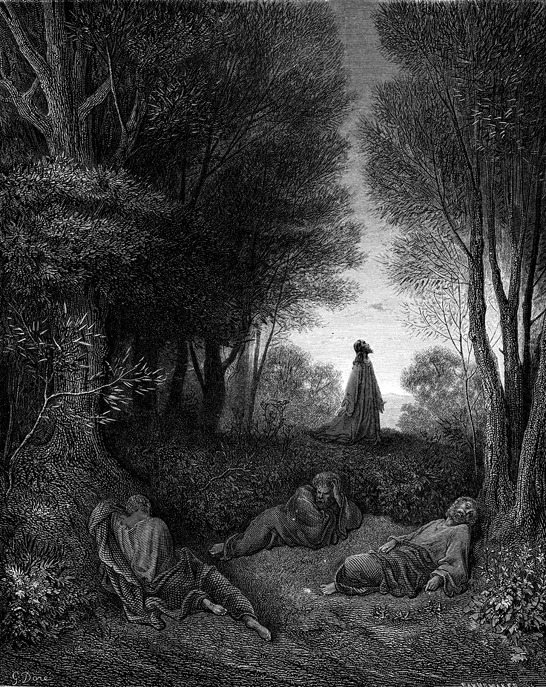
Gethsemane: Not as I Will
Matthew 26:31-32
Jesus says they will all fall away that night and cites Zechariah 13:7. The shepherd language of 9:36 and 18:12 reaches its darkest point here. He answers the scattering with a promise to go ahead of them into Galilee after he has risen, the struck shepherd leading the flock again.
Matthew 26:31
“He foretels what they should suffer, that they might not after it had befallen them despair of salvation; but doing penitence might be set free. And He adds emphatically this night, (1 These. 5:7.) because as they that are drunken are drunken by night, so they that are scandalized are scandalized by night, and in the dark. This is found in Zacharias in words different; it is said to God in the person of the Prophet, Smite the shepherd, and the sheep will be scattered abroad. (Zech. 13:7.)”
Jerome · written before 420 · Catena Aurea by Aquinaspatristic
1 more voice on this verse
Matthew 26:31
“Jesus foretells the fall of Peter - This is also recorded in Mar 14:27-31; Luk 22:31-34; Joh 13:34-38. Mat 26:31 Then saith Jesus unto them - The occasion of his saying this was Peter’s bold affirmation that he was ready to die with him, Joh 13:36 Jesus had told them that he was going away - that is, was about to die. Peter asked him whither he was going. Jesus replied that he could not follow him then, but should afterward. Peter, not satisfied with that, said that he was ready to lay down his life for him.”
Cross references
Matthew 26:31
- QuotingZechariah 13:7“Awake, O sword, against My Shepherd, against the man who is My Companion, declares the LORD of Hosts. Strike the Shepherd, and the sheep will be scattered, and I will turn My hand against the little ones.”
'I will smite the shepherd, and the sheep shall be scattered' ('it is written')
Adam Clarke hears the shepherd of verse 31 still speaking, with the scattered flock gathered again and led from the front. The angel at the tomb repeats this promise in 28:7. The eleven meet him on a mountain in Galilee in 28:16.
Matthew 26:32
“But after I am risen again - Don’t lose your confidence; for though I shall appear for a time to be wholly left to wicked men, and be brought under the power of death, yet I will rise again, and triumph over all your enemies and mine. I will go before you - Still alluding to the case of the shepherd and his sheep. Though the shepherd has been smitten and the sheep scattered, the shepherd shall revive again, collect the scattered flock, and go before them, and lead them to peace, security, and happiness.”
Adam Clarke · Commentary on the Bible (1810-1826)evangelical
Matthew 26:33-35
Peter sets himself against the prophecy just given: "Even if all fall away on account of You, I never will". Jesus answers with an exact prediction, that "before the rooster crows, you will deny Me three times". Peter vows to die before he denies him.
Matthew 26:33
“Peter - said unto him, Though all men shall be offended - yet will I never - The presumptuous person imagines he can do every thing, and can do nothing: thinks he can excel all, and excels in nothing: promises every thing, and performs nothing. The humble man acts a quite contrary part. There is nothing we know so little of as ourselves - nothing we see less of than our own weakness and poverty. The strength of pride is only for a moment.”
Adam Clarke · Commentary on the Bible (1810-1826)evangelical
before the rooster crows: John Wesley places cockcrow near three in the morning, the usual hour a rooster was heard. Mark 14:30 has the rooster crow twice. Jerome sees meaning in the hour, for Peter denies in the darkness and weeps as the light returns.
Matthew 26:34
“Before cock crowing thou wilt deny me thrice - That is, before three in the morning, the usual time of cock crowing: although one cock was heard to crow once, after Peter's first denial of his Lord.”
John Wesley · Explanatory Notes upon the New Testament (1755)evangelical
Rabanus Maurus reads Peter as answering the threat he expected, the fear of death. The other disciples make the same vow in the same zeal. All of them flee at verse 56.
Matthew 26:35
“Peter understood the Lord to have foretold that he should deny Him under terror of death, and therefore he declares that though death were imminent, nothing could shake him from his faith; and the other Apostles in like manner in the warmth of their zeal, valued not the infliction of death, but human presumption is vain without Divine aid.”
Rabanus Maurus · written before 856 · Catena Aurea by Aquinaspatristic
Matthew 26:36-38
a place called Gethsemane: Jesus goes with his disciples to Gethsemane, a name meaning oil press, a garden among olive trees at the foot of the Mount of Olives. He takes Peter and the two sons of Zebedee, the three who saw the transfiguration, and "began to be sorrowful and deeply distressed".
Matthew 26:36
“A place called Gethsemane - A garden at the foot of the mount of Olives. The name seems to be formed from גת gath, a press, and סמן shemen, oil; probably the place where the produce of the mount of Olives was prepared for use. The garden of the oil-press, or olive-press. Sit ye here - Or, stay in this place, while I go and pray yonder: and employ ye the time as I shall employ it - in watching unto prayer.”
Adam Clarke · Commentary on the Bible (1810-1826)evangelical
2 more voices on this verse
Matthew 26:36
“Then cometh Jesus to a place called Gethsemane - That is, the valley of fatness. The garden probably had its name from its soil and situation, laying in some little valley between two of those many hills, the range of which constitutes the Mount of Olives.”
John Wesley · Explanatory Notes upon the New Testament (1755)evangelical
Matthew 26:36
The verses we have now read describe what is commonly called Christ’s agony at Gethsemane. It is a passage which undoubtedly contains deep and mysterious things. We ought to read it with reverence and wonder, for there is much in it which we cannot fully comprehend. Why do we find our Lord so “sorrowful and very heavy,” as he is here described? What are we to make of his words, “My soul is exceeding sorrowful even unto death.”
J.C. Ryle · Expository Thoughts on the Gospels: Matthew (1856)Reformed Evangelical
the two sons of Zebedee: The words sorrowful and deeply distressed stand for two Greek verbs. John Wesley reads the first as sorrow that pierces and the second as a man pressed down and almost overwhelmed. Adam Clarke describes a sorrow that drains the body's strength.
Matthew 26:37
“And he took with him Peter and the two sons of Zebedee - That is, James and John; the same persons who had beheld his transfiguration on the mount - that they might contemplate this agony in the light of that glory which they had there seen; and so be kept from being stumbled by a view of his present humiliation. Began to be sorrowful - Λυπεισθαι, from λυω, to dissolve - exquisite sorrow, such as dissolves the natural vigor, and threatens to separate soul and body. And very heavy - Overwhelmed with anguish - αδημονειν.”
Adam Clarke · Commentary on the Bible (1810-1826)evangelical
1 more voice on this verse
Matthew 26:37
“Who can tell what painful and dreadful sensations were then impressed on him by the immediate hand of God? The former word in the original properly signifies, to be penetrated with the most exquisite sorrow; the latter to be quite depressed, and almost overwhelmed with the load.”
John Wesley · Explanatory Notes upon the New Testament (1755)evangelical
sorrow to the point of death: Adam Clarke reads the phrase as literal, a soul so consumed that death would follow without help. Jerome sees a real human sorrow here. He distinguishes sorrow that begins in the soul from sorrow that rules it, and Jesus knew the first without being mastered.
Matthew 26:38
“Then saith he - Then saith - Jesus: - I have added the word Jesus, ὁ Ιησους, on the authority of a multitude of eminent MSS. See them in Griesbach. My soul is exceeding sorrowful, (or, is surrounded with exceeding sorrow), even unto death - This latter word explains the two former: My soul is so dissolved in sorrow, my spirit is filled with such agony and anguish, that, if speedy succor be not given to my body, death must be the speedy consequence.”
Adam Clarke · Commentary on the Bible (1810-1826)evangelical
let this cup pass from Me: Jesus falls facedown and prays, "let this cup pass from Me," the cup being a familiar Old Testament figure for the wrath of God's judgment. He submits his will to the Father's: "Yet not as I will, but as You will". The honest request and the full submission stand together.
Matthew 26:39
“And going a little farther - About a stone's cast, Luke xxii, 41 - So that the apostles could both see and hear him still. If it be possible, let this cup pass from me - And it did pass from him quickly. When he cried unto God with strong cries and tears, he was heard in that which he feared.”
John Wesley · Explanatory Notes upon the New Testament (1755)evangelical
2 more voices on this verse
Matthew 26:39
“Fell on his face - See the note on Luk 22:44. This was the ordinary posture of the supplicant when the favor was great which was asked, and deep humiliation required. The head was put between the knees, and the forehead brought to touch the earth - this was not only a humiliating, but a very painful posture also. This cup - The word cup is frequently used in the Sacred Writings to point out sorrow, anguish, terror, death. It seems to be an allusion to a very ancient method of punishing criminals.”
Adam Clarke · Commentary on the Bible (1810-1826)evangelical
Matthew 26:39
“THE Apostle Paul, writing concerning our Lord Jesus Christ, says, "Though He were a Son, yet learned He obedience by the things which He suffered." He who, as God, knew all things, had to learn obedience in the time of His humiliation. He who is, in Himself, Wisdom Incarnate, did, Himself, condescend to enter the school of suffering—there we learn that important lesson of the Christian life—obedience to the will of God. And here, in Gethsemane's Garden, you can see the Divine Scholar going forth to practice His lesson.”
Charles Spurgeon · written before 1892 · The Metropolitan Tabernacle Pulpit, Sermon No. 2715: “Christian Resignation” (lightly modernized text, CCEL edition)Particular Baptist
Matthew 26:40-41
to keep watch with Me: Jesus finds the disciples sleeping and puts the question "Were you not able to keep watch with Me for one hour?" to Peter, the man who had just vowed to die with him. The command "Watch and pray so that you will not enter into temptation" names their coming failure.
Matthew 26:40
“He - saith unto Peter - He addressed himself more particularly to this apostle, because of the profession he had made, Mat 26:33; as if he had said: “Is this the way you testify your affectionate attachment to me? Ye all said you were ready to die with me; what, then, cannot you watch One hour?” Instead of ουκ ισχυσατε, could Ye not, the Codex Alexandrinus, the later Syriac in the margin, three of the Itala, and Juvencus, read ουκ ισχυσας, couldst Thou not - referring the reproach immediately to Peter, who had made the promises mentioned before.”
Adam Clarke · Commentary on the Bible (1810-1826)evangelical
Jerome reads the wording closely: temptation comes to every mind, and the prayer asks that it never gain the victory. John Wesley hears a gentle rebuke with a kind excuse inside it. Jesus spoke it while his own soul was heavy with sorrow.
Matthew 26:41
“That ye enter not into temptation - If ye cannot endure a little fatigue when there is no suffering, how will ye do when the temptation, the great trial of your fidelity and courage, cometh? Watch - that ye be not taken unawares; and pray - that when it comes ye may be enabled to bear it. The spirit - is willing, but the flesh is weak - Your inclinations are good - ye are truly sincere; but your good purposes will be overpowered by your timidity.”
Adam Clarke · Commentary on the Bible (1810-1826)evangelical
2 more voices on this verse
Matthew 26:41
“It is impossible that the human mind should not be tempted, therefore He says not Watch and pray that ye be not tempted, but that ye enter not into temptation, that is, that temptation vanquish you not. This is against those rash persons who think that whatever they believe they can perform. The more confident we are of our zeal, the more mistrustful should we be of the frailty of the flesh.”
Jerome · written before 420 · Catena Aurea by Aquinaspatristic
Matthew 26:41
“The spirit - Your spirit: ye yourselves. How gentle a rebuke was this, and how kind an apology! especially at a time when our Lord's own mind was so weighed down with sorrow.”
John Wesley · Explanatory Notes upon the New Testament (1755)evangelical
Matthew 26:42-44
The second prayer narrows the first: verse 39 asked whether the cup could pass, and Jesus accepts it will not pass "unless I drink it". He finds them asleep a second time, "for their eyes were heavy," and prays a third time, "saying the same thing".
Matthew 26:42
“O my Father, if this cup may not pass away from me - If it be not possible - to redeem fallen man, unless I drink this cup, unless I suffer death for them; thy will be done - I am content to suffer whatever may be requisite to accomplish the great design. In this address the humanity of Christ most evidently appears; for it was his humanity alone that could suffer; and if it did not appear that he had felt these sufferings, it would have been a presumption that he had not suffered, and consequently made no atonement.”
Adam Clarke · Commentary on the Bible (1810-1826)evangelical
their eyes were heavy: Luke 22:45 traces their sleep to sorrow. Adam Clarke asks whether the powers of darkness added weight to their eyes. Jerome reads the heaviness as a sign of the denial close at hand, and he notes that Jesus prays alone for all.
Matthew 26:43
“Their eyes were heavy - That is, they could not keep them open. Was there nothing preternatural in this? Was there no influence here from the powers of darkness?”
Adam Clarke · Commentary on the Bible (1810-1826)evangelical
prayed a third time: Adam Clarke sets the third prayer beside Paul, who prayed three times for his thorn to be taken away in 2 Corinthians 12:8. Saying the same thing again marks earnest desire. Jerome links the three prayers to the law of two or three witnesses in Deuteronomy 19:15.
Matthew 26:44
“He prayed the third time, that in the mouth of two or three witnesses every word might be established.”
Jerome · written before 420 · Catena Aurea by Aquinaspatristic
1 more voice on this verse
Matthew 26:44
“Prayed the third time - So St. Paul - I besought the Lord Thrice that it might depart from me, 2Co 12:8. This thrice repeating the same petition argues deep earnestness of soul.”
Adam Clarke · Commentary on the Bible (1810-1826)evangelical
Matthew 26:45-46
the hour is near: Jesus announces that "the hour is near, and the Son of Man is betrayed into the hands of sinners," the arrest arriving as he speaks. The hour of his earlier sayings has now come. With "Rise, let us go," he goes out to meet his betrayer.
Matthew 26:45
“Sleep on now, and take your rest - Perhaps it might be better to read these words interrogatively, and paraphrase them thus: Do ye sleep on still? Will no warnings avail? Will no danger excite you to watchfulness and prayer? My hour - in which I am to be delivered up, is at hand; therefore now think of your own personal safety. The Son of man is betrayed into the hands of sinners - Αμαρτωλων, viz. the Gentiles or heathens, who were generally distinguished by this appellation from the Jews.”
Adam Clarke · Commentary on the Bible (1810-1826)evangelical
1 more voice on this verse
Matthew 26:45
“Having concluded His third prayer, and having obtained that the Apostles' terror should be corrected by subsequent penitence, He goes forth undaunted by the prospect of His own Passion to meet His pursuers, and offers Himself voluntarily to be sacrificed. Arise, let us be going; as much as to say, Let them not find you trembling, let us go forth willingly to death, that they may see us confident and rejoicing in suffering; Lo, he that shall betray me draweth near.”
Jerome · written before 420 · Catena Aurea by Aquinaspatristic
Jerome hears the command to rise as a call to go out to the betrayer without trembling. Jesus gives himself up to death of his own will. Adam Clarke reads it as proof that Jesus knew their plan and could have fled; he goes to meet them.
Matthew 26:46
“Rise, let us be going - That is, to meet them, giving thereby the fullest proof that I know all their designs, and might have, by flight or otherwise, provided for my own safety; but I go willingly to meet that death which their malice designs me, and, through it, provide for the life of the world.”
Adam Clarke · Commentary on the Bible (1810-1826)evangelical
Betrayed With a Kiss
Matthew 26:47-49
large crowd armed with swords: Judas, "one of the Twelve," arrives with a large crowd "armed with swords and clubs," sent by the chief priests and elders. The signal, "The One I kiss is the man; arrest Him," turns the greeting of a disciple to his rabbi into the means of betrayal.
Matthew 26:47
“And while he yet spake,.... While he was thus speaking to his disciples, before the last words, he is at hand that doth betray me, were well out of his mouth; such an exact knowledge had Christ of every motion of Judas, of what he was about, and where he was: lo! Judas, one of the twelve, came. The Persic version adds, "in sight"; of Christ, and the disciples; they saw him, and knew him, though some little distance: he came to Gethsemane, and into the garden, where they were, with a design to betray his master.”
3 more voices on this verse
Matthew 26:47
“The account of Jesus’ being betrayed by Judas is recorded by all the evangelists. See Mar 14:43-52; Luk 22:47-53; Joh 18:2-12. Mat 26:47 Judas, one of the twelve, came - This was done while Jesus was addressing his disciples. John informs us that Judas knew the place, because Jesus was in the habit of going there with his disciples. Judas had passed the time, after he left Jesus and the other disciples at the Passover, in arranging matters with the Jews, collecting the band, and preparing to go.”
Matthew 26:47
“Some may say that a great multitude came, because of the great multitude of those who already believed, who, they feared, might rescue Him out of their hands; but I think there is another reason for this, and that is, that they who thought that He cast out dæmons through Beelzebub, supposed that by some magic He might escape the hands of those who sought to hold Him.”
Origen of Alexandria · written before 253 · Catena Aurea by Aquinaspatristic
Matthew 26:47
“We see in these verses the cup of our Lord Jesus Christ’s sufferings beginning to be filled. We see him betrayed by one of his disciples, forsaken by the rest, and taken prisoner by his deadly enemies. Never surely was there sorrow like his sorrow. Never may we forget, as we read this part of the Bible, that our sins were the cause of these sorrows! Jesus was “delivered was delivered for our offences.” ( Romans 4:25 ). Let us notice for one thing in these verses what gracious condescension marked our Lord’s intercourse with his disciples.”
J.C. Ryle · Expository Thoughts on the Gospels: Matthew (1856)Reformed Evangelical
had arranged a signal with them: The kiss would single him out at night. Jerome says Judas took the miracles of Jesus for magic. He adds that Judas feared another change like the one on the mountain, by which Jesus might slip from the soldiers' hands.
Matthew 26:48
“Gave them a sign - How coolly deliberate is this dire apostate! The man whom I shall kiss - how deeply hypocritical! That is he, hold him fast, seize him - how diabolically malicious! Hail, Master - A usual compliment among the Jews. Judas pretends to wish our Lord continued health while he is meditating his destruction! How many compliments of this kind are there in the world!”
Adam Clarke · Commentary on the Bible (1810-1826)evangelical
John Gill notes that Judas went ahead of the crowd, as Luke records, so that he would seem to have come apart from them. Gill compares Joab, who greeted Amasa with a kiss and struck him dead in 2 Samuel 20:9-10. The greeting wished Jesus health, as Adam Clarke notes.
Matthew 26:50-51
seized Jesus, and arrested Him: Jesus still calls Judas "Friend" and tells him "do what you came for". The men then seize him, the end the council planned in verse 4. One of his companions cuts off the ear of the servant of the high priest, and John names the two as Peter and Malchus.
Matthew 26:50
“And Jesus said unto him, friend,.... Not in an ironical and sarcastic way, but because he pretended to be his friend, by saluting and kissing him, in the manner he had done; or rather, because Christ had always used him as his friend, his familiar friend, who had been of his councils, and had ate at his table; and therefore this carried in it something very cutting, had Judas had any conscience, or sense of gratitude: wherefore art thou come?”
1 more voice on this verse
Matthew 26:50
“Jesus said - Friend - Rather, companion, εταιρε, (not Friend), wherefore, rather, against whom (εφ’ ὃ, the reading of all the best MSS.) art thou come? How must these words have cut his very soul, if he had any sensibility left! Surely, thou, who hast so long been my companion, art not come against me, thy Lord, Teacher and Friend! What is the human heart not capable of, when abandoned by God, and influenced by Satan and the love of money!”
Adam Clarke · Commentary on the Bible (1810-1826)evangelical
cutting off his ear: Luke and John both specify the right ear. Adam Clarke notes that the Greek verb means the ear was taken off entirely. Jerome reads the servant's name, Malchus, which means king, as a picture of the former kingship of the Jewish people now serving the priests.
Matthew 26:51
“One of them which were with Jesus - This was Peter - struck a servant of the high priest’s, the servant’s name was Malchus, Joh 18:10, and smote off his ear. In Luk 22:51, it is said, Jesus touched and healed it. Here was another miracle, and striking proof of the Divinity of Christ. Peter did not cut the ear, merely, he cut it Off, αφειλεν.”
Adam Clarke · Commentary on the Bible (1810-1826)evangelical
Matthew 26:52-54
sword will die by the sword: Jesus orders the sword put away with a general rule, "all who draw the sword will die by the sword". He could call on his Father for "more than twelve legions of angels," so his arrest is his own choice. He yields so that the Scriptures will be fulfilled.
Matthew 26:52
“Put up again thy sword into his place - Neither Christ nor his religion is to be defended by the secular arm. God is sufficiently able to support his ark: Uzzah need not stretch out his hand on the occasion. Even the shadow of public justice is not to be resisted by a private person, when coming from those in public authority. The cause of a Christian is the cause of God: sufferings belong to one, and vengeance to the other. Let the cause, therefore, rest in his hands, who will do it ample justice.”
Adam Clarke · Commentary on the Bible (1810-1826)evangelical
more than twelve legions of angels?: Jerome and Adam Clarke both set the twelve legions against the twelve disciples, one of whom had just betrayed him. John Wesley adds that the least of these angels could overturn the earth. Jesus leaves that prayer unspoken.
Matthew 26:53
“More than twelve legions of angels? - As if he had said, Instead of you twelve, one of whom is a traitor, my Father can give me more than twelve legions of angels to defend me. A legion, at different times, contained different numbers; 4,200, 5,000, and frequently 6,000 men; and from this saying, taking the latter number, which is the common rate, may we not-safely believe that the angels of God amount to more than 72,000?”
Adam Clarke · Commentary on the Bible (1810-1826)evangelical
1 more voice on this verse
Matthew 26:53
“He will presently give me more than twelve legions of angels - The least of whom, it is probable, could overturn the earth and destroy all the inhabitants of it.”
John Wesley · Explanatory Notes upon the New Testament (1755)evangelical
would the Scriptures be fulfilled: Adam Clarke names the passages most in view as Psalms 22 and 69, Isaiah 53 and Daniel 9:24-27. Jerome says the prophets would have spoken in vain unless the Lord confirmed their words by suffering. The necessity lies in what God had written.
Matthew 26:54
“But how then - Had I such a defense - shall the Scriptures be fulfilled, which say, that thus it must be? That is, that I am to suffer and die for the sin of the world. Probably the Scriptures to which our Lord principally refers are Psalm 22, 69, and especially Isa 53:1-12, and Dan 9:24-27. Christ shows that they had no power against him but what he permitted; and that he willingly gave up himself into their hands.”
Adam Clarke · Commentary on the Bible (1810-1826)evangelical
1 more voice on this verse
Matthew 26:54
“This speech shows a mind willing to suffer; vainly would the Prophets have prophesied truly, unless the Lord asserts their truth by His suffering.”
Jerome · written before 420 · Catena Aurea by Aquinaspatristic
Matthew 26:55-56
as you would an outlaw?: Jesus asks why the crowd comes "with swords and clubs" as against an outlaw. He names the same purpose as verse 54, "that the writings of the prophets would be fulfilled". Then "all the disciples deserted Him and fled," as he foretold at verse 31 from Zechariah 13:7.
Matthew 26:55
“Are ye come out as against a thief - At this time Judea was much infested by robbers, so that armed men were obliged to be employed against them - to this our Lord seems to allude. See on Mat 26:52 (note). I sat daily with you - Why come in this hostile manner? Every day, for four days past, ye might have met with me in the temple, whither I went to teach you the way of salvation. See on Mat 21:17 (note).”
Adam Clarke · Commentary on the Bible (1810-1826)evangelical
deserted Him and fled: Adam Clarke takes the first sentence as Matthew's own comment, like his fulfilment notes elsewhere. John Gill reads it as the words of Jesus, since Mark 14:49 puts the saying in his mouth. Clarke adds that even Peter and John fled.
Matthew 26:56
“But all this was done, that the Scriptures of the prophets might be fulfilled,.... Some have thought these to be the words of the evangelist, making this remark upon what was said and done; but by what both Mark and Luke record, Mar 14:49, they appear to be the words of Christ himself; who observes this, partly to make himself, as man, easy under the treatment he met with; and partly, to fortify the minds of his disciples against offence at it; and also to throw conviction, or confusion, into the minds of his enemies.”
1 more voice on this verse
Matthew 26:56
“But all this was done - This is probably the observation of the evangelist. See on Mat 2:23 (note). Then all the disciples forsook him and fled - O what is man! How little is even his utmost sincerity to be depended on! Jesus is abandoned by all! - even zealous Peter and loving John are among the fugitives! Was ever master so served by his scholars? Was ever parent so treated by his children? Is there not as much zeal and love among them all as might make one martyr for God and truth?”
Adam Clarke · Commentary on the Bible (1810-1826)evangelical
Cross references
Matthew 26:56
- Quoted inMatthew 26:56“But this has all happened so that the writings of the prophets would be fulfilled.” Then all the disciples deserted Him and fled.”
touto de holon gegonen hina plerothosin hai graphai ton propheton ('that the scriptures of the prophets might be fulfilled'), a plural-scriptures fulfillment frame with no single source; the arrest as fulfilling Scripture wholesale
Before Caiaphas and the Council
Matthew 26:57-58
to the house of Caiaphas: Jesus is taken to the house of Caiaphas, where the scribes and elders meet at night, though Jewish law generally forbade capital trials after dark. Peter follows "at a distance, right up to the courtyard of the high priest," and sits with the guards "to see the outcome".
Matthew 26:57
“They - led him away to Caiaphas - John says, Joh 18:13, that they led him first to Annas; but this appears to have been done merely to do him honor as the father-in-law of Caiaphas, and his colleague in the high priesthood. But as the Sanhedrin was assembled at the house of Caiaphas, it was there he must be brought to undergo his mock trial: but see on Joh 18:13 (note).”
Adam Clarke · Commentary on the Bible (1810-1826)evangelical
1 more voice on this verse
Matthew 26:57
“We read, in these verses, how our Lord Jesus Christ was brought before Caiaphas, the high priest, and solemnly pronounced guilty. It was fitting that it should be so. The great day of atonement was come: the wondrous type of the scapegoat was about to be completely fulfilled. It was only suitable that the Jewish high priest should do his part, and declare sin to be upon the head of the victim, before he was led forth to be crucified ( Leviticus 16:21 ). May we ponder these things and understand them.”
J.C. Ryle · Expository Thoughts on the Gospels: Matthew (1856)Reformed Evangelical
to see the outcome: Jerome notes that the others fled while Peter still followed, however far behind. John 18:15-16 adds that another disciple, known to the high priest, brought Peter inside, and John Gill records that he is thought to be John. Adam Clarke warns weak believers to avoid snares.
Matthew 26:58
“And entering inside, he sat with the ministers, to see the end.... Whether out of love for his disciples or out of human curiosity, the high priest wanted to know what he would decide about the Lord: whether he would condemn him to death or release him after beating him. And there was a difference of opinion among the ten apostles and Peter. Those (people) flee, but this one, although far away, still follows the Savior.”
Jerome · written before 420 · Commentary on Matthewpatristic
2 more voices on this verse
Matthew 26:58
“Peter followed him afar off - Poor Peter! this is the beginning of his dreadful fall. His fear kept him from joining the company, and publicly acknowledging his Lord; and his affection obliged him to follow at a distance that he might see the end. And sat with the servants, to see the end - When a man is weak in faith, and can as yet only follow Christ at a distance, he should avoid all dangerous places, and the company of those who are most likely to prove a snare to him.”
Adam Clarke · Commentary on the Bible (1810-1826)evangelical
Matthew 26:58
“But Peter followed him afar off,.... The Ethiopic version adds, alone; and which seems to be the true case; for though there was another disciple who also followed Jesus, and is thought to be John, yet it looks as if they followed him separately, and not together; for the other disciple went into the palace with Jesus, but Peter not till afterwards, being espied by his fellow disciple standing without.”
Matthew 26:59-61
seeking false testimony against Jesus: The chief priests and the Sanhedrin seek "false testimony against Jesus in order to put Him to death," so the verdict comes before the evidence. Many false witnesses come forward, until two claim he said, "I am able to destroy the temple of God and rebuild it in three days".
Matthew 26:59
“False witness - That is, they sought for witnesses who would accuse him of crime of violation of the laws of the land or of God. We are not to suppose that “they wished” them to be “false” witnesses. They were indifferent, probably, whether they were true or false, if they could succeed in condemning him. “The evangelist” calls it false testimony. Before these witnesses were sought, we learn from John Joh 18:19-23 that the high priest asked Jesus of his disciples and his doctrine.”
many false witnesses came forward: The law required two or three witnesses to agree before a man could be put to death, as Deuteronomy 17:6 sets out. The council finally found two. Thomas Aquinas reads the long failure to find a charge as a mark of the innocence of Christ.
Matthew 26:60
“Though many false witnesses came - There is an unaccountable confusion in the MSS. in this verse: without stating the variations, which may be seen in Griesbach, I shall give that which I believe to be the genuine sense of the evangelist.”
Adam Clarke · Commentary on the Bible (1810-1826)evangelical
1 more voice on this verse
Matthew 26:60
“Yet found they none - On whose evidence they could condemn him to die. At last came two false witnesses - Such they were, although part of what they said was true; because our Lord did not speak some of those words at all; nor any of them in this sense.”
John Wesley · Explanatory Notes upon the New Testament (1755)evangelical
Jerome defines a false witness as one who repeats words in a sense other than the speaker's. Mark 14:58 gives the charge in a longer form, contrasting a temple built by human hands with one built without them. Albert Barnes takes both forms as spoken at the trial.
Matthew 26:61
“And said, This fellow said ... - Mark has recorded this testimony differently. According to him, they said, “We heard him say, I will destroy this temple that is made with hands, and within three days I will build another. made without hands.” Probably both forms of giving in the testimony were used on the trial, and Matthew has recorded it as it was given at one time and Mark at another, so that there is no contradiction.”
Matthew 26:62-64
Pressed to answer testimony that has already failed, Jesus stays silent, as Isaiah 53:7 describes. Put under oath "by the living God," he answers "You have said it yourself," a plain yes under the oath formulas. His words on the Son of Man join Daniel 7:13 and Psalm 110:1.
Matthew 26:62
“Headlong and uncontrolled rage, unable to find even a false accusation, moves the High Priest from his throne, the motion of his body showing the emotion of his mind. And the High Priest arose, and said unto him, Answerest thou nothing to the things which these witness against Thee? For as God, He knew that whatever He said would be twisted into an accusation against Him. But at this His silence before false witnesses and ungodly Priests, the High Priest was exasperated, and summons Him to answer, that from anything He says he may raise a charge against Him.”
Jerome · written before 420 · Catena Aurea by Aquinaspatristic
under oath by the living God: Clarke notes Jesus kept silent before contradictory evidence, then answered at once when called on in the name of God to confess the truth. The oath bound him to answer. Jerome presses the high priest, since he put Jesus under oath to condemn him and refused to believe the answer.
Matthew 26:63
“I adjure thee by the living God - I put thee to thy oath. To this solemn adjuration Christ immediately replies, because he is now called on, in the name of God, to bear another testimony to the truth. The authority of God in the most worthless magistrate should be properly respected. However necessary our Lord saw it to be silent, when the accusations were frivolous, and the evidence contradictory, he felt no disposition to continue this silence, when questioned concerning a truth, for which he came into the world to shed his blood.”
Adam Clarke · Commentary on the Bible (1810-1826)evangelical
at the right hand of Power: John Wesley notes that Jesus speaks of himself in the third person, modestly and yet plainly, and he reads Power as a name for God. Adam Clarke reads the coming on the clouds as judgment on that generation within a few years. The judge would become the judged.
Matthew 26:64
“Hereafter shall ye see the Son of man - He speaks in the third person, modestly, and yet plainly; Sitting on the right hand of power - That is, the right hand of God: And coming upon the clouds of heaven - As he is represented by Daniel, Dan. vii, 13, 14.”
John Wesley · Explanatory Notes upon the New Testament (1755)evangelical
1 more voice on this verse
Matthew 26:64
“Our Lord, before His enemies, was silent in His own defense, but He faithfully warned and boldly avowed the Truth of God. His was the silence of patience, not of indifference—of courage, not of cowardice. It is written that "before Pontius Pilate He witnessed a good confession," and that statement may, also, be well applied to His utterances before Caiaphas, for there He was not silent when it came to confession of necessary Truths of God.”
Cross references
Matthew 26:64
- QuotingPsalms 110:1The LORD said to my Lord: “Sit at My right hand until I make Your enemies a footstool for Your feet.”
'sitting on the right hand of power', before the Sanhedrin (w/ Dan 7:13)
ConnectionsPsalms 110:1
Matthew 26:65-68
high priest tore his clothes: The high priest tears his clothes, the prescribed act on hearing blasphemy, and treats Jesus' own claim as the capital charge sought since verse 59. The council answers "He deserves to die," a verdict his own words supplied. They spit in his face, an abuse that echoes Isaiah 50:6.
Matthew 26:65
“Then the high priest rent his clothes,.... Both his outer and inner garments. This he did, to show his zeal for the honour and glory of God, his grief and concern at the profanation of his holy name by a false oath, and his abhorrence of, and indignation at the blasphemy he supposed Christ to be guilty of, in asserting himself to be the Son of God.”
1 more voice on this verse
Matthew 26:65
“Then the high priest rent his clothes - Though the high priest was forbidden to rend his clothes (that is, his upper garment) in some cases where others were allowed to do it, Lev. xxi, 10; yet in case of blasphemy or any public calamity, it was thought allowable.”
John Wesley · Explanatory Notes upon the New Testament (1755)evangelical
Adam Clarke observes that the high priest acted as judge and accuser at once. The council answered without weighing the miracles of Jesus or the words of the prophets. Origen sees the irony: the council said the source of all life deserves to die.
Matthew 26:66
“How great their error! to pronounce the principle of all men's life to be guilty of death, and not to acknowledge by the testimony of the resurrection of so many, the Fount of life, from Whom life flows to all that rise again.”
Origen of Alexandria · written before 253 · Catena Aurea by Aquinaspatristic
1 more voice on this verse
Matthew 26:66
“He is guilty of death - Ενοχος θανατου εστι, he is liable to death. All the forms of justice are here violated. The judge becomes a party and accuser, and proceeds to the verdict without examining whether all the prophecies concerning the Messiah, and the innumerable miracles which he wrought, did not justify him. Examination and proof are the ruin of all calumnies, and of the authors of them, and therefore they take care to keep off from these two things. See Quesnel.”
Adam Clarke · Commentary on the Bible (1810-1826)evangelical
they spit in His face: Albert Barnes says the men who struck Him used fists and then open hands, with a Greek word that can mean striking the mouth. To spit in a man's face was the deepest insult, as in Numbers 12:14. John Wesley gives the abuse to the guards.
Matthew 26:67
“Then did they spit in his face - This, among the Jews, as among us, was significant of the highest contempt and insult, Num 12:14; Isa 50:6; Job 30:10. And buffeted him - That is, they struck him with their hands closed, or with the fist. Others smote him with the palms of their hands - The word used in the original here means literally to strike with rods. It also means to strike the mouth with the open hand, as if to prevent a person’s speaking, or to evince abhorrence of what he had spoken.”
1 more voice on this verse
Matthew 26:67
“Then - After he had declared he was the Son of God, the sanhedrim doubtless ordered him to be carried out, while they were consulting what to do. And then it was that the soldiers who kept him began these insults upon him.”
John Wesley · Explanatory Notes upon the New Testament (1755)evangelical
Mark 14:65 records they blindfolded Him first, as Adam Clarke notes, so the men who struck Him told Him to prophesy who had done it. The mockery aims at the name Christ. Jerome answers that Jesus had already prophesied the siege of Jerusalem and the fall of the temple.
Matthew 26:68
“Prophesy unto us, thou Christ - Their conduct toward him now was expressly prophesied of, by a man whose Divine mission they did not pretend to deny; see Isa 50:6. It appears that, before they buffeted him, they bound up his eyes, See Mar 14:65.”
Adam Clarke · Commentary on the Bible (1810-1826)evangelical
Peter Denies Him Three Times
Matthew 26:69-70
girl came up to him: Peter sits in the courtyard, and a servant girl says, "You also were with Jesus the Galilean," the first test of the denial foretold. He denies it "before them all" with an outright lie, "I do not know what you are talking about". The fall comes hours after his vow.
Matthew 26:69
Upon examining Peter's denial, we note that "as yet the Spirit had not been given, because Jesus was not yet glorified." For this reason, neither was it possible for Peter at the time to profess belief in Jesus nor was he to be criticized for not professing belief in him, since it is said to those who profess belief: "It is not you who speak, but the Spirit of your Father speaking through you."
Origen of Alexandria · written before 253 · Commentary on Matthew 114patristic
2 more voices on this verse
Matthew 26:69
“Now Peter sat without in the palace - Mark says the first denial took place while Peter was “beneath in the palace.” This “palace” was the large hall or court belonging to the residence of the high priest. The part of it where Jesus and the council were was “elevated,” probably above the rest for a tribunal. Peter was “beneath or in the “lower part” of the hall, with the servants at the fire.”
Matthew 26:69
“These verses relate a remarkable and deeply instructive event: the apostle Peter’s denial of Christ. It is one of those events which indirectly prove the truth of the Bible. If the Gospel had been a mere invention of man, we should never have been told that one of its principal preachers was once so weak and erring as to deny his Master. The first thing that demands our notice is the full nature of the sin of which Peter was guilty. It was a great sin.”
J.C. Ryle · Expository Thoughts on the Gospels: Matthew (1856)Reformed Evangelical
he denied it before them all: Adam Clarke traces the fall in stages, from following at a distance to open denial. Origen notes that the Spirit had yet to be given, as John 7:39 says. Ambrose prefers a denying Peter to a Lord proved false.
Matthew 26:70
“But he denied before them all - So the evil principle gains ground. Before, he followed at a distance, now he denies; this is the second gradation in his fall.”
Adam Clarke · Commentary on the Bible (1810-1826)evangelical
Matthew 26:71-72
another servant girl saw him: At the gateway another servant girl tells the people there, "This man was with Jesus of Nazareth," so the charge now reaches a wider audience. Peter denies it again "with an oath," and the plain lie of verse 70 becomes a sworn one: "I do not know the man!"
Matthew 26:71
“When he was gone out into the porch - The “entrance,” or the small apartment between the outer door and the large hall in the center of the building. See plan of a house, Notes, Mat 9:1-8. Peter was embarrassed and confused by the question, and to save his confusion from attracting notice, he went away from the fire into the porch, where he expected to be unobserved - yet in vain. By the very movement to avoid detection, he came into contact with another who knew him and repeated the charge.”
denied it with an oath: Adam Clarke observes that a liar reaches for an oath because he suspects his word is doubted. Peter now calls Jesus only the man. In 5:33-37 Jesus had forbidden his disciples to swear oaths at all.
Matthew 26:72
“And again he denied with an oath - This is a third gradation of his iniquity. He has told a lie, and he swears to support it. A liar has always some suspicion that his testimony is not credited, for he is conscious to his own falsity, and is therefore naturally led to support his assertions by oaths.”
Adam Clarke · Commentary on the Bible (1810-1826)evangelical
Matthew 26:73-75
Bystanders tell Peter "Surely you are one of them," adding that "your accent gives you away," his Galilean speech plain to hear in Jerusalem. He begins "to curse and swear," and the third denial completes what Jesus foretold at verse 34. John's Gospel later shows him restored.
Matthew 26:73
“And after a while - That is, about an hour after (Luke). Peter by this time had returned into the palace or hall, and stood warming himself by the fire, Joh 18:25. Thy speech bewrayeth thee - Your language makes it manifest that you are of his company. That is, as Mark adds, he was a “Galilean,” and in this way his speech betrayed him. It is probable that the Galileans were distinguished for some peculiarity of pronunciation, perhaps some unique rusticity or coarseness in their manner of speaking, that distinguished them from the refinement of the capital, Jerusalem.”
1 more voice on this verse
Matthew 26:73
“Surely thou art also one of them, for thy speech discovereth thee - Malchus might have brought a stronger proof than this. But such is the overruling providence of God, that the world, in the height of their zeal, commonly catch hold of the very weakest of all arguments against the children of God.”
John Wesley · Explanatory Notes upon the New Testament (1755)evangelical
began to curse and swear: Adam Clarke weighs two Greek readings of the verb to curse. He takes the better attested one to mean that Peter swore firmly he did not know the man. The other means he called curses down on himself; Clarke adds that the common reading makes the sin worse.
Matthew 26:74
“Then began he to curse and to swear - Rather, Then he began positively to affirm - καταθεματιζειν, from κατα intensive, and τιθημι, I lay down, place, affirm. But the common reading is καταναθεματιζειν, which signifies to wish curses on himself. The former reading is supported by almost every MS. of value, and is, beyond dispute, the true reading, and has been received by Griesbach into the text. The business is bad enough, but the common reading makes it worse.”
Adam Clarke · Commentary on the Bible (1810-1826)evangelical
went outside and wept bitterly: Luke 22:61 adds Jesus turned and looked at Peter, and Albert Barnes places Jesus above Peter, where he could see him by the fire. Leo the Great gives these tears the power of baptism to wash away the sin of denial. Peter later faced his own suffering without fear.
Matthew 26:75
“And Peter remembered the word of Jesus ... - Luke has mentioned a beautiful and touching circumstance omitted by the other evangelists, that when the cock crew, “Jesus turned and looked upon Peter,” and that then he remembered his words. They were in the same room - Jesus at the upper end of the hall, elevated for a tribunal and Peter below with the servants, so that Jesus could look down upon Peter standing near the fire.”
Keep studying
Studies32
- Angelology
- Forgiveness
- The Words Nasa, Salach and Aphiemi
- Gethsemane (The Garden Called the Oil Press)
- The Words Todah, Yadah and Eucharisteo
- Hell and the Final State of the Lost
Show the next 6 titles
- The High-Priestly Line
- Jesus
- Jesus on Prayer
- The Lord's Prayer
- Strength Under Control
- The Gentleness of Christ
Show the next 6 titles
- Oaths. Let Your Yes Be Yes
- Peter's Denial: Matthew 26 · Mark 14 · Luke 22 · John 18
- The Scarlet Thread
- The Book of the Covenant
- The Bride & the Jewish Wedding
- The Cleansing of the Temple: John 2 · Matthew 21
Show the next 6 titles
People and groups1
Places2
Words12
Trails1
Sources for this chapter
The summary
Jamieson, Fausset & Brown, Commentary Critical and Explanatory; John Calvin, Commentaries; John Wesley, Explanatory Notes Upon the New Testament and Matthew Henry, Complete Commentary.
The context
C. F. Keil, Biblical Commentary on the Book of Daniel and Matthew Henry, Commentary on the Whole Bible.
The exposition
Adam Clarke, Commentary on the Bible; Albert Barnes; Ambrose of Milan, Catena Aurea by Aquinas; Charles Spurgeon; Jamieson, Fausset & Brown, Commentary Critical and Explanatory on the Whole Bible; Jerome; John Calvin, Commentary on a Harmony of the Evangelists; John Chrysostom, Homilies on the Gospel of Matthew; John Gill; John Wesley, Explanatory Notes upon the New Testament; Leo the Great, Catena Aurea by Aquinas; Matthew Henry, Commentary on the Whole Bible; Origen of Alexandria; Rabanus Maurus, Catena Aurea by Aquinas and Thomas Aquinas, Commentary on Matthew.
The painting
The Agony in the Garden, Gustave Doré (engraving), public domain