
Subject
Suffering
What Scripture says about pain, where God is in it, and what it works.
Part of What stands against Him
Also called: affliction, pain, tribulation, trouble, why do the righteous suffer, trial
This subject covers pain, why Scripture allows the question, and where God is in it. Sorrow after a death belongs to Grief. Continuing under the pressure belongs to Perseverance.
What Suffering covers, and where it stops
This subject covers pain, why Scripture allows the question, and where God is in it. Sorrow after a death belongs to Grief. Continuing under the pressure belongs to Perseverance.
On this page, 8 sections
The one drawing
Across the canon
Old Testament
New Testament
- Matthew3
- Mark1
- Luke1
- John1
- Acts1
- Romans3
- 1 Corinthians1
- 2 Corinthians3
- Philippians1
- Colossians1
- Hebrews1
- James2
- 1 Peter3
- Revelation1
The other 46 books of the canon carry none.
12 passages
Where Scripture speaks
The passages this subject stands on, in canon order.
And to Adam He said: “Because you have listened to the voice of your wife and have eaten from the tree of which I commanded you not to eat, cursed is the ground because of you; through toil you will eat of it all the days of your life.saying: “Naked I came from my mother’s womb, and naked I will return. The LORD gave, and the LORD has taken away. Blessed be the name of the LORD.”But I know that my Redeemer lives, and in the end He will stand upon the earth.My ears had heard of You, but now my eyes have seen You.My God, my God, why have You forsaken me? Why are You so far from saving me, so far from my words of groaning?Many are the afflictions of the righteous, but the LORD delivers him from them all.It was good for me to be afflicted, that I might learn Your statutes.He was despised and rejected by men, a man of sorrows, acquainted with grief. Like one from whom men hide their faces, He was despised, and we esteemed Him not.But He was pierced for our transgressions, He was crushed for our iniquities; the punishment that brought us peace was upon Him, and by His stripes we are healed.Yet it was the LORD’s will to crush Him and to cause Him to suffer; and when His soul is made a guilt offering, He will see His offspring, He will prolong His days, and the good pleasure of the LORD will prosper in His hand.Because of the loving devotion of the LORD we are not consumed, for His mercies never fail.yet I will exult in the LORD; I will rejoice in the God of my salvation!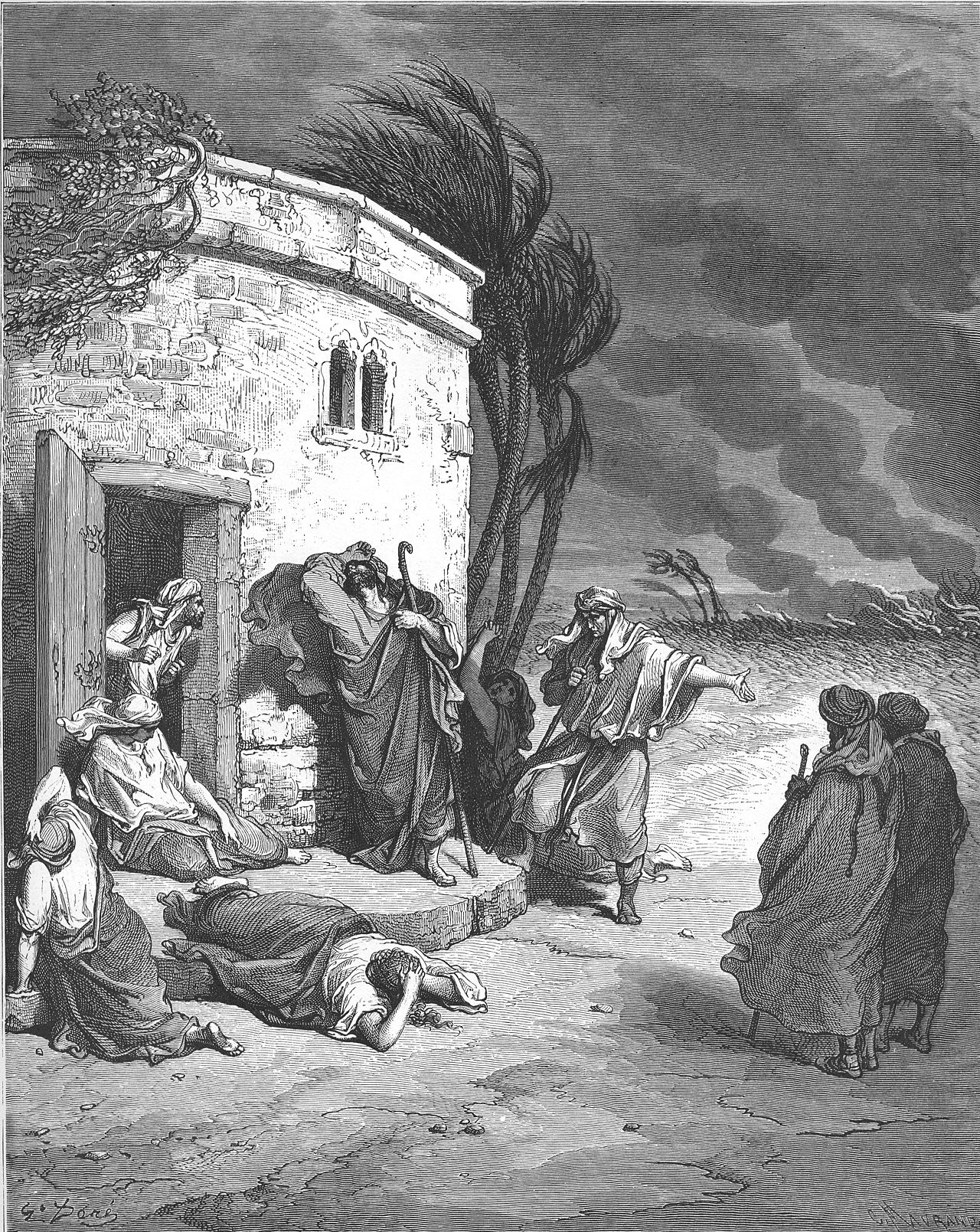
Suffering in Scripture, in full
Suffering enters the story at the Fall. Genesis 3 turns childbirth into pain and labor into toil, and the rest of the Old Testament treats hardship as the ordinary texture of life east of Eden rather than an anomaly to be argued away. Job is the canon's sustained case study: a righteous man loses everything, his friends insist the loss must be payment for hidden sin, and the book systematically dismantles that retribution theology without supplying a tidy replacement.
God's answer from the whirlwind is not an explanation but a confrontation with His own greatness — Job's resolution comes relationally ("now mine eye seeth thee," Job 42:5), not theoretically.
The Psalms carry the same honesty into worship, alternating lament and trust in the same breath (Psalm 22; Psalm 34:19), and Isaiah 53 pushes suffering to its sharpest point: a Servant of the LORD who is despised, stricken, and "bruised for our iniquities," whose suffering is not merely endured but purposeful and substitutionary.
The Gospels present Jesus as both the fulfillment of that Servant figure and its clearest teacher. He predicts his own suffering repeatedly and treats it as necessary rather than accidental (Mark 8:31; Luke 24:26 — "Behooved it not the Christ to suffer these things, and to enter into his glory?"). Gethsemane shows the cost held inside real human will (Matthew 26:39), and the cross itself is where Isaiah 53 lands in history.
Christ's suffering does double duty in the New Testament: it is substitutionary — done for sinners, once, sufficient — and it is exemplary, a pattern disciples are called to walk in (1 Peter 2:21; Matthew 16:24, "take up his cross"). The two are not confused with each other; only His suffering atones, but His suffering also becomes the shape every subsequent chapter reads suffering through.
The epistles turn that pattern into a working theology for the church. Paul treats suffering as normal Christian experience, not exceptional (Acts 14:22; Romans 8:18), sees it as productive rather than merely survived (Romans 5:3, tribulation working perseverance), and frames it as participation in Christ rather than isolation from Him (Philippians 3:10, "the fellowship of his sufferings"; Colossians 1:24).
Suffering also becomes the occasion for a ministry of comfort passed from the comforted to the still-suffering (2 Corinthians 1:4), and for grace proven adequate precisely where strength runs out (2 Corinthians 12:9).
James and Peter add the testing motif: trials are not merely endured but examined, since they prove whether faith is genuine (James 1:2–4; 1 Peter 1:6–7), and Peter names present suffering "the fiery trial" believers should expect, not one that catches them by surprise (1 Peter 4:12).
The canon answers suffering with several true answers at once, and holds them all. Job's friends' mechanical cause-and-effect theology is explicitly rejected by the book itself; not all suffering is discipline for sin, and Job, Paul's thorn in 2 Corinthians 12, and Christ's own innocent suffering all stand as scriptural refutations of that reflex.
At the same time, Scripture does affirm real purposes in suffering — refining faith, producing endurance, conforming believers to Christ — without claiming to have named every purpose in every case. The honest tension is between the church's confidence that God works good through suffering (Romans 8:28) and the same church's honest confession that it does not always know how, or why a given affliction remains unresolved this side of eternity.
Revelation 21:4 does not explain suffering; it ends it — "death shall be no more; neither shall there be mourning, nor crying, nor pain, any more" — and that eschatological horizon, not a philosophical resolution, is where the biblical treatment of suffering finally rests.
4 voices
What teachers have said
“Those who suffer for Christ, have his gracious presence with them in their sufferings, even in the fiery furnace, even in the valley of the shadow of death, and therefore need fear no evil.”
John Wesley · Explanatory Notes upon the Old Testament, 1765
“He is praying, suffering many things, from evil yearning to be delivered: it remains that we hear in what evil he is, and when he begins to speak, let us acknowledge there ourselves to be; in order that the tribulation being shared, we may conjoin prayer.”
Augustine of Hippo · Exposition on Psalm 55
Written before 430.
“The furnace proveth the potter's vessel, and righteous men the trial of tribulation.”
Cyprian · Treatise XI Exhortation to Martyrdom Addressed to Fortunatus
Written before 258.
“a rock to build upon, a rock to take shelter in. The rock of ages, in whom is everlasting strength, would be his rock, his strength in the inner man, both for doing and suffering.”
Matthew Henry · Commentary on the Whole Bible, 1710
Where it leads
Everything the site holds on suffering
On this page
Studies3
On this subject
On this book
The words underneath
Each card is one Hebrew or Greek word behind suffering. It gives the sense, the count across the canon, and the number in Strong's 1890 concordance.
sheber: breaking
Hebrew · H7667Strong's entry: a fracture, figuratively, ruin; specifically, a solution (of a dream)
suffering pictured as something shattered
45 times in the Old Testament · sheber, in full →
thlipsis: pressure
Greek · G2347Strong's entry: pressure (literally or figuratively)
the NT's word for the crushing weight of trial
44 times in the New Testament · thlipsis, in full →
tsarah: dearth
Hebrew · H6869Strong's entry: tightness (i.e. figuratively, trouble); transitively, a female rival
the anguish of being pressed on every side
73 times in the Old Testament · tsarah, in full →
to suffer
Greek · G3958Strong's entry: to experience a sensation or impression (usually painful)
the verb the NT uses for what Christ endured on the cross
42 times in the New Testament · open the word study →
23 verses
The complete list
This subject carries 35 curated verses. 12 of them are quoted above, and the other 23 stand here, book by book. Open a book to read the references with a clause of each verse.
Matthew3
- Matthew 5:10Blessed are those who are persecuted because of righteousness, for theirs is the kingdom of...
- Matthew 16:24Then Jesus told His disciples, “If anyone wants to come after Me, he must deny himself and take...
- Matthew 26:39Going a little farther, He fell facedown and prayed, “My Father, if it is possible, let this...
Luke1
Romans3
- Romans 5:3Not only that, but we also rejoice in our sufferings, because we know that suffering produces...
- Romans 8:18I consider that our present sufferings are not comparable to the glory that will be revealed in...
- Romans 8:28And we know that God works all things together for the good of those who love Him, who are...
1 Corinthians1
2 Corinthians3
- 2 Corinthians 1:4who comforts us in all our troubles, so that we can comfort those in any trouble with the...
- 2 Corinthians 4:17For our light and momentary affliction is producing for us an eternal weight of glory that is...
- 2 Corinthians 12:9But He said to me, “My grace is sufficient for you, for My power is perfected in weakness.”...
James2
1 Peter3
- 1 Peter 1:6In this you greatly rejoice, though now for a little while you may have had to suffer grief in...
- 1 Peter 2:21For to this you were called, because Christ also suffered for you, leaving you an example, that...
- 1 Peter 4:12Beloved, do not be surprised at the fiery trial that has come upon you, as though something...
What stands against Him
The subjects beside it
On this page
Subjects1