
Matthew 26:43
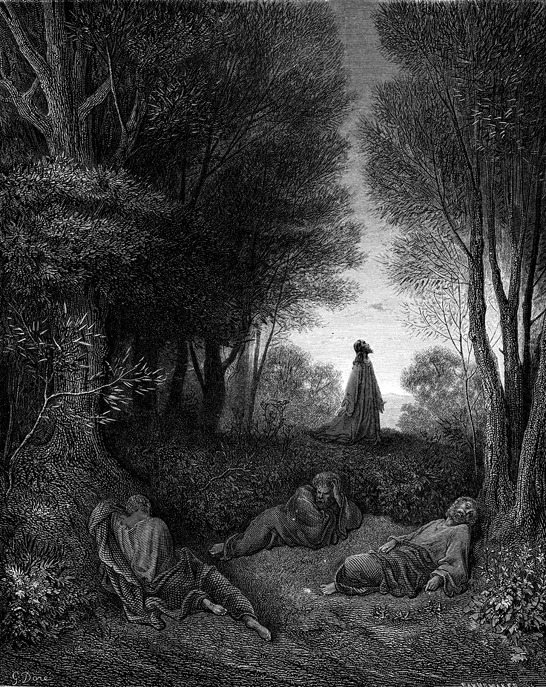
in Matthew 26And again Jesus returned and found them sleeping—for their eyes were heavy.
BSB
The same verse in ASV and KJV ▾
ASV
And he came again and found them sleeping, for their eyes were heavy.
KJV
And he came and found them asleep again: for their eyes were heavy.
⋯
This verse in Matthew 26
Commentary
13 notes on this verse(Verse 43, 44.) And he came again and found them sleeping. For their eyes were heavy. And leaving them, he went away again and prayed for the third time, saying the same thing. He alone prays for all, just as he alone suffers for everyone. But the apostles' eyes grew weak and burdened by imminent denial.
The record, by era
The Church Fathers5 voices
But notice that after the first prayer "he came to the disciples and found them sleeping." Likewise after the second prayer "he came and found them sleeping, for their eyes were heavy." On this, I believe they were the eyes not so much of their bodies as of their souls. Besides, he had not yet removed the heaviness from their eyes, "because he was not yet glorified." And just as "the Spirit had not been given, because Jesus was not yet glorified," so too the heaviness had not yet been removed from their eyes "because Jesus was not yet glorified." Therefore he does not rebuke them, but "leaving them again, he went away and prayed for the third time, saying the same words." He also teaches us through those "same words," that we may not grow faint in prayer but persist in the very words of our prayer until we obtain those things we have begun to pray for.
And I suppose that the eyes of their body were not so much affected as the eyes of their mind, because the Spirit was not yet given them.
The fact that, after returning and finding them asleep, he first reproves them, secondly is silent and thirdly orders them to rest, can be explained in this way: First, after the resurrection, he scolded them for scattering and for being apprehensive and restless; second, once the Holy Spirit had been sent, he came and found them sleeping, since their eyes were too heavy for them to discern the freedom of the gospel—having been held back by the love of the law for some time, their faith was still sleeping; and third, with the return of his radiance, he restored them to restfulness and peace of mind.
That He prays for this a second and a third time, comes of the feelings belonging to human frailty, through which also He feared death, thus giving assurance that He was truly made man. For in Scripture when any thing is repeated a second and third time, that is the greatest proof of its truth and reality; as, for example, when Joseph says to Pharaoh, And for that thou sawedst it twice, it is proof of the thing being established by God. (Gen. 41:32.)
Christ singly prays for all, as He singly suffers for all. Their eyes were heavy, i. e. an oppression and stupefaction came on as their denial drew near.
7 more voices on this verse
The Medieval Church3 voices
Consequently, the second falling asleep of the disciples is set forth: and he cometh again and findeth them sleeping: for their eyes were heavy, with sleep, i.e., on account of sleep, and on account of sadness; Ps. 30:10: my eye is troubled through indignation.
Or, The Lord prayed thrice, to teach us to pray for pardon of sins past, defence against present evil, and provision against future perils, and that we should address every prayer to Father, Son, and Holy Spirit, and that our spirit, soul, and body should be kept in safety.
He went away again the second time, and prayed, saying, O My Father, if this cup can not pass away from Me, except I drink it, Thy will be done. And He came and found them asleep again: for their eyes were heavy. And He …
The Puritans and the Awakening1 voice
And he came and found them asleep again,.... For they were aroused and awaked, in some measure, by what he had said to them; but no sooner was he gone but they fell asleep again, and thus he found them a second time; or, "he came again and found them asleep"; so read the Vulgate Latin, the Syriac, Arabic, and Ethiopic versions, and Munster's Hebrew Gospel: for their eyes were heavy; with sleep through fatigue, sorrow, &c.
The Nineteenth Century3 voices
Their eyes were heavy - That is, they could not keep them open. Was there nothing preternatural in this? Was there no influence here from the powers of darkness?
The verses we have now read describe what is commonly called Christ’s agony at Gethsemane. It is a passage which undoubtedly contains deep and mysterious things. We ought to read it with reverence and wonder, for there is much in it which we cannot fully comprehend. Why do we find our Lord so “sorrowful and very heavy,” as he is here described? What are we to make of his words, “My soul is exceeding sorrowful even unto death.”
The verses we have now read describe what is commonly called Christ’s agony at Gethsemane. It is a passage which undoubtedly contains deep and mysterious things. We ought to read it with reverence and wonder, for there is much in it which we cannot fully comprehend. Why do we find our Lord so “sorrowful and very heavy,” as he is here described? What are we to make of his words, “My soul is exceeding sorrowful even unto death.” Why do we see him going apart from his disciples, and falling on his face, and crying to his Father with strong cries, and thrice repeated prayer? Why is the almighty Son of God, who had worked so many miracles, so heavy and disquieted? Why is Jesus, who came into the world to die, so like one ready to faint at the approach of death? Why is all this? There is but one reasonable answer to these questions: the weight that pressed down our Lord’s soul was not the fear of death and its pains. Thousands have endured the most agonizing sufferings of body, and died without a groan, and so, no doubt, might our Lord. But the real weight that bowed down the heart of Jesus was the weight of the sin of the world, which seems to have now pressed down upon him with peculiar force: it was the burden of our guilt imputed to him, which was now laid on him, as on the head of the scapegoat. How great that burden must have been no human heart can conceive! It is known only to God. Well may the Greek Litany speak of the “unknown sufferings of Christ.” The words of Scott on this subject are probably correct: “Christ at this time endured as much misery of the same kind with that of condemned spirits, as could possibly consist with a pure conscience, perfect love of God and man, and an assured confidence of a glorious event.”
The words behind it
12 Greek wordsEvery Greek word of this verse in the order it stands, with what it means and the door to its own study. The last column counts the times a word stands in the whole Bible: the rarer the word, the more the places it appears belong together.
| Greek | Sound | Meaning | Word study | In the Bible |
|---|---|---|---|---|
| καὶ | kai | And | G2532 → | 9120 times |
| ἐλθὼν | elthon | having come | G2064 → | 628 times |
| πάλιν | palin | again | G3825 → | 139 times |
| εὗρεν | heuren | He found | G2147 → | 175 times |
| αὐτοὺς | autous | them | G846 → | 5565 times |
| καθεύδοντας· | katheudontas | sleeping; | G2518 → | 22 times |
| ἦσαν | esan | were | G1510 → | 2333 times |
| γὰρ | gar | for | G1063 → | 1039 times |
| αὐτῶν | auton | of them | G846 → | 5565 times |
| οἱ | hoi | the | G3588 → | 19766 times |
| ὀφθαλμοὶ | ophthalmoi | eyes | G3788 → | 100 times |
| βεβαρημένοι.¶ | bebaremenoi | wearied. | G916 → |
καὶAnd
kaiG2532 →9120 times
ἐλθὼνhaving come
elthonG2064 →628 times
πάλινagain
palinG3825 →139 times
εὗρενHe found
heurenG2147 →175 times
αὐτοὺςthem
autousG846 →5565 times
καθεύδοντας·sleeping;
katheudontasG2518 →22 times
ἦσανwere
esanG1510 →2333 times
γὰρfor
garG1063 →1039 times
αὐτῶνof them
autonG846 →5565 times
οἱthe
hoiG3588 →19766 times
ὀφθαλμοὶeyes
ophthalmoiG3788 →100 times
βεβαρημένοι.¶wearied.
bebaremenoiG916 →
A shaded row is a word that stands 400 times or fewer in the Bible.
The walk
8 stopsEach card is a verse this one points to, and under it the verses that one points to in turn. Where several paths arrive at the same place, that place is listed first: the text keeps returning to it.
Through
Romans 13:1Everyone must submit himself to the governing authorities, for there is no authority except that which is from God. The authorities that exist have been appointed by God.
it leads to
- Titus 3:1
Remind the believers to submit to rulers and authorities, to be obedient and ready for every good work,
- 1 Peter 2:13–17
Submit yourselves for the Lord’s sake to every human institution, whether to the king as the supreme authority,
- Daniel 2:21
He changes the times and seasons; He removes kings and establishes them. He gives wisdom to the wise and knowledge to the discerning.
- John 19:11
Jesus answered, “You would have no authority over Me if it were not given to you from above. Therefore the one who handed Me over to you is guilty of greater sin.”
- Proverbs 8:15–16
By me kings reign, and rulers enact just laws;
- Titus 3:1
Through
Jonah 1:6The captain approached him and said, “How can you sleep? Get up and call upon your God. Perhaps this God will consider us, so that we may not perish.”
it leads to
- Psalms 107:28–29
Then they cried out to the LORD in their trouble, and He brought them out of their distress.
- Jonah 3:9
Who knows? God may turn and relent; He may turn from His fierce anger, so that we will not perish.”
- 2 Samuel 12:22
David answered, “While the child was alive, I fasted and wept, for I said, ‘Who knows? The LORD may be gracious to me and let him live.’
- Psalms 107:28–29
Where this verse is studied
On this page
Studies31
- Angelology
- Forgiveness
- The Words Nasa, Salach and Aphiemi
- Gethsemane (The Garden Called the Oil Press)
- The Words Todah, Yadah and Eucharisteo
- Hell and the Final State of the Lost
Show the next 6 titles
- The High-Priestly Line
- Jesus
- Jesus on Prayer
- The Lord's Prayer
- Strength Under Control
- The Gentleness of Christ
Show the next 6 titles
- Oaths. Let Your Yes Be Yes
- Peter's Denial: Matthew 26 · Mark 14 · Luke 22 · John 18
- The Scarlet Thread
- The Son of Man: Daniel 7:13-14
- The Book of the Covenant
- The Bride & the Jewish Wedding
Show the next 6 titles
About Matthew
This page draws on 12 works. Open the list of works
This page draws on Adam Clarke, Commentary on the Bible; Hilary of Poitiers, Commentary on Matthew 31.11; J.C. Ryle, Expository Thoughts on the Gospels: Matthew; Jerome, Commentary on Matthew; Jerome, Catena Aurea by Aquinas; John Chrysostom, Catena Aurea by Aquinas; John Gill, Exposition of the New Testament (1746-1748); Origen of Alexandria, COMMENTARY ON MATTHEW 95; Origen of Alexandria, Catena Aurea by Aquinas; Rabanus Maurus, Catena Aurea by Aquinas; Theophylact of Ohrid, Commentary on Matthew and Thomas Aquinas, Commentary on Matthew.