
Matthew 26:37
in Matthew 26He took with Him Peter and the two sons of Zebedee and began to be sorrowful and deeply distressed.
BSB
The same verse in ASV and KJV ▾
ASV
And he took with him Peter and the two sons of Zebedee, and began to be sorrowful and sore troubled.
KJV
And he took with him Peter and the two sons of Zebedee, and began to be sorrowful and very heavy.
⋯
This verse in Matthew 26
Commentary
16 notes on this verse(non. occ.) But we say that passible man was so taken by God the Son, that His Deity remained impassible. Indeed the Son of God suffered, not by imputation but actually, all that Scripture testifies, in respect of that part of Him which could suffer, viz. in respect of the substance that He had taken on Him.
This site's exposition
a place called Gethsemane
on Matthew 26:36-38
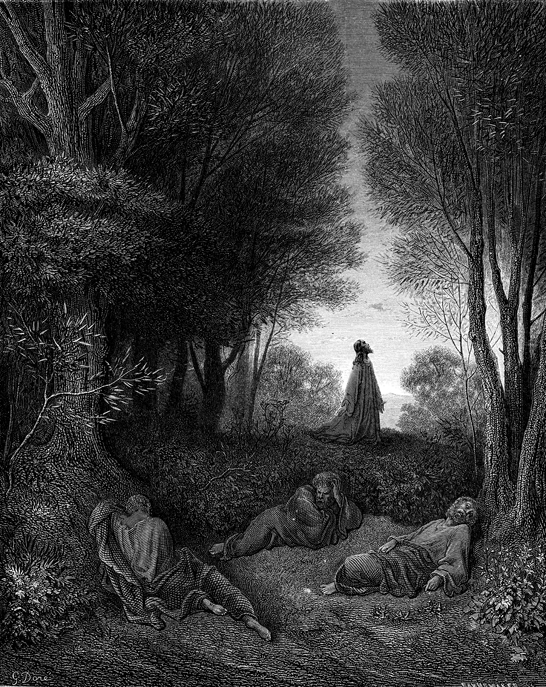
Then cometh Jesus with them unto a place called Gethsemane, a garden whose name means oil press, situated at the foot of the mount of Olives among ancient olive trees. He took with him Peter and the two sons of Zebedee, the same three who witnessed the transfiguration's glory now called to witness its opposite, and began to be sorrowful and very heavy names a genuine anguish rather than a performance of it. My soul is exceeding sorrowful, even unto death: tarry ye here, and watch with me asks for simple human companionship in the hour of greatest need, a request the three will fail to keep.
The record, by era
The Church Fathers5 voices
(Lib. 83. Quæst. q. 80.) We have the narratives of the Evangelists, by which we know that Christ was both born of the Blessed Virgin Mary, was seized by the Jews, scourged, crucified, put to death, and buried in a tomb, all which cannot be supposed to have taken place without a body, and not even the maddest will say that these things are to be understood figuratively, when they are told by men who wrote what they remembered to have happened. These then are witnesses that He had a body, as those affections which cannot be without mind prove Him to have had a mind, and which we read in the accounts of the same Evangelists, that Jesus wondered, was angry, was sorrowful. (de. Civ. Dei, xiv. 9.) Since then these things are related in the Evangelists, they are not surely false, but as when He willed He became Man, so likewise when He willed He took into His human soul these passions for the sake of adding assurance to the dispensation. We indeed have these passions by reason of the weakness of our human nature; not so the Lord Jesus, whose weakness was of power.
When we read that the Lord was sad, we must examine everything that was said to find out why he was sad. He previously warned that they would all fall away. Brimming with confidence, Peter responded that even though all the others might be alarmed, he would not be moved—he who the Lord predicted would deny knowing him three times. In fact, Peter and all the other disciples promised that even in the face of death they would not deny him. He then proceeded on and ordered his disciples to sit down while he prayed. Having brought with him Peter, James and John, he began to grieve. Before he brought them along with him, he did not feel sad. It was only after they had accompanied him that he grew exceedingly sad. His sadness thus arose not from himself but from those whom he had taken with him. It must be realized that the Son of man brought with him none but those whom he showed that he would come into his kingdom at that time when, in the presence of Moses and Elijah on the mountain, he was surrounded by all the splendor of his eternal glory. But the reason for bringing them with him both then and now was the same.
These words, He began to be sorrowful and very heavy, are interpreted by heretics that fear of death assailed the Son of God, being (as they allege) neither begotten from eternity, nor existing in the Father's infinite substance, but produced out of nothing by Him who created all things; and that hence He was liable to anguish of grief, and fear of death. And He who can fear death can also die; and He who can die, though He shall exist after death, yet is not eternal through Him who begot Him in past time. Had these faith to receive the Gospels, they would know that the Word was in the beginning God, and from the beginning with God, and that the eternity of Him who begets and Him who is begotten is one and the same. But if the assumption of flesh infected with its natural infirmity the virtue of that incorruptible substance, so that it became subject to pain, and shrinking from death, it would also become thereby liable to corruption, and thus its immortality being changed into fear, that which is in it is capable of at some time ceasing to be. But God ever is without measure of time, and such as He is, He continues to be eternally. Nothing then in God can die, nor can God have any fear springing out of Himself. (de Trin. x. 10.) I suppose that there are some who offer here no other cause of His fear than His passion and death. I ask those who think thus, whether it stands with reason that He should have feared to die, who banished from the Apostles all fear of death, and exhorted them to the glory of martyrdom? How can we suppose Him to have felt pain and grief in the sacrament of death, who rewards with life those who die for Him? And what pangs of death could He fear, who came to death of the free choice of His own power? […]
He had accepted the disciples’ faith and the devotedness of their will, but He foresaw that they would be troubled and scattered abroad, and therefore bade them sit still in their places; for to sit belongs to one at ease, but they would be grievously troubled that they should have denied Him. In what fashion He went forward it describes, And taking with him Peter and the two sons of Zebedee, he began to be sorrowful and very heavy; the same to whom He had shewn His glory in the mount. By this place are overthrown the Manichæans, who said that He took an unreal body; and those also who said that He had not a real soul, but His Divinity in place of a soul
(Verse 37) And taking with him Peter and the two sons of Zebedee, he began to be sad and sorrowful. What we have said above about the passion and pre-passion is also shown in the present chapter, that the Lord, in order to prove the truth of his assumption as a man, was truly saddened, but so that the passion would not dominate his soul, he began to be saddened through pre-sorrow. For it is one thing to be saddened, and another thing to begin to be saddened. But He was saddened not by the fear of suffering, for which He had come, that He might suffer; and He had reprimanded Peter for his timidity; but on account of the most unfortunate Judas, and the scandal of all the apostles, and the rejection of the Jewish people, and the destruction of miserable Jerusalem. Hence Jonas also, grieving over the withering of a gourd or a ivy, was grieved (Jonah 4), unwilling to lose his former shelter. But if the sadness of the soul is interpreted by the heretics not as the affection of the Savior towards those who are about to perish, but as the suffering, let them answer how they explain that which is said through Ezekiel in the person of God: And in all these things you have saddened me (Ezekiel 16, Septuagint version).
9 more voices on this verse
The Church Fathers1 voice
A commentator
John ChrysostomHomily on the Gospel of Matthew 83 · Written in the 5th century.
proposed
And He takes with Him the three, and saith unto them, "my soul is exceeding sorrowful, even unto death." Wherefore doth He not take all with Him? That they might not be cast down; but these He taketh that had been spectators of His glory.
The Medieval Church3 voices
(Fid. Orth. iii. 23.) Or otherwise; All things which have not yet been brought into existence by their Maker have a natural desire of existence, and naturally shun non-existence. God the Word then, having been made Man, had this desire, through which He desired food, drink, and sleep, by which life is supported, and naturally used them, and contrariwise shunned the things that are destructive of life. Hence in the season of His Passion which He endured voluntarily, He had the natural fear and sorrow for death. For there is a natural fear wherewith the soul shrinks from separation from the body, by reason of that close sympathy implanted from the first by the Maker of all things.
And taking with him Peter and the two sons of Zebedee etc. Here he announces the necessity of prayer: and this was sadness. And first, he sets forth the witnesses of the sadness; second, he shows the sadness; third, he repels it. The second is …
He does not take all the disciples with Him, but only the three to whom He showed His glory on Mt. Tabor, lest the others see Him very heavy of heart while He was praying, and be scandalized. But He leaves even these three and …
The Puritans and the Awakening2 voices
Who can tell what painful and dreadful sensations were then impressed on him by the immediate hand of God? The former word in the original properly signifies, to be penetrated with the most exquisite sorrow; the latter to be quite depressed, and almost overwhelmed with the load.
And he took with him Peter, and the two sons of Zebedee,....
The Nineteenth Century3 voices
And he took with him Peter and the two sons of Zebedee - That is, James and John; the same persons who had beheld his transfiguration on the mount - that they might contemplate this agony in the light of that glory which they had there seen; and so be kept from being stumbled by a view of his present humiliation. Began to be sorrowful - Λυπεισθαι, from λυω, to dissolve - exquisite sorrow, such as dissolves the natural vigor, and threatens to separate soul and body. And very heavy - Overwhelmed with anguish - αδημονειν.
The verses we have now read describe what is commonly called Christ’s agony at Gethsemane. It is a passage which undoubtedly contains deep and mysterious things. We ought to read it with reverence and wonder, for there is much in it which we cannot fully comprehend. Why do we find our Lord so “sorrowful and very heavy,” as he is here described? What are we to make of his words, “My soul is exceeding sorrowful even unto death.”
The verses we have now read describe what is commonly called Christ’s agony at Gethsemane. It is a passage which undoubtedly contains deep and mysterious things. We ought to read it with reverence and wonder, for there is much in it which we cannot fully comprehend. Why do we find our Lord so “sorrowful and very heavy,” as he is here described? What are we to make of his words, “My soul is exceeding sorrowful even unto death.” Why do we see him going apart from his disciples, and falling on his face, and crying to his Father with strong cries, and thrice repeated prayer? Why is the almighty Son of God, who had worked so many miracles, so heavy and disquieted? Why is Jesus, who came into the world to die, so like one ready to faint at the approach of death? Why is all this? There is but one reasonable answer to these questions: the weight that pressed down our Lord’s soul was not the fear of death and its pains. Thousands have endured the most agonizing sufferings of body, and died without a groan, and so, no doubt, might our Lord. But the real weight that bowed down the heart of Jesus was the weight of the sin of the world, which seems to have now pressed down upon him with peculiar force: it was the burden of our guilt imputed to him, which was now laid on him, as on the head of the scapegoat. How great that burden must have been no human heart can conceive! It is known only to God. Well may the Greek Litany speak of the “unknown sufferings of Christ.” The words of Scott on this subject are probably correct: “Christ at this time endured as much misery of the same kind with that of condemned spirits, as could possibly consist with a pure conscience, perfect love of God and man, and an assured confidence of a glorious event.”
The words behind it
13 Greek wordsEvery Greek word of this verse in the order it stands, with what it means and the door to its own study. The last column counts the times a word stands in the whole Bible: the rarer the word, the more the places it appears belong together.
| Greek | Sound | Meaning | Word study | In the Bible |
|---|---|---|---|---|
| Καὶ | kai | And | G2532 → | 9120 times |
| παραλαβὼν | paralabon | having taken with [Him] | G3880 → | 49 times |
| τὸν | ton | <the> | G3588 → | 19766 times |
| Πέτρον | petron | Peter | G4074 → | 155 times |
| καὶ | kai | and | G2532 → | 9120 times |
| τοὺς | tous | the | G3588 → | 19766 times |
| δύο | duo | two | G1417 → | 133 times |
| υἱοὺς | huious | sons | G5207 → | 377 times |
| Ζεβεδαίου | zebedaiou | of Zebedee | G2199 → | 12 times |
| ἤρξατο | erxato | He began | G757 → | 85 times |
| λυπεῖσθαι | lupeisthai | to be sorrowful | G3076 → | 26 times |
| καὶ | kai | and | G2532 → | 9120 times |
| ἀδημονεῖν.¶ | ademonein | to be deeply distressed. | G85 → |
ΚαὶAnd
kaiG2532 →9120 times
παραλαβὼνhaving taken with [Him]
paralabonG3880 →49 times
τὸν<the>
tonG3588 →19766 times
ΠέτρονPeter
petronG4074 →155 times
καὶand
kaiG2532 →9120 times
τοὺςthe
tousG3588 →19766 times
δύοtwo
duoG1417 →133 times
υἱοὺςsons
huiousG5207 →377 times
Ζεβεδαίουof Zebedee
zebedaiouG2199 →12 times
ἤρξατοHe began
erxatoG757 →85 times
λυπεῖσθαιto be sorrowful
lupeisthaiG3076 →26 times
καὶand
kaiG2532 →9120 times
ἀδημονεῖν.¶to be deeply distressed.
ademoneinG85 →
A shaded row is a word that stands 400 times or fewer in the Bible.
The walk
8 stopsEach card is a verse this one points to, and under it the verses that one points to in turn. Where several paths arrive at the same place, that place is listed first: the text keeps returning to it.
Through
Matthew 17:1After six days Jesus took with Him Peter, James, and John the brother of James, and led them up a high mountain by themselves.
it leads to
- Luke 9:28–36
About eight days after Jesus had said these things, He took with Him Peter, John, and James, and went up on a mountain to pray.
- 2 Corinthians 13:1
This is the third time I am coming to you. “Every matter must be established by the testimony of two or three witnesses.”
Reached by 2 separate paths from here.
- Mark 5:37
And He did not allow anyone to accompany Him except Peter, James, and John the brother of James.
- 2 Peter 1:18
And we ourselves heard this voice from heaven when we were with Him on the holy mountain.
- Luke 9:28–36
Through
Matthew 20:20Then the mother of Zebedee’s sons came to Jesus with her sons and knelt down to make a request of Him.
it leads to
- Mark 10:35–45
Then James and John, the sons of Zebedee, came to Jesus and declared, “Teacher, we want You to do for us whatever we ask.”
- Matthew 4:21
Going on from there, He saw two other brothers, James son of Zebedee and his brother John. They were in a boat with their father Zebedee, mending their nets. Jesus called them,
- Matthew 8:2
Suddenly a leper came and knelt before Him, saying, “Lord, if You are willing, You can make me clean.”
- Mark 10:35–45
Through
Mark 5:37And He did not allow anyone to accompany Him except Peter, James, and John the brother of James.
it leads to
- Mark 14:33
He took with Him Peter, James, and John, and began to be deeply troubled and distressed.
- Mark 14:33
Where this verse is studied
On this page
Studies15
On this verse
On this chapter
- Angelology
- Archaeology and the Bible (the Evidence Ledger)
- Gethsemane (The Garden Called the Oil Press)
- Peter's Denial: Matthew 26 · Mark 14 · Luke 22 · John 18
- The Blood
- The Bride & the Jewish Wedding
- The Cleansing of the Temple: John 2 · Matthew 21
- The Father's Will
- The Lord's Supper
- The Right Hand
- The Shepherd
- The Sword
- The Tree
- The Vine & the Vineyard
About Matthew
This page draws on 16 works. Open the list of works
This page draws on Adam Clarke, Commentary on the Bible; Albert Barnes, Notes, Explanatory and Practical, on the Gospels; Augustine of Hippo, Catena Aurea by Aquinas; Hilary of Poitiers, Commentary on Matthew 31.4; Hilary of Poitiers, Catena Aurea by Aquinas; J.C. Ryle, Expository Thoughts on the Gospels: Matthew; Jerome, Catena Aurea by Aquinas; Jerome, Commentary on Matthew; John Chrysostom, Homily on the Gospel of Matthew 83; John Damascene, Catena Aurea by Aquinas; John Gill, Exposition of the New Testament (1746-1748); John Wesley, Explanatory Notes upon the New Testament; Matthew Henry, Commentary on the Whole Bible; Remigius of Rheims, Catena Aurea by Aquinas; Theophylact of Ohrid, Commentary on Matthew and Thomas Aquinas, Commentary on Matthew.