
Matthew 26:40
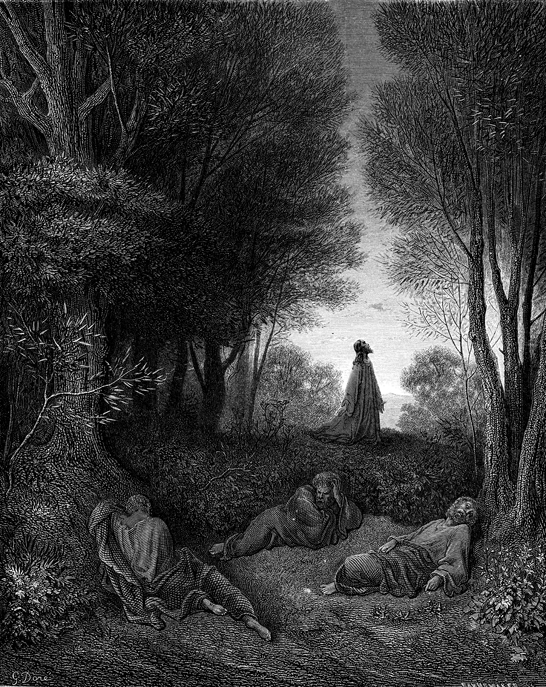
in Matthew 26Then Jesus returned to the disciples and found them sleeping. “Were you not able to keep watch with Me for one hour?” He asked Peter.
BSB
The same verse in ASV and KJV ▾
ASV
And he cometh unto the disciples, and findeth them sleeping, and saith unto Peter, What, could ye not watch with me one hour?
KJV
And he cometh unto the disciples, and findeth them asleep, and saith unto Peter, What, could ye not watch with me one hour?
⋯
This verse in Matthew 26
Commentary
17 notes on this verse(Verse 40.) And he came to his disciples and found them sleeping, and said to Peter, 'So you could not watch with me one hour? He who said above, 'Even if all are scandalized in you, I will never be scandalized,' now cannot overcome sleep due to the magnitude of sorrow.'
This site's exposition
to keep watch with Me
on Matthew 26:40-41
Jesus finds the disciples sleeping and puts the question "Were you not able to keep watch with Me for one hour?" to Peter, the man who had just vowed to die with him. The command "Watch and pray so that you will not enter into temptation" names their coming failure in advance, with Peter's denial only hours away.
The record, by era
The Church Fathers5 voices
And though Jesus went but a little forward, they could not watch one hour in His absence; let us therefore pray that Jesus may never depart even a little from us.
As long as Jesus was present, his disciples did not sleep. After he had walked away a short distance, they were unable to watch for even one hour in his absence. For this reason we should pray that Jesus will not leave us for even a short while but will fulfill what he promised when he said to us, "And I am with you all days, even to the end of the world." In this way will we keep watch as he banishes sleep from our souls, to make it possible for us to fulfill his command: "Do not give sleep to your eyes or slumber to your eyelids, that you may escape as a doe from the nets and a bird from the snare of the fowlers." But coming to the disciples and finding them asleep, he arouses them with a word and tells them to listen, so he may as it were say to those who are listening: "How is it that you were not able to watch with me for even one hour?"He orders us then to be wakeful so we may keep watch and pray. Now that person watches who does good works, that person watches who diligently attends to the truth of the faith lest he be ensnared by any shady teaching. He who watches and prays in this way will have his prayer heard. This is what the Lord means when he says, "Watch and pray." We should first watch and, while watching, we should pray.
When then He returned to His disciples and found them sleeping, He rebukes Peter, Could ye not watch one hour with me? He addresses Peter rather than the rest, because he had most loudly boasted that he would not be offended.
The fact that, after returning and finding them asleep, he first reproves them, secondly is silent and thirdly orders them to rest, can be explained in this way: First, after the resurrection, he scolded them for scattering and for being apprehensive and restless; second, once the Holy Spirit had been sent, he came and found them sleeping, since their eyes were too heavy for them to discern the freedom of the gospel—having been held back by the love of the law for some time, their faith was still sleeping; and third, with the return of his radiance, he restored them to restfulness and peace of mind.
After that, he returns to the disciples and finds them sleeping. He asks Peter why he could not watch with him one hour—Peter, indeed, was one of the three, for he had boasted in front of the others that he would not fall away. And he indicates the cause of his greater fear, saying, "Pray that you may not enter into temptation." He wanted then to prevent temptation (so he included in his prayer the words "lead us not into temptation"), lest anything in us cater to the weakness of the flesh. He also makes it clear why he urged them to pray in order to avoid temptation, saying, "The spirit indeed is willing, but the flesh is weak." These words did not apply to himself but were aimed at them. For that matter, how is it that now his spirit is willing, whereas before his soul was sad even to death? At any rate, he orders them to watch and pray lest they give in to temptation and succumb to the weakness of the body. He therefore prays that, if possible, the cup may pass from himself, for when it comes to drinking from it, all flesh is weak.
10 more voices on this verse
The Church Fathers3 voices
Or the sleep which He would have them forego is not bodily rest, for which at this critical time there was no room, but mental torpor, the sleep of unbelief.
A commentator
John ChrysostomHomily on the Gospel of Matthew 83 · Written in the 5th century.
proposed
Not without reason doth He inveigh against Peter most, although the others also had slept; but to make him feel by this also, for the cause which I mentioned before. Then because the others also said the same thing (for when Peter had said (these are the words), "Though I must die with Thee, I will not deny Thee; likewise also," it is added, "said all the disciples"); He addresses Himself to all, convicting their weakness. For they who are desiring to die with Him, were not then able so much as to sorrow with Him wakefully, but sleep overcame them.
A commentator
John ChrysostomHomily on the Gospel of Matthew 83 · Written in the 5th century.
proposed
However, even these He dismisses: "And He went on a little farther, and prayeth, saying, Father, if it be possible, let this cup pass from me; nevertheless not as I will, but as Thou wilt. And He cometh unto them, and findeth them sleeping, and saith unto Peter, What, could ye not watch with me one hour? Watch and pray, that ye enter not into temptation; the spirit indeed is willing, but the flesh is weak." And He prays with earnestness, in order that the thing might not seem to be acting. And sweats flow over him for the same cause again, even that the heretics might not say this, that He acts the agony. Therefore there is a sweat like drops of blood, and an angel appeared strengthening Him, and a thousand sure signs of fear, lest any one should affirm the words to be feigned. For this cause also was this prayer. By saying then, "If it be possible, let it pass from me," He showed His humanity; but by saying, "Nevertheless not as I will, but as Thou wilt," He showed His virtue and self-command, teaching us even when nature pulls us back, to follow God. For since it was not enough for the foolish to show His face only, He uses words also. Again, words sufficed not alone, but deeds likewise were needed; these also He joins with the words, that even they who are in a high degree contentious may believe, that He both became man and died. For if, even when these things are so, this be still disbelieved by some, much more, if these had not been. See by how many things He shows the reality of the incarnation: by what He speaks, by what He suffers. After that He cometh and saith to Peter, as it is said, "What, couldest thou not watch one hour with me?" All were sleeping, and He rebukes Peter, hinting at him, in what He spake. […]
The Medieval Church3 voices
Or, The Lord prayed thrice, to teach us to pray for pardon of sins past, defence against present evil, and provision against future perils, and that we should address every prayer to Father, Son, and Holy Spirit, and that our spirit, soul, and body should be kept in safety.
And he cometh to his disciples. Here he rebukes the failing of the disciples. And first, the failing is set forth; second, the rebuke; third, the admonition; fourth, the reason for the admonition. When he had prayed, he cometh to his disciples and findeth them …
And He cometh unto the disciples, and findeth them asleep, and saith unto Peter, What, could ye not watch with Me one hour? Watch and pray, that ye enter not into temptation: the spirit indeed is willing, but the flesh is weak. Because Peter and …
The Puritans and the Awakening1 voice
And he cometh unto the disciples,....
The Nineteenth Century3 voices
He - saith unto Peter - He addressed himself more particularly to this apostle, because of the profession he had made, Mat 26:33; as if he had said: “Is this the way you testify your affectionate attachment to me? Ye all said you were ready to die with me; what, then, cannot you watch One hour?” Instead of ουκ ισχυσατε, could Ye not, the Codex Alexandrinus, the later Syriac in the margin, three of the Itala, and Juvencus, read ουκ ισχυσας, couldst Thou not - referring the reproach immediately to Peter, who had made the promises mentioned before.
The verses we have now read describe what is commonly called Christ’s agony at Gethsemane. It is a passage which undoubtedly contains deep and mysterious things. We ought to read it with reverence and wonder, for there is much in it which we cannot fully comprehend. Why do we find our Lord so “sorrowful and very heavy,” as he is here described? What are we to make of his words, “My soul is exceeding sorrowful even unto death.”
The verses we have now read describe what is commonly called Christ’s agony at Gethsemane. It is a passage which undoubtedly contains deep and mysterious things. We ought to read it with reverence and wonder, for there is much in it which we cannot fully comprehend. Why do we find our Lord so “sorrowful and very heavy,” as he is here described? What are we to make of his words, “My soul is exceeding sorrowful even unto death.” Why do we see him going apart from his disciples, and falling on his face, and crying to his Father with strong cries, and thrice repeated prayer? Why is the almighty Son of God, who had worked so many miracles, so heavy and disquieted? Why is Jesus, who came into the world to die, so like one ready to faint at the approach of death? Why is all this? There is but one reasonable answer to these questions: the weight that pressed down our Lord’s soul was not the fear of death and its pains. Thousands have endured the most agonizing sufferings of body, and died without a groan, and so, no doubt, might our Lord. But the real weight that bowed down the heart of Jesus was the weight of the sin of the world, which seems to have now pressed down upon him with peculiar force: it was the burden of our guilt imputed to him, which was now laid on him, as on the head of the scapegoat. How great that burden must have been no human heart can conceive! It is known only to God. Well may the Greek Litany speak of the “unknown sufferings of Christ.” The words of Scott on this subject are probably correct: “Christ at this time endured as much misery of the same kind with that of condemned spirits, as could possibly consist with a pure conscience, perfect love of God and man, and an assured confidence of a glorious event.”
The words behind it
21 Greek wordsEvery Greek word of this verse in the order it stands, with what it means and the door to its own study. The last column counts the times a word stands in the whole Bible: the rarer the word, the more the places it appears belong together.
| Greek | Sound | Meaning | Word study | In the Bible |
|---|---|---|---|---|
| καὶ | kai | And | G2532 → | 9120 times |
| ἔρχεται | erchetai | He comes | G2064 → | 628 times |
| πρὸς | pros | to | G4314 → | 700 times |
| τοὺς | tous | the | G3588 → | 19766 times |
| μαθητὰς | mathetas | disciples | G3101 → | 260 times |
| καὶ | kai | and | G2532 → | 9120 times |
| εὑρίσκει | heuriskei | finds | G2147 → | 175 times |
| αὐτοὺς | autous | them | G846 → | 5565 times |
| καθεύδοντας | katheudontas | sleeping | G2518 → | 22 times |
| καὶ | kai | And | G2532 → | 9120 times |
| λέγει | legei | He says | G3004 → | 1325 times |
| τῷ | to | <the> | G3588 → | 19766 times |
| Πέτρῳ· | petro | to Peter; | G4074 → | 155 times |
| οὕτως | houtos | Thus | G3779 → | 208 times |
| οὐκ | ouk | not | G3756 → | 1664 times |
| ἰσχύσατε | ischusate | were you able | G2480 → | 28 times |
| μίαν | mian | one | G1520 → | 343 times |
| ὥραν | horan | hour | G5610 → | 106 times |
| γρηγορῆσαι | gregoresai | to watch | G1127 → | 22 times |
| μετ᾽ | met᾽ | with | G3326 → | 461 times |
| ἐμοῦ; | emou | Me? | G1473 → | 839 times |
καὶAnd
kaiG2532 →9120 times
ἔρχεταιHe comes
erchetaiG2064 →628 times
πρὸςto
prosG4314 →700 times
τοὺςthe
tousG3588 →19766 times
μαθητὰςdisciples
mathetasG3101 →260 times
καὶand
kaiG2532 →9120 times
εὑρίσκειfinds
heuriskeiG2147 →175 times
αὐτοὺςthem
autousG846 →5565 times
καθεύδονταςsleeping
katheudontasG2518 →22 times
καὶAnd
kaiG2532 →9120 times
λέγειHe says
legeiG3004 →1325 times
τῷ<the>
toG3588 →19766 times
Πέτρῳ·to Peter;
petroG4074 →155 times
οὕτωςThus
houtosG3779 →208 times
οὐκnot
oukG3756 →1664 times
ἰσχύσατεwere you able
ischusateG2480 →28 times
μίανone
mianG1520 →343 times
ὥρανhour
horanG5610 →106 times
γρηγορῆσαιto watch
gregoresaiG1127 →22 times
μετ᾽with
met᾽G3326 →461 times
ἐμοῦ;Me?
emouG1473 →839 times
A shaded row is a word that stands 400 times or fewer in the Bible.
The walk
8 stopsEach card is a verse this one points to, and under it the verses that one points to in turn. Where several paths arrive at the same place, that place is listed first: the text keeps returning to it.
Through
Luke 22:45When Jesus rose from prayer and returned to the disciples, He found them asleep, exhausted from sorrow.
it leads to
- Mark 14:40–41
And again Jesus returned and found them sleeping—for their eyes were heavy. And they did not know what to answer Him.
Reached by 2 separate paths from here.
- Mark 14:40–41
Through
Matthew 26:38Then He said to them, “My soul is consumed with sorrow to the point of death. Stay here and keep watch with Me.”
it leads to
- John 12:27
Now My soul is troubled, and what shall I say? ‘Father, save Me from this hour’? No, it is for this purpose that I have come to this hour.
- 1 Peter 3:18
For Christ also suffered for sins once for all, the righteous for the unrighteous, to bring you to God. He was put to death in the body but made alive in the Spirit,
- 1 Peter 2:24
He Himself bore our sins in His body on the tree, so that we might die to sin and live to righteousness. “By His stripes you are healed.”
- John 12:27
Through
Luke 9:32Meanwhile Peter and his companions were overcome by sleep, but when they awoke, they saw Jesus’ glory and the two men standing with Him.
it leads to
- Daniel 8:18
While he was speaking with me, I fell into a deep sleep, with my face to the ground. Then he touched me, helped me to my feet,
- John 1:14
The Word became flesh and made His dwelling among us. We have seen His glory, the glory of the one and only Son from the Father, full of grace and truth.
- Daniel 10:9
I heard the sound of his words, and as I listened, I fell into a deep sleep, with my face to the ground.
- Matthew 26:40–43
Then Jesus returned to the disciples and found them sleeping. “Were you not able to keep watch with Me for one hour?” He asked Peter.
- Daniel 8:18
Where this verse is studied
On this page
Studies15
On this verse
About Matthew
This page draws on 16 works. Open the list of works
This page draws on Adam Clarke, Commentary on the Bible; Hilary of Poitiers, Catena Aurea by Aquinas; Hilary of Poitiers, Commentary on Matthew 31.11; Hilary of Poitiers, Commentary on Matthew 31.9; J.C. Ryle, Expository Thoughts on the Gospels: Matthew; Jerome, Commentary on Matthew; Jerome, Catena Aurea by Aquinas; John Chrysostom, Homily on the Gospel of Matthew 83; John Gill, Exposition of the New Testament; John Gill, Exposition of the New Testament (1746-1748); Matthew Henry, Commentary on the Whole Bible; Origen of Alexandria, Catena Aurea by Aquinas; Origen of Alexandria, COMMENTARY ON MATTHEW 93; Rabanus Maurus, Catena Aurea by Aquinas; Theophylact of Ohrid, Commentary on Matthew and Thomas Aquinas, Commentary on Matthew.