
Matthew 26:45
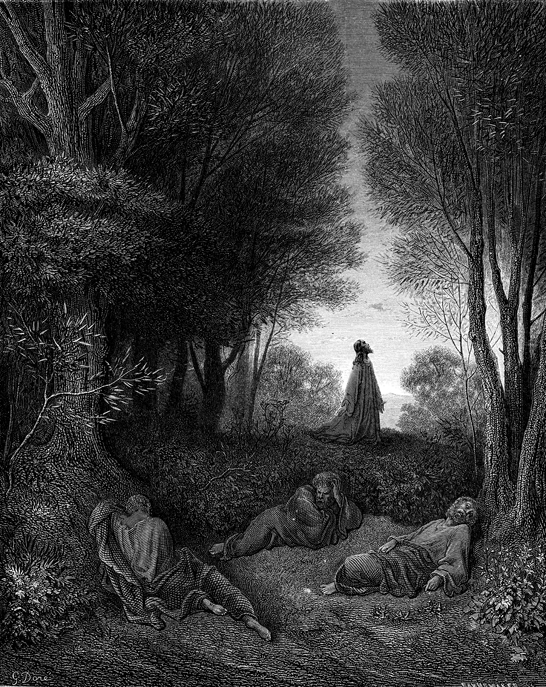
in Matthew 26Then He returned to the disciples and said, “Are you still sleeping and resting? Look, the hour is near, and the Son of Man is betrayed into the hands of sinners.
BSB
The same verse in ASV and KJV ▾
ASV
Then cometh he to the disciples, and saith unto them, Sleep on now, and take your rest: behold, the hour is at hand, and the Son of man is betrayed into the hands of sinners.
KJV
Then cometh he to his disciples, and saith unto them, Sleep on now, and take your rest: behold, the hour is at hand, and the Son of man is betrayed into the hands of sinners.
⋯
This verse in Matthew 26
Commentary
15 notes on this verseHaving concluded His third prayer, and having obtained that the Apostles' terror should be corrected by subsequent penitence, He goes forth undaunted by the prospect of His own Passion to meet His pursuers, and offers Himself voluntarily to be sacrificed. Arise, let us be going; as much as to say, Let them not find you trembling, let us go forth willingly to death, that they may see us confident and rejoicing in suffering; Lo, he that shall betray me draweth near.
The record, by era
The Church Fathers5 voices
(de Cons. Ev. iii. 4.) This speech as Matthew has it seems self-contradictory. For how could He say, Sleep on, and take your rest, and immediately continue, Rise, let us be going. This contradiction some have endeavoured to reconcile by supposing the words, Sleep on, and take your rest, to be an ironical rebuke, and not a permission; it might be rightly so taken if need were. But as Mark records it, when He had said, Sleep on, and take your rest, He added, it is enough, and then continued, The hour is come, behold, the Son of man is betrayed into the hands of sinners; (Mark 14:41.) we clearly understand the Lord to have been silent some time after He had said, Sleep on, to allow of their doing so, and then after some interval to have roused them with, Behold, the hour is at hand. And as Mark fills up the sense with, it is enough, that is, ye have had rest enough.
Or, the sleep He now bids His disciples take is of a different sort from that which is related above to have befallen them. Then He found them sleeping, not taking repose, but because their eyes were heavy, but now they are not merely to sleep, but to take their rest, that this order may be rightly observed, namely, that we first watch with prayer that we enter not into temptation, and afterwards sleep and take our rest, when having found a place for the Lord, a tabernacle for the God of Jacob, (Ps. 132:3.) we may go up into our bed, and give sleep to our eyes. It may be also that the soul, unable to sustain a continual energy by reason of its union with the flesh, may blamelessly admit some relaxations, which may be the moral interpretation of slumbers, and then again after due time be quickened to new energy.
Then, undoubtedly after the third prayer, he came to the disciples. But the sleep he now orders them to sleep is not that which, as is written, came upon the disciples twice before. For at first "he found them sleeping" but not at rest, and "again he came and found them sleeping, for their eyes were heavy." But now he orders them not simply to sleep but to take their rest. Indeed, there is a big difference between the sleep implied in Christ's second command to "sleep now and take your rest" and the sleep that is against his will after he orders them to "remain here and watch one hour with me." There was nothing contradictory between his words "watch with me" and later, "Sleep on and take your rest." He simply kept a certain order, so that first indeed we should watch and pray that we do not enter into temptation, and then we should sleep and take our rest according to Christ's command.
The fact that, after returning and finding them asleep, he first reproves them, secondly is silent and thirdly orders them to rest, can be explained in this way: First, after the resurrection, he scolded them for scattering and for being apprehensive and restless; second, once the Holy Spirit had been sent, he came and found them sleeping, since their eyes were too heavy for them to discern the freedom of the gospel—having been held back by the love of the law for some time, their faith was still sleeping; and third, with the return of his radiance, he restored them to restfulness and peace of mind.
After His persevering prayer, after His departures and several returns, He takes away their fear, restores their confidence, and exhorts them to sleep on, and take their rest. Or, He bids them sleep on, and take their rest, because He now confidently awaited His Father's will concerning the disciples, concerning which He had said, Thy will be done, and in obedience to which He drunk the cup that was to pass from Him to us, diverting upon Himself the weakness of our body, the terrors of dismay, and even the pains of death itself. And whereas, when He returned and found them sleeping, He rebukes them the first time, the second time says nothing, the third time bids them take their rest; the interpretation of this is, that at the first after His resurrection, when He finds them dispersed, distrustful, and timorous, He rebukes them; the second time, when their eyes were heavy to look upon the liberty of the Gospel, He visited them, sending them the Spirit, the Paraclete; for, held back by attachment to the Law, they slumbered in respect of faith; but the third time, when He shall come in His glory, He shall restore them to quietness and confidence.
9 more voices on this verse
The Church Fathers3 voices
(Verse 45.) Then he came to his disciples and said to them: Sleep now, and rest: behold, the hour is at hand, and the Son of man shall be delivered into the hands of sinners (Matthew 26 and 2 Corinthians 13). After he had prayed three times, that every word might stand in the mouth of two or three witnesses, and had obtained by subsequent penance that the fear of the apostles be corrected, he proceeds secure in his passion to his persecutors, and offers himself to be put to death, and says to his disciples:
A commentator
John ChrysostomHomily on the Gospel of Matthew 83 · Written in the 5th century.
proposed
"And He came and found them asleep." For besides that it was late at night, their eyes also were weighed down by their despondency. And the third time He went and spake the same thing, establishing the fact, that He was become man. For the second and third time is in the Scriptures especially indicative of truth; like as Joseph also said to Pharaoh, "Did the dream appear to thee the second time? For truth was this done, and that thou mightest be assured that this shall surely be." Therefore He too once, and twice, and three times spake the same thing, for the sake of proving the incarnation. And wherefore came He the second time? In order to reprove them, for that they were so drowned in despondency, as not to have any sense even of His presence. He did not however reprove them, but stood apart from them a little, showing their unspeakable weakness, that not even when they had been rebuked, were they able to endure. […]
Or, He prays thrice for the Apostles, and for Peter in particular, who was to deny Him thrice.
The Medieval Church2 voices
Then he cometh to his disciples and saith to them. And first, he grants them sleep; second, he rouses them, at rise, let us go. First, he gives permission; second, he assigns the cause, at behold, the hour is at hand, and the Son of …
Then cometh He to His disciples, and saith unto them, Sleep on now, and take your rest: behold, the hour is at hand, and the Son of Man is betrayed into the hands of sinners. Rise, let us be going: behold, he is at hand …
The Puritans and the Awakening1 voice
Then cometh he to his disciples,.... The three that were nearest to him, "the third time", as Mark says, Mar 14:41, and as it was, and saith unto them, sleep on now, and take your rest.
The Nineteenth Century3 voices
Sleep on now, and take your rest - Perhaps it might be better to read these words interrogatively, and paraphrase them thus: Do ye sleep on still? Will no warnings avail? Will no danger excite you to watchfulness and prayer? My hour - in which I am to be delivered up, is at hand; therefore now think of your own personal safety. The Son of man is betrayed into the hands of sinners - Αμαρτωλων, viz. the Gentiles or heathens, who were generally distinguished by this appellation from the Jews.
The verses we have now read describe what is commonly called Christ’s agony at Gethsemane. It is a passage which undoubtedly contains deep and mysterious things. We ought to read it with reverence and wonder, for there is much in it which we cannot fully comprehend. Why do we find our Lord so “sorrowful and very heavy,” as he is here described? What are we to make of his words, “My soul is exceeding sorrowful even unto death.”
The verses we have now read describe what is commonly called Christ’s agony at Gethsemane. It is a passage which undoubtedly contains deep and mysterious things. We ought to read it with reverence and wonder, for there is much in it which we cannot fully comprehend. Why do we find our Lord so “sorrowful and very heavy,” as he is here described? What are we to make of his words, “My soul is exceeding sorrowful even unto death.” Why do we see him going apart from his disciples, and falling on his face, and crying to his Father with strong cries, and thrice repeated prayer? Why is the almighty Son of God, who had worked so many miracles, so heavy and disquieted? Why is Jesus, who came into the world to die, so like one ready to faint at the approach of death? Why is all this? There is but one reasonable answer to these questions: the weight that pressed down our Lord’s soul was not the fear of death and its pains. Thousands have endured the most agonizing sufferings of body, and died without a groan, and so, no doubt, might our Lord. But the real weight that bowed down the heart of Jesus was the weight of the sin of the world, which seems to have now pressed down upon him with peculiar force: it was the burden of our guilt imputed to him, which was now laid on him, as on the head of the scapegoat. How great that burden must have been no human heart can conceive! It is known only to God. Well may the Greek Litany speak of the “unknown sufferings of Christ.” The words of Scott on this subject are probably correct: “Christ at this time endured as much misery of the same kind with that of condemned spirits, as could possibly consist with a pure conscience, perfect love of God and man, and an assured confidence of a glorious event.”
The words behind it
26 Greek wordsEvery Greek word of this verse in the order it stands, with what it means and the door to its own study. The last column counts the times a word stands in the whole Bible: the rarer the word, the more the places it appears belong together.
| Greek | Sound | Meaning | Word study | In the Bible |
|---|---|---|---|---|
| Τότε | tote | Then | G5119 → | 160 times |
| ἔρχεται | erchetai | He comes | G2064 → | 628 times |
| πρὸς | pros | to | G4314 → | 700 times |
| τοὺς | tous | the | G3588 → | 19766 times |
| μαθητὰς | mathetas | disciples | G3101 → | 260 times |
| καὶ | kai | and | G2532 → | 9120 times |
| λέγει | legei | says | G3004 → | 1325 times |
| αὐτοῖς· | autois | to them; | G846 → | 5565 times |
| καθεύδετε | katheudete | Sleep | G2518 → | 22 times |
| τὸ | to | <the> | G3588 → | 19766 times |
| λοιπὸν | loipon | later on | G3063 → | |
| καὶ | kai | and | G2532 → | 9120 times |
| ἀναπαύεσθε· | anapauesthe | take your rest; | G373 → | |
| ἰδοὺ | idou | Behold | G2400 → | 200 times |
| ἤγγικεν | engiken | has drawn near | G1448 → | 42 times |
| ἡ | he | the | G3588 → | 19766 times |
| ὥρα, | hora | hour, | G5610 → | 106 times |
| καὶ | kai | and | G2532 → | 9120 times |
| ὁ | ho | the | G3588 → | 19766 times |
| υἱὸς | huios | Son | G5207 → | 377 times |
| τοῦ | tou | <the> | G3588 → | 19766 times |
| ἀνθρώπου | anthropou | of Man | G444 → | 549 times |
| παραδίδοται | paradidotai | is betrayed | G3860 → | 119 times |
| εἰς | eis | into | G1519 → | 1755 times |
| χεῖρας | cheiras | [the] hands | G5495 → | 175 times |
| ἁμαρτωλῶν. | hamartolon | of sinners. | G268 → | 47 times |
ΤότεThen
toteG5119 →160 times
ἔρχεταιHe comes
erchetaiG2064 →628 times
πρὸςto
prosG4314 →700 times
τοὺςthe
tousG3588 →19766 times
μαθητὰςdisciples
mathetasG3101 →260 times
καὶand
kaiG2532 →9120 times
λέγειsays
legeiG3004 →1325 times
αὐτοῖς·to them;
autoisG846 →5565 times
καθεύδετεSleep
katheudeteG2518 →22 times
τὸ<the>
toG3588 →19766 times
λοιπὸνlater on
loiponG3063 →
καὶand
kaiG2532 →9120 times
ἀναπαύεσθε·take your rest;
anapauestheG373 →
ἰδοὺBehold
idouG2400 →200 times
ἤγγικενhas drawn near
engikenG1448 →42 times
ἡthe
heG3588 →19766 times
ὥρα,hour,
horaG5610 →106 times
καὶand
kaiG2532 →9120 times
ὁthe
hoG3588 →19766 times
υἱὸςSon
huiosG5207 →377 times
τοῦ<the>
touG3588 →19766 times
ἀνθρώπουof Man
anthropouG444 →549 times
παραδίδοταιis betrayed
paradidotaiG3860 →119 times
εἰςinto
eisG1519 →1755 times
χεῖρας[the] hands
cheirasG5495 →175 times
ἁμαρτωλῶν.of sinners.
hamartolonG268 →47 times
A shaded row is a word that stands 400 times or fewer in the Bible.
The walk
8 stopsEach card is a verse this one points to, and under it the verses that one points to in turn. Where several paths arrive at the same place, that place is listed first: the text keeps returning to it.
Through
John 17:1When Jesus had spoken these things, He lifted up His eyes to heaven and said, “Father, the hour has come. Glorify Your Son, that Your Son may glorify You.
it leads to
- John 12:23
But Jesus replied, “The hour has come for the Son of Man to be glorified.
Reached by 3 separate paths from here.
- John 13:31–32
When Judas had gone out, Jesus said, “Now the Son of Man is glorified, and God is glorified in Him.
- Philippians 2:9–11
Therefore God exalted Him to the highest place and gave Him the name above all names,
- John 17:4–5
I have glorified You on earth by accomplishing the work You gave Me to do.
- John 12:27–28
Now My soul is troubled, and what shall I say? ‘Father, save Me from this hour’? No, it is for this purpose that I have come to this hour.
- John 12:23
Through
John 13:1It was now just before the Passover Feast, and Jesus knew that His hour had come to leave this world and return to the Father. Having loved His own who were in the world,…
it leads to
- 1 John 4:19
We love because He first loved us.
- John 13:34
A new commandment I give you: Love one another. As I have loved you, so you also must love one another.
- John 13:3
Jesus knew that the Father had delivered all things into His hands, and that He had come from God and was returning to God.
- 1 John 4:19
Where this verse is studied
On this page
Studies15
About Matthew
This page draws on 14 works. Open the list of works
This page draws on Adam Clarke, Commentary on the Bible; Augustine of Hippo, Catena Aurea by Aquinas; Hilary of Poitiers, Commentary on Matthew 31.11; Hilary of Poitiers, Catena Aurea by Aquinas; J.C. Ryle, Expository Thoughts on the Gospels: Matthew; Jerome, Catena Aurea by Aquinas; Jerome, Commentary on Matthew; John Chrysostom, Homily on the Gospel of Matthew 83; John Gill, Exposition of the New Testament (1746-1748); Origen of Alexandria, Catena Aurea by Aquinas; Origen of Alexandria, COMMENTARY ON MATTHEW 96; Remigius of Rheims, Catena Aurea by Aquinas; Theophylact of Ohrid, Commentary on Matthew and Thomas Aquinas, Commentary on Matthew.