
Matthew 26:36
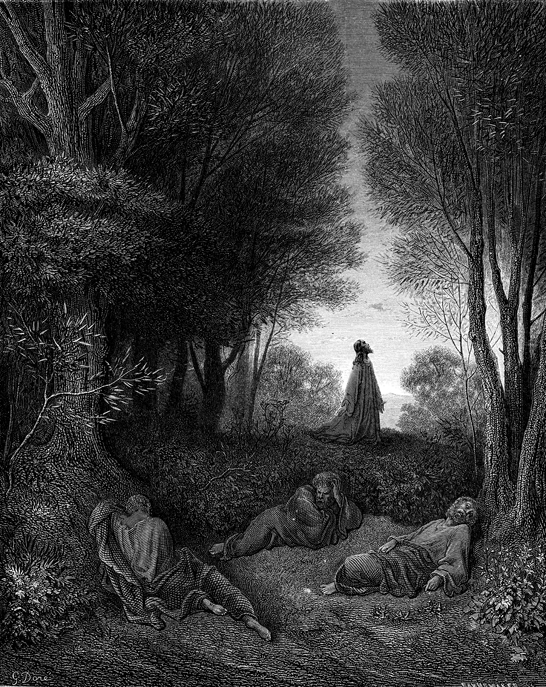
in Matthew 26At that time Jesus went with His disciples to a place called Gethsemane, and He told them, “Sit here while I go over there and pray.”
BSB
The same verse in ASV and KJV ▾
ASV
Then cometh Jesus with them unto a place called Gethsemane, and saith unto his disciples, Sit ye here, while I go yonder and pray.
KJV
Then cometh Jesus with them unto a place called Gethsemane, and saith unto the disciples, Sit ye here, while I go and pray yonder.
⋯
This verse in Matthew 26
Commentary
19 notes on this verse(Verse 36.) Then Jesus came with them to a village called Gethsemane and said to his disciples, 'Sit here while I go over there and pray.' Gethsemane means 'very fertile valley,' in which he ordered the disciples to sit for a little while and wait for the Lord to return, while he prayed for everyone alone.
This site's exposition
a place called Gethsemane
on Matthew 26:36-38
Then cometh Jesus with them unto a place called Gethsemane, a garden whose name means oil press, situated at the foot of the mount of Olives among ancient olive trees. He took with him Peter and the two sons of Zebedee, the same three who witnessed the transfiguration's glory now called to witness its opposite, and began to be sorrowful and very heavy names a genuine anguish rather than a performance of it. My soul is exceeding sorrowful, even unto death: tarry ye here, and watch with me asks for simple human companionship in the hour of greatest need, a request the three will fail to keep.
The record, by era
The Church Fathers5 voices
Jesus brought his disciples from the upper room to a garden which was called Gethsemane because, after he was betrayed, he did not want to be arrested in the same place where he and his disciples had eaten the Passover. Even before he was betrayed, however, he thought it fitting to choose to pray in places devoted purely to prayer, for he knew that some locations are holier than others, as it is written: "The place where you are standing is holy ground."
For it was not fitting that He should be seized in the place where He had sate and eaten the Passover with His disciples. Also He must first pray, and choose a place pure for prayer.
The Evangelist had said a little above, that when they had sung an hymn they went out to the mount of Olives; to point out the part of the mount to which they took their way, he now adds, Then came Jesus with them to a garden called Gethsemane. He had accepted the disciples' faith and the devotedness of their will, but He foresaw that they would be troubled and scattered abroad, and therefore bade them sit still in their places; for to sit belongs to one at ease, but they would be grievously troubled that they should have denied Him.
Gethsemane is interpreted, 'The rich valley;' and there He bade His disciples sit a little while, and wait His return whilst He prayed alone for all.
A commentator
John ChrysostomHomily on the Gospel of Matthew 83 · Written in the 5th century.
proposed
Because they clung to Him inseparably, therefore He saith, "Tarry ye here, while I go away and pray." For it was usual with Him to pray apart from them. And this He did teaching us in our prayers, to prepare silence for ourselves and great retirement.
12 more voices on this verse
The Medieval Church4 voices
Luke says, To the mount of Olives, (Luke 22:39.) and John, Went forth over the brook Cedron, where was a garden, (John 18:1.) which is the same as this Gethsemane, and is a place where He prayed at the foot of mount Olivet, where is a garden, and a Church now builtr When the Lord prayed in the mountain, He taught us to make supplication for heavenly things; when He prays in the garden, He teaches us to study humility in our prayer. And beautifully, as He draws near His Passion, does He pray in the 'valley of fatness,' showing that through the valley of humility, and the richness of charity, He took upon Him death for our sakes. The practical instruction which we may also learn from this is, that we should not suffer our heart to dry up from the richness of charity.
(de. Fid. Orth. iii. 24.) But seeing that prayer is the sending up the understanding to God, or the asking of God things fitting, how did the Lord pray? For His understanding needed not to be lifted up to God, having been once united hypostatically to God the Word. Neither could He need to ask of God things fitting, for the One Christ is both God and Man. But giving in Himself a pattern to us, He taught us to ask of God, and to lift up our minds to Him. As He took on Him our passions, that by triumphing over them Himself, He might give us also the victory over them, so now He prays to open to us the way to that lifting up to God, to fulfil for us all righteousness, to reconcile His Father to us, to pay honour to Him as the First Cause, and to show that He is not against God.
Then Jesus came with them into a country place which is called Gethsemani. In this part, the preparation by prayer is set forth; and he does three things. First, the intention to pray is set forth; second, the necessity of praying; third, the manner. The …
Peter said unto Him, Even if I must die with Thee, yet will I not deny Thee. Likewise also said all the disciples. Then cometh Jesus with them unto a place called Gethsemane, and saith unto the disciples, Sit ye here, while I go away …
The Puritans and the Awakening2 voices
Then cometh Jesus with them,.... The eleven disciples, unto a place called Gethsemane; the Syriac version calls it Ghedsiman; the Persic, Ghesmani, so the Arabic; the Vulgate Latin, and the Ethiopic, Gethsemani: in Munster's Hebrew Gospel, and in the Vulgate Latin, and Arabic versions, it is called a "village"; and in the Ethiopic version, "a village of wine"; and in the Syriac and Persic versions, a place. Here, according to an Ethiopic writer, the Virgin Mary was buried by the apostles (d).
Then cometh Jesus to a place called Gethsemane - That is, the valley of fatness. The garden probably had its name from its soil and situation, laying in some little valley between two of those many hills, the range of which constitutes the Mount of Olives.
The Nineteenth Century6 voices
A place called Gethsemane - A garden at the foot of the mount of Olives. The name seems to be formed from גת gath, a press, and סמן shemen, oil; probably the place where the produce of the mount of Olives was prepared for use. The garden of the oil-press, or olive-press. Sit ye here - Or, stay in this place, while I go and pray yonder: and employ ye the time as I shall employ it - in watching unto prayer.
The verses we have now read describe what is commonly called Christ’s agony at Gethsemane. It is a passage which undoubtedly contains deep and mysterious things. We ought to read it with reverence and wonder, for there is much in it which we cannot fully comprehend. Why do we find our Lord so “sorrowful and very heavy,” as he is here described? What are we to make of his words, “My soul is exceeding sorrowful even unto death.”
The verses we have now read describe what is commonly called Christ’s agony at Gethsemane. It is a passage which undoubtedly contains deep and mysterious things. We ought to read it with reverence and wonder, for there is much in it which we cannot fully comprehend. Why do we find our Lord so “sorrowful and very heavy,” as he is here described? What are we to make of his words, “My soul is exceeding sorrowful even unto death.” Why do we see him going apart from his disciples, and falling on his face, and crying to his Father with strong cries, and thrice repeated prayer? Why is the almighty Son of God, who had worked so many miracles, so heavy and disquieted? Why is Jesus, who came into the world to die, so like one ready to faint at the approach of death? Why is all this? There is but one reasonable answer to these questions: the weight that pressed down our Lord’s soul was not the fear of death and its pains. Thousands have endured the most agonizing sufferings of body, and died without a groan, and so, no doubt, might our Lord. But the real weight that bowed down the heart of Jesus was the weight of the sin of the world, which seems to have now pressed down upon him with peculiar force: it was the burden of our guilt imputed to him, which was now laid on him, as on the head of the scapegoat. How great that burden must have been no human heart can conceive! It is known only to God. Well may the Greek Litany speak of the “unknown sufferings of Christ.” The words of Scott on this subject are probably correct: “Christ at this time endured as much misery of the same kind with that of condemned spirits, as could possibly consist with a pure conscience, perfect love of God and man, and an assured confidence of a glorious event.”
THOUGH I have taken only these few words for my text, I shall endeavor to bring the whole narrative before your mind's eyes. It is a part of the teaching of Holy Writ that man is a composite being—his nature being divisible into three parts—"spirit," "soul," and "body." I am not going to draw any nice distinctions tonight between the spirit and the soul, or to analyze the connecting link between our immaterial life and consciousness and the physical condition of our nature and the materialism of the world around us.
THOUGH I have taken only these few words for my text, I shall endeavor to bring the whole narrative before your mind's eyes. It is a part of the teaching of Holy Writ that man is a composite being—his nature being divisible into three parts—"spirit," "soul," and "body." I am not going to draw any nice distinctions tonight between the spirit and the soul, or to analyze the connecting link between our immaterial life and consciousness and the physical condition of our nature and the materialism of the world around us. Suffice it to say that whenever our vital organization is mentioned, this triple constitution is pretty sure to be referred to. If you notice it carefully, you will see in our Savior's sufferings on our behalf that the passion extended to His spirit, soul, and body—and although at the last extremity upon the Cross it was hard to tell in which respect He suffered most, all three being strained to the utmost—yet it is certain there were three distinct conflicts in accordance with this threefold endowment of humanity. The first part of our Lord's dolorous pain fell upon His spirit. This took place at the table in that upper chamber where He ate the Passover with His disciples. Those of you who have read the narrative attentively will have noticed these remarkable words in the thirteenth chapter of John and the twenty-first verse: "When Jesus had said these things, He was troubled in spirit, and testified and said, Verily, verily, I say unto you, that one of you shall betray Me." Of that silent conflict in the Savior's heart while He was sitting at the table no one was a spectator. Into any man's spiritual apprehensions it was beyond the power of any other creature to penetrate.
A commentator
Albert Barnes1798–1870
Notes, Explanatory and Practical, on the Old and New Testaments (1832-1869)
proposed
Jesus’ agony in Gethsemane - This account is also recorded in Mar 14:32-42; Luk 22:39-46; Joh 18:1. Mat 26:36 Then cometh ... - After the institution of the Lord’s Supper, in the early part of the night, he went out to the Mount of Olives. In his journey he passed over the brook Cedron Joh 18:1, which bounded Jerusalem on the east. Unto a place - John calls this “a garden.” This garden was on the western side of the Mount of Olives, and a short distance from Jerusalem. The word used by John means not properly a garden for the cultivation of vegetables, but a place planted with the olive and other trees, perhaps with a fountain of water, and with walks and groves; a proper place of refreshment in a hot climate, and of retirement from the noise of the adjacent city. Such places were doubtless common in the vicinity of Jerusalem. Messrs. Fisk and King, American missionaries were at the place which is commonly supposed to have been the garden of Gethsemane in 1823. They tell us that the garden is about a stone’s cast from the brook of Cedron; that it now contains eight large and venerable-looking olives, whose trunks show their great antiquity. The spot is sandy and barren, and appears like a forsaken place. A low broken wall surrounds it. Mr. King sat down beneath one of the trees and read Isa 53:1-12, and also the gospel history of our Redeemer’s sorrow during that memorable night in which he was there betrayed; and the interest of the association was heightened by the passing through the place of a party of Bedouins, armed with spears and swords. A recent traveler says of this place that it “is a field or garden about 50 paces square, with a few shrubs growing in it, and eight olive-trees of great antiquity, the whole enclosed with a stone wall.” The place was probably fixed upon, as Dr. […]
The words behind it
21 Greek wordsEvery Greek word of this verse in the order it stands, with what it means and the door to its own study. The last column counts the times a word stands in the whole Bible: the rarer the word, the more the places it appears belong together.
| Greek | Sound | Meaning | Word study | In the Bible |
|---|---|---|---|---|
| Τότε | tote | Then | G5119 → | 160 times |
| ἔρχεται | erchetai | comes | G2064 → | 628 times |
| μετ᾽ | met᾽ | with | G3326 → | 461 times |
| αὐτῶν | auton | them | G846 → | 5565 times |
| ὁ | ho | <the> | G3588 → | 19766 times |
| Ἰησοῦς | iesous | Jesus | G2424 → | 908 times |
| εἰς | eis | to | G1519 → | 1755 times |
| χωρίον | chorion | a place | G5564 → | |
| λεγόμενον | legomenon | being named | G3004 → | 1325 times |
| Γεθσημανὶ | gethsemani | Gethsemane | G1068 → | |
| καὶ | kai | and | G2532 → | 9120 times |
| λέγει | legei | He says | G3004 → | 1325 times |
| τοῖς | tois | to the | G3588 → | 19766 times |
| μαθηταῖς· | mathetais | disciples; | G3101 → | 260 times |
| καθίσατε | kathisate | do sit | G2523 → | 44 times |
| αὐτοῦ | autou | here | G847 → | |
| ἕως | he'os | until | G2193 → | 146 times |
| οὗ | hou | that | G3739 → | 1405 times |
| ἀπελθὼν | apelthon | having gone away | G565 → | 115 times |
| ἐκεῖ | ekei | over there | G1563 → | 105 times |
| προσεύξωμαι.¶ | proseuxomai | I may pray. | G4336 → | 85 times |
ΤότεThen
toteG5119 →160 times
ἔρχεταιcomes
erchetaiG2064 →628 times
μετ᾽with
met᾽G3326 →461 times
αὐτῶνthem
autonG846 →5565 times
ὁ<the>
hoG3588 →19766 times
ἸησοῦςJesus
iesousG2424 →908 times
εἰςto
eisG1519 →1755 times
χωρίονa place
chorionG5564 →
λεγόμενονbeing named
legomenonG3004 →1325 times
ΓεθσημανὶGethsemane
gethsemaniG1068 →
καὶand
kaiG2532 →9120 times
λέγειHe says
legeiG3004 →1325 times
τοῖςto the
toisG3588 →19766 times
μαθηταῖς·disciples;
mathetaisG3101 →260 times
καθίσατεdo sit
kathisateG2523 →44 times
αὐτοῦhere
autouG847 →
ἕωςuntil
he'osG2193 →146 times
οὗthat
houG3739 →1405 times
ἀπελθὼνhaving gone away
apelthonG565 →115 times
ἐκεῖover there
ekeiG1563 →105 times
προσεύξωμαι.¶I may pray.
proseuxomaiG4336 →85 times
A shaded row is a word that stands 400 times or fewer in the Bible.
The walk
8 stopsEach card is a verse this one points to, and under it the verses that one points to in turn. Where several paths arrive at the same place, that place is listed first: the text keeps returning to it.
Through
Matthew 26:39Going a little farther, He fell facedown and prayed, “My Father, if it is possible, let this cup pass from Me. Yet not as I will, but as You will.”
it leads to
- John 6:38
For I have come down from heaven, not to do My own will, but to do the will of Him who sent Me.
- Philippians 2:8
And being found in appearance as a man, He humbled Himself and became obedient to death—even death on a cross.
- Luke 22:41–42
And He withdrew about a stone’s throw beyond them, where He knelt down and prayed,
- Matthew 26:42
A second time He went away and prayed, “My Father, if this cup cannot pass unless I drink it, may Your will be done.”
- John 5:30
I can do nothing by Myself; I judge only as I hear. And My judgment is just, because I do not seek My own will, but the will of Him who sent Me.
- John 6:38
Through
Matthew 26:42A second time He went away and prayed, “My Father, if this cup cannot pass unless I drink it, may Your will be done.”
it leads to
- Matthew 26:39
Going a little farther, He fell facedown and prayed, “My Father, if it is possible, let this cup pass from Me. Yet not as I will, but as You will.”
- Mark 14:39–40
Again He went away and prayed, saying the same thing.
- Hebrews 4:15
For we do not have a high priest who is unable to sympathize with our weaknesses, but we have one who was tempted in every way that we are, yet was without sin.
- Matthew 26:39
Where this verse is studied
On this page
Studies15
On this verse
On this chapter
- Angelology
- Archaeology and the Bible (the Evidence Ledger)
- Gethsemane (The Garden Called the Oil Press)
- Peter's Denial: Matthew 26 · Mark 14 · Luke 22 · John 18
- The Blood
- The Bride & the Jewish Wedding
- The Cleansing of the Temple: John 2 · Matthew 21
- The Father's Will
- The Lord's Supper
- The Right Hand
- The Shepherd
- The Sword
- The Tree
- The Vine & the Vineyard
About Matthew
Who and where
1 name in this verse with a page on the site.
This page draws on 18 works. Open the list of works
This page draws on Adam Clarke, Commentary on the Bible; Albert Barnes, Notes, Explanatory and Practical, on the Gospels; Albert Barnes, Notes, Explanatory and Practical, on the Old and New Testaments (1832-1869); Charles Spurgeon, The Metropolitan Tabernacle Pulpit, Sermon No. 693: “The Garden Of The Soul” (lightly modernized text, CCEL edition); J.C. Ryle, Expository Thoughts on the Gospels: Matthew; Jerome, Commentary on Matthew; Jerome, Catena Aurea by Aquinas; John Chrysostom, Homily on the Gospel of Matthew 83; John Damascene, Catena Aurea by Aquinas; John Gill, Exposition of the New Testament (1746-1748); John Wesley, Explanatory Notes upon the New Testament; Matthew Henry, Commentary on the Whole Bible; Origen of Alexandria, COMMENTARY ON MATTHEW 89.3; Origen of Alexandria, Catena Aurea by Aquinas; Rabanus Maurus, Catena Aurea by Aquinas; Remigius of Rheims, Catena Aurea by Aquinas; Theophylact of Ohrid, Commentary on Matthew and Thomas Aquinas, Commentary on Matthew.