
Matthew 26:44
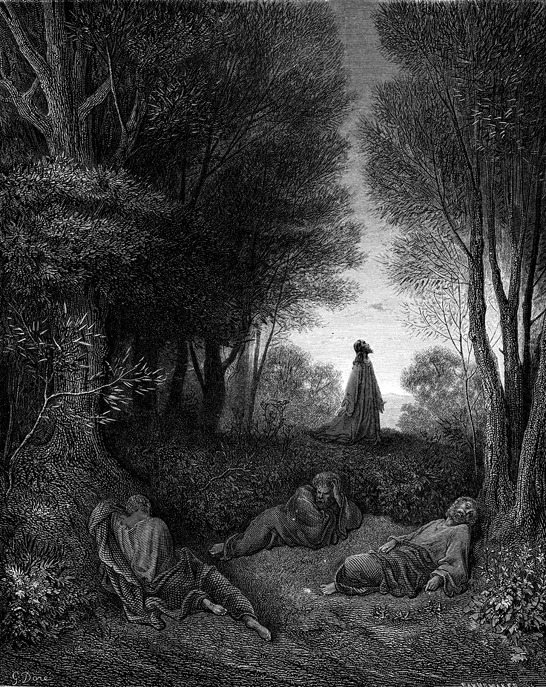
in Matthew 26So He left them and went away once more and prayed a third time, saying the same thing.
BSB
The same verse in ASV and KJV ▾
ASV
And he left them again, and went away, and prayed a third time, saying again the same words.
KJV
And he left them, and went away again, and prayed the third time, saying the same words.
⋯
This verse in Matthew 26
Commentary
12 notes on this verse(Verse 43, 44.) And he came again and found them sleeping. For their eyes were heavy. And leaving them, he went away again and prayed for the third time, saying the same thing. He alone prays for all, just as he alone suffers for everyone. But the apostles' eyes grew weak and burdened by imminent denial.
The record, by era
The Church Fathers5 voices
He prayed the third time, that in the mouth of two or three witnesses every word might be established.
Or, He prays thrice for the Apostles, and for Peter in particular, who was to deny Him thrice.
That He prays for this a second and a third time, comes of the feelings belonging to human frailty, through which also He feared death, thus giving assurance that He was truly made man. For in Scripture when any thing is repeated a second and third time, that is the greatest proof of its truth and reality; as, for example, when Joseph says to Pharaoh, And for that thou sawedst it twice, it is proof of the thing being established by God. (Gen. 41:32.)
Wherefore He does not rebuke them, but goes again and prays, teaching us that we should not faint but should persevere in prayer, until we obtain what we have begun to ask.
The fact that, after returning and finding them asleep, he first reproves them, secondly is silent and thirdly orders them to rest, can be explained in this way: First, after the resurrection, he scolded them for scattering and for being apprehensive and restless; second, once the Holy Spirit had been sent, he came and found them sleeping, since their eyes were too heavy for them to discern the freedom of the gospel—having been held back by the love of the law for some time, their faith was still sleeping; and third, with the return of his radiance, he restored them to restfulness and peace of mind.
6 more voices on this verse
The Medieval Church2 voices
And leaving them, he went again and prayed the third time. Here he treats of the third prayer: and he does two things. First, he sets forth the order; second, the granting of sleep, at then he cometh to his disciples etc. He says: and …
Or, The Lord prayed thrice, to teach us to pray for pardon of sins past, defence against present evil, and provision against future perils, and that we should address every prayer to Father, Son, and Holy Spirit, and that our spirit, soul, and body should be kept in safety.
The Puritans and the Awakening1 voice
And he left them, and went away again,....
The Nineteenth Century3 voices
Prayed the third time - So St. Paul - I besought the Lord Thrice that it might depart from me, 2Co 12:8. This thrice repeating the same petition argues deep earnestness of soul.
The verses we have now read describe what is commonly called Christ’s agony at Gethsemane. It is a passage which undoubtedly contains deep and mysterious things. We ought to read it with reverence and wonder, for there is much in it which we cannot fully comprehend. Why do we find our Lord so “sorrowful and very heavy,” as he is here described? What are we to make of his words, “My soul is exceeding sorrowful even unto death.”
The verses we have now read describe what is commonly called Christ’s agony at Gethsemane. It is a passage which undoubtedly contains deep and mysterious things. We ought to read it with reverence and wonder, for there is much in it which we cannot fully comprehend. Why do we find our Lord so “sorrowful and very heavy,” as he is here described? What are we to make of his words, “My soul is exceeding sorrowful even unto death.” Why do we see him going apart from his disciples, and falling on his face, and crying to his Father with strong cries, and thrice repeated prayer? Why is the almighty Son of God, who had worked so many miracles, so heavy and disquieted? Why is Jesus, who came into the world to die, so like one ready to faint at the approach of death? Why is all this? There is but one reasonable answer to these questions: the weight that pressed down our Lord’s soul was not the fear of death and its pains. Thousands have endured the most agonizing sufferings of body, and died without a groan, and so, no doubt, might our Lord. But the real weight that bowed down the heart of Jesus was the weight of the sin of the world, which seems to have now pressed down upon him with peculiar force: it was the burden of our guilt imputed to him, which was now laid on him, as on the head of the scapegoat. How great that burden must have been no human heart can conceive! It is known only to God. Well may the Greek Litany speak of the “unknown sufferings of Christ.” The words of Scott on this subject are probably correct: “Christ at this time endured as much misery of the same kind with that of condemned spirits, as could possibly consist with a pure conscience, perfect love of God and man, and an assured confidence of a glorious event.”
The words behind it
13 Greek wordsEvery Greek word of this verse in the order it stands, with what it means and the door to its own study. The last column counts the times a word stands in the whole Bible: the rarer the word, the more the places it appears belong together.
| Greek | Sound | Meaning | Word study | In the Bible |
|---|---|---|---|---|
| Καὶ | kai | And | G2532 → | 9120 times |
| ἀφεὶς | apheis | having left | G863 → | 143 times |
| αὐτοὺς | autous | them | G846 → | 5565 times |
| πάλιν | palin | again | G3825 → | 139 times |
| ἀπελθὼν | apelthon | having gone away | G565 → | 115 times |
| προσηύξατο | proseuxato | He prayed | G4336 → | 85 times |
| ἐκ | ek | for | G1537 → | 911 times |
| τρίτου | tritou | [the] third time | G5154 → | 56 times |
| τὸν | ton | the | G3588 → | 19766 times |
| αὐτὸν | auton | same | G846 → | 5565 times |
| λόγον | logon | thing | G3056 → | 329 times |
| εἰπὼν | eipon | having said | G2036 → | 925 times |
| πάλιν.¶ | palin | again. | G3825 → | 139 times |
ΚαὶAnd
kaiG2532 →9120 times
ἀφεὶςhaving left
apheisG863 →143 times
αὐτοὺςthem
autousG846 →5565 times
πάλινagain
palinG3825 →139 times
ἀπελθὼνhaving gone away
apelthonG565 →115 times
προσηύξατοHe prayed
proseuxatoG4336 →85 times
ἐκfor
ekG1537 →911 times
τρίτου[the] third time
tritouG5154 →56 times
τὸνthe
tonG3588 →19766 times
αὐτὸνsame
autonG846 →5565 times
λόγονthing
logonG3056 →329 times
εἰπὼνhaving said
eiponG2036 →925 times
πάλιν.¶again.
palinG3825 →139 times
A shaded row is a word that stands 400 times or fewer in the Bible.
The walk
8 stopsEach card is a verse this one points to, and under it the verses that one points to in turn. Where several paths arrive at the same place, that place is listed first: the text keeps returning to it.
Through
Luke 18:1Then Jesus told them a parable about their need to pray at all times and not lose heart:
it leads to
- Colossians 4:2
Devote yourselves to prayer, being watchful and thankful,
- Romans 12:12
Be joyful in hope, patient in affliction, persistent in prayer.
- 1 Thessalonians 5:17
Pray without ceasing.
- Philippians 4:6
Be anxious for nothing, but in everything, by prayer and petition, with thanksgiving, present your requests to God.
- Ephesians 6:18
Pray in the Spirit at all times, with every kind of prayer and petition. To this end, stay alert with all perseverance in your prayers for all the saints.
- Colossians 4:2
Through
Matthew 6:7And when you pray, do not babble on like pagans, for they think that by their many words they will be heard.
it leads to
- Ecclesiastes 5:2–3
Do not be quick to speak, and do not be hasty in your heart to utter a word before God. After all, God is in heaven and you are on earth. So let your…
- Ecclesiastes 5:7
For as many dreams bring futility, so do many words. Therefore, fear God.
- 1 Kings 18:26–29
And they took the bull that was given them, prepared it, and called on the name of Baal from morning until noon, shouting, “O Baal, answer us!” But there was no sound, and no…
- Ecclesiastes 5:2–3
Where this verse is studied
On this page
Studies31
- Angelology
- Forgiveness
- The Words Nasa, Salach and Aphiemi
- Gethsemane (The Garden Called the Oil Press)
- The Words Todah, Yadah and Eucharisteo
- Hell and the Final State of the Lost
Show the next 6 titles
- The High-Priestly Line
- Jesus
- Jesus on Prayer
- The Lord's Prayer
- Strength Under Control
- The Gentleness of Christ
Show the next 6 titles
- Oaths. Let Your Yes Be Yes
- Peter's Denial: Matthew 26 · Mark 14 · Luke 22 · John 18
- The Scarlet Thread
- The Son of Man: Daniel 7:13-14
- The Book of the Covenant
- The Bride & the Jewish Wedding
Show the next 6 titles
About Matthew
This page draws on 11 works. Open the list of works
This page draws on Adam Clarke, Commentary on the Bible; Hilary of Poitiers, Commentary on Matthew 31.11; J.C. Ryle, Expository Thoughts on the Gospels: Matthew; Jerome, Commentary on Matthew; Jerome, Catena Aurea by Aquinas; John Chrysostom, Catena Aurea by Aquinas; John Gill, Exposition of the New Testament (1746-1748); Origen of Alexandria, Catena Aurea by Aquinas; Rabanus Maurus, Catena Aurea by Aquinas; Remigius of Rheims, Catena Aurea by Aquinas and Thomas Aquinas, Commentary on Matthew.