
Matthew 26:38
in Matthew 26Then He said to them, “My soul is consumed with sorrow to the point of death. Stay here and keep watch with Me.”
BSB
The same verse in ASV and KJV ▾
ASV
Then saith he unto them, My soul is exceeding sorrowful, even unto death: abide ye here, and watch with me.
KJV
Then saith he unto them, My soul is exceeding sorrowful, even unto death: tarry ye here, and watch with me.
⋯
This verse in Matthew 26
Commentary
21 notes on this verse(Verse 37) And taking with him Peter and the two sons of Zebedee, he began to be sad and sorrowful. What we have said above about the passion and pre-passion is also shown in the present chapter, that the Lord, in order to prove the truth of his assumption as a man, was truly saddened, but so that the passion would not dominate his soul, he began to be saddened through pre-sorrow. For it is one thing to be saddened, and another thing to begin to be saddened.
This site's exposition
a place called Gethsemane
on Matthew 26:36-38
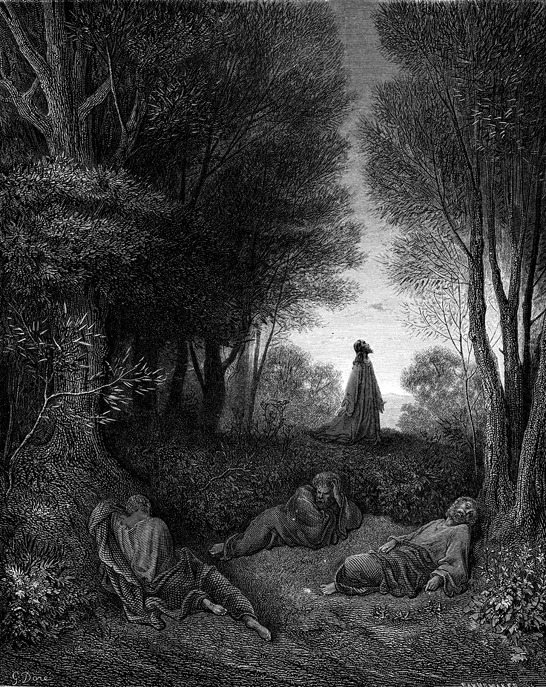
Jesus goes with his disciples to Gethsemane, a name meaning oil press, a garden among olive trees at the foot of the Mount of Olives. He takes Peter and the two sons of Zebedee, the three who saw the transfiguration, and "began to be sorrowful and deeply distressed".
This site's exposition
sorrow to the point of death
Adam Clarke reads the phrase as literal, a soul so consumed that death would follow without help. Jerome sees a real human sorrow here. He distinguishes sorrow that begins in the soul from sorrow that rules it, and Jesus knew the first without being mastered.
The record, by era
The Church Fathers5 voices
(ill. Luc. 22:43.) He is sorrowful, yet not Himself, but His soul; not His Wisdom, not His divine Substance, but His soul, for He took upon Him my soul, and my body.
(Lib. 83. Quæst. q. 80.) We have the narratives of the Evangelists, by which we know that Christ was both born of the Blessed Virgin Mary, was seized by the Jews, scourged, crucified, put to death, and buried in a tomb, all which cannot be supposed to have taken place without a body, and not even the maddest will say that these things are to be understood figuratively, when they are told by men who wrote what they remembered to have happened. These then are witnesses that He had a body, as those affections which cannot be without mind prove Him to have had a mind, and which we read in the accounts of the same Evangelists, that Jesus wondered, was angry, was sorrowful. (de. Civ. Dei, xiv. 9.) Since then these things are related in the Evangelists, they are not surely false, but as when He willed He became Man, so likewise when He willed He took into His human soul these passions for the sake of adding assurance to the dispensation. We indeed have these passions by reason of the weakness of our human nature; not so the Lord Jesus, whose weakness was of power.
"Stay here and keep watch with me." It is as though Jesus had said, "Although I told the other disciples to 'sit here while I go and pray' but brought you three along with me, I don't want you to come any further, for you are not yet able. So, stay here keeping watch as I keep watch, knowing that the others were commanded to sit over there because they are weaker and need to be protected from this agony. [But] I have brought you who are stronger with me to labor with me in watching and praying. Nevertheless, you remain here, that each one stand firm in the state of his calling,for every grace (however great it may be) has a superior." What Jesus meant when he said "remain here" is explained by what was said next: "going a little farther, he fell on his face." Therefore let us remain where Jesus commanded us to remain, as the apostle also admonished: "Everyone should remain in the state in which he was called." And let us do everything in our power to keep watch with him who "neither slumbers nor sleeps, who keeps Israel."
Or otherwise; My soul is sorrowful even unto death; as much as to say, Sorrow is begun in me, but not to endure for ever, but only till the hour of death; that when I shall die for sin, I shall die also to all sorrow, whose beginnings only are in me. Tarry ye here, and watch with me; as much as to say, The rest I bade sit yonder as weak, removing them from this struggle; but you I have brought hither as being stronger, that ye may toil with me in watching and prayer. But abide you here, that every man may stay in his own rank and station; since all grace, however great, has its superior.
Then he said, "My soul is sad, even to death." Did he say, My soul is sad because of death? Certainly not. For if death were the reason for his fear, he certainly ought to have said so. But the reason for his fear lies elsewhere. Actually we have no indication, since the reason for what begins in another person may differ from what it is at the end. He had just said before, "You will all fall away this night because of me." He knew that they would be frightened, that they would run away and deny knowing him. And since blasphemy against the Holy Spirit is forgiven neither here nor in eternity, he feared they might deny that he is God, once they looked upon him beaten and spat upon and crucified. This was the reason that prompted Peter, who, in betraying Christ, denied him in this way: "I do not know the man," for anything said against the Son of man will be forgiven. Christ is therefore sad even to death. So it is not death itself but the process of death that is feared, for after his death the faith of the believers would be strengthened by the power of the resurrection.
13 more voices on this verse
The Church Fathers6 voices
"My soul," says He, "is exceeding sorrowful, even unto death; " and "the bread that I will give is my flesh, (which I will give) for the life of the world.
He sometimes also fled from violence Himself, but for the same reason as had led Him to command the apostles to do so: that is, He wanted to fulfil His ministry of teaching; and when it was finished, I do not say He stood firm, but He had no desire even to get from His Father the aid of hosts of angels: finding fault, too, with Peter's sword. He likewise acknowledged, it is true, that His "soul was troubled, even unto death," and the flesh weak; with the design, (however,) first of all, that by having, as His own, trouble of soul and weakness of the flesh, He might show you that both the substances in Him were truly human; lest, as certain persons have now brought it in, you might be led to think either the flesh or the soul of Christ different from ours; and then, that, by an exhibition of their states, you might be convinced that they have no power at all of themselves without the spirit.
(Verse 38.) Then he said to them, My soul is sorrowful, even to death; wait here, and watch with me. The soul is saddened and not, however, by death, but is saddened even unto death, until he frees his apostles by his suffering. And what he commanded: wait here, and watch with me, he does not forbid sleep, the time of which was not imminent with danger, but he forbids sleep of unfaithfulness, and dulness of mind. Therefore, let those who suspect that Jesus took on an irrational soul declare how he could be saddened and know the time of sadness. Although even dumb animals die, they do not know the reasons or the time until which they must be saddened.
He is sorrowful not because of death, but unto death, until He has set the Apostles free by His Passion. Let those who imagine Jesus to have taken an irrational soul, say how it is that He is thus sorrowful, and knows the season of His sorrow, for though the brute animals have sorrow, yet they know neither the causes of it, nor the time for which it must endure. Or the sleep which He would have them forego is not bodily rest, for which at this critical time there was no room, but mental torpor, the sleep of unbelief.
And He takes with Him the three, and saith unto them, "my soul is exceeding sorrowful, even unto death." Wherefore doth He not take all with Him? That they might not be cast down; but these He taketh that had been spectators of His glory.
For He showed to what belongs (the incidents of) being destroyed, thrown down, and kept down-even to that to which it also appertains to be lifted and raised up again; although He was at the same time bearing about with Him "a soul that was trembling even unto death," but which did not fall through death, because even the Scripture informs us that "He spoke of His body.
The Medieval Church3 voices
Then he saith to them: my soul is sorrowful even unto death etc. He does not say: I am sorrowful, because "I" is indicative of the person, but he was not saddened insofar as he was the Word, but according to his soul; therefore the …
(Fid. Orth. iii. 20.) Wherefore the passions of our nature were in Christ both by nature and beyond nature. By nature, because He left His flesh to suffer the things incidental to it; beyond nature, because these natural emotions did not in Him precede the will. For in Christ nothing befel of compulsion, but all was voluntary; with His will He hungered, with His will He feared, or was sorrowful. Here His sorrow is declared, Then saith he unto them, My soul is sorrowful even unto death.
He was sorrowful and heavy in accord with the divine plan, so as to confirm that He was truly man. For it is human nature to fear death; it was against our nature that death entered, and for this reason our nature flees from it. …
The Puritans and the Awakening1 voice
Then saith he unto them,.... The three disciples, Peter, James, and John, who, by his looks and gestures, might know somewhat of the inward distress of his mind; yet he choose to express it to them in words, saying, my soul is exceeding sorrowful, even unto death.
The Nineteenth Century3 voices
Then saith he - Then saith - Jesus: - I have added the word Jesus, ὁ Ιησους, on the authority of a multitude of eminent MSS. See them in Griesbach. My soul is exceeding sorrowful, (or, is surrounded with exceeding sorrow), even unto death - This latter word explains the two former: My soul is so dissolved in sorrow, my spirit is filled with such agony and anguish, that, if speedy succor be not given to my body, death must be the speedy consequence.
The verses we have now read describe what is commonly called Christ’s agony at Gethsemane. It is a passage which undoubtedly contains deep and mysterious things. We ought to read it with reverence and wonder, for there is much in it which we cannot fully comprehend. Why do we find our Lord so “sorrowful and very heavy,” as he is here described? What are we to make of his words, “My soul is exceeding sorrowful even unto death.”
The verses we have now read describe what is commonly called Christ’s agony at Gethsemane. It is a passage which undoubtedly contains deep and mysterious things. We ought to read it with reverence and wonder, for there is much in it which we cannot fully comprehend. Why do we find our Lord so “sorrowful and very heavy,” as he is here described? What are we to make of his words, “My soul is exceeding sorrowful even unto death.” Why do we see him going apart from his disciples, and falling on his face, and crying to his Father with strong cries, and thrice repeated prayer? Why is the almighty Son of God, who had worked so many miracles, so heavy and disquieted? Why is Jesus, who came into the world to die, so like one ready to faint at the approach of death? Why is all this? There is but one reasonable answer to these questions: the weight that pressed down our Lord’s soul was not the fear of death and its pains. Thousands have endured the most agonizing sufferings of body, and died without a groan, and so, no doubt, might our Lord. But the real weight that bowed down the heart of Jesus was the weight of the sin of the world, which seems to have now pressed down upon him with peculiar force: it was the burden of our guilt imputed to him, which was now laid on him, as on the head of the scapegoat. How great that burden must have been no human heart can conceive! It is known only to God. Well may the Greek Litany speak of the “unknown sufferings of Christ.” The words of Scott on this subject are probably correct: “Christ at this time endured as much misery of the same kind with that of condemned spirits, as could possibly consist with a pure conscience, perfect love of God and man, and an assured confidence of a glorious event.”
The words behind it
16 Greek wordsEvery Greek word of this verse in the order it stands, with what it means and the door to its own study. The last column counts the times a word stands in the whole Bible: the rarer the word, the more the places it appears belong together.
| Greek | Sound | Meaning | Word study | In the Bible |
|---|---|---|---|---|
| Τότε | tote | Then | G5119 → | 160 times |
| λέγει | legei | He says | G3004 → | 1325 times |
| αὐτοῖς | autois | to them | G846 → | 5565 times |
| περίλυπός | perilupos | Very sorrowful | G4036 → | |
| ἐστιν | estin | is | G1510 → | 2333 times |
| ἡ | he | the | G3588 → | 19766 times |
| ψυχή | psuche | soul | G5590 → | 103 times |
| μου | mou | of Mine | G3165 → | 1936 times |
| ἕως | he'os | until | G2193 → | 146 times |
| θανάτου· | thanatou | death; | G2288 → | 120 times |
| μείνατε | meinate | do remain | G3306 → | 118 times |
| ὧδε | hode | here | G5602 → | 61 times |
| καὶ | kai | and | G2532 → | 9120 times |
| γρηγορεῖτε | gregoreite | do watch | G1127 → | 22 times |
| μετ᾽ | met᾽ | with | G3326 → | 461 times |
| ἐμοῦ.¶ | emou | Me. | G1473 → | 839 times |
ΤότεThen
toteG5119 →160 times
λέγειHe says
legeiG3004 →1325 times
αὐτοῖςto them
autoisG846 →5565 times
περίλυπόςVery sorrowful
periluposG4036 →
ἐστινis
estinG1510 →2333 times
ἡthe
heG3588 →19766 times
ψυχήsoul
psucheG5590 →103 times
μουof Mine
mouG3165 →1936 times
ἕωςuntil
he'osG2193 →146 times
θανάτου·death;
thanatouG2288 →120 times
μείνατεdo remain
meinateG3306 →118 times
ὧδεhere
hodeG5602 →61 times
καὶand
kaiG2532 →9120 times
γρηγορεῖτεdo watch
gregoreiteG1127 →22 times
μετ᾽with
met᾽G3326 →461 times
ἐμοῦ.¶Me.
emouG1473 →839 times
A shaded row is a word that stands 400 times or fewer in the Bible.
The walk
8 stopsEach card is a verse this one points to, and under it the verses that one points to in turn. Where several paths arrive at the same place, that place is listed first: the text keeps returning to it.
Through
1 Peter 2:24He Himself bore our sins in His body on the tree, so that we might die to sin and live to righteousness. “By His stripes you are healed.”
it leads to
- Isaiah 53:4–6
Surely He took on our infirmities and carried our sorrows; yet we considered Him stricken by God, struck down and afflicted.
- Matthew 8:17
This was to fulfill what was spoken through the prophet Isaiah: “He took on our infirmities and carried our diseases.”
- Romans 6:11
So you too must count yourselves dead to sin, but alive to God in Christ Jesus.
- Revelation 22:2
down the middle of the main street of the city. On either side of the river stood a tree of life, bearing twelve kinds of fruit and yielding a fresh crop for each month.…
- 1 John 2:29
If you know that He is righteous, you also know that everyone who practices righteousness has been born of Him.
- Isaiah 53:4–6
Through
1 Peter 4:7The end of all things is near. Therefore be clear-minded and sober, so that you can pray.
it leads to
- James 5:8–9
You, too, be patient and strengthen your hearts, because the Lord’s coming is near.
- 1 Peter 1:13
Therefore prepare your minds for action. Be sober-minded. Set your hope fully on the grace to be given you at the revelation of Jesus Christ.
- James 5:8–9
Through
1 Peter 3:18For Christ also suffered for sins once for all, the righteous for the unrighteous, to bring you to God. He was put to death in the body but made alive in the Spirit,
it leads to
- Hebrews 9:28
so also Christ was offered once to bear the sins of many; and He will appear a second time, not to bear sin, but to bring salvation to those who eagerly await Him.
- Hebrews 9:28
Where this verse is studied
On this page
Studies31
On this chapter
- Angelology
- Forgiveness
- The Words Nasa, Salach and Aphiemi
- The Words Todah, Yadah and Eucharisteo
- Hell and the Final State of the Lost
- The High-Priestly Line
Show the next 6 titles
About Matthew
This page draws on 19 works. Open the list of works
This page draws on Adam Clarke, Commentary on the Bible; Albert Barnes, Notes, Explanatory and Practical, on the Gospels; Ambrose of Milan, Catena Aurea by Aquinas; Augustine of Hippo, Catena Aurea by Aquinas; Hilary of Poitiers, Commentary on Matthew 31.5; J.C. Ryle, Expository Thoughts on the Gospels: Matthew; Jerome, Commentary on Matthew; Jerome, Catena Aurea by Aquinas; John Chrysostom, Homily on the Gospel of Matthew 83; John Damascene, Catena Aurea by Aquinas; John Gill, Exposition of the New Testament (1746-1748); Matthew Henry, Commentary on the Whole Bible; Origen of Alexandria, COMMENTARY ON MATTHEW 91.19; Origen of Alexandria, Catena Aurea by Aquinas; Tertullian, On the Flesh of Christ; Tertullian, On Flight in Persecution; Tertullian, On the Resurrection of the Flesh; Theophylact of Ohrid, Commentary on Matthew and Thomas Aquinas, Commentary on Matthew.