
Matthew 26:41
in Matthew 26“Watch and pray so that you will not enter into temptation. For the spirit is willing, but the body is weak.”
BSB
The same verse in ASV and KJV ▾
ASV
Watch and pray, that ye enter not into temptation: the spirit indeed is willing, but the flesh is weak.
KJV
Watch and pray, that ye enter not into temptation: the spirit indeed is willing, but the flesh is weak.
⋯
This verse in Matthew 26
Commentary
31 notes on this verseIt is impossible that the human mind should not be tempted, therefore He says not Watch and pray that ye be not tempted, but that ye enter not into temptation, that is, that temptation vanquish you not. This is against those rash persons who think that whatever they believe they can perform. The more confident we are of our zeal, the more mistrustful should we be of the frailty of the flesh.
This site's exposition
to keep watch with Me
on Matthew 26:40-41
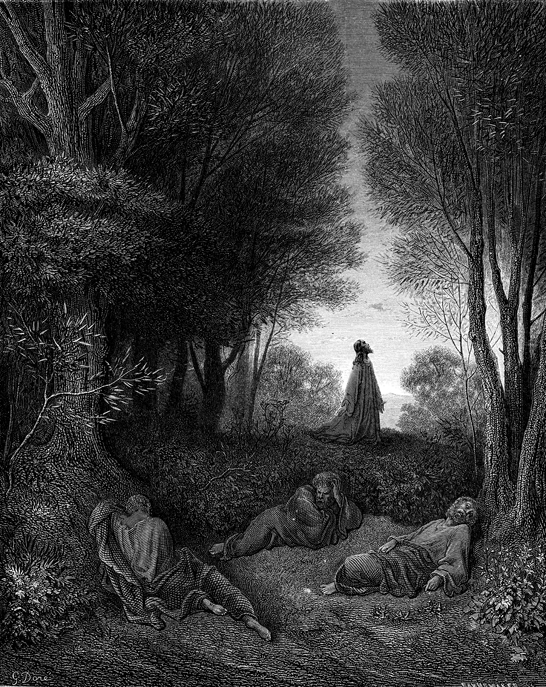
Jesus finds the disciples sleeping and puts the question "Were you not able to keep watch with Me for one hour?" to Peter, the man who had just vowed to die with him. The command "Watch and pray so that you will not enter into temptation" names their coming failure in advance, with Peter's denial only hours away.
The record, by era
The Church Fathers5 voices
A commentator
Desert FathersThe Desert Fathers, Sayings of the Early Christian Monks · Written before 500.
proposed
Cassian told a story of a hermit who was living in the desert. He asked God to grant that he should never fall asleep when the conversation was edifying but that if anyone spoke with back-biting or hate, he should nod off at once so …
A commentator
Desert FathersThe Desert Fathers, Sayings of the Early Christian Monks · Written before 500.
proposed
Evagrius said, 'If your attention falters, pray. As it is written, pray in fear and trembling (cf. Phil. 2:12), earnestly and watchfully. We ought to pray like that, especially because our unseen and wicked enemies are trying to hinder us forcefully.'
"Pray that you do not enter into temptation"—that you enter not again into "contentions, envying, animosities, dissension, detractions, seditions, whispering." For we have not planted and watered the Lord's garden in you only to reap these thorns from you. But if your weakness still stirs up a storm, pray that you may be delivered from temptation. Those among you who trouble you, whoever they may be, will incur judgment unless they amend their lives.
Finding them thus sleeping, He rouses them with a word to hearken, and commands them to watch; Watch and pray, that ye enter not into temptation; that first we should watch, and so watching pray. He watches who does good works, and is careful that He does not run into any dark doctrine, for so the prayer of the watchful is heard. Here it should be enquired, whether as all men's flesh is weak, so all men's spirit is willing, or whether only that of the saints; and whether in unbelievers the spirit is not also dull, as the flesh is weak. In another sense the flesh of those only is weak whose spirit is willing, and who with their willing spirit do mortify the deeds of the flesh. These then He would have watch and pray that they should not enter into temptation, for the more spiritual any one may be, the more careful should he be that his goodness should not suffer a great fall.
As long as Jesus was present, his disciples did not sleep. After he had walked away a short distance, they were unable to watch for even one hour in his absence. For this reason we should pray that Jesus will not leave us for even a short while but will fulfill what he promised when he said to us, "And I am with you all days, even to the end of the world." In this way will we keep watch as he banishes sleep from our souls, to make it possible for us to fulfill his command: "Do not give sleep to your eyes or slumber to your eyelids, that you may escape as a doe from the nets and a bird from the snare of the fowlers." But coming to the disciples and finding them asleep, he arouses them with a word and tells them to listen, so he may as it were say to those who are listening: "How is it that you were not able to watch with me for even one hour?"He orders us then to be wakeful so we may keep watch and pray. Now that person watches who does good works, that person watches who diligently attends to the truth of the faith lest he be ensnared by any shady teaching. He who watches and prays in this way will have his prayer heard. This is what the Lord means when he says, "Watch and pray." We should first watch and, while watching, we should pray.
24 more voices on this verse
The Church Fathers16 voices
The fact that, after returning and finding them asleep, he first reproves them, secondly is silent and thirdly orders them to rest, can be explained in this way: First, after the resurrection, he scolded them for scattering and for being apprehensive and restless; second, once the Holy Spirit had been sent, he came and found them sleeping, since their eyes were too heavy for them to discern the freedom of the gospel—having been held back by the love of the law for some time, their faith was still sleeping; and third, with the return of his radiance, he restored them to restfulness and peace of mind.
And why He thus encouraged them to pray that they might not enter into temptation, He adds, For the spirit indeed is willing, but the flesh is weak; this He says not of Himself, but addresses them.
After that, he returns to the disciples and finds them sleeping. He asks Peter why he could not watch with him one hour—Peter, indeed, was one of the three, for he had boasted in front of the others that he would not fall away. And he indicates the cause of his greater fear, saying, "Pray that you may not enter into temptation." He wanted then to prevent temptation (so he included in his prayer the words "lead us not into temptation"), lest anything in us cater to the weakness of the flesh. He also makes it clear why he urged them to pray in order to avoid temptation, saying, "The spirit indeed is willing, but the flesh is weak." These words did not apply to himself but were aimed at them. For that matter, how is it that now his spirit is willing, whereas before his soul was sad even to death? At any rate, he orders them to watch and pray lest they give in to temptation and succumb to the weakness of the body. He therefore prays that, if possible, the cup may pass from himself, for when it comes to drinking from it, all flesh is weak.
Otherwise; In these words He shows that He took real flesh of the Virgin, and had a real soul, saying that His spirit is willing to suffer, but His flesh weak in fearing the pain of Passion.
But we read "that the flesh is weak; " and hence we soothe ourselves in some cases.
But we read "that the flesh is weak; " and hence we soothe ourselves in some cases. Yet we read, too, that "the spirit is strong; " for each clause occurs in one and the same sentence.
To us it is matter for thankfulness if we do now publicly confess our iniquities or our turpitudes: for we do at the same time both make satisfaction for our former sins, by mortification of our flesh and spirit, and lay beforehand the foundation of defences against the temptations which will closely follow. "Watch and pray," saith (the Lord), "lest ye fall into temptation." And the reason, I believe, why they were tempted was, that they fell asleep; so that they deserted the Lord when apprehended, and he who continued to stand by Him, and used the sword, even denied Him thrice: for withal the word had gone before, that "no one untempted should attain the celestial kingdoms.
This passage He confirms by subsequent ones, saying, "Pray that ye be not tempted; " yet they were tempted, (as they showed) by de-setting their Lord, because they had given way rather to sleep than prayer.
From the saying of our Lord we know that the flesh is weak, the spirit willing. Let us not, withal, take delusive comfort from the Lord's acknowledgment of the weakness of the flesh.
If the "spirit is willing, but the flesh," without patience, "weak," where, save in patience, is the safety of the spirit, and of the flesh itself? But when the Lord says this about the flesh, pronouncing it "weak," He shows what need there is of strengthening, it-that is by patience-to meet every preparation for subverting or punishing faith; that it may bear with all constancy stripes, fire, cross, beasts, sword; all which prophets and apostles, by enduring, conquered!
And how long will this most shameless "infirmity" persevere in waging a war of extermination against the "better things? "The time for its indulgence was (the interval) until the Paraclete began His operations, to whose coming were deferred by the Lord (the things) which in H's day "could not be endured; "which it is now no longer competent for any one to be unable to endure, seeing that He through whom the power of enduring is granted is not wanting. How long shall we allege "the flesh," because the Lord said, "the flesh is weak? " But He has withal premised that "the Spirit is prompt," in order that the Spirit may vanquish the flesh-that the weak may yield to the stronger.
He likewise acknowledged, it is true, that His "soul was troubled, even unto death," and the flesh weak; with the design, (however,) first of all, that by having, as His own, trouble of soul and weakness of the flesh, He might show you that both the substances in Him were truly human; lest, as certain persons have now brought it in, you might be led to think either the flesh or the soul of Christ different from ours; and then, that, by an exhibition of their states, you might be convinced that they have no power at all of themselves without the spirit. And for this reason He puts first "the willing spirit," that, looking to the natures respectively of both the substances, you may see that you have in you the spirit's strength as well as the flesh's weakness; and even from this may learn what to do, and by what means to do it, and what to bring under what,-the weak, namely, under the strong, that you may not, as is now your fashion, make excuses on the ground of the weakness of the flesh, forsooth, but put out of sight the strength of the spirit.
(Verse 41.) Watch and pray, so that you do not enter into temptation. It is impossible for the human soul not to be tempted. Hence, in the Lord's Prayer, we say: Lead us not into temptation, which we cannot bear (or be able to bear) (Matthew 6:13; Luke 11:4). Not completely rejecting temptation, but praying for the strength to endure it. Therefore, at present, it does not say: Watch and pray, lest you be tempted; but, lest you enter into temptation, that is, lest the temptation overcomes and conquers you, and keeps you within its grasp. For example, the martyr, who sheds his blood for the confessing the Lord, is indeed tempted; but he is not caught in the snares of temptations. However, whoever denies, falls into the traps of temptation. The spirit is indeed willing, but the flesh is weak. This is against the reckless ones, who think they can achieve whatever they believe. Therefore, as much as we trust in the ardor of the mind, so much do we fear the fragility of the flesh. But nevertheless, according to the Apostle, in the spirit the works of the flesh are put to death (1 Peter 3).
A commentator
John ChrysostomHomily on the Gospel of Matthew 83 · Written in the 5th century.
proposed
And at one time He addresses Himself to Peter, at another to all in common. And to him He saith, "Simon, Simon, Satan hath desired to have you, that he may sift you as wheat; but I have prayed for thee;" and to all in common, "Pray that ye enter not into temptation;" every way plucking up their self-will, and making them earnest-minded. Then, that He might not seem to make His language altogether condemnatory, He saith, "The spirit indeed is ready, but the flesh is weak." For even although thou dost desire to despise death, yet thou wilt not be able, until God stretch forth His hand, for the carnal mind draws down.
A commentator
John ChrysostomHomily on the Gospel of Matthew 83 · Written in the 5th century.
proposed
However, even these He dismisses: "And He went on a little farther, and prayeth, saying, Father, if it be possible, let this cup pass from me; nevertheless not as I will, but as Thou wilt. And He cometh unto them, and findeth them sleeping, and saith unto Peter, What, could ye not watch with me one hour? Watch and pray, that ye enter not into temptation; the spirit indeed is willing, but the flesh is weak." And He prays with earnestness, in order that the thing might not seem to be acting. And sweats flow over him for the same cause again, even that the heretics might not say this, that He acts the agony. Therefore there is a sweat like drops of blood, and an angel appeared strengthening Him, and a thousand sure signs of fear, lest any one should affirm the words to be feigned. For this cause also was this prayer. By saying then, "If it be possible, let it pass from me," He showed His humanity; but by saying, "Nevertheless not as I will, but as Thou wilt," He showed His virtue and self-command, teaching us even when nature pulls us back, to follow God. For since it was not enough for the foolish to show His face only, He uses words also. Again, words sufficed not alone, but deeds likewise were needed; these also He joins with the words, that even they who are in a high degree contentious may believe, that He both became man and died. For if, even when these things are so, this be still disbelieved by some, much more, if these had not been. See by how many things He shows the reality of the incarnation: by what He speaks, by what He suffers. After that He cometh and saith to Peter, as it is said, "What, couldest thou not watch one hour with me?" All were sleeping, and He rebukes Peter, hinting at him, in what He spake. […]
Would any man have dared to touch even with his little finger, the body of Christ, if it had been of an unusual nature; or to smear His face with spitting, if it had not invited it (by its abjectness)? Why talk of a heavenly flesh, when you have no grounds to offer us for your celestial theory? Why deny it to be earthy, when you have the best of reasons for knowing it to be earthy? He hungered under the devil's temptation; He thirsted with the woman of Samaria; He wept over Lazarus; He trembles at death (for "the flesh," as He says, "is weak " ); at last, He pours out His blood.
The Medieval Church3 voices
Watch and pray, that ye enter not into temptation. In this part the admonition is added. You trust in yourselves; but you ought to have recourse to the helps of prayer; hence pray that ye enter not into temptation. Hence above at 6:13 in the …
Or, The Lord prayed thrice, to teach us to pray for pardon of sins past, defence against present evil, and provision against future perils, and that we should address every prayer to Father, Son, and Holy Spirit, and that our spirit, soul, and body should be kept in safety.
And He cometh unto the disciples, and findeth them asleep, and saith unto Peter, What, could ye not watch with Me one hour? Watch and pray, that ye enter not into temptation: the spirit indeed is willing, but the flesh is weak. Because Peter and …
The Puritans and the Awakening2 voices
The spirit - Your spirit: ye yourselves. How gentle a rebuke was this, and how kind an apology! especially at a time when our Lord's own mind was so weighed down with sorrow.
Watch and pray,.... These two are very justly put together.
The Nineteenth Century3 voices
That ye enter not into temptation - If ye cannot endure a little fatigue when there is no suffering, how will ye do when the temptation, the great trial of your fidelity and courage, cometh? Watch - that ye be not taken unawares; and pray - that when it comes ye may be enabled to bear it. The spirit - is willing, but the flesh is weak - Your inclinations are good - ye are truly sincere; but your good purposes will be overpowered by your timidity.
The verses we have now read describe what is commonly called Christ’s agony at Gethsemane. It is a passage which undoubtedly contains deep and mysterious things. We ought to read it with reverence and wonder, for there is much in it which we cannot fully comprehend. Why do we find our Lord so “sorrowful and very heavy,” as he is here described? What are we to make of his words, “My soul is exceeding sorrowful even unto death.”
The verses we have now read describe what is commonly called Christ’s agony at Gethsemane. It is a passage which undoubtedly contains deep and mysterious things. We ought to read it with reverence and wonder, for there is much in it which we cannot fully comprehend. Why do we find our Lord so “sorrowful and very heavy,” as he is here described? What are we to make of his words, “My soul is exceeding sorrowful even unto death.” Why do we see him going apart from his disciples, and falling on his face, and crying to his Father with strong cries, and thrice repeated prayer? Why is the almighty Son of God, who had worked so many miracles, so heavy and disquieted? Why is Jesus, who came into the world to die, so like one ready to faint at the approach of death? Why is all this? There is but one reasonable answer to these questions: the weight that pressed down our Lord’s soul was not the fear of death and its pains. Thousands have endured the most agonizing sufferings of body, and died without a groan, and so, no doubt, might our Lord. But the real weight that bowed down the heart of Jesus was the weight of the sin of the world, which seems to have now pressed down upon him with peculiar force: it was the burden of our guilt imputed to him, which was now laid on him, as on the head of the scapegoat. How great that burden must have been no human heart can conceive! It is known only to God. Well may the Greek Litany speak of the “unknown sufferings of Christ.” The words of Scott on this subject are probably correct: “Christ at this time endured as much misery of the same kind with that of condemned spirits, as could possibly consist with a pure conscience, perfect love of God and man, and an assured confidence of a glorious event.”
The words behind it
16 Greek wordsEvery Greek word of this verse in the order it stands, with what it means and the door to its own study. The last column counts the times a word stands in the whole Bible: the rarer the word, the more the places it appears belong together.
| Greek | Sound | Meaning | Word study | In the Bible |
|---|---|---|---|---|
| γρηγορεῖτε | gregoreite | do watch | G1127 → | 22 times |
| καὶ | kai | and | G2532 → | 9120 times |
| προσεύχεσθε | proseuchesthe | do pray | G4336 → | 85 times |
| ἵνα | ina | that | G2443 → | 668 times |
| μὴ | me | not | G3361 → | 1066 times |
| εἰσέλθητε | eiselthete | you may enter | G1525 → | 194 times |
| εἰς | eis | into | G1519 → | 1755 times |
| πειρασμόν. | peirasmon | temptation. | G3986 → | |
| τὸ | to | The | G3588 → | 19766 times |
| μὲν | men | indeed | G3303 → | 176 times |
| πνεῦμα | pneuma | spirit | G4151 → | 378 times |
| πρόθυμον | prothumon | [is] willing | G4289 → | |
| ἡ | he | <the> | G3588 → | 19766 times |
| δὲ | de | however | G1161 → | 2765 times |
| σὰρξ | sarx | the flesh | G4561 → | 146 times |
| ἀσθενής.¶ | asthenes | weak. | G772 → | 26 times |
γρηγορεῖτεdo watch
gregoreiteG1127 →22 times
καὶand
kaiG2532 →9120 times
προσεύχεσθεdo pray
proseuchestheG4336 →85 times
ἵναthat
inaG2443 →668 times
μὴnot
meG3361 →1066 times
εἰσέλθητεyou may enter
eiseltheteG1525 →194 times
εἰςinto
eisG1519 →1755 times
πειρασμόν.temptation.
peirasmonG3986 →
τὸThe
toG3588 →19766 times
μὲνindeed
menG3303 →176 times
πνεῦμαspirit
pneumaG4151 →378 times
πρόθυμον[is] willing
prothumonG4289 →
ἡ<the>
heG3588 →19766 times
δὲhowever
deG1161 →2765 times
σὰρξthe flesh
sarxG4561 →146 times
ἀσθενής.¶weak.
asthenesG772 →26 times
A shaded row is a word that stands 400 times or fewer in the Bible.
The walk
8 stopsEach card is a verse this one points to, and under it the verses that one points to in turn. Where several paths arrive at the same place, that place is listed first: the text keeps returning to it.
Through
Ephesians 6:18Pray in the Spirit at all times, with every kind of prayer and petition. To this end, stay alert with all perseverance in your prayers for all the saints.
it leads to
- 1 Thessalonians 5:17
Pray without ceasing.
- Colossians 4:2
Devote yourselves to prayer, being watchful and thankful,
- Philippians 4:6
Be anxious for nothing, but in everything, by prayer and petition, with thanksgiving, present your requests to God.
- 1 Timothy 2:1
First of all, then, I urge that petitions, prayers, intercessions, and thanksgiving be offered for everyone—
- Jude 1:20
But you, beloved, by building yourselves up in your most holy faith and praying in the Holy Spirit,
- 1 Thessalonians 5:17
Through
Matthew 6:13And lead us not into temptation, but deliver us from the evil one.’
it leads to
- 1 Corinthians 10:13
No temptation has seized you except what is common to man. And God is faithful; He will not let you be tempted beyond what you can bear. But when you are tempted, He will…
- Revelation 7:14–17
“Sir,” I answered, “you know.” So he replied, “These are the ones who have come out of the great tribulation; they have washed their robes and made them white in the blood of the…
- John 17:15
I am not asking that You take them out of the world, but that You keep them from the evil one.
- 1 Corinthians 10:13
Where this verse is studied
On this page
Studies15
On this verse
About Matthew
This page draws on 28 works. Open the list of works
This page draws on Adam Clarke, Commentary on the Bible; Augustine of Hippo, LETTER 211; Desert Fathers, The Desert Fathers, Sayings of the Early Christian Monks; Hilary of Poitiers, Commentary on Matthew 31.11; Hilary of Poitiers, Catena Aurea by Aquinas; Hilary of Poitiers, Commentary on Matthew 31.9; J.C. Ryle, Expository Thoughts on the Gospels: Matthew; Jerome, Catena Aurea by Aquinas; Jerome, Commentary on Matthew; John Chrysostom, Homily on the Gospel of Matthew 83; John Gill, Exposition of the New Testament; John Gill, Exposition of the New Testament (1746-1748); John Wesley, Explanatory Notes upon the New Testament; Matthew Henry, Commentary on the Whole Bible; Origen of Alexandria, Catena Aurea by Aquinas; Origen of Alexandria, COMMENTARY ON MATTHEW 93; Rabanus Maurus, Catena Aurea by Aquinas; Remigius of Rheims, Catena Aurea by Aquinas; Tertullian, To His Wife Book I; Tertullian, On Baptism; Tertullian, On Prayer; Tertullian, Ad Martyras; Tertullian, Of Patience; Tertullian, On Monogamy; Tertullian, On Flight in Persecution; Tertullian, On the Flesh of Christ; Theophylact of Ohrid, Commentary on Matthew and Thomas Aquinas, Commentary on Matthew.