
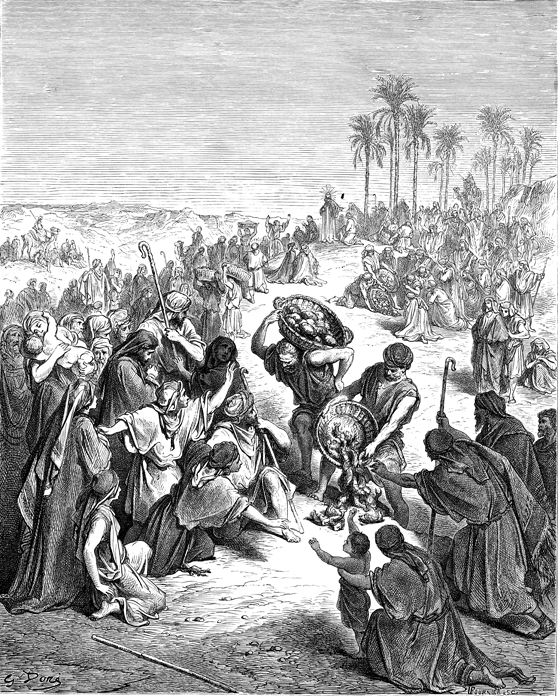
Johnchapter 6
71 verses · John, by tradition · AD 85 to 95 · The Gospels
Jesus answered, “I am the bread of life. Whoever comes to Me will never hunger, and whoever believes in Me will never thirst.
Introduction
John, by tradition, The Gospels, John Overview.
John wrote this chapter for readers who knew the story of the manna in the wilderness and who had seen people leave the faith. It begins with a crowd eager to follow and ends with most of them gone. Between the two stand a meal, a night on the water and a long argument in a synagogue. Listen for bread, and for how often the crowd asks for one thing while Jesus offers another. Notice the question Jesus puts to the Twelve at the close. Read it as a chapter about what people come to Jesus for.
Context
- Who
- Readers watching a large crowd shrink to a handful
- What
- The feeding of the five thousand, Jesus walking on the sea, and the discourse on the bread of life in the synagogue at Capernaum.
- Where
- A hillside on the far shore of the Sea of Galilee, the lake at night, and the synagogue at Capernaum.
- When
- Near the Passover, about AD 29, a year before the crucifixion.
- Why
- To show that Jesus is the true bread from heaven, whom a person must receive to have life.
Historical context
The season is given by the food. Barley ripens before wheat, and barley loaves were the cheap bread of poor households, so a boy carrying five of them fits a spring crowd near Passover walking out to a hillside with grass on it.
Show the rest of the historical context, 3 more paragraphs
The crowd's reaction is a political fact, not a compliment. They intended to come and take him by force to make him king, and this is Galilee under Herod Antipas, in a generation that produced several would-be liberators who gathered crowds and were cut down. Withdrawing to the mountain alone was, among other things, refusing a coronation the Romans would have answered with cavalry.
The lake crossing works the way that lake works. It sits in a deep bowl, wind funnels down the ravines after dark, and the disciples had rowed three or four miles, which puts them in the middle of the widest part, before they saw him.
The synagogue discourse turns on a well-known expectation: as Moses gave manna, so it was said the Messiah would bring bread from heaven again. Jesus grants the frame and moves the bread, the manna fed people who died anyway. Then he uses language about eating his flesh and drinking his blood, which to Jewish ears was close to unbearable, since consuming blood in any form was forbidden outright in the Law. John reports that many disciples turned back that day, and he does not soften it.
Significance
The crowd asks what work they must do, and the answer collapses the whole question: this is the work of God, that you believe in him whom he has sent. Then they ask for a sign, having eaten one the day before.
Show the rest of the significance, 1 more paragraph
For readers whose congregations were losing people to pressure, the honest ending mattered. Many walked away. Jesus turns to the twelve and asks whether they want to go too, and Peter's answer is not enthusiasm but exhausted loyalty: Lord, to whom shall we go? You have the words of eternal life.
The heads below are this chapter's scenes. The numbered points under each are its verses.
Five Loaves, Two Fish, Five Thousand Fed
John 6:1-4
the Sea of Tiberias): John gives the lake both of its names, the Sea of Galilee and the Sea of Tiberias. The second comes from the city Herod Antipas built on its shore. A large crowd follows Him after the signs He worked on the sick, and the Passover was near.
John 6:1
“Jesus went over - Went to the east side of the sea. The place to which he went was Bethsaida, Luk 9:10. The account of this miracle of feeding the five thousand is recorded also in Mat 14:13-21; Mar 6:32-44; Luk 9:10-17. John has added a few circumstances omitted by the other evangelists.”
3 more voices on this verseWhat preachers and commentators have said about this verse, in their own words.
John 6:1
“Christ did not go directly over cross this inland sea, but made a coasting voyage to another place on the same side. It is not tempting God to choose to go by water, when there is convenience for it, even to those places whither we might go by land; for Christ never tempted the Lord his God, Matt. iv.”
Matthew Henry · Commentary on the Whole Bible (1707-1721)puritan
John 6:1
“But he does so for the express purpose of passing from them to Christ's sermon, which was delivered next day at Capernaum, because the two things were connected; and therefore this narrative, though the other three Evangelists have it in common with him, has this peculiarity, that it is directed to another object, as we shall see.”
John Calvin · Commentaries (1554)reformed
John 6:1
“These verses describe one of our Lord's most remarkable miracles. Of all the great works that He did, none was done so publicly as this, and before so many witnesses. Of all the miracles related in the Gospels, this is the only one which all the four Gospel-writers alike record. This fact alone (like the four times repeated account of the crucifixion and resurrection) is enough to show that it is a miracle demanding special attention. We have, for one thing, in this miracle, a lesson about Christ's almighty power.”
because they saw the signs: John gives the crowd's reason as the signs, healings he leaves the other Gospels to record, as Clarke observes. Gill reads the motive as curiosity or the hope of bodily cure, while Calvin sees an eagerness to hear Christ. Verse 26 puts the motive to the test.
John 6:2
“And a great multitude followed him,.... From several cities and towns in Galilee, where he had been preaching and working miracles: because they saw his miracles which he did on them that were diseased; so that it was not for the sake of his doctrine, or for the good of their souls, they followed him; but either to gratify their curiosity in seeing his miracles, or to be healed in their bodies, as others had been.”
2 more voices on this verse
John 6:2
“They saw his miracles which he did - John does not mention these miracles; but Matthew details them, Matthew 12:2-14:13. John seems more intent on supplying the deficiencies of the other evangelists than in writing a connected history himself.”
Adam Clarke · Commentary on the Bible (1810-1826)evangelical
John 6:2
“Here we see, in the first place, how eager was the desire of the people to hear Christ, since all of them, forgetting themselves, take no concern about spending the night in a desert place.”
John Calvin · Commentaries (1554)reformed
went up on the mountain: Clarke and Gill place the mountain in the desert near Bethsaida, where Jesus went up with His disciples for rest. The crowds had left them no time to eat. Gill adds that a Jewish teacher sat down to teach, and so He sat down with His disciples.
John 6:3
“And Jesus went up into a mountain,.... In a desert place near Bethsaida, Luk 9:10; and there he sat with his disciples; partly for security from the cruelty of Herod, having just heard of the beheading of John; and partly for privacy, that he might have some conversation alone with his disciples, upon their return from off their journey; as also for the sake of rest and refreshment; and according to the custom of the Jewish doctors, which now prevailed; see Gill on Mat 5:1, he sat with his disciples, in order to teach and instruct them.”
2 more voices on this verse
John 6:3
“Went up into a mountain - This mountain must have been in the desert of Bethsaida, in the territories of Philip, tetrarch of Galilee. Our Lord withdrew to this place for a little rest; for he and his disciples had been so thronged with the multitudes, continually coming and going, that they had not time to take necessary food. See Mar 6:31.”
Adam Clarke · Commentary on the Bible (1810-1826)evangelical
John 6:3
“Christ was now driven to be a field preacher; but his word was never the worse, nor the less acceptable, for that, to those who knew how to value it, who followed him still, not only when he went out to a desert place, but when he went up to a mountain, though up-hill be against heart.”
Matthew Henry · Commentary on the Whole Bible (1707-1721)puritan
the Jewish Feast of the Passover: Gill counts this as the third Passover of the ministry after John 2:13. Theophylact reads the word Jewish as setting the feast apart from Christ, since with the truth revealed the types were at an end. John sets the loaves beside that feast.
John 6:4
“The persecutions of the Jews gave Him reason for retiring, and thus setting aside the Law. The truth being now revealed, types were at an end, and He was under no obligation to keep the Jewish feasts. Observe the expression, a feast of the Jews, (Mat. 14:13) not a feast of Christ.”
Theophylact of Ohrid · written before 1107 · Catena Aurea by Aquinaspatristic
2 more voices on this verse
John 6:4
“And the passover, a feast of the Jews, was nigh. This was the third passover, since our Lord's baptism, and entrance on his public ministry; see Joh 2:13. Whether Christ went up to this feast is not certain; some think he did not; but from what is said in Joh 7:1, it looks as if he did: how nigh it was to the feast, cannot well be said.”
John 6:4
“And the passover - was nigh - This happened about ten or twelve days before the third passover which Christ celebrated after his baptism. Calmet. For a particular account of our Lord’s four passovers see the note on Joh 2:13. For thirty days before the Passover there were great preparations made by the Jews, but especially in the last nineteen days, in order to celebrate the feast with due solemnity. Lightfoot supposes that what is here related happened within the last fifteen days. See Calmet’s opinion above.”
Adam Clarke · Commentary on the Bible (1810-1826)evangelical
John 6:5-7
Jesus puts the question to Philip, Where can we buy bread, and John says that He already knew what He was about to do. The question tests Philip. Philip answers with arithmetic, two hundred denarii, about eight months of a laborer's daily pay, still short of a small piece each.
John 6:5
“When Jesus then lift up his eyes,.... Being before engaged in close conversation with his disciples, and looking wistly and intently on them, whilst he was discoursing with them: and saw a great company come unto him; who came on foot, over the bridge at Chammath, from Capernaum, and other cities of Galilee: he saith unto Philip; he directed his discourse to him particularly, because he was of Bethsaida, near to which place Christ now was, and therefore might be best able to answer the following question: whence shall we buy bread, that these may eat?”
2 more voices on this verse
John 6:5
“Saw a great company - See this miracle explained at large on Mat 14:13 (note), etc.; Mar 6:31 (note), etc.; Luk 9:10 (note), etc. In speaking of the passovers, and various other matters, it does not appear that John follows any strict chronological order. From Joh 6:15, it appears that our Lord had come down from the mountain, and fed the multitudes in a plain at the foot of it. Saith unto Philip - This, with what follows, to the end of the seventh verse, is not mentioned by any of the other evangelists.”
Adam Clarke · Commentary on the Bible (1810-1826)evangelical
John 6:5
“A lesson most excellent did Christ again devise for His disciples, and fittest for the most holy men, both persuading them in utter straits to overcome cowardice in respect of hospitality, and to cast far away hesitation hereto, rather with more zealous motions to attain unto the virtue thereof. For what is there greater than this among those who know and will the things whereby it befitteth to purchase unto themselves the friendship from above?”
Cyril of Alexandria · written before 444 · Commentary on the Gospel of John, Book 3patristic
He was asking this to test him: John adds that Jesus knew what He was about to do. Clarke says this Gospel often sets its own judgment beside the facts, and the test asked whether Philip had minded the signs already seen. Spurgeon says John here keeps the reader from thinking that Jesus did not know.
John 6:6
“OBSERVE, dear Friends, how careful the Holy Spirit is that we should not make a mistake about our Lord Jesus Christ. He knew that men are liable to think too little of the ever-blessed Son of God and that some, who call themselves Christians, nevertheless deny Christ's Deity and are always ready to forge an argument against the true and real Deity of the Savior out of anything which appears to limit His power or knowledge. Here is an instance of the care of the Spirit to prevent our falling into an erroneous conclusion.”
2 more voices on this verse
John 6:6
“Therefore one may well say to the words of Philip and Andrew also, Will the Lord's Hand suffice not? And let us too taking the nature of the thing by way of example, hold that littleness of faith is the worst of sicknesses and surpasses all evil, and if God work or promise to do, be it full surely received in simple faith, and let not the Deity be accused, from our inability to conceive how what is above us shall happen, by reason of our own powerlessness unto ought.”
Cyril of Alexandria · written before 444 · Commentary on the Gospel of John, Book 3patristic
John 6:6
“This he said to prove him - To try his faith, and to see whether he and the other apostles had paid proper attention to the miracles which they had already seen him work; and to draw their attention more particularly to that which he was now about to perform. This is an observation of the evangelist himself, who often interweaves his own judgment with the facts he relates, which St. Matthew rarely ever does.”
Adam Clarke · Commentary on the Bible (1810-1826)evangelical
Philip counts the cost and stops there. Cyril says he looked to money as the only means and left the power of Jesus out of the reckoning. Gill suggests the sum may have been all the common purse held.
John 6:7
“Feebly again does Philip advance, not to the power of Jesus to do all things, and that easily, but on hearing Whence shall we buy said to prove him, forthwith he catches at it, and looks at the means by money alone, not conceiving that the nature of the thing may be accomplished otherwise than by the common law, and that practised by all, to wit, prodigality of expenditure.”
Cyril of Alexandria · written before 444 · Commentary on the Gospel of John, Book 3patristic
John 6:8-9
Andrew, Simon Peter’s brother: Andrew brings forward what is there, five barley loaves and two small fish from a boy. Barley was the cheap grain, the bread the poor ate. Andrew's own report ends in a question about how far so little will go among so many.
John 6:8
“One of his disciples, Andrew, Simon Peter's brother,.... Who also, and his brother Peter, were of Bethsaida, as well as Philip, and was a disciple of Christ's; he hearing what Christ said to Philip, and what answer he returned, saith unto him; to Christ, with but little more faith than Philip, if any.”
2 more voices on this verse
John 6:8
“Andrew, Simon Peter’s brother, saith - The other evangelists attribute this answer to the apostles in general. See the passages referred to above.”
Adam Clarke · Commentary on the Bible (1810-1826)evangelical
John 6:8
“Andrew is in the same perplexity that Philip is; only he has rather higher notions of our Lord: There is a lad here which hath five barley loaves and two small fishes. This passage confounds the Manicheans, who say that bread and all such things were created by an evil Deity. The Son of the good God, Jesus Christ, multiplied the loaves. Therefore they could not have been naturally evil; a good God would never have multiplied what was evil.”
Theophylact of Ohrid · written before 1107 · Catena Aurea by Aquinaspatristic
five barley loaves and two small fish: Clarke notes that the Greek word for the boy may mean a little child or a servant. He and Gill both wonder whether the boy carried the disciples' food or had come to sell his loaves in the crowd. Andrew names what is there even while doubting it will help.
John 6:9
“There is a lad here - Παιδαριον, a little boy, or servant, probably one who carried the apostles’ provisions, or who came on purpose to sell his bread and fish. Five barley loaves - Barley scarcely bore one-third of the value of wheat in the east: see Rev 6:6. That it was a very mean fare appears from Eze 13:19, where the false prophetesses are said to pollute the name of God for handfuls of barley, i.e. for the meanest reward.”
Adam Clarke · Commentary on the Bible (1810-1826)evangelical
2 more voices on this verse
John 6:9
“There is a lad here,.... Who either belonged to Christ and his disciples, and was employed to carry their provisions for them; which, if so, shows how meanly Christ and his disciples lived; or he belonged to some in the multitude; or rather he came here to sell what he had got: which hath five barley loaves.”
John 6:9
“But that this point is true, that that number which is called five, which agrees in no respect with their argument, and does not harmonize with their system, nor is suitable for a typical manifestation of the things in the Pleroma, [yet has a wide prevalence,] will be proved as follows from the Scriptures. Soter is a name of five letters; Pater, too, contains five letters; Agape (love), too, consists of five letters; and our Lord, after blessing the five loaves, fed with them five thousand men.”
Irenaeus · written before 202 · Against Heresies 2.24.4patristic
John 6:10-13
plenty of grass in that place: marks the spring, the season of the Passover just named. Jesus gave thanks over the loaves and had them handed out until everyone was full, and the leftovers fill twelve baskets. He orders them gathered so nothing is wasted.
John 6:10
“There was much grass in the place - Perhaps newly mown grass, or hay, is meant, (so the Vulgate faenum), and this circumstance marks out more particularly that the passover was at hand. In Palestine the grass is ready for mowing in March; and this miracle seems to have been wrought only a few days before the commencement of that festival: see Joh 6:4.”
Adam Clarke · Commentary on the Bible (1810-1826)evangelical
1 more voice on this verse
John 6:10
“The Saviour practised His accustomed gentleness, and takes away the sharpness of His reproaches. For He doth not rebuke bitterly His disciples, albeit they were deeply slumbering in respect of their faintheartedness and littleness of faith in Him: but rather He leads them by His Deeds to the apprehension of the things which as yet they believe not.”
Cyril of Alexandria · written before 444 · Commentary on the Gospel of John, Book 3patristic
gave thanks, and distributed: Jesus gives thanks before the bread is multiplied, and Henry takes this as the pattern for every meal received from God's hand. Gill notes from the other Gospels that the disciples carried the food from His hands to the seated crowd. Clarke's arithmetic sets one loaf against each thousand men.
John 6:11
“And Jesus took the loaves,.... Into his hands, as also the fishes, in order to feed the multitude with them: and when he had given thanks; for them, and blessed them, or implored a blessing on them, that they might be nourishing to the bodies of men, as was his usual manner, and which is an example to us; he distributed to the disciples, and the disciples to them that were sat down.”
2 more voices on this verse
John 6:11
“Jesus took the loaves - See the notes on Mat 14:19-21 (note). As there were five loaves and five thousand people, so there was one loaf to every thousand men, independently of the women and children.”
Adam Clarke · Commentary on the Bible (1810-1826)evangelical
John 6:11
“Look, there are the people! Five thousand of them, as hungry as hunters, and they all need to have food given to them, for they cannot, any of them, travel to buy it! And here is the provision! Five thin wafers—and those of barley, more fit for horses than for men—and two little anchovies, by way of a relish! Five thousand people and five little biscuits to feed them! The disproportion is enormous—if each one should have only the tiniest crumb, there would not be enough!”
Cyril asks why the Lord would trouble over the scraps of five barley loaves. He answers that the gathering makes the miracle plain to all who hear of it. Gill gives two reasons, proof of the miracle and a lesson in thrift amid plenty.
John 6:12
“When they were filled,.... Had not only eaten, but had made a full meal, and were thoroughly satisfied, having eaten as much as they could, or chose to eat: he said unto his disciples, gather up the fragments that remain, that nothing be lost; this he said, partly that the truth, reality, and greatness of the miracle might be clearly discerned; and partly, to teach frugality, that, in the midst of abundance, care be taken that nothing be lost of the good things which God gives; and which may be useful to other persons, or at another time.”
2 more voices on this verse
John 6:12
“To some one Christ may seem out of sparing of the fragments to have bidden His disciples to gather them together. Yet (I think) every one will fitly imagine, that Christ would not endure to descend to such littleness: and why say I Christ? not even one of us would do so: for what would be supposed to be the remnant of five barley loaves? But the verse has a great economy, and makes the miracle evident to the hearers.”
Cyril of Alexandria · written before 444 · Commentary on the Gospel of John, Book 3patristic
John 6:12
“Gather up the fragments - “Great will be the punishment of those who waste the crumbs of food, scatter seed, and neglect the law.” Synops Sohar. Among the Jews the פאה peah, or residue after a meal, was the property of the servitors.”
Adam Clarke · Commentary on the Bible (1810-1826)evangelical
filled twelve baskets: More is left over than was there at the start. Gill counts a full basket for each disciple, and he leaves open whether the bread multiplied in the hands of those serving or those eating.
John 6:13
“Therefore they gathered them together,.... The several broken bits of bread, which lay about upon the grass, which the people had left, after they had been sufficiently refreshed: and filled twelve baskets; every disciple had a basket filled: with the fragments of the five barley loaves; and it may be of the fishes also: which remained over and above unto them that had eaten; such a marvellous increase was there, through the power of Christ going along with them; insomuch that they multiplied to such a degree, either in the hands of the distributors, or of the eaters.”
1 more voice on this verse
John 6:13
“But greater yet and more noteworthy, and of exceeding profit to us, is this: consider how by this miracle He makes us most zealous in our desire to exercise hospitality most gladly, wellnigh calling aloud to us by the things that were done, that the things of God shall not fail him that is ready to communicate, and rejoiceth in habit of neighbourly love, and readily fulfilleth what is written, Break thy bread to the hungry.”
Cyril of Alexandria · written before 444 · Commentary on the Gospel of John, Book 3patristic
John 6:14-15
The Prophet who is to come is the promise of Deuteronomy 18:15, a prophet like Moses. The crowd reads the sign rightly and then moves to make Him king by force, a crown held out on their own terms. Jesus withdrew to the mountain alone.
John 6:14
“This is of a truth that prophet - Spoken of, Deu 18:15, viz. the Messiah. How near were these people at this time to the kingdom of heaven!”
Adam Clarke · Commentary on the Bible (1810-1826)evangelical
1 more voice on this verse
John 6:14
“The Pharisees despised them as not knowing the law; but, it should seem, they knew more of him that is the end of the law than the Pharisees did. The miracles which Christ wrought did clearly demonstrate that he was the Messiah promised, a teacher come from God, the great prophet, and could not but convince the amazed spectators that this was he that should come.”
Matthew Henry · Commentary on the Whole Bible (1707-1721)puritan
make Him king by force: The crowd would make Him king by force, and Barnes says they hoped for a Messiah who would reign as an earthly prince. Ryle says Jesus came to serve and to give His life, so He withdrew again to a mountain by Himself.
John 6:15
“When Jesus perceived ... - They were satisfied by the miracle that he was the Messiah. They supposed that the Messiah was to be a temporal prince. They saw that Jesus was retiring, unambitious, and indisposed to assume the ensigns of office. They thought, therefore, that they would proclaim him as the long-expected king, and constrain him to assume the character and titles of an earthly prince. Men often attempt to dictate to God, and suppose that they understand what is right better than he does.”
2 more voices on this verse
John 6:15
“But, [2.] It was an irregular zeal; for First, It was grounded upon a mistake concerning the nature of Christ's kingdom, as if it were to be of this world, and he must appear with outward pomp, a crown on his head, and an army at his foot; such a king as this they would make him, which was as great a disparagement to his glory as it would be to lacquer gold or paint a ruby.”
Matthew Henry · Commentary on the Whole Bible (1707-1721)puritan
John 6:15
“At once He departed, and left them. He wanted no such honors as these. He had come, "not to be ministered unto, but, to minister and to give his life a ransom for many." (Matt. 20:28.) We see the same spirit and frame of mind all through our Lord's earthly ministry. From His cradle to His grave He was "clothed with humility." (1 Pet. 5:5.) He was born of a poor woman, and spent the first thirty years of His life in a carpenter's house at Nazareth. He was followed by poor companions—many of them no better than fishermen.”
Walking on a Storm-Tossed Sea
John 6:16-18
His disciples went down to the sea: Evening comes, and the disciples start across the sea for Capernaum. Darkness had already fallen, and Jesus had not yet come to them, while a strong wind rose and the sea grew rough. Cold air off the hills drops onto the warm lake, and squalls come up fast there.
John 6:16
“And when even was now come,.... The last of the evenings, when night was coming on; for the first of the evenings took place before they sat down to eat, when the above miracle was wrought; see Mat 14:15. His disciples went down unto the sea; of Galilee, or Tiberias, to the sea side; and this was by the order, and even constraint of Christ, who would have them go before him, that he might be clear of the multitude, and have an opportunity for solitary prayer, See Gill on Mat 14:22, Mar 6:45.”
3 more voices on this verse
John 6:16
“See this miracle of walking on the sea explained in the notes at Mat 14:22-33. Compare Mar 6:45-52. Joh 6:21 Immediately - Quickly. Before a long time. How far they were from the land we know not, but there is no evidence that there was a miracle in the case. The word translated “immediately” does not of necessity imply that there was no interval of time, but that there was not a long interval.”
John 6:16
“The first sign having been miraculously accomplished, His flight and withdrawal are economically found to be the root again and occasion of another, and the Wonderworker proceeds, as it is written, from might to might. For since He was being sought as King by them who were astonished at that great miracle, and was Himself refusing worldly honours according to the preceding account; it was altogether necessary that He should depart from the place, yea, rather from their whole country.”
Cyril of Alexandria · written before 444 · Commentary on the Gospel of John, Book 3patristic
John 6:16
“Here is the stormy wind arising and fulfilling the word of God. They were Christ's disciples, and were now in the way of their duty, and Christ was now in the mount praying for them; and yet they were in this distress. The perils and afflictions of this present time may very well consist with our interest in Christ and his intercession.”
Matthew Henry · Commentary on the Whole Bible (1707-1721)puritan
It was already dark: Mark 6:45 sends them to Bethsaida, and Clarke says it lay a few miles from Capernaum on the same side of the sea. Spurgeon sets the dark night on the sea against the day of the loaves. Cyril says the dark drove the disciples to seek Jesus.
John 6:17
“Toward Capernaum - St. Mark says, Mar 6:45, that our Lord commanded them to go along to Bethsaida; and in the course of the history we find they got neither to Bethsaida nor Capernaum, but landed in the country of Genesaret: Mat 14:34. Our Lord seems to have desired them to go either to Bethsaida or Capernaum, which were only a very few miles distant, and on the same side of the sea.”
Adam Clarke · Commentary on the Bible (1810-1826)evangelical
2 more voices on this verse
John 6:17
“Many things at once are being profitably contrived, and the circumstances drive the disciples to a more zealous search after the Saviour. For the deep darkness of the night troubles them, hovering like smoke upon the raving waves, and takes from them all knowledge of whither at length to steer. Moreover the fierceness of winds troubles them not a little, riding on the waves with a rushing noise, and raising the billows to unwonted height.”
Cyril of Alexandria · written before 444 · Commentary on the Gospel of Johnpatristic
John 6:17
“CHRIST'S disciples, when they joined Him, had some very happy times with Him—and they had just had a very grand day in feeding the multitude. I wish I had been there to help in the feeding of 5,000 men. Everyone who had a share in that service was highly honored and those who were not there might well regret their absence on such an eventful day! But notice fair days have foul eventides and the Christ manifested during the day may become a Christ hidden during the night.”
Charles Spurgeon · written before 1892 · The Metropolitan Tabernacle Pulpit, Sermon No. 2945: “Night-and Jesus Not There!” (lightly modernized text, CCEL edition)Particular Baptist
the sea grew agitated: Gill judges that the storm rose after they had reached the middle of the lake, when turning back was no easier than going on. Cyril pictures the wind and the dark together robbing them of any sense of where to steer. Jesus comes to them in that state.
John 6:18
“And the sea arose,.... Swelled, and was tumultuous and raging; the waves mounted up, and tossed the ship to and fro: by reason of a great wind that blew; which agitated the waters of the sea, and lifted up the waves; which storm seems to have arose after they had set sail, and were got into the midst of the sea.”
John 6:19-21
Three or four miles out, in a rising wind, Jesus comes to them walking on the sea and they are terrified. It is I renders ego eimi, the two words of John 8:58. They were willing to take Him aboard, and the boat at once reached the shore.
John 6:19
“Had rowed - Their vessel was a small one only, something of the boat kind: as to sails, if they had any, they could not now venture to carry them, because of the storm. Five and twenty or thirty furlongs - Between three and four miles. The sea of Tiberias, on which they now were, was, according to Josephus, War, book iii. chap. 25, forty furlongs, or five miles in breadth; and one hundred and forty furlongs, or eighteen miles, in length. Pliny, lib. v. chap. 15, makes it about six miles broad, and sixteen long.”
Adam Clarke · Commentary on the Bible (1810-1826)evangelical
3 more voices on this verse
John 6:19
“When they are separated by great interval from the land, and it was like that they in their trouble would no way be saved (for they were now in the midst of the sea) then Christ thrice longed for appears to them. For thus could He give most welcome salvation to those in danger, when fear had already cut off all hope of life.”
Cyril of Alexandria · written before 444 · Commentary on the Gospel of Johnpatristic
John 6:19
“It is natural for heavy bodies to sink in water, but Christ walked upon the water as upon dry land, which was more than Moses's dividing the water and walking through the water. (2.) The concern Christ has for his disciples in distress: He drew nigh to the ship; for therefore he walked upon the water, as he rides upon the heavens, for the help of his people, Deut. xxxiii.”
Matthew Henry · Commentary on the Whole Bible (1707-1721)puritan
John 6:19
“He would appear to them at first like a dark moving speck upon the waters; then as a human figure, but--in the dark tempestuous sky, and not dreaming that it could be their Lord--they take it for a spirit. (How often thus we miscall our chiefest mercies--not only thinking them distant when they are near, but thinking the best the worst!)”
Jamieson, Fausset & Brown · Commentary Critical and Explanatory on the Whole Bible (1871)reformed
When Jesus says It is I, Aquinas says He takes away their doubt about who has come to them on the sea. Matthew 14:27 and Mark 6:50 add a call to take courage before these words. John gives the shorter form.
John 6:20
It is I; be not afraid--Matthew (Mt 14:27) and Mark (Mr 6:50) give before these exhilarating words, that to them well-known one, "Be of good cheer!"
Jamieson, Fausset & Brown · Commentary Critical and Explanatory on the Whole Bible (1871)reformed
at once the boat reached the shore: Gill and Cyril count the boat reaching the shore at once as a second sign, the power of God carrying it with no more rowing. Clarke says only that John seems to tell it as a wonder. Henry says they were glad to take Him in.
John 6:21
“The Lord not only releases the voyagers from dangers, wondrously shining on them, but also frees them both from toil and sweat, by His God-befitting Power thrusting forward the ship on to the opposite shore. For they were expecting that by rowing on still, they should with difficulty be able to reach the end, but He releases them from these their toils, revealing Himself to them in a very little time the Worker of many miracles to their full assurance.”
Cyril of Alexandria · written before 444 · Commentary on the Gospel of John, Book 3patristic
2 more voices on this verse
John 6:21
“Then they willingly received him into the ship,.... When they knew who he was; and especially he was the more welcome, as they were in distress; and he able, as they well knew, to help them: and immediately the ship was at the land whither they went; which was done, as Nonnus observes, by a divine motion; for not only the wind ceased, but another miracle was wrought; the ship was in an instant at the place whither they intended to go.”
John 6:21
“Immediately the ship was at the land - How far they were from the place at which they landed, when our Lord came to them, we know not. But the evangelist seems to speak of their sudden arrival there as extraordinary and miraculous.”
Adam Clarke · Commentary on the Bible (1810-1826)evangelical
I Am the Bread of Life
John 6:22-24
only one boat had been there: The crowd works it out from the boats. Only one boat had been there, and Jesus had not boarded it, yet in the morning He is gone. Boats from Tiberias land near the place of the meal, and the crowd takes them to Capernaum to look for Him.
John 6:22
“The miracle does not escape notice, I mean Jesus walking on. the very sea, although it took place by night and in the dark, and was ordered in secret. But the crowd of those who were wont to follow Him perceives, assured (as is probable) by much watching, that He had neither sailed with His disciples, nor had crossed in any other ship. For there was there the Apostles' ship alone, which they took and went away before Him.”
Cyril of Alexandria · written before 444 · Commentary on the Gospel of John, Book 3patristic
some boats from Tiberias: Barnes gives the reason for the detail: the crowd could suppose that Jesus had left in one of these boats after His disciples sailed. Tiberias was the capital Herod Antipas made for Galilee, and it later became a seat of Jewish learning. Henry sees here a diligent search for Christ.
John 6:23
“There came other boats - After the disciples had departed. This is added because, from what follows, it appears that they supposed that he had entered one of those boats and gone to Capernaum after his disciples had departed. From Tiberias - This town stood on the western borders of the lake, not far from where the miracle had been performed. It was so called in honor of the Emperor Tiberius. It was built by Herod Antipas, and was made by him the capital of Galilee. The city afterward became a celebrated seat of Jewish learning.”
2 more voices on this verse
John 6:23
“Note, Those that would find Christ must accomplish a diligent search, must seek till they find, must go from sea to sea, to seek the word of God, rather than live without it; and those whom Christ has feasted with the bread of life should have their souls carried out in earnest desires towards him. Much would have more, in communion with Christ.”
Matthew Henry · Commentary on the Whole Bible (1707-1721)puritan
John 6:23
“The mystical meaning is, that the conventicles of heretics are without the company of Christ and His disciples. And other ships coming, is the sudden growth of heresies. By the crowd, which saw that Jesus was not there, or His disciples, are designated those who seeing the errors of heretics, leave them and turn to the true faith.”
Bede · written before 735 · Catena Aurea by Aquinaspatristic
went to Capernaum to look for Him: Clarke reckons that boats could never have carried five or six thousand people, so many must have gone around on foot. Spurgeon and Cyril both weigh the motive, a search for more loaves and a wonder that stopped short of faith. Jesus names that motive in verse 26.
John 6:24
“They also took shipping - That is, as many of them as could get accommodated with boats took them and thus got to Capernaum; but many others doubtless went thither on foot, as it is not at all likely that five or six thousand persons could get boats enow to carry them.”
Adam Clarke · Commentary on the Bible (1810-1826)evangelical
2 more voices on this verse
John 6:24
“These men follow Him, marvelling perchance at His miracles, yet not receiving any profit from them unto the duty of faith, but as though they were making some return to the Wonder-worker by merely bestowing on Him a not undesired praise. For this is a dreary disease of a mind and soul which is never accustomed to be led to the choice of what is profitable for her.”
Cyril of Alexandria · written before 444 · Commentary on the Gospel of John, Book 3patristic
John 6:24
“THE persons who are here described as seeking for Jesus were looking after Him from a very mean and selfish motive—not because of the gracious words which He spoke, nor to render Him thanks for benefits received at His hands— but merely because they had eaten of the loaves and fishes, and hoped to do so again. From such sordid motives let us flee. May we all shun with detestation the very idea of making a profession of religion for the sake of worldly advantage. It is detestable to the last degree.”
John 6:25-27
They ask when He got there, and Jesus answers the motive under the question, that they are looking for Him after the loaves. Do not work for food that perishes turns them toward food that endures to eternal life, the gift of the Son of Man.
John 6:25
“Their speech takes the form of being that of those who love Him and feigns sweetness, but is convicted of being exceeding senseless and childish. For they ought not on meeting with so great a teacher, to have talked to no purpose, and taken no pains to learn anything. For what was the need of being eager to ask Him, when He came there? what good would they be likely to get from knowing? We must then seek wisdom from the wise, and let a prudent silence be preferred to undisciplined words.”
Cyril of Alexandria · written before 444 · Commentary on the Gospel of John, Book 3patristic
2 more voices on this verse
John 6:25
“On the other side of the sea - That is, on the sea coast, to the northward of it, where Capernaum lies in the land of Genesaret: but see the note, on Joh 6:17, Joh 6:22. It was in one of the synagogues of Capernaum that he delivered the following discourse: see Joh 6:59.”
Adam Clarke · Commentary on the Bible (1810-1826)evangelical
John 6:25
“If men have no more to show for their love to Christ than their running after sermons and prayers, and their pangs of affection to good preaching, they have reason to suspect themselves no better than this eager crowd. But though these people were no better principled, and Christ knew it, yet he was willing to be found of them, and admitted them into fellowship with him.”
Matthew Henry · Commentary on the Whole Bible (1707-1721)puritan
because you ate the loaves: The signs pointed to a higher presence, say Jamieson, Fausset and Brown, yet the crowd came back because they ate the loaves. From the loaves Jesus turns at once to other bread, as He turned from well water in John 4. Ryle sees Jesus knowing the heart.
John 6:26
We should mark first, in this passage, what knowledge of man's heart our Lord Jesus Christ possesses. We see Him exposing the false motives of those who followed Him for the sake of the loaves and fishes. They had followed Him across the Lake of Galilee. They seemed at first sight ready to believe in Him, and do Him honor. But He knew the inward springs of their conduct, and was not deceived. "You seek me," He said, "not because you saw the miracles, but because you ate the loaves, and were filled."
3 more voices on this verse
John 6:26
“We will say something common, yet worn by little use. Great teachers are often wont to be not slightly angry, when they are questioned about vain and useless matters. And we shall find them so, not out of haughtiness, but rather from annoyance at the folly of the questioners.”
Cyril of Alexandria · written before 444 · Commentary on the Gospel of John, Book 3patristic
John 6:26
"Ye seek Me not because ye saw the miracles"--literally, "the signs," that is, supernatural tokens of a higher presence, and a divine commission, "but because ye did eat of the loaves and were filled." From this He proceeds at once to that other Bread, just as, with the woman of Samaria, to that other Water (Joh 4:9-15).
Jamieson, Fausset & Brown · Commentary Critical and Explanatory on the Whole Bible (1871)reformed
John 6:26
“Ye seek me, not because ye saw, etc. - Though the miracle of the loaves was one of the most astonishing that ever was wrought upon earth; and though this people had, by the testimony of all their senses, the most convincing proof of its reality; yet we find many of them paid little attention to it, and regarded the omnipotent hand of God in it no farther than it went to satisfy the demands of their appetite!”
Adam Clarke · Commentary on the Bible (1810-1826)evangelical
Barnes reads the command as a matter of priority, since 2 Thessalonians 3:10 still binds a man to earn his bread. Food that perishes must never be the chief aim. Ambrose applies the seal to believers who bear Christ.
John 6:27
“Observe here, First, Who gives this meat: the Son of man, the great householder and master of the stores, who is entrusted with the administration of the kingdom of God among men, and the dispensation of the gifts, graces, and comforts of that kingdom, and has power to give eternal life, with all the means of it and preparatives for it.”
Matthew Henry · Commentary on the Whole Bible (1707-1721)puritan
2 more voices on this verse
John 6:27
“Therefore, since Christ was already formed in this [Church], He says, 'Set me as a seal upon your heart, as a seal upon your arm' (Song of Songs 8:6). Christ is a seal on the forehead, a seal on the heart. On the forehead, so that we may always confess [our faith]; on the heart, so that we may always love; a seal on the arm, so that we may always work.”
Ambrose of Milan · written before 397 · On Isaac and the Soul 8.75patristic
John 6:27
“Labour not - This does not mean that we are to make no effort for the supply of our wants (compare 1Ti 5:1; 2Th 3:10), but that we are not to manifest anxiety, we are not to make this the main or supreme object of our desire. See the notes at Mat 6:25. The meat that perisheth - The food for the supply of your natural needs. It perishes. The strength you derive from it is soon exhausted, and your wasted powers need to be reinvigorated.”
John 6:28-29
What must we do assumes a list of tasks to be finished. Jesus names one thing, believing in the One the Father has sent, and He calls that believing the work of God. They ask in the plural and He answers in the singular.
John 6:28
“Not of good purpose is the enquiry, nor yet as one might suppose does the question proceed from desire of knowledge on their part, but is rather the result of exceeding arrogance. For as if they would deign to learn nought beyond what they knew already, they well nigh say something of this sort, Sufficient, good Sir, to us are the writings of Moses: we know as much as we need of the things at which he who is skilful in the works of God ought to aim.”
Cyril of Alexandria · written before 444 · Commentary on the Gospel of John, Book 3patristic
2 more voices on this verse
John 6:28
“Then said they unto him,.... Understanding by what he said, that they must labour and work, though not for perishing food, yet for durable food; and as they imagined, in order to obtain eternal life by working: what shall we do that we might work the works of God?”
John 6:28
“What shall we do, that we might work the works of God? - That is, such things as God will approve. This was the earnest inquiry of men who were seeking to be saved. They had crossed the Sea of Tiberias to seek him; they supposed him to be the Messiah, and they sincerely desired to be taught the way of life; yet it is observable that they expected to find that way as other sinners commonly do - by their works. The idea of doing something to merit salvation is one of the last that the sinner ever surrenders.”
Spurgeon says the work of God here is the work God asks of those who ask Him. He grants that faith is also God's own work. Barnes says Jesus still gives them a work to do: to believe in the One God has sent.
John 6:29
“It was therefore always the Son (of whom we read) under the designation of the Almighty and Most High God, and King, and Lord. To those also who inquired "what they should do to work the works of God," He answered, "This is the work of God, that ye believe on Him whom He hath sent.”
Tertullian · written before 220 · Against Praxeaspatristic
3 more voices on this verse
John 6:29
“This is the work of God - This is the thing that will be acceptable to God, or which you are to do in order to be saved. Jesus did not tell them they had nothing to do, or that they were to sit down and wait, but that there was a work to perform, and that was a duty that was imperative. It was to believe on the Messiah.”
John 6:29
“NOTICE the connection or you will miss the meaning of the words, for, at first sight it looks as if our Savior taught us that it is the work of God for us to believe on Him. Now, that would be quite true and it is very plainly taught in other parts of Scripture that faith is the work of God, but that is not the teaching in this particular instance, as will be very plain if you look at the context. First, our Savior said to the people, "See how you labor after the bread of your bodies.”
John 6:29
This is the work of God, &c.--That lies at the threshold of all acceptable obedience, being not only the prerequisite to it, but the proper spring of it--in that sense, the work of works, emphatically "the work of God."
Jamieson, Fausset & Brown · Commentary Critical and Explanatory on the Whole Bible (1871)reformed
John 6:30-31
A day after the loaves they ask for another sign. Their fathers ate the manna in the wilderness, and they quote Psalm 78:24 on bread from heaven to eat. Forty years of daily bread stands beside one afternoon on a hillside.
John 6:30
“What sign - Τι σημειον, What miracle; so the word is evidently used, Joh 2:11, Joh 2:23, and in many other places. That we may see, and believe thee - That, having seen the miracle, we may believe thee to be the promised Messiah. They had already seen the miracle of the five loaves, and did not believe; and it was impossible for them to see any thing more descriptive of unlimited power and goodness.”
Adam Clarke · Commentary on the Bible (1810-1826)evangelical
1 more voice on this verse
John 6:30
“The disposition of the Jews unveils itself by little and little, although, hidden and as yet buried in less overt reasonings. For they were saying in their folly, What shall we do that we might work the works of God? as if, as we said before, they held the commandment through Moses sufficient to conduct them to all wisdom, whereby they might know how to perform what was well-pleasing unto God. But their aim being such was concealed, but is now being unveiled, and by little and little comes forth more plainly.”
Cyril of Alexandria · written before 444 · Commentary on the Gospel of John, Book 3patristic
Barnes recalls that the name manna came from the question the people asked when they first saw it in Exodus 16. Jamieson, Fausset and Brown note that the manna fell only from the lower heavens, where the Father now gives the true bread from heaven.
John 6:31
Moses gave you not, &c.--"It was not Moses that gave you the manna, and even it was but from the lower heavens; 'but My Father giveth you the true bread,' and that 'from heaven.'"
Jamieson, Fausset & Brown · Commentary Critical and Explanatory on the Whole Bible (1871)reformed
2 more voices on this verse
John 6:31
“Now, just before (the passage in hand), He had declared His flesh to be "the bread which cometh down from heaven," impressing on (His hearers) constantly under the figure of necessary food the memory of their forefathers, who had preferred the bread and flesh of Egypt to their divine calling. Then, turning His subject to their reflections, because He perceived that they were going to be scattered from Him, He says: "The flesh profiteth nothing.”
Tertullian · written before 220 · On the Resurrection of the Fleshpatristic
John 6:31
“Our fathers - The Jews who were led by Moses through the wilderness. Did eat manna - This was the name given by the Jews to the food which was furnished to them by God in their journey. It means literally, “What is this?” and was the question which they asked when they first saw it, Exo 16:14-15. It was small like frost, and of the size of coriander-seed, and had a sweetish taste like honey.”
Cross references
John 6:31
- QuotingPsalms 78:24“He rained down manna for them to eat; He gave them grain from heaven.”
'He gave them bread from heaven to eat' (bread-of-life discourse, 'as it is written')
John 6:32-33
the true bread from heaven: Jesus corrects the premise in their own quotation. The manna was always the Father's gift, and the Father gives the true bread from heaven now, in the present tense. The bread of God is a person come down from heaven, and He gives life to the world.
John 6:32
“Now too does the Saviour most severely convict them of being without understanding, and exceedingly ignorant of what is in the Mosaic writings. For they ought to have known quite clearly that Moses was ministering the things of God to the people, and again those of the children of Israel to God, and was himself the worker in none of the miracles, but a minister rather and under-worker of those things which the Giver to them of all good things willed to do for the benefit of those who had been called out of bondage.”
Cyril of Alexandria · written before 444 · Commentary on the Gospel of John, Book 3patristic
Cyril says Jesus lessens the wonder of the manna by setting it beside something far greater, with Moses as its minister and never its giver. Jamieson, Fausset and Brown tie the verse to 1 John 1:2, the eternal life that was with the Father and was made known.
John 6:33
For the bread of God is he, &c.--This verse is perhaps best left in its own transparent grandeur--holding up the Bread Itself as divine, spiritual, and eternal; its ordained Fountain and essential Substance, "Him who came down from heaven to give it" (that Eternal Life which was with the Father and was manifested unto us, 1Jo 1:2); and its designed objects, "the world."
Jamieson, Fausset & Brown · Commentary Critical and Explanatory on the Whole Bible (1871)reformed
2 more voices on this verse
John 6:33
“It was needful not only to remove Moses from God-befitting Authority, according to their conception, and to show that he was a minister of that miraculous working, rather than the bestower of it, but also to lessen the wonder though miraculously wrought, and to show that it was nothing at all in comparison with the greater. For imagine Christ calling out something like this, The great things, sirs, do ye reckon among the little and meanest, and the beneficence of the Lord of all ye have meted out with most petty limits.”
Cyril of Alexandria · written before 444 · Commentary on the Gospel of Johnpatristic
John 6:33
“The bread of God - The means of support which God furnishes. That which, in his view, is needful for man. Is he ... - Is the Messiah who has come from heaven. And giveth life ... - See the notes at Joh 1:4.”
John 6:34-35
Give us this bread at all times asks for the gift while the giver stands there. I am the bread of life is the first of this Gospel's sayings that join a predicate to that name. Hunger and thirst are both answered in Him.
John 6:34
“Lord, evermore give us this bread - Either meaning, “Let the miracle of the manna be renewed, and continue among us for ever:” or, “Let that bread of which thou hast spoken, become our constant nourishment.” The Jews expected that, when the Messiah should come, he would give them all manner of delicacies, and, among the rest, manna, wine, and spicy oil. From the following extract, we may see where Mohammed got his Paradise. “Many affirm, says Rab.”
Adam Clarke · Commentary on the Bible (1810-1826)evangelical
1 more voice on this verse
John 6:34
“Hereby is clearly divulged, though much desiring to be hid, the aim of the Jews, and that one might see that it is not lawful for the Truth to lie, which said that not because they saw the miracles, were they therefore eager to follow Him, but because they did eat of the loaves and were filled. With reason then were they condemned for their much dulness, and I suppose one should truly say to them, Lo a foolish people and without heart, they have eyes and see not, they have ears and hear not.”
Cyril of Alexandria · written before 444 · Commentary on the Gospel of John, Book 3patristic
Jamieson, Fausset and Brown observe that from here the discourse speaks of Himself about thirty-five times by Stier's count. Spurgeon says Jesus spoke the words without softening them into a comparison with bread. Barnes points back to the living water of John 4:14.
John 6:35
“Three of our Lord Jesus Christ's great sayings are strung together, like pearls, in this passage. Each of them ought to be precious to every true Christian. All taken together, they form a mine of truth, into which he that searches need never search in vain. We have, first, in these verses, a saying of Christ about Himself. We read that Jesus said—"I am the bread of life—he that comes to me shall never hunger, and he that believes on me shall never thirst." Our Lord would have us know that He himself is the appointed food of man's soul.”
4 more voices on this verse
John 6:35
“Who then is rich, unless where the height of riches is wisdom and knowledge of God? Who is rich but the Lord Jesus, who always abounds, and never fails? The poor came into this world, and has abounded to all, and has filled all. How great is he in riches, who by his poverty has made all rich! But he became poor for our sake, being rich with the Father.”
Ambrose of Milan · written before 397 · On the Blessings of the Patriarchs 9.38patristic
John 6:35
“I am the bread of life--Henceforth the discourse is all in the first person, "I," "Me," which occur in one form or other, as STIER reckons, thirty-five times. he that cometh to me--to obtain what the soul craves, and as the only all-sufficient and ordained source of supply. hunger . . . thirst--shall have conscious and abiding satisfaction.”
Jamieson, Fausset & Brown · Commentary Critical and Explanatory on the Whole Bible (1871)reformed
John 6:35
“I am the bread of life - I am the support of spiritual life; or my doctrines will give life and peace to the soul. Shall never hunger - See the notes at Joh 4:14.”
John 6:35
OUR Savior used expressions concerning Himself which might be turned to another meaning than He intended. He did not guard His words by saying, "I am like bread, and faith is like eating and drinking," but He said, "I am the bread of life," and, "except a man eat My flesh and drink My blood there is no life in him."
ConnectionsExodus 25:30
John 6:36-37
you have seen Me and still you do not believe: They have seen Him and they still do not believe, and the promise that follows is that everyone the Father gives Me will come. Calvin hears the Father's effectual gift of the elect; Wesley hears a grace held out to all and freely received. Whoever comes is never driven away.
John 6:36
“But I said unto you - This he said, not in so many words, but in substance, in Joh 6:26. Though they saw him, and had full proof of his divine mission, yet they did not believe. Jesus then proceeds to state that, although they did not believe on him, yet his work would not be in vain, for others would come to him and be saved.”
1 more voice on this verse
John 6:36
“By many words doth He struggle with them, and in every way urge them to salvation by faith. But He was not ignorant, as God, that they would run off to unbelief, as their sister or intimate foster sister, and would regard as nought, Him who calleth them to life.”
Cyril of Alexandria · written before 444 · Commentary on the Gospel of Johnpatristic
I will never drive away: Barnes says the word for everyone is neuter in Greek, the Father's gift seen as one whole. Spurgeon calls the two clauses high doctrine and broad doctrine, one seen from God's side and one from the side of the one who comes.
John 6:37
THESE two sentences have been looked upon as representing two sides of Christian doctrine. They enable us to see it from two standpoints—the Godward and the manward. The first sentence contains what some call high doctrine. If by "high" they mean "glorious towards God," I fully agree with them, for it is a grand, God-honoring Truth which our Lord Jesus declares in these words—"All that the Father gives Me shall come to Me."
2 more voices on this verse
John 6:37
“All that the Father giveth Me shall come to Me, It did not behove the Lord simply to say, Ye have both seen Me and believe not, but it was necessary that He should bring in besides the reason of their blindness, that they might learn that they had fallen under the Divine displeasure.”
Cyril of Alexandria · written before 444 · Commentary on the Gospel of John, Book 3patristic
John 6:37
“This "shall" expresses the glorious certainty of it, the Father being pledged to see to it that the gift be no empty mockery. (2) "AND HIM THAT COMETH TO ME I WILL IN NO WISE CAST OUT." As the former was the divine, this is just the human side of the same thing. True, the "coming" ones of the second clause are just the "given" ones of the first.”
Jamieson, Fausset & Brown · Commentary Critical and Explanatory on the Whole Bible (1871)reformed
John 6:38-40
the will of Him who sent Me: He has come down from heaven to do the will of the One who sent Him. That will is stated twice, that He lose none of those the Father has given Him and raise them up at the last day. It narrows to each one who looks to the Son.
John 6:38
“For I came down from heaven,.... by change of place, or local motion; for Christ is the immense, infinite, and omnipresent God, and cannot be said properly to move from place to place; for he fills all places, even heaven and earth, with his presence, and was in heaven as the Son of God, at the same time he was here on earth as the son of man: wherefore this must be understood in a manner becoming his proper deity, his divine sonship, and personality: this descent was by the assumption of the human nature into union with his divine…”
2 more voices on this verse
John 6:38
“Not to do mine own will - I am come, not to act according to human motives, passions, or prejudices; but according to infinite wisdom, goodness, and mercy. Jewish passions and prejudices would reject publicans and sinners as those alluded to, and shut the gate of heaven against the Gentiles; but God’s mercy receives them, and I am come to manifest that mercy to men.”
Adam Clarke · Commentary on the Bible (1810-1826)evangelical
John 6:38
“If [Christ] himself proclaimed that he did not his own but the Father's will, without doubt those things that he used to do were the Father's will. We are now encouraged to do these exemplary things too: to preach, to work, to endure even to the point of death. And we need the will of God so that we may be able to fulfill these duties.… [Christ] himself was the will and the power of the Father. And yet, for the demonstration of the patience that was due, he gave himself up to the Father's will.”
Tertullian · written before 220 · On Prayer 4patristic
I shall lose none: The will of Him who sent Me is that He lose none, and Barnes says the Father's will and the Son's faithfulness make it sure. Jamieson, Fausset and Brown say those given are both kept and raised up at the last day. Jerome sees the lost sheep carried home.
John 6:39
“I should lose nothing, but should raise it up at the last day--The meaning is not, of course, that He is charged to keep the objects entrusted to Him as He received them, so as they should merely suffer nothing in His hands.”
Jamieson, Fausset & Brown · Commentary Critical and Explanatory on the Whole Bible (1871)reformed
2 more voices on this verse
John 6:39
“Christ speaks here of the whole of his humanity, which he had taken on him in its entirety at his birth. Then shall the sheep that was lost and was wandering in the lower world be carried healthy on the Savior's shoulders. And the sheep that was sick with sin shall be taken care of by the mercy of the Judge.”
Jerome · written before 420 · Against John of Jerusalem 34patristic
John 6:39
“SUCH is our impertinent curiosity that we would gladly peer between the folded leaves of the Divine purposes. The eager thirst of man to discover secrets, to solve mysteries, to draw aside the folded curtains and to ascertain that which is past finding out, tempts him full often to the wildest conjecture and the most adventurous speculation. How many would rush to any part of the earth were it possible to light upon a spot from which they could reconnoiter the times and the seasons to get a sight of the future?”
Cross references
John 6:39
- Quoted inJohn 18:9This was to fulfill the word He had spoken: “I have not lost one of those You have given Me.”
hina plerothe ho logos hon eipen ('that the saying might be fulfilled which he spake'), the FULFILLMENT formula applied to JESUS' OWN prior word, not the OT (a Johannine sub-type)
everyone who looks to the Son: Gill says the will in verse 39 is the Father's secret will, and this one is His will made known in the gospel. Cyril says the will is said again to make it plain.
John 6:40
“And this is the will of him that sent me,.... The Vulgate Latin adds, "of my Father"; and all the Oriental versions read only, "and this is the will of my Father"; this is his declared, his revealed will in the Gospel, which the sons of men are made acquainted with, as the other was his secret will, which was only known to the Son till he discovered it.”
2 more voices on this verse
John 6:40
“Having now defined the good Will of the Father, He makes it clear, and sets it forth more at large for the consideration of the hearers, through repeating it yet again. For what the mode of bringing is, and what any gain from being brought, He clearly explains.”
Cyril of Alexandria · written before 444 · Commentary on the Gospel of Johnpatristic
John 6:40
“This is the will of him that sent me - Lest they should take a wrong meaning out of his words, as many have done since, he tells them that, far from any person being excluded from his mercy, it was the will of God that every one who saw him might believe and be saved. The power, without which they could not believe, he freely gave them; but the use of that power was their own. God gives the grace of repentance and faith to every man; but he neither repents nor believes for any man.”
Adam Clarke · Commentary on the Bible (1810-1826)evangelical
Eat My Flesh, Drink My Blood: The Murmuring Begins
John 6:41-42
began to grumble about Jesus: The grumbling is the word Exodus 16 uses of Israel over the manna. What starts it is the claim to have come down from heaven. They name Him Joseph's son, whose father and mother they know, and on those terms heaven is out of the question.
John 6:41
“Again are they angry who of those things which are spoken by Christ understand no whit: and herein may be especially seen the uninstructed mind. For not being able to grasp the ideas, whereby they might (it is like) be trans-made unto the better, they end in unseasonable littleness of soul. For shall not we find what has been said true in respect of the Jews themselves? for why are they angry? what reason called them thereto? why do they murmur?”
Cyril of Alexandria · written before 444 · Commentary on the Gospel of John, Book 4patristic
1 more voice on this verse
John 6:41
“The Jews then murmured - Because the whole of his discourse event to prove that he was infinitely greater than Moses; and that he alone could give present peace and eternal glory to men.”
Adam Clarke · Commentary on the Bible (1810-1826)evangelical
whose father and mother we know?: They reason from what they can check, a known father and mother, against a claim they cannot check, a descent from heaven. Jesus answers in verses 43 and 44 with the Father's drawing. He leaves the question of His parents where they put it.
John 6:42
“And they said, is not this Jesus the son of Joseph?....”
1 more voice on this verse
John 6:42
“O deep unlearning, and understanding darkened with unmixed strong drink: the heart of this people is waxen fat, as it is written. For indeed they perceive not a whit of those things which they ought clearly to understand, and both think and speak things worthy of laughter.”
Cyril of Alexandria · written before 444 · Commentary on the Gospel of John, Book 4patristic
John 6:43-44
Stop grumbling among yourselves answers the complaint of verse 41. No one can come to Him unless the Father who sent Him draws him, and the drawing ends in the raising at the last day. The verb is helko, used of hauling in a net and dragging a man along.
John 6:43
“The Jews look down upon Jesus, ignorant that His Father is in heaven, and in nowise acknowledging that He is by Nature Son of the Lord of all, but looking only to His earthly mother and Joseph. Wherefore He replies more warmly to them, and immediately to their profit hastens back to His very God-befitting Dignity, and whereby He knows as God both their secret murmuring and that which has gone up into their mind, through these very things He gives them to understand that they have fallen from the truth, and formed an exceeding mean conception of Him.”
Cyril of Alexandria · written before 444 · Commentary on the Gospel of John, Book 4patristic
the Father who sent Me draws him: No one can come to Jesus unless the Father draws him. Clarke cites Augustine: a man is drawn by what he delights in, as a sheep follows green grass. On that reading the Father draws without force, and the one He draws Jesus will raise up at the last day.
John 6:44
“And you say that the Son of God is subject by reason of weakness—the Son, to whom the Father brings men and women that he may raise them up in the last day. Does this seem in your eyes to be subjection where the kingdom is prepared for the Father and the Father brings it to the Son? There is no place for perversion of words since the Son gives the kingdom to the Father and none is preferred before him.”
Ambrose of Milan · written before 397 · Exposition of the Christian Faith 2.12.104patristic
2 more voices on this verse
John 6:44
“Except the Father - draw him - But how is a man drawn? St. Augustin answers from the poet, Trahit sua quemque voluptas; a man is attracted by that which he delights in. Show green herbage to a sheep, he is drawn by it: show nuts to a child, and he is drawn by them. They run wherever the person runs who shows these things: they run after him, but they are not forced to follow; they run, through the desire they feel to get the things they delight in.”
Adam Clarke · Commentary on the Bible (1810-1826)evangelical
John 6:44
“COMING to Christ” is a very common phrase in Holy Scripture. It is used to express those acts of the soul wherein, leaving at once our self-righteousness, and our sins, we fly unto the Lord Jesus Christ, and receive his righteousness to be our covering, and his blood to be our atonement.”
John 6:45-46
They will all be taught by God comes from Isaiah 54:13, a promise of a people God teaches Himself. Hearing the Father and learning from Him ends at the Son. Only the One who is from God has seen the Father.
John 6:45
“In the prophets - Isa 54:13. A similar sentiment is found in Mic 4:1-4, and Jer 31:34; but by the prophets, here, is meant the book of the prophets, and it is probable that Jesus had reference only to the place in Isaiah, as this was the usual way of quoting the prophets. Shall be all taught of God - This explains the preceding verse. It is by the teaching of his Word and Spirit that men are drawn to God.”
2 more voices on this verse
John 6:45
Every man therefore, &c.--that is, who hath been thus efficaciously taught of Him. cometh unto me--with absolute certainty, yet in the sense above given of "drawing"; that is, "As none can come to Me but as divinely drawn, so none thus drawn shall fail to come."
Jamieson, Fausset & Brown · Commentary Critical and Explanatory on the Whole Bible (1871)reformed
John 6:45
I SUPPOSE that you never noticed any great literary excellence in Bradshaw's Railway Guide. "No," you say, "one writing would be very much out of place in such a book as that—it is meant to be a plain direction to travelers. When we consult it, we do not wish to be entertained, we want to be guided as to the best and quickest route to our desired destination."
Charles Spurgeon · written before 1892 · The Metropolitan Tabernacle Pulpit, Sermon No. 2606: “Choice Teaching for the Chosen” (lightly modernized text, CCEL edition)Particular Baptist
Cross references
John 6:45
- QuotingIsaiah 54:13“Then all your sons will be taught by the LORD, and great will be their prosperity.”
'they shall be all taught of God' ('it is written in the prophets')
only He has seen the Father: Cyril reads the verse as a check on hearers who thought their fathers had seen God at Sinai. It turns them from a bodily idea of the invisible God. Only the Son has that sight.
John 6:46
“Having foreseen as God, that they would no wise receive the revelation through the Spirit, nor would take in the Wisdom from above in its illuminations, but would reject out of much ill-advisedness the very duty of seeing the Father and (so to say) of being instructed by very Vision of God, which as they supposed was once the case with their fathers, when the glory of God came down upon the mount Sinai: He first draws them back, and turns them as with a bridle to the duty of not having a gross conception of God, and of not…”
Cyril of Alexandria · written before 444 · Commentary on the Gospel of John, Book 4patristic
1 more voice on this verse
John 6:46
“Not that any man hath seen the Father - He does not teach men by appearing personally before them, or by any other outward voice than that of his word and messengers; but he teaches by his Spirit. This teaching from God implies: 1. That they shall have proper instruction. 2. That they shall comprehend it; for, when God teaches, there is no delay in learning. And, 3. That this teaching should be by the influence of the Holy Ghost upon their minds.”
Adam Clarke · Commentary on the Bible (1810-1826)evangelical
John 6:47-48
he who believes has eternal life: puts the verb in the present tense, and the life is held from the moment faith begins. I am the bread of life stands here a second time. At verse 35 it answered hunger and thirst; here it joins eternal life and the manna.
John 6:47
“Hath everlasting life - He is entitled to this, on his believing me to be the Messiah, and trusting in me alone for salvation. Our blessed Lord recapitulates here what he had said in the preceding discourse.”
Adam Clarke · Commentary on the Bible (1810-1826)evangelical
2 more voices on this verse
John 6:47
“Faith therefore is the door and way unto life, and return from corruption unto incorruption. But herein no less is the economy a marvel to the learners: for when He perceived that they understood nothing at all, and saw that they did not suppose they ought to give any credence even to the words of the Prophets, He cuts off, as far as possible, their weakness unto faith by human arguments, by an oath to its truth. For setting before them which believe much to be envied prizes, with their longing desire for these as with traces.”
Cyril of Alexandria · written before 444 · Commentary on the Gospel of John, Book 4patristic
John 6:47
“OBSERVE carefully the order in which our Lord puts the two blessings He mentions—first, life through believing on Him, and then food to sustain that life. First, "he that believes on Me has everlasting life," and next to that, "I am that bread of life." Life comes first and food follows afterwards. It is impossible for a dead man to feed, or to be fed— only the living can eat and drink.”
Charles Spurgeon · written before 1892 · The Metropolitan Tabernacle Pulpit, Sermon No. 2706: “Feeding on the Bread of Life” (lightly modernized text, CCEL edition)Particular Baptist
I am the bread of life: Spurgeon observes that Jesus points to Himself here, His person before His words or His offices. Athanasius sets this bread against sin's own bread, the stolen bread that ends in death for those who love pleasure. Clarke names His teaching and Spirit as the nourishment.
John 6:48
“God by his living Word enlivens everyone and gives his Word as food and life to the saints, as the Lord declares, "I am the bread of life." … But sin, too, has its own special bread—of death, calling to those who are lovers of pleasure and lack understanding. [Sin] says, "Touch with delight secret bread and sweet waters that are stolen." For one who merely touches them has no idea that what is born from the earth perishes with [sin].”
Athanasius of Alexandria · written before 373 · Festal Letter 7.4-6patristic
2 more voices on this verse
John 6:48
“I am that bread of life - I alone afford, by my doctrine and Spirit, that nourishment by which the soul is saved unto life eternal.”
Adam Clarke · Commentary on the Bible (1810-1826)evangelical
John 6:48
“You will observe that our Lord here speaks concerning Himself. He speaks not merely of His Words, nor of His offices, nor of His work, but of Himself. "I am that bread of life." And herein He teaches us all to fix our eyes mainly upon His blessed Person and to think of Him first and foremost. He is the center and soul of all. There is a tendency about us all to get away from Jesus and to look rather to the streams than to the Fountainhead.”
John 6:49-51
Your fathers ate the manna in the wilderness: The fathers ate the manna in the wilderness; they died all the same. He calls Himself the living bread come down from heaven, and the bread He will give is His flesh, for the life of the world. The future tense points to the cross.
John 6:49
“Your fathers did eat manna - There was a real miracle performed in their behalf; there was a perpetual interposition of God which showed that they were his chosen people. And are dead - The bread which they ate could not save them from death. Though God interfered in their behalf, yet they died. We may learn, 1. That that is not the most valuable of God’s gifts which merely satisfies the temporal wants. 2. That the most distinguished temporal blessings will not save from death. Wealth, friends, food, raiment, will not preserve life.”
2 more voices on this verse
John 6:49
“Your fathers did eat manna in the wilderness,.... All the while they were in the wilderness, for the space of forty years, till they came to the borders of the land of Canaan; this was their only food on which they lived, during their travels through the wilderness.”
John 6:49
It has been proven that the sacraments of the church are more ancient; now realize that they are more powerful. In very fact it is a marvelous thing that God rained manna on the ancestors and they were fed by daily nourishment from heaven. Therefore, it is said, "Humankind has eaten the bread of angels."
Ambrose of Milan · written before 397 · On the Mysteries 8.47patristic
may eat of it and not die: The contrast with the manna turns on the word die. The fathers ate and died, and this bread is given so that death does not have the last word. Ambrose reads the verse of receiving the Lord Himself, who gave His flesh, and Wesley takes eating as believing.
John 6:50
“We are able to receive the Lord Himself, who gave His flesh for us, as He Himself says: "I am the bread of life. Your fathers ate the manna in the desert, and they died: but this is the bread which comes down from heaven, that if any man eat of it, he may not die" (John 6:48-50).”
Ambrose of Milan · written before 397 · On the Blessings of the Patriarchs 9.39patristic
for the life of the world: Wesley holds that the bread Jesus gives for the life of the world, His flesh, points to His death and only remotely to the Supper. Jamieson, Fausset and Brown set I will give beside the words at the Supper in Luke 22:19.
John 6:51
“If any eat of this bread - That is, believe in me: he shall live forever - In other words, he that believeth to the end shall be saved. My flesh which I will give you - This whole discourse concerning his flesh and blood refers directly to his passion, and but remotely, if at all, to the Lord's Supper.”
John Wesley · Explanatory Notes upon the New Testament (1755)evangelical
3 more voices on this verse
John 6:51
“The bread that I will give is by flesh - That is, his body would be offered as a sacrifice for sin, agreeably to his declaration when he instituted the Supper: “This is my body which is broken for you,” 1Co 11:24. Life of the world - That sinners might, by his atoning sacrifice, be recovered from spiritual death, and be brought to eternal life.”
John 6:51
“For as it certainly is in the power of a mother to give strong food to her infant, [but she does not do so], as the child is not yet able to receive more substantial nourishment; so also it was possible for God Himself to have made man perfect from the first, but man could not receive this [perfection], being as yet an infant. And for this cause our Lord in these last times, when He had summed up all things into Himself, came to us, not as He might have come, but as we were capable of beholding Him.”
Irenaeus · written before 202 · Against Heresies 4.38.1patristic
John 6:51
“The words "I will give" may be compared with the words of institution at the Supper, "This is My body which is given for you" (Lu 22:19), or in Paul's report of it, "broken for you" (1Co 11:24).”
Jamieson, Fausset & Brown · Commentary Critical and Explanatory on the Whole Bible (1871)reformed
The grumbling of verse 41 hardens into open argument among themselves. Their question about eating His flesh takes the words at the flattest level, a man handing out his own body. They press on the method, how it could be done.
John 6:52
“Few passages of Scripture have been so painfully twisted and perverted as that which we have now read. The Jews are not the only people who have striven about its meaning. A sense has been put upon it, which it was never intended to bear. Fallen man, in interpreting the Bible, has an unhappy aptitude for turning food into poison. The things that were written for his benefit, he often makes an occasion for falling. Let us first consider carefully, what these verses do NOT mean.”
eat the flesh and drink the blood: He answers the offense with the same words, harder. Eating the flesh and drinking the blood of the Son of Man is now the condition of having any life at all. Calvin hears a true partaking of Christ Himself; Wesley hears the soul feeding on Christ crucified by faith.
John 6:53
“Then Jesus said unto them,.... The Jews, who were litigating this point among themselves: verily, verily, I say unto you; or you may assure yourselves of the truth of what follows, except ye eat the flesh of the son of man, and drink his blood, ye have no life in you: by "the son of man", Christ means himself; under which title he often speaks of himself; because it was a title of the Messiah under the Old Testament; and was expressive of the truth of his human nature, though as attended with weakness and infirmities.”
4 more voices on this verse
John 6:53
“In these verses Jesus repeats what he had in substance said before. Except ye eat the flesh ... - He did not mean that this should be understood literally, for it was never done, and it is absurd to suppose that it was intended to be so understood. Nothing can possibly be more absurd than to suppose that when he instituted the Supper, and gave the bread and wine to his disciples, they literally ate his flesh and drank his blood. Who can believe this?”
John 6:53
“How he will give them his flesh to eat he does not yet tell them, for he knew they were in darkness and would never in that state be able to understand what is ineffable.… But the power of learning suitably follows on those who believe.… It was therefore right that faith should first be rooted in them before understanding.… And it is for this reason (I suppose) that the Lord refrained from telling them how he would give them his flesh to eat, calling them to believe before they seek.”
Cyril of Alexandria · written before 444 · Commentary on the Gospel of John, Book 4patristic
John 6:53
“Unless ye eat the flesh of the Son of man - Spiritually: unless ye draw continual virtue from him by faith. Eating his flesh is only another expression for believing.”
John Wesley · Explanatory Notes upon the New Testament (1755)evangelical
John 6:53
“They asked how it was possible to eat His flesh. He answers, with great solemnity, "It is indispensable." Yet even here a thoughtful hearer might find something to temper the harshness. He says they must not only "eat His flesh" but "drink His blood," which could not but suggest the idea of His death--implied in the separation of one's flesh from his blood.”
Jamieson, Fausset & Brown · Commentary Critical and Explanatory on the Whole Bible (1871)reformed
John 6:54-56
Whoever eats My flesh and drinks My blood: He calls His flesh real food and His blood real drink. The one who feeds on Him remains in Him, and He remains in that person. Remaining is the word John opens out at chapter 15, and the words aim at union with Christ.
John 6:54
“Then, again, how can they say that the flesh, which is nourished with the body of the Lord and with His blood, goes to corruption, and does not partake of life? Let them, therefore, either alter their opinion, or cease from offering the things just mentioned. But our opinion is in accordance with the Eucharist, and the Eucharist in turn establishes our opinion. For we offer to Him His own, announcing consistently the fellowship and union of the flesh and Spirit.”
Irenaeus · written before 202 · Against Heresies 4.18.5patristic
1 more voice on this verse
John 6:54
“Hath eternal life - This can never be understood of the sacrament of the Lord’s supper. 1. Because this was not instituted till a year after; at the last Passover. 2. It cannot be said that those who do not receive that sacrament must perish everlastingly. 3. Nor can it be supposed that all those who do receive it are necessarily and eternally saved.”
Adam Clarke · Commentary on the Bible (1810-1826)evangelical
My flesh is real food: Clarke prefers the manuscripts that read an adjective in both clauses, so the flesh is the true food and the blood the true drink. Cyril sets them against the manna and the water from the rock, which could not keep the fathers from death. Spurgeon reads the words spiritually.
John 6:55
“My flesh is meat indeed, and my blood is drink indeed - Or, rather, My flesh is the true meat, etc. In both clauses of this verse, instead of αληθως, the adverb, I read αληθης, the adjective, agreeing with βρωσις. This reading is supported by BCKLT, and twenty-one others; both the Arabic, Coptic, Sahidic, Armenian, two copies of the Itala, Clement, Origen, Cyril, Chrysostom, and Damascenus. Our Lord terms his flesh, the true meat, and his blood the true drink, because those who received the grace merited by his death would be really nourished and supported thereby unto eternal life.”
Adam Clarke · Commentary on the Bible (1810-1826)evangelical
2 more voices on this verse
John 6:55
“Again does He contrast the Mystic Blessing with the supply of manna, and the savour of the cup with the founts from rocky beds. And what He said afore in other words, this He again says here, manifoldly fashioning the same discourse. For He does not advise them to marvel overmuch at the manna, but rather to receive Him, as Bread from Heaven, and the Giver of eternal life. For Your fathers (He says) ate the manna in the wilderness and died: this is the Bread Which cometh down from heaven, that a man may eat thereof and not die.”
Cyril of Alexandria · written before 444 · Commentary on the Gospel of John, Book 4patristic
John 6:55
“IT was our Lord Jesus Christ who uttered these words and some of those who heard Him misunderstood His meaning, for they asked, "How can this Man give us His flesh to eat?" This is not altogether surprising, for there are still millions of persons upon the earth who will persist in understanding literally what our Lord intended to be understood spiritually. To us who know the meaning of Christ's words, it seems monstrous that anyone could have supposed that Jesus meant men to eat His real, literal flesh and to drink His actual blood!”
Charles Spurgeon · written before 1892 · The Metropolitan Tabernacle Pulpit, Sermon No. 3192: “The Soul's Food and Drink” (lightly modernized text, CCEL edition)Particular Baptist
remains in Me, and I in him: Clarke says food that is eaten becomes part of the one who eats it. So the one who eats His flesh and drinks His blood remains in Him. Jamieson, Fausset and Brown say Jesus and the one who believes share one life and remain two persons.
John 6:56
“He that eateth . . . dwelleth in me and I in him--As our food becomes incorporated with ourselves, so Christ and those who eat His flesh and drink His blood become spiritually one life, though personally distinct.”
Jamieson, Fausset & Brown · Commentary Critical and Explanatory on the Whole Bible (1871)reformed
1 more voice on this verse
John 6:56
“Dwelleth in me, and I in him - Of all connections and unions, none is so intimate and complete as that which is effected by the digestion of aliments, because they are changed into the very substance of him who eats them; and this our Lord makes the model of that union which subsists between himself and genuine believers. He lives in them, and they in him; for they are made partakers of the Divine nature: 2Pe 1:4. To this verse the following addition is made in the Codex Bezae, three copies of the Itala, and Victorinus.”
Adam Clarke · Commentary on the Bible (1810-1826)evangelical
John 6:57-58
the living Father sent Me: , and the Son lives by the Father. The one who feeds on Him lives by that same life, and He names Himself once more the bread that came down from heaven. Verse 58 closes the whole discourse on living forever.
John 6:57
“All things that the Father has are the Son's. On the other hand, all that belongs to the Son is the Father's. Nothing then is unique to either one, because all things are in common. For their being [essence] itself is common and equal, even though the Son receives it from the Father. It is in this respect … that it is said, "I live by the Father," not as though his life and being were kept together by the Father but because he has his being from him beyond all time and beyond all cause.”
Gregory of Nazianzus · written before 390 · On the Son, Theological 4(30).11patristic
1 more voice on this verse
John 6:57
“So he that eateth me, even he shall live by me - From which we learn that the union between Christ and his followers shall be similar to that which subsists between God and Christ.”
Adam Clarke · Commentary on the Bible (1810-1826)evangelical
Jamieson, Fausset and Brown say the discourse speaks of Christ, and the Supper gives its figures visible form for the one who eats in faith. Wesley hears Jesus naming Himself the bread, set against the manna the fathers ate before they died.
John 6:58
“This is - That is, I am the bread - Which is not like the manna your fathers ate, who died notwithstanding.”
John Wesley · Explanatory Notes upon the New Testament (1755)evangelical
2 more voices on this verse
John 6:58
“Great (saith He) ought to be the effects of great things, and the gifts of the Grace from above, should appear God-befitting and worthy of the Divine Munificence. For if thou have wholly received in faith that the Bread came, down from heaven, let it produce continous life in them that long after it, and have the unceasing Operation of immortality.”
Cyril of Alexandria · written before 444 · Commentary on the Gospel of John, Book 4patristic
John 6:58
“This is that bread ... - This is the true bread that came down. The word “that” should not be in the translation. Shall live for ever - Not on the earth, but in the enjoyments of a better world.”
teaching in the synagogue in Capernaum: The address was given in the synagogue at Capernaum. The words about eating flesh and drinking blood were spoken in the most public and most formal room in the town. Every hearer there lived under the standing ban on blood at Leviticus 17:10.
John 6:59
“These things said he in the synagogue,.... Openly and publicly, in the place of divine worship, where the Jews resorted for that purpose: as he taught in Capernaum; his own city, and where there was a synagogue, into which he often went and taught his doctrines, and wrought miracles; see Mat 3:13.”
3 more voices on this verse
John 6:59
“In the synagogue - in Capernaum - From Joh 6:26, to this verse, the evangelist gives us the discourse which our Lord preached in the synagogue, in which he was repeatedly interrupted by the Jews; but this gave him the fuller opportunity to proclaim the whole truth relative to his passion and death, to edify the disciples, and confute these gainsayers.”
Adam Clarke · Commentary on the Bible (1810-1826)evangelical
John 6:59
“The most wise Evangelist introducing to us the exposition of marvellous mysteries, with reason attributes to our Saviour Christ, the commencement of the doctrine thereof, by the clear view of His Person shaming the gainsayer, and scaring off beforehand those who should come with a view to gainsay: for sometimes the renown of the teachers makes the hearer more ready to believe, and demands a more earnest assent on the part of the learners. Full well too does he add, In the Synagogue.”
Cyril of Alexandria · written before 444 · Commentary on the Gospel of John, Book 4patristic
John 6:59
“They knew this was the likeliest place to seek Christ in, for it was his custom to attend public assemblies for religious worship, Luke iv. Note, Christ must be sought, and will be found, in the congregations of his people and in the administration of his ordinances; public worship is what Christ chooses to own and grace with his presence and the manifestations of himself.”
Matthew Henry · Commentary on the Whole Bible (1707-1721)puritan
A Hard Saying: Many Turn Back, the Twelve Stay
John 6:60-61
Many of His disciples means a wider circle than the Twelve, people who had followed Him through Galilee. Their verdict is short, a difficult teaching that no one can accept. Jesus asks whether it offends them and leaves the saying standing.
John 6:60
“We learn from these verses that some of Christ's sayings seem hard to flesh and blood. We are told that "many" who had followed our Lord for a season, were offended when He spoke of "eating his flesh and drinking his blood." They murmured and said, "This is an hard saying; who can accept it?" Murmurs and complaints of this kind are very common. It must never surprise us to hear them. They have been, they are, they will be as long as the world stands. To some Christ's sayings appear hard to understand.”
3 more voices on this verse
John 6:60
“This is the custom of the simple: they ever find fault with the more subtle doctrines and foolishly tear in pieces any thought that is above them, because themselves understand it not: although they ought rather to have been eager to learn, and to have loved to search diligently the things spoken, not on the contrary to rise up against so wise words, and call that hard, which they ought to have marvelled at. For they are somewhat in the same plight, as one may see those in who have lost their teeth.”
Cyril of Alexandria · written before 444 · Commentary on the Gospel of John, Book 4patristic
John 6:60
“This is a hard saying - Hard to the children of the world, but sweet to the children of God. Scarce ever did our Lord speak more sublimely, even to the apostles in private.”
John Wesley · Explanatory Notes upon the New Testament (1755)evangelical
John 6:60
“Many therefore of his disciples - So it appears that he had many more than the twelve, who constantly accompanied him. This is a hard saying; who can hear it? - Who can digest such doctrine as this? It is intolerable: it is impracticable. There is a similar saving in Euripides, to the σκληρος λογος of the evangelist. Ποτερα θελεις σοι μαλθακα ψευδη λεγω, η σκληρ’ αληθη, φραζε; Tell me whether thou wouldst that I should speak unto thee, a Soft Lie, or the Harsh Truth?”
Adam Clarke · Commentary on the Bible (1810-1826)evangelical
Bonaventure notes that the grumbling was in secret, yet it did not escape the Lord. Clarke takes this knowledge of hearts as proof that He was God, and so as proof that His teaching was true. The grumbling repeats that of verse 41.
John 6:61
“Jesus knew in himself - By giving them this proof that he knew their hearts he also proved that he was God; that he could not be deceived himself, and that it was impossible for him to deceive any; consequently, that the doctrine he taught them must be the truth of God.”
Adam Clarke · Commentary on the Bible (1810-1826)evangelical
John 6:62-63
ascend to where He was before?: Verse 62 asks what they will do when they see the Son of Man going up to where He was before. He hands them the key: the Spirit gives life while the flesh profits nothing, and His words are spirit and life. The feeding is on the words He speaks.
John 6:62
“Doth this offend you? what and if ye shall see the Son of Man ascend up where He was before? From utter ignorance, certain of those who were being taught by Christ the Saviour, were offended at His words.”
Cyril of Alexandria · written before 444 · Commentary on the Gospel of John, Book 4patristic
3 more voices on this verse
John 6:62
“What if ye shall see the Son of man ascend where he was before? - How much more incredible will it then appear to you, that he should give you his flesh to eat?”
John Wesley · Explanatory Notes upon the New Testament (1755)evangelical
John 6:62
“If ye shall see the Son of man ascend - Ye need not be stumbled at what I say concerning eating my flesh and drinking my blood, for ye shall soon have the fullest proof that this is figuratively spoken, for I shall ascend with the same body with which I shall arise from the dead; therefore my flesh and blood, far from being eaten by men, shall not even be found among them.”
Adam Clarke · Commentary on the Bible (1810-1826)evangelical
John 6:62
“What and if, &c.--that is, "If ye are stumbled at what I have said, how will ye bear what I now say?" Not that His ascension itself would stumble them more than His death, but that after recoiling from the mention of the one, they would not be in a state of mind to take in the other.”
Jamieson, Fausset & Brown · Commentary Critical and Explanatory on the Whole Bible (1871)reformed
the flesh profits nothing: Readers differ over the Spirit here. Ambrose reads it as the Holy Spirit, for where the Spirit is there is life; Barnes takes it as the spiritual doctrine Jesus taught. Wesley and Spurgeon both read the flesh as a bare literal sense that profits nothing.
John 6:63
“It is the Spirit - The spiritual meaning of these words, by which God giveth life. The flesh - The bare, carnal, literal meaning, profiteth nothing. The words which I have spoken, they are spirit - Are to be taken in a spiritual sense and, when they are so understood, they are life - That is, a means of spiritual life to the hearers.”
John Wesley · Explanatory Notes upon the New Testament (1755)evangelical
3 more voices on this verse
John 6:63
“Learn now that as the Father is the Fount of life, so, too, many have stated that the Son is signified as the Fount of life. This is why he says that with you, almighty God, your Son is the Fount of life. That is the Fount of the Holy Spirit, for the Spirit is life, as the Lord says: "The words that I have spoken to you are spirit and life," for where the Spirit is, there also is life. And where life is, there is also the Holy Spirit.”
Ambrose of Milan · written before 397 · On the Holy Spirit 1.15.172patristic
John 6:63
“It is the Spirit that quickeneth - These words have been understood in different ways. The word “Spirit,” here, evidently does not refer to the Holy Spirit, for he adds, “The words that I speak unto you, they are spirit.” He refers here, probably, to the doctrine which he had been teaching in opposition to their notions and desires. “My doctrine is spiritual; it is fitted to quicken and nourish the soul. It is from heaven. Your doctrine or your views are earthly, and may be called flesh, or fleshly, as pertaining only to the support of the body.”
John 6:63
“OUR Lord had plainly told His hearers that He was the Bread of Life. And that except they ate His flesh and drank His blood there was no life in them. His hearers understood this in a sensual manner and they very naturally put the question, "How can this Man give us His flesh to eat?" Now the Savior had never intended to be understood in a carnal manner. It was far enough from His design to inculcate the carnal eating of His body and therefore He at once told them that His words were not understood.”
John 6:64-65
Under the offense lies plain unbelief. Jesus had known which of them refused Him from the beginning, and which one would betray Him. The Father's granting is set over the unbelief just named.
John 6:64
But there are some of you who believe not - And so receive no life by them, because you take them in a gross literal sense. For Jesus knew from the beginning - Of his ministry: who would betray him - Therefore it is plain, God does foresee future contingencies:- "But his foreknowledge causes not the fault, Which had no less proved certain unforeknown."
John Wesley · Explanatory Notes upon the New Testament (1755)evangelical
3 more voices on this verse
John 6:64
“But there are some of you that believe not - This is addressed to Judas, and to those disciples who left him: Joh 6:66. And who should betray him - Or, who would deliver him up. Because he knew all things; he knew from the first, from Judas’s call to the apostleship, and from eternity, (if the reader pleases), who it was who would (not should) deliver him up into the hands of the Jews.”
Adam Clarke · Commentary on the Bible (1810-1826)evangelical
John 6:64
“Herein again one may clearly see fulfilled that which was fore-heralded by one of the holy Prophets, With your hearing ye shall hear, and shall not understand, and looking shall look and shall not see. For the heart of this people is waxen fat, and they have weighed down their ears and closed their eyes, lest they should at all see with their eyes, and understand with their heart, and should convert, and I should heal them.”
Cyril of Alexandria · written before 444 · Commentary on the Gospel of John, Book 4patristic
John 6:64
“But there are some, &c.--that is, "But it matters little to some of you in what sense I speak, for ye believe not." This was said, adds the Evangelist, not merely of the outer but of the inner circle of His disciples; for He knew the traitor, though it was not yet time to expose him.”
Jamieson, Fausset & Brown · Commentary Critical and Explanatory on the Whole Bible (1871)reformed
unless the Father has granted it: Jesus ties this saying to verse 44, and Jamieson, Fausset and Brown say the Father grants it by drawing a man from within. Gill says coming to Jesus is the gift of God. Clarke cites Augustine that these disciples could not believe because they would not.
John 6:65
“Therefore said I unto you - Joh 6:44. See the note there. Except it were given unto him - None can come at first, unless he be drawn by the Father; and none can continue, unless he continue under those sacred influences which God gives only to those who do not receive his first graces in vain. St. Augustin himself grants that it was the sole fault of these disciples that they did not believe, and were saved. Quare non Poterant credere, si a me quaeratur, cito respondeo, quia Nolebant.”
Adam Clarke · Commentary on the Bible (1810-1826)evangelical
2 more voices on this verse
John 6:65
“And he said, therefore said I unto you,.... Referring to Joh 6:44, where the substance of what is here said, is there delivered; though the Ethiopic version reads, therefore I say unto you, what follows: that no man can come to me, except it be given him of my Father; which is the same, as to be drawn by the Father; for faith in Christ is the gift of God, and coming to him, is owing to efficacious grace, and is not the produce of man's power and freewill; See Gill on Joh 6:44.”
John 6:65
“Therefore said I, &c.--that is, "That was why I spoke to you of the necessity of divine teaching which some of you are strangers to." except it were given him--plainly showing that by the Father's "drawing" (Joh 6:44) was meant an internal and efficacious operation, for in recalling the statement here He says, it must be "given to a man to come" to Christ.”
Jamieson, Fausset & Brown · Commentary Critical and Explanatory on the Whole Bible (1871)reformed
John 6:66-67
turned back and no longer walked with Him: The crowd that gathered for bread thins to twelve men here. Jesus lets them go, and He puts the question to the Twelve, whether they want to leave too. The Twelve are named here for the first time in this Gospel.
John 6:66
“Many of his disciples went back - They no longer associated with him, nor professed to acknowledge him as the Messiah. None of these were of the twelve. Christ had many others who generally attended his ministry, and acknowledged him for the Messiah.”
Adam Clarke · Commentary on the Bible (1810-1826)evangelical
2 more voices on this verse
John 6:66
These verses form a sorrowful conclusion to the famous discourse of Christ which occupies the greater part of the sixth chapter. They supply a melancholy proof of the hardness and corruption of man's heart. Even when the Son of God was the preacher, many seem to have heard in vain. Let us mark in this passage what an old sin apostasy is. We read that when our Lord had explained what He meant by "eating and drinking his flesh and blood,"—"After this, many of his disciples quit following him and did not accompany him any longer."
John 6:66
“BROTHERS AND SISTERS, we believe that the righteous shall hold on his way and he that has clean hands shall wax stronger and stronger. We also believe that he that believes in Christ "has everlasting life" and, consequently, must live forever. The living water which Christ gives a man shall be in him a well of water springing up unto everlasting life. Our Lord has said of His sheep that they shall never perish, neither shall any pluck them out of His hands.”
Many disciples turned back, and Jamieson, Fausset and Brown say Jesus felt it when He asked the Twelve. Barnes says it was a time to try the Twelve. Spurgeon says the teaching was like winnowing, and the wheat stayed while the chaff was blown away.
John 6:67
“The twelve - The twelve apostles. Will ye also go away? - Many apostatized, and it was natural now for Jesus to submit the question to the twelve. “Will you, whom I have chosen, on whom I have bestowed the apostleship, and who have seen the evidence of my Messiahship, will you now also leave me?” This was the time to try them; and it is always a time to try real Christians when many professed disciples become cold and turn back; and then we may suppose Jesus addressing us, and saying, Will ye also go away!”
2 more voices on this verse
John 6:67
“No mischief that ever befalls our Christian communities is more lamentable than that which comes from the defection of the members. The heaviest sorrow that can wring a pastor's heart is such as comes from the betrayal of his most familiar friend. The direst calamity the Church can dread is not such as will arise from the assault of enemies outside, but from false brethren and traitors within the camp.”
Charles Spurgeon · written before 1892 · The Metropolitan Tabernacle Pulpit, Sermon No. 2914: “A Mournful Defection” (lightly modernized text, CCEL edition)Particular Baptist
John 6:67
“Will ye also go away?--Affecting appeal! Evidently Christ felt the desertion of Him even by those miserable men who could not abide His statements; and seeing a disturbance even of the wheat by the violence of the wind which blew away the chaff (not yet visibly showing itself, but open to His eyes of fire), He would nip it in the bud by this home question.”
Jamieson, Fausset & Brown · Commentary Critical and Explanatory on the Whole Bible (1871)reformed
John 6:68-69
to whom would we go?: Lord, to whom would we go is an answer given with the difficulty still standing. Peter finds nothing else that holds the words of eternal life. The Twelve name Him the Holy One of God, John's counterpart to the confession at Caesarea Philippi.
John 6:68
“Simon Peter answered - With his usual zeal and readiness, speaking in behalf of the whole, To whom shall we go? Where shall we find a more gracious master - a more powerful Redeemer - a more suitable Savior? Thou alone hast the words of eternal life. None can teach the doctrine of salvation but thyself; and none can confer the gift of eternal life but thou alone. Reader, let me ask, whither art thou going? Has the world - the devil - the flesh - the words of eternal life? Art thou turning thy back upon God and Christ?”
Adam Clarke · Commentary on the Bible (1810-1826)evangelical
1 more voice on this verse
John 6:68
“Did not certain of the disciples turn back from the Lord Himself, When they were offended? Yet the rest did not therefore think that they must turn away from following Him, but because they knew that He was the Word of Life, and was come from God, they continued in His company to the very last, after He had gently inquired of them whether they also would go away.”
Tertullian · written before 220 · The Prescription Against Hereticspatristic
Peter speaks for all the Twelve, yet Barnes notes that one of them was a traitor, as Jesus says in the next verse. Jamieson, Fausset and Brown see a faith that rests on personal knowledge of a living Lord when first principles are tested. Believing and knowing stand together.
John 6:69
“Marvellous is the faith of the holy Apostles, fervent their manner of confession, most loveable and pre-eminent their understanding. For not like certain of the more ignorant, or like them who used to call the Word of the Saviour hard, did they rightly go back and fall, nor of lightness readily caught were they called to belief, but being fully assured beforehand and persuaded of a truth that their Instructor was full of life-giving Words, the Teacher of heavenly doctrines.”
Cyril of Alexandria · written before 444 · Commentary on the Gospel of John, Book 4patristic
2 more voices on this verse
John 6:69
“We are sure ... - See a similar confession of Peter in Mat 16:16, and the notes at that place. Peter says we are sure, in the name of the whole of the apostles. Jesus immediately cautions him, as he did on other occasions, not to be too confident, for one of them actually had no such feelings, but was a traitor.”
John 6:69
“At such seasons, a clear perception that to abandon the faith of Christ is to face black desolation, ruin and death; and on recoiling from this, to be able to fall back, not merely on first principles and immovable foundations, but on personal experience of a Living Lord in whom all truth is wrapt up and made flesh for our very benefit--this is a relief unspeakable.”
Jamieson, Fausset & Brown · Commentary Critical and Explanatory on the Whole Bible (1871)reformed
John 6:70-71
The confession is answered with a warning, one of you is a devil, said of a man sitting inside the chosen Twelve. John names him at once, Judas, the son of Simon Iscariot, who would later betray Jesus. Chosen and false stand at the same table.
John 6:70
“Jesus answered the - And yet even ye have not all acted suitable to this knowledge. Have I not chosen or elected you twelve? - But they might fall even from that election. Yet one of you - On this gracious warning, Judas ought to have repented; is a devil - Is now influenced by one.”
John Wesley · Explanatory Notes upon the New Testament (1755)evangelical
3 more voices on this verse
John 6:70
“Have not I chosen you twelve - Have I not, in an especial manner, called you to believe in my name, and chosen you to be my disciples and the propagators of my doctrine! Nevertheless, one of you is a devil, or accuser, enlisted on the side of Satan, who was a murderer from the beginning.”
Adam Clarke · Commentary on the Bible (1810-1826)evangelical
John 6:70
“He continues His reproach, and clenches them with severer words, cutting off that which is slack and fallen into negligence in their desire to be wise. For He almost seems to say somewhat of this sort, "O My disciples, this is the time for heed and wit and a mind braced unto the desire of salvation. For most slippery is the way of perdition, which drags downwards not only the feeble mind, but also that which already thinketh it standeth fast.”
Cyril of Alexandria · written before 444 · Commentary on the Gospel of John, Book 4patristic
John 6:70
“Have not I chosen . . . and one of you is a devil:--"Well said, Simon Bar-jonas, but that 'we' embraces not so wide a circle as in the simplicity of thine heart thou thinkest; for though I have chosen you but twelve, one even of these is a 'devil'" (the temple, the tool of that wicked one).”
Jamieson, Fausset & Brown · Commentary Critical and Explanatory on the Whole Bible (1871)reformed
he was later to betray Jesus: John names Judas, the son of Simon Iscariot, so no other of the Twelve would be suspected, Gill says. Barnes says the Twelve went on trusting Judas, who kept the common purse. Theophylact says one who worked signs with the Twelve still fell.
John 6:71
“He spake of Judas Iscariot, the son of Simon,.... These are the words of the evangelist, pointing out the person Christ intended, lest any other should be suspected: for he it was that should betray him: as it was determined and foretold, and which Christ knew full well, and therefore said the above words: being one of the twelve; apostles, whom Christ had chosen, and which was an aggravation of his crime.”
Keep studying
Studies29
- Names of God
- The Tabernacle
- Predestination and Election
- Bread
- The Bronze Serpent
- Cut Off from Among His People
Show the next 6 titles
- Eternal Life
- Eternal Security, and the Five Warnings of Hebrews
- Feeding the Five Thousand, John 6:1-15
- Generosity
- Why He Said He Came
- The Words Qadosh and Hagios
Show the next 6 titles
Places1
Sources for this chapter
The summary
Jamieson, Fausset & Brown, Commentary Critical and Explanatory; John Calvin, Commentaries; John Wesley, Explanatory Notes Upon the New Testament and Matthew Henry, Complete Commentary.
The exposition
Adam Clarke, Commentary on the Bible; Albert Barnes; Alexander Maclaren, Expositions of Holy Scripture, John; Ambrose of Milan; Athanasius of Alexandria, FESTAL LETTER 7.4-6; Bonaventure, Commentary on John, Chapter 6; Brooke Foss Westcott, The Gospel according to St. John; Charles Spurgeon; Cyril of Alexandria; J. C. Ryle, Expository Thoughts on the Gospels, John; J.C. Ryle, Expository Thoughts on the Gospels: John (lightly modernized text, Grace Gems edition); Jamieson, Fausset & Brown, Commentary Critical and Explanatory on the Whole Bible; Jerome, AGAINST JOHN OF JERUSALEM 34; John Calvin; John Gill; John Lightfoot, Horae Hebraicae et Talmudicae on John; John Wesley, Explanatory Notes upon the New Testament; Matthew Henry, Commentary on the Whole Bible; Tertullian, On the Resurrection of the Flesh; Theophylact of Ohrid and Thomas Aquinas, Commentary on John.
The painting
The Feeding of the Multitude, Gustave Doré (engraving), public domain