
John 6:11
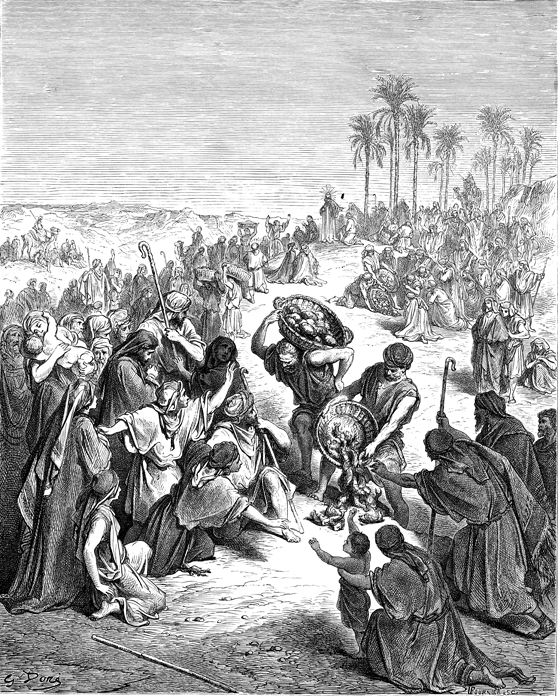
in John 6Then Jesus took the loaves and the fish, gave thanks, and distributed to those who were seated as much as they wanted.
BSB
The same verse in ASV and KJV ▾
ASV
Jesus therefore took the loaves; and having given thanks, he distributed to them that were set down; likewise also of the fishes as much as they would.
KJV
And Jesus took the loaves; and when he had given thanks, he distributed to the disciples, and the disciples to them that were set down; and likewise of the fishes as much as they would.
⋯
This verse in John 6
Commentary
27 notes on this verseAnd Jesus took the loaves,.... Into his hands, as also the fishes, in order to feed the multitude with them: and when he had given thanks; for them, and blessed them, or implored a blessing on them, that they might be nourishing to the bodies of men, as was his usual manner, and which is an example to us; he distributed to the disciples, and the disciples to them that were sat down.
This site's exposition
plenty of grass in that place
on John 6:10-13
Plenty of grass in that place marks the spring, the season of the Passover just named. Jesus gave thanks over the loaves and had them handed out until everyone was full, and the leftovers fill twelve baskets. He orders them gathered so nothing is wasted.
This site's exposition
gave thanks, and distributed
Jesus gives thanks before the bread is multiplied, and Henry takes this as the pattern for every meal received from God's hand. Gill notes from the other Gospels that the disciples carried the food from His hands to the seated crowd. Clarke's arithmetic sets one loaf against each thousand men.
The record, by era
The Church Fathers5 voices
(Tr. xxiv. s. 1.) He multiplied in His hands the five loaves, just as He produces harvest out of a few grains. There was a power in the hands of Christ; and those five loaves were, as it were, seeds, not indeed committed to the earth, but multiplied by Him who made the earth. (Tr. xxiv. s. 5) By the act of breaking He multiplied the five loaves. The five books of Moses, when expounded by breaking, i. e. unfolding them, made many books. (lib. lxxxiii. Quæst. qu. 61) Our Lord by breaking, as it were, what was hard in the Law, and opening what was shut, that time when He opened the Scriptures to the disciples after the resurrection, brought the Law out in its full meaning.
For who now feeds the whole world, but He who out of a few seeds creates the harvests? He wrought, therefore, as God. For by the same power whereby He multiplies the stores of grain from a few seeds, did He multiply in His hands the five loaves. For power was in the hands of Christ, and those five loaves were as seeds, not indeed committed to the earth, but multiplied by Him who made the earth.
In the case of the five loaves a miracle of the same type excites our wonder. By their increase five thousand men and countless women and children are saved from hunger; the method eludes our powers of observation. Five loaves are offered and broken; while the Apostles are dividing them a succession of new-created portions passes, they cannot tell how, through their hands. The loaf which they are dividing grows no smaller, yet their hands are continually full of the pieces. The swiftness of the process baffles sight; you follow with the eye a hand full of portions, and meantime you see that the contents of the other hand are not diminished, and all the while the heap of pieces grows. The carvers are busy at their task, the eaters are hard at work; the hungry are satisfied, and the fragments fill twelve baskets. Sight or sense cannot discover the mode of so noteworthy a miracle. What was not existent is created; what we see passes our understanding. Our only resource is faith in God's omnipotence.
(iii. de Trin. c. 18) Five loaves are then set before the multitude, and broken. The broken portions pass through into the hands of those who break, that from which they are broken all the time not at all diminishing. And yet there they are, the bits taken from it, in the hands of the persons breakingd. There is no catching by eye or touch the miraculous operation: that is, which was not, that is seen, which is not understood. It only remains for us to believe that God can do all things.
A commentator
Romanos the MelodistKONTAKION ON THE MULTIPLICATION OF LOAVES 13.19-20 · Written before 555.
proposed
Christ had brought to Him the five loaves of bread, And straightway, lifting His eyes to the Father, He said: "I am doing Thy deeds; for I am Thy Son; For in the beginning, I created the whole world Together with Thee and the Holy …
19 more voices on this verse
The Church Fathers6 voices
They saw a man, blind from his birth, proclaiming to them the God who had restored his sight. They saw a paralytic, who had grown up, as it were, and become one with his infirmity, at His bidding loosed from his disease. They saw Lazarus, who was made an exile from the region of death. They heard that He had walked on the sea. They heard of the wine that, without previous culture, was ministered; of the bread that was eaten at that spontaneous banquet; they heard that the demons had been put to flight; the sick restored to health. Their very streets proclaimed His deeds of wonder; their roads declared His healing power to those who journeyed on them.
A commentator
Cyril of AlexandriaCommentary on the Gospel of John, Book 3 · Written before 444.
proposed
He gives thanks, as an ensample to us and a pattern of the piety which ought to be in us: and attributes again as Man the Power of the miracle to the Divine Nature. For this was His custom, both helping by an example of piety, as we have said, those to whom He was manifested as a Teacher of what is most excellent, and by an economy concealing yet His God-befitting Dignity, till the time of His Passion should be at hand: for it was His earnest care that it should be hid from the prince of this world. For this reason, doth He elsewhere too use words befitting men, as a Man, and heals again the understanding of His hearers, sometimes making most wise alluring as in the words, Father, I thank Thee that Thou heardest Me. Seest thou in how human guise His speech, and well calculated to trouble the understanding of the more simple? But when He says this, as Man, then again He straightway unfolds the mode of the economy, and the object of His will to lie hid, by most excellent arrangement fortifying the mind of the more simple which had received a shock. For I knew (He saith) that Thou hearest Me always. Why then dost Thou speak these things? Because of the multitude which stood by I said it, that they may believe (saith He) that Thou sentest Me. Is it not then hereby plain, that with a view manifoldly to assist us, and to fulfill, as befitted Him, the secret economy with Flesh, He sometimes speaks more lowlily, than He really is? As therefore in that passage, I thank Thee, is taken economically, so here too. [He blessed is understood of the bread.] But we must observe that instead of gave thanks, Matthew has said, blessed, but the edition of the saints will in no wise differ. For Paul will show that they are both one, saying that every meat 9 of God is good, and nothing to be refused: for it is sanctified by the word of God and prayer. […]
But why when He was about to restore the paralytic did He not pray, nor when He was raising the dead, or bridling the sea, while He doth so here over the loaves? It was to show that when we begin our meals, we ought to give thanks unto God. Moreover, He doth it especially in a lesser matter, that thou mayest learn that He doth it not as having any need; for were this the case, much more would He have done so in greater things; but when He did them by His own authority, it is clear that it was through condescension that He acted as He did in the case of the lesser.
"And He gave to them that were set down, and they were filled." Seest thou how great is the interval between the servants and the Master? They having grace by measure, wrought their miracles accordingly, but God, who acteth with free power, did all most abundantly.
That wine, which was produced by God in a vineyard, and which was first consumed, was good. None of those who drank of it found fault with it; and the Lord partook of it also. But that wine was better which the Word made from water, on the moment, and simply for the use of those who had been called to the marriage.
So very mystically the five loaves are broken by the Savior, and fill the crowd of the listeners. For great is the crowd that keep to the things of the senses, as if they were the only things in existence. "Cast your eyes round, and see," says Plato, "that none of the uninitiated listen." Such are they who think that nothing else exists but what they can hold firmly with their hands; but do not admit as in the department of existence, actions and processes of generation, and the whole of the unseen. For such are those who keep by the five senses. But the knowledge of God is a thing inaccessible to the ears and other organs of the senses with this kind of people.
The Medieval Church5 voices
i. e. green grass. It was the time of the Passover, which was kept the first month of the spring. So the men sat down in number about five thousand. The Evangelist only counts the men, following the direction in the law. Moses numbered the people from twenty years old and upwards, making no mention of the women; to signify that the manly and juvenile character is especially honourable in God's eyes. And Jesus took the loaves; and when He had given thanks, He distributed to them that were sat down: and likewise of the fishes as much as they would. We learn too from this miracle, not to be pusillanimous in the greatest straits of poverty.
Having taken the loaves, He gives thanks. By this He shows that before partaking of food one ought to give thanks to God. And since the crowd was there, He gives thanks in the presence of the crowd also so that all might know that …
Here the multiplication of the loaves is touched upon, which was obtained through the giving of thanks and completed in the distribution of the loaves. Therefore he says: "Jesus therefore took the loaves," in order to multiply them: for his hand is one of power; …
His not making new loaves, but multiplying what there were, means that He did not reject the Old Testament, but only developed and explained it.
Then (v 11), the Evangelist presents the feeding of the crowd. First, we see the attitude of Christ; secondly, the food used; thirdly, that the people were satisfied. As to the attitude of Jesus, both his humility and his giving of thanks are mentioned. We …
The Puritans and the Awakening3 voices
Observe, (1.) It was done with thanksgiving: He gave thanks. Note, [1.] We ought to give thanks to God for our food, for it is a mercy to have it, and we have it from the hand of God, and must receive it with thanksgiving, 1 Tim. iv.
Those who call feeding upon fish fasting reproach the entertainment Christ here made, which was a full feast. The care that was taken of the broken meat. (1.) The orders Christ gave concerning it (
quarantine:debris (2026-07-29) — unbalanced-parens
Good motions are often crushed, and come to nothing, for want of being prosecuted in time. They came to Capernaum, and, for aught that appears, these unsound hypocritical followers of Christ had a calm and pleasant passage, while his sincere disciples had a rough and stormy one. It is not strange if it fare worst with the best men in this evil world.
The Nineteenth Century5 voices
Jesus took the loaves - See the notes on Mat 14:19-21 (note). As there were five loaves and five thousand people, so there was one loaf to every thousand men, independently of the women and children.
A commentator
J.C. Ryle1816–1900
Expository Thoughts on the Gospels: John (lightly modernized text, Grace Gems edition) (1869)
These verses describe one of our Lord's most remarkable miracles. Of all the great works that He did, none was done so publicly as this, and before so many witnesses. Of all the miracles related in the Gospels, this is the only one which all the four Gospel-writers alike record. This fact alone (like the four times repeated account of the crucifixion and resurrection) is enough to show that it is a miracle demanding special attention. We have, for one thing, in this miracle, a lesson about Christ's almighty power.
Look, there are the people! Five thousand of them, as hungry as hunters, and they all need to have food given to them, for they cannot, any of them, travel to buy it! And here is the provision! Five thin wafers—and those of barley, more fit for horses than for men—and two little anchovies, by way of a relish! Five thousand people and five little biscuits to feed them! The disproportion is enormous—if each one should have only the tiniest crumb, there would not be enough!
A commentator
J.C. Ryle1816–1900
Expository Thoughts on the Gospels: John (lightly modernized text, Grace Gems edition) (1869)
proposed
These verses describe one of our Lord's most remarkable miracles. Of all the great works that He did, none was done so publicly as this, and before so many witnesses. Of all the miracles related in the Gospels, this is the only one which all the four Gospel-writers alike record. This fact alone (like the four times repeated account of the crucifixion and resurrection) is enough to show that it is a miracle demanding special attention. We have, for one thing, in this miracle, a lesson about Christ's almighty power. We see our Lord feeding five thousand men with "five barley loaves and two small fish." We see clear proof that a miraculous event took place in the "twelve baskets of fragments" that remained after all had eaten. Creative power was manifestly exercised. Food was called into existence that did not exist before. In healing the sick, and raising the dead, something was amended or restored that had already existed. In feeding five thousand men with five loaves, something must have been created which before had no existence. Such a history as this ought to be specially instructive and encouraging to all who endeavor to do good to souls. It shows us the Lord Jesus "able to save to the uttermost." He is One who has all power over dead hearts. Not only can He mend that which is broken—build up that which is ruined—heal that which is sick—strengthen that which is weak. He can do even greater things than these. He can call into being that which was not before, and call it out of nothing. We must never despair of any one being saved. So long as there is life there is hope. Reason and sense may say that some poor sinner is too hardened, or too old to be converted. Faith will reply—"Our Master can create as well as renew . With a Savior who, by His Spirit, can create a new heart, nothing is impossible."
Look, there are the people! Five thousand of them, as hungry as hunters, and they all need to have food given to them, for they cannot, any of them, travel to buy it! And here is the provision! Five thin wafers—and those of barley, more fit for horses than for men—and two little anchovies, by way of a relish! Five thousand people and five little biscuits to feed them! The disproportion is enormous—if each one should have only the tiniest crumb, there would not be enough! In like manner, there are millions of people in London and only a handful of whole-hearted Christians earnestly desiring to see the city converted to Christ. There are more than a thousand millions of men in this round world and oh, so few missionaries breaking the Bread of Life to them! Almost as few for the millions, as were these five barley cakes for those five thousand! The problem is a very difficult one. The contrast between the supply and the demand would have struck us much more vividly if we had been there, in that crowd at Bethsaida, than it does sitting here, nearly 1,900 years later, and merely hearing about it. But the Lord Jesus was equal to the emergency! None of the people went away without sharing in His bounty—they were all filled. Our blessed Master, now that He has ascended into the heavens, has more rather than less power! He is not baffled because of our need, but can even now use paltry means to accomplish His own glorious purposes. Therefore let no man's heart fail him. Do not despair of the evangelization of London, nor think it hopeless that the Gospel should be preached in all nations for a testimony unto them. Have faith in God, who is in Christ Jesus! Have faith in the compassion of the Great Mediator—He will not desert the people in their spiritual needs any more than He failed that hungry throng in their temporal need, long ago.
The words behind it
18 Greek wordsEvery Greek word of this verse in the order it stands, with what it means and the door to its own study. The last column counts the times a word stands in the whole Bible: the rarer the word, the more the places it appears belong together.
| Greek | Sound | Meaning | Word study | In the Bible |
|---|---|---|---|---|
| ἔλαβεν | elaben | Took | G2983 → | 257 times |
| οὖν | oun | then | G3767 → | 497 times |
| τοὺς | tous | the | G3588 → | 19766 times |
| ἄρτους | artous | loaves | G740 → | 97 times |
| ὁ | ho | <the> | G3588 → | 19766 times |
| Ἰησοῦς | iesous | Jesus | G2424 → | 908 times |
| καὶ | kai | and | G2532 → | 9120 times |
| εὐχαριστήσας | eucharistesas | having given thanks | G2168 → | 38 times |
| διέδωκεν | diedoken | He distributed | G1239 → | |
| τοῖς | tois | to those | G3588 → | 19766 times |
| ἀνακειμένοις, | anakeimenois | reclining, | G345 → | 13 times |
| ὁμοίως | homoios | likewise | G3668 → | 30 times |
| καὶ | kai | also | G2532 → | 9120 times |
| ἐκ | ek | of | G1537 → | 911 times |
| τῶν | ton | the | G3588 → | 19766 times |
| ὀψαρίων | opsarion | fish | G3795 → | 5 times |
| ὅσον | hoson | as much as | G3745 → | 110 times |
| ἤθελον. | ethelon | they were wishing. | G2309 → | 208 times |
ἔλαβενTook
elabenG2983 →257 times
οὖνthen
ounG3767 →497 times
τοὺςthe
tousG3588 →19766 times
ἄρτουςloaves
artousG740 →97 times
ὁ<the>
hoG3588 →19766 times
ἸησοῦςJesus
iesousG2424 →908 times
καὶand
kaiG2532 →9120 times
εὐχαριστήσαςhaving given thanks
eucharistesasG2168 →38 times
διέδωκενHe distributed
diedokenG1239 →
τοῖςto those
toisG3588 →19766 times
ἀνακειμένοις,reclining,
anakeimenoisG345 →13 times
ὁμοίωςlikewise
homoiosG3668 →30 times
καὶalso
kaiG2532 →9120 times
ἐκof
ekG1537 →911 times
τῶνthe
tonG3588 →19766 times
ὀψαρίωνfish
opsarionG3795 →5 times
ὅσονas much as
hosonG3745 →110 times
ἤθελον.they were wishing.
ethelonG2309 →208 times
A shaded row is a word that stands 400 times or fewer in the Bible.
The walk
8 stopsEach card is a verse this one points to, and under it the verses that one points to in turn. Where several paths arrive at the same place, that place is listed first: the text keeps returning to it.
Through
1 Thessalonians 5:18Give thanks in every circumstance, for this is God’s will for you in Christ Jesus.
it leads to
- Ephesians 5:20
always giving thanks to God the Father for everything in the name of our Lord Jesus Christ.
- Philippians 4:6
Be anxious for nothing, but in everything, by prayer and petition, with thanksgiving, present your requests to God.
- Colossians 3:17
And whatever you do, in word or deed, do it all in the name of the Lord Jesus, giving thanks to God the Father through Him.
- Hebrews 13:15
Through Jesus, therefore, let us continually offer to God a sacrifice of praise, the fruit of lips that confess His name.
- Job 1:21
saying: “Naked I came from my mother’s womb, and naked I will return. The LORD gave, and the LORD has taken away. Blessed be the name of the LORD.”
- Ephesians 5:20
Through
Luke 24:30While He was reclining at the table with them, He took bread, spoke a blessing and broke it, and gave it to them.
it leads to
- Matthew 14:19
And He directed the crowds to sit down on the grass. Taking the five loaves and the two fish and looking up to heaven, He spoke a blessing. Then He broke the loaves and…
Reached by 2 separate paths from here.
- Matthew 15:36
Taking the seven loaves and the fish, He gave thanks and broke them. Then He gave them to the disciples, and the disciples gave them to the people.
Reached by 2 separate paths from here.
- Matthew 14:19
Through
Romans 14:6He who observes a special day does so to the Lord; he who eats does so to the Lord, for he gives thanks to God; and he who abstains does so to the Lord…
it leads to
- 1 Corinthians 10:30–31
If I partake in the meal with thankfulness, why am I denounced because of that for which I give thanks?
- 1 Corinthians 10:30–31
Where this verse is studied
On this page
Studies15
On this verse
On this chapter
About John
This page draws on 21 works. Open the list of works
This page draws on Adam Clarke, Commentary on the Bible; Alcuin of York, Catena Aurea by Aquinas; Augustine of Hippo, Catena Aurea by Aquinas; Augustine of Hippo, Tractates on John 24; Bonaventure, Commentary on John, Chapter 6; Charles Spurgeon, The Metropolitan Tabernacle Pulpit, Sermon No. 2216: “The Lad's Loaves in the Lord's Hands” (lightly modernized text, CCEL edition); Clement of Alexandria, The Stromata Book 5; Cyril of Alexandria, Commentary on the Gospel of John, Book 3; Hilary of Poitiers, ON THE TRINITY 3.6; Hilary of Poitiers, Catena Aurea by Aquinas; Irenaeus, Against Heresies Book III; J.C. Ryle, Expository Thoughts on the Gospels: John (lightly modernized text, Grace Gems edition); Jamieson, Fausset & Brown, Commentary Critical and Explanatory on the Whole Bible; John Chrysostom, Homily on the Gospel of John 42; John Gill, Exposition of the New Testament (1746-1748); Matthew Henry, Commentary on the Whole Bible; Methodius of Olympus, Oration on the Psalms; Romanos the Melodist, KONTAKION ON THE MULTIPLICATION OF LOAVES 13.19-20; Theophylact of Ohrid, Catena Aurea by Aquinas; Theophylact of Ohrid, Commentary on John and Thomas Aquinas, Commentary on John.