
John 6:30
in John 6So they asked Him, “What sign then will You perform, so that we may see it and believe You? What will You do?
BSB
The same verse in ASV and KJV ▾
ASV
They said therefore unto him, What then doest thou for a sign, that we may see, and believe thee? what workest thou?
KJV
They said therefore unto him, What sign shewest thou then, that we may see, and believe thee? what dost thou work?
⋯
This verse in John 6
Commentary
15 notes on this verseThe disposition of the Jews unveils itself by little and little, although, hidden and as yet buried in less overt reasonings. For they were saying in their folly, What shall we do that we might work the works of God? as if, as we said before, they held the commandment through Moses sufficient to conduct them to all wisdom, whereby they might know how to perform what was well-pleasing unto God. But their aim being such was concealed, but is now being unveiled, and by little and little comes forth more plainly.
This site's exposition
What sign then will You perform
on John 6:30-31
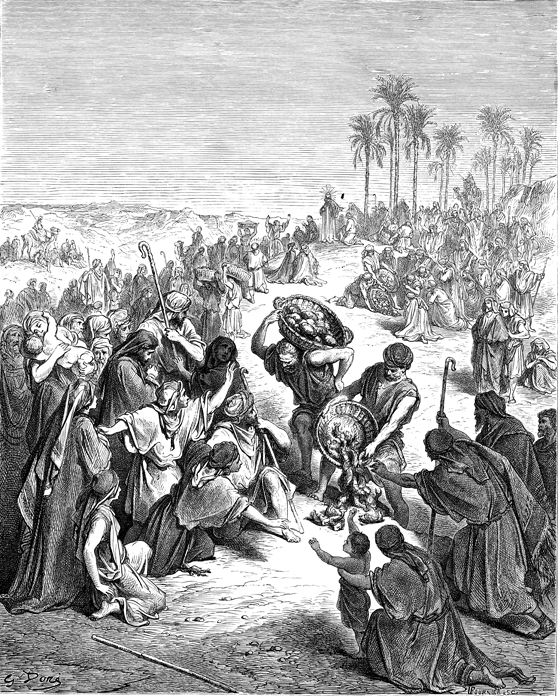
A day after the loaves they ask for another sign. Their fathers ate the manna in the wilderness, and they quote Psalm 78:24 on bread from heaven to eat. Forty years of daily bread stands beside one afternoon on a hillside.
The record, by era
The Church Fathers5 voices
Because, then, He invited them to faith, they still on their part desired to see signs that they might believe. They did not count Him worthy of belief, to whom they themselves bore the witness that He had fed so many thousands with five loaves. Already they had forgotten: they sought meat that perisheth. They said therefore to Him, "What sign showest Thou, that we may see and believe Thee? What dost Thou work? Our fathers did eat manna in the desert, as it is written, He gave them bread from heaven to eat." What is it that I promise? I promise the bread from heaven.
(xxv. 12) To eat then that meat which endureth unto everlasting life, is to believe on Him. Why dost thou make ready thy tooth and thy belly? Only believe, and thou hast eaten already. As He called on them to believe, they still asked for miracles whereby to believe; They said therefore unto Him, What sign shewest Thou then, that we may see and believe Thee? What dost Thou work? (Tr. xxv. s. 12) Or thus; Our Lord sets Himself above Moses, who did not dare to say that He gave the meat which perisheth not. The multitude therefore remembering what Moses had done, and wishing for some greater miracle, say, as it were, Thou promisest the meat which perisheth not, and doest not works equal to those Moses did. He gave us not barley loaves, but manna from heaven.
Mark too their hypocrisy. They said not, "Moses did this sign, what doest thou?" thinking it would annoy Him; but for a while they address Him with great reverence, through expectation of food. So they neither said, "God did this, what doest thou?" that they might not seem to make Him equal with God; nor did they bring forward Moses, that they might not seem to lower Him, but put the matter in an intermediate form, "Our fathers did eat manna in the wilderness." He indeed might have replied, "I, but now, have wrought greater wonders than did Moses, requiring no rod, having no need of prayer, but doing all of Myself; and, if ye call to remembrance the manna, see, I have given you bread." But this was not the season for such speeches; and the one thing He earnestly desired was, to bring them to spiritual food.
What then did they? As though they had heard nothing, they said, "What shall we do, that we might work the works of God?" This they said, not that they might learn and do them, (as the sequel shows,) but to induce Him again to supply them with food, and desiring to persuade Him to satisfy them. What then saith Christ? "This is the work of God, that ye believe on Him whom He hath sent." On this they asked, "What sign showest thou, that we may see and believe?" Nothing more senseless, nothing more unreasonable, than these men! While the miracle was yet in their hands, as though none had been done, they spake after this manner, "What sign shewest thou?" and having thus spoken, they do not even allow Him the right of choosing the sign, but think to force Him to exhibit none other than such a one as was wrought in the days of their fathers; wherefore they say, "Our fathers did eat manna in the wilderness," thinking by this to provoke Him to work such a miracle as might supply them with carnal nourishment. Else why did they mention none other of the miracles of old, though many took place in those times, both in Egypt and at the sea and in the wilderness, but only that of the manna? Was it not because they greatly desired that one by reason of the tyranny of their bellies? Ye who when ye saw His miracle called him a Prophet, and attempted to make Him a king, how is that now, as though none had been wrought, ye have become thankless and ill-minded, and ask for a sign, uttering words fit for parasites, or hungry dogs? Does the manna now seem wonderful to you? Your soul is not now parched up. Mark too their hypocrisy. They said not, "Moses did this sign, what doest thou?" thinking it would annoy Him; but for a while they address Him with great reverence, through expectation of food. […]
Nothing more senseless, nothing more unreasonable, than these men! While the miracle was yet in their hands, as though none had been done, they spake after this manner, "What sign shewest thou?" and having thus spoken, they do not even allow Him the right of choosing the sign, but think to force Him to exhibit none other than such a one as was wrought in the days of their fathers; wherefore they say, "Our fathers did eat manna in the wilderness," thinking by this to provoke Him to work such a miracle as might supply them with carnal nourishment. Else why did they mention none other of the miracles of old, though many took place in those times, both in Egypt and at the sea and in the wilderness, but only that of the manna? Was it not because they greatly desired that one by reason of the tyranny of their bellies?
8 more voices on this verse
The Medieval Church3 voices
903 Next, we see the origin of this food. First, we have the question asked by the Jews; secondly, the answer of Christ (v 32). Three things are done about the first: first, the Jews look for a sign; secondly, they decide what it should …
See what ingratitude and insensibility. After having seen so many and such great miracles, they again ask for a sign, and one even greater than the loaves with which they were fed. As gluttons, they again demand such a miracle as would serve their belly. …
Here the humiliation of those who despise and are proud is touched upon: for they did not wish to believe in Christ through the signs which they had seen, as if their fathers had seen greater signs. Therefore they say: "What sign therefore do you …
The Puritans and the Awakening1 voice
They said therefore unto him,.... Seeing he proposed believing in him as the grand work of God to be done, and what is most acceptable in his sight: what sign showest thou then, that we may see and believe thee? The people of the Jews were always requiring signs and wonders, and when they had one and another shown them, they still sought for more, and were never satisfied; see Mat 12:
The Nineteenth Century4 voices
What sign - Τι σημειον, What miracle; so the word is evidently used, Joh 2:11, Joh 2:23, and in many other places. That we may see, and believe thee - That, having seen the miracle, we may believe thee to be the promised Messiah. They had already seen the miracle of the five loaves, and did not believe; and it was impossible for them to see any thing more descriptive of unlimited power and goodness.
A commentator
J.C. Ryle1816–1900
Expository Thoughts on the Gospels: John (lightly modernized text, Grace Gems edition) (1869)
proposed
These verses form the beginning of one of the most remarkable passages in the Gospels. None, perhaps, of our Lord's discourses has occasioned more controversy, and been more misunderstood, than that which we find in the Sixth Chapter of John. We should observe, for one thing, in these verses, the spiritual ignorance and unbelief of the natural man. Twice over we see this brought out and exemplified.
A commentator
J.C. Ryle1816–1900
Expository Thoughts on the Gospels: John (lightly modernized text, Grace Gems edition) (1869)
proposed
These verses form the beginning of one of the most remarkable passages in the Gospels. None, perhaps, of our Lord's discourses has occasioned more controversy, and been more misunderstood, than that which we find in the Sixth Chapter of John. We should observe, for one thing, in these verses, the spiritual ignorance and unbelief of the natural man. Twice over we see this brought out and exemplified. When our Lord instructed his hearers to "labor for the food which endures to eternal life," they immediately began to think of 'works to be done', and a goodness of their own to be established. "What shall we do that we might work the works of God?" Doing, doing, doing, was their only idea of the way to heaven. Again, when our Lord spoke of Himself as One sent of God, and the need of believing on Him at once, they turn round with the question,"What sign show you? what do you work?" Fresh from the mighty miracle of the loaves and fishes, one might have thought they had had a sign sufficient to convince them. Taught by our Lord Jesus Christ himself, one might have expected a greater readiness to believe. But alas! there are no limits to man's dulness, prejudice, and unbelief in spiritual matters. It is a striking fact that the only thing which our Lord is said to have "marveled" at during His earthly ministry, was man's "unbelief." (Mark 6:6.) We shall do well to remember this, if we ever try to do good to others in the matter of religion. We must not be cast down because our words are not believed, and our efforts seem thrown away. We must not complain of it as a strange thing, and suppose that the people we have to deal with are peculiarly stubborn and hard. We must recollect that this is the very cup of which our Lord had to drink, and like Him we must patiently work on.
A commentator
Albert Barnes1798–1870
Notes, Explanatory and Practical, on the Old and New Testaments (1832-1869)
proposed
What sign showest thou? - On the word sign, compare the notes at Isa 7:14. What miracle dost thou work to prove that thou art the Messiah? They had just seen the miracle of the loaves in the desert, which was sufficient to show that he was the Messiah, and it would seem from the preceding narrative that those who crossed the lake to see him supposed that he was the Christ. It seems wonderful that they should so soon ask for further evidence that he was sent from God; but it is not improbable that this question was put by other Jews, rulers of the synagogue, who happened to be present, and who had not witnessed his miracles. Those men were continually asking for signs and proofs that he was the Messiah. See Mat 12:38-39; Mar 8:11; Luk 11:29. As Jesus claimed the right of teaching them, and as it was manifest that he would teach them differently from what they supposed Moses to teach, it was natural to ask him by what authority he claimed the right to be heard.
The words behind it
15 Greek wordsEvery Greek word of this verse in the order it stands, with what it means and the door to its own study. The last column counts the times a word stands in the whole Bible: the rarer the word, the more the places it appears belong together.
| Greek | Sound | Meaning | Word study | In the Bible |
|---|---|---|---|---|
| Εἶπον | eipon | They said | G2036 → | 925 times |
| οὖν | oun | therefore | G3767 → | 497 times |
| αὐτῷ· | auto | to Him; | G846 → | 5565 times |
| τί | ti | What | G5101 → | 563 times |
| οὖν | oun | then | G3767 → | 497 times |
| ποιεῖς | poieis | do | G4160 → | 569 times |
| σὺ | su | You yourself | G4771 → | 2973 times |
| σημεῖον | semeion | [as a] sign | G4592 → | 75 times |
| ἵνα | ina | that | G2443 → | 668 times |
| ἴδωμεν | idomen | we may see | G1492 → | 374 times |
| καὶ | kai | and | G2532 → | 9120 times |
| πιστεύσωμέν | pisteusomen | may believe | G4100 → | 237 times |
| σοι; | soi | You? | G4771 → | 2973 times |
| τί | ti | What | G5101 → | 563 times |
| ἐργάζῃ; | ergaze | work do You perform? | G2038 → | 41 times |
ΕἶπονThey said
eiponG2036 →925 times
οὖνtherefore
ounG3767 →497 times
αὐτῷ·to Him;
autoG846 →5565 times
τίWhat
tiG5101 →563 times
οὖνthen
ounG3767 →497 times
ποιεῖςdo
poieisG4160 →569 times
σὺYou yourself
suG4771 →2973 times
σημεῖον[as a] sign
semeionG4592 →75 times
ἵναthat
inaG2443 →668 times
ἴδωμενwe may see
idomenG1492 →374 times
καὶand
kaiG2532 →9120 times
πιστεύσωμένmay believe
pisteusomenG4100 →237 times
σοι;You?
soiG4771 →2973 times
τίWhat
tiG5101 →563 times
ἐργάζῃ;work do You perform?
ergazeG2038 →41 times
A shaded row is a word that stands 400 times or fewer in the Bible.
The walk
8 stopsEach card is a verse this one points to, and under it the verses that one points to in turn. Where several paths arrive at the same place, that place is listed first: the text keeps returning to it.
Through
John 10:38But if I am doing them, even though you do not believe Me, believe the works themselves, so that you may know and understand that the Father is in Me, and I am in…
it leads to
- Acts 2:22
Men of Israel, listen to this message: Jesus of Nazareth was a man certified by God to you by miracles, wonders, and signs, which God did among you through Him, as you yourselves know.
Reached by 2 separate paths from here.
- John 10:30
I and the Father are one.”
- John 14:20
On that day you will know that I am in My Father, and you are in Me, and I am in you.
- John 10:25
“I already told you,” Jesus replied, “but you did not believe. The works I do in My Father’s name testify on My behalf.
- John 14:9–11
Jesus replied, “Philip, I have been with you all this time, and still you do not know Me? Anyone who has seen Me has seen the Father. How can you say, ‘Show us the…
- Acts 2:22
Through
John 12:37Although Jesus had performed so many signs in their presence, they still did not believe in Him.
it leads to
- Luke 16:31
Then Abraham said to him, ‘If they do not listen to Moses and the prophets, they will not be persuaded even if someone rises from the dead.’”
Reached by 2 separate paths from here.
- John 15:24
If I had not done among them the works that no one else did, they would not be guilty of sin; but now they have seen and hated both Me and My Father.
Reached by 2 separate paths from here.
- Luke 16:31
Through
1 Corinthians 1:22Jews demand signs and Greeks search for wisdom,
it leads to
- Matthew 16:1–4
Then the Pharisees and Sadducees came and tested Jesus by asking Him to show them a sign from heaven.
- Matthew 16:1–4
Where this verse is studied
On this page
Studies15
About John
This page draws on 13 works. Open the list of works
This page draws on Adam Clarke, Commentary on the Bible; Albert Barnes, Notes, Explanatory and Practical, on the Old and New Testaments (1832-1869); Augustine of Hippo, Tractates on John 25; Augustine of Hippo, Catena Aurea by Aquinas; Bonaventure, Commentary on John, Chapter 6; Cyril of Alexandria, Commentary on the Gospel of John, Book 3; J.C. Ryle, Expository Thoughts on the Gospels: John (lightly modernized text, Grace Gems edition); Jamieson, Fausset & Brown, Commentary Critical and Explanatory on the Whole Bible; John Chrysostom, Homily on the Gospel of John 45; John Gill, Exposition of the New Testament; John Gill, Exposition of the New Testament (1746-1748); Theophylact of Ohrid, Commentary on John and Thomas Aquinas, Commentary on John.