
John 6:8
in John 6One of His disciples, Andrew, Simon Peter’s brother, said to Him,
BSB
The same verse in ASV and KJV ▾
ASV
One of his disciples, Andrew, Simon Peter’s brother, saith unto him,
KJV
One of his disciples, Andrew, Simon Peter’s brother, saith unto him,
⋯
This verse in John 6
Commentary
10 notes on this verseAndrew is in the same perplexity that Philip is; only he has rather higher notions of our Lord: There is a lad here which hath five barley loaves and two small fishes. This passage confounds the Manicheans, who say that bread and all such things were created by an evil Deity. The Son of the good God, Jesus Christ, multiplied the loaves. Therefore they could not have been naturally evil; a good God would never have multiplied what was evil.
This site's exposition
Andrew, Simon Peter's brother
on John 6:8-9
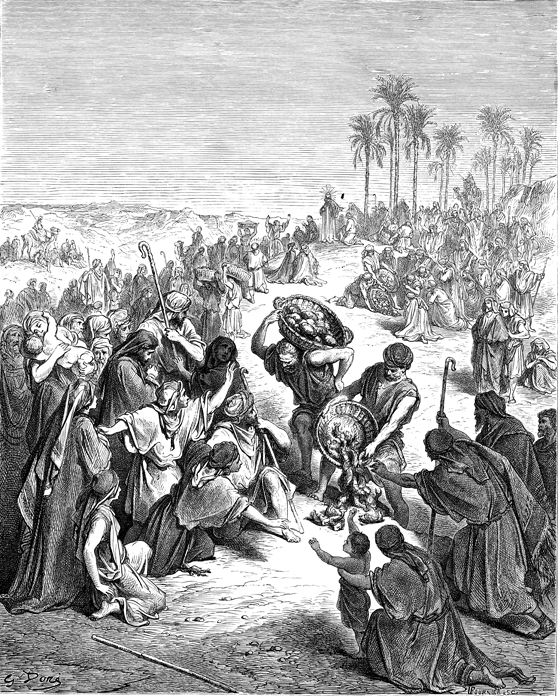
Andrew brings forward what is there, five barley loaves and two small fish from a boy. Barley was the cheap grain, the bread the poor ate. Andrew's own report ends in a question about how far so little will go among so many.
The record, by era
The Church Fathers2 voices
A commentator
Romanos the MelodistKONTAKION ON THE MULTIPLICATION OF LOAVES 13.12-17 · Written before 555.
proposed
"Master, we can find only five barley loaves; No one of us brought anything into the desert, But a child is here who has them. O Lover of man, no other resource is possible for us. For an enormous and boundless number of people, O …
(de Con. Evang. ii. c. xlvi) Andrew's suggestion about the five loaves and two fishes, is given as coming from the disciples in general, in the other Evangelists, and the plural number is used.
The Medieval Church2 voices
Andrew, however, seems to sense that a miracle is going to take place. Perhaps he recalled the miracle performed by Elisha with the barley loaves, when he fed a hundred men with twenty loaves (2 Kgs 4:42). And so he says, There is a boy …
Here is noted the fourth occasion, namely the insufficiency of food for the feeding of so great a multitude. For since there were five thousand, they had only five loaves; and this is noted in Andrew's response. Therefore he says: "One of his disciples, Andrew, …
The Puritans and the Awakening1 voice
One of his disciples, Andrew, Simon Peter's brother,.... Who also, and his brother Peter, were of Bethsaida, as well as Philip, and was a disciple of Christ's; he hearing what Christ said to Philip, and what answer he returned, saith unto him; to Christ, with but little more faith than Philip, if any.
3 more voices on this verse
The Nineteenth Century3 voices
Andrew, Simon Peter’s brother, saith - The other evangelists attribute this answer to the apostles in general. See the passages referred to above.
A commentator
J.C. Ryle1816–1900
Expository Thoughts on the Gospels: John (lightly modernized text, Grace Gems edition) (1869)
These verses describe one of our Lord's most remarkable miracles. Of all the great works that He did, none was done so publicly as this, and before so many witnesses. Of all the miracles related in the Gospels, this is the only one which all the four Gospel-writers alike record. This fact alone (like the four times repeated account of the crucifixion and resurrection) is enough to show that it is a miracle demanding special attention. We have, for one thing, in this miracle, a lesson about Christ's almighty power.
A commentator
J.C. Ryle1816–1900
Expository Thoughts on the Gospels: John (lightly modernized text, Grace Gems edition) (1869)
proposed
These verses describe one of our Lord's most remarkable miracles. Of all the great works that He did, none was done so publicly as this, and before so many witnesses. Of all the miracles related in the Gospels, this is the only one which all the four Gospel-writers alike record. This fact alone (like the four times repeated account of the crucifixion and resurrection) is enough to show that it is a miracle demanding special attention. We have, for one thing, in this miracle, a lesson about Christ's almighty power. We see our Lord feeding five thousand men with "five barley loaves and two small fish." We see clear proof that a miraculous event took place in the "twelve baskets of fragments" that remained after all had eaten. Creative power was manifestly exercised. Food was called into existence that did not exist before. In healing the sick, and raising the dead, something was amended or restored that had already existed. In feeding five thousand men with five loaves, something must have been created which before had no existence. Such a history as this ought to be specially instructive and encouraging to all who endeavor to do good to souls. It shows us the Lord Jesus "able to save to the uttermost." He is One who has all power over dead hearts. Not only can He mend that which is broken—build up that which is ruined—heal that which is sick—strengthen that which is weak. He can do even greater things than these. He can call into being that which was not before, and call it out of nothing. We must never despair of any one being saved. So long as there is life there is hope. Reason and sense may say that some poor sinner is too hardened, or too old to be converted. Faith will reply—"Our Master can create as well as renew . With a Savior who, by His Spirit, can create a new heart, nothing is impossible."
The words behind it
12 Greek wordsEvery Greek word of this verse in the order it stands, with what it means and the door to its own study. The last column counts the times a word stands in the whole Bible: the rarer the word, the more the places it appears belong together.
| Greek | Sound | Meaning | Word study | In the Bible |
|---|---|---|---|---|
| Λέγει | legei | Says | G3004 → | 1325 times |
| αὐτῷ | auto | to Him | G846 → | 5565 times |
| εἷς | heis | one | G1520 → | 343 times |
| ἐκ | ek | of | G1537 → | 911 times |
| τῶν | ton | the | G3588 → | 19766 times |
| μαθητῶν | matheton | disciples | G3101 → | 260 times |
| αὐτοῦ, | autou | of Him, | G846 → | 5565 times |
| Ἀνδρέας | andreas | Andrew | G406 → | 13 times |
| ὁ | ho | the | G3588 → | 19766 times |
| ἀδελφὸς | adelphos | brother | G80 → | 343 times |
| Σίμωνος | simonos | of Simon | G4613 → | 75 times |
| Πέτρου· | petrou | Peter; | G4074 → | 155 times |
ΛέγειSays
legeiG3004 →1325 times
αὐτῷto Him
autoG846 →5565 times
εἷςone
heisG1520 →343 times
ἐκof
ekG1537 →911 times
τῶνthe
tonG3588 →19766 times
μαθητῶνdisciples
mathetonG3101 →260 times
αὐτοῦ,of Him,
autouG846 →5565 times
ἈνδρέαςAndrew
andreasG406 →13 times
ὁthe
hoG3588 →19766 times
ἀδελφὸςbrother
adelphosG80 →343 times
Σίμωνοςof Simon
simonosG4613 →75 times
Πέτρου·Peter;
petrouG4074 →155 times
A shaded row is a word that stands 400 times or fewer in the Bible.
The walk
5 stopsEach card is a verse this one points to, and under it the verses that one points to in turn. Where several paths arrive at the same place, that place is listed first: the text keeps returning to it.
Through
Matthew 4:18As Jesus was walking beside the Sea of Galilee, He saw two brothers, Simon called Peter and his brother Andrew. They were casting a net into the sea, for they were fishermen.
it leads to
- John 1:40–42
Andrew, Simon Peter’s brother, was one of the two who heard John’s testimony and followed Jesus.
- Matthew 10:2
These are the names of the twelve apostles: first Simon, called Peter, and his brother Andrew; James son of Zebedee, and his brother John;
- Luke 6:14
Simon, whom He named Peter, and his brother Andrew; James and John; Philip and Bartholomew;
- Mark 1:16–20
As Jesus was walking beside the Sea of Galilee, He saw Simon and his brother Andrew. They were casting a net into the sea, for they were fishermen.
- Luke 5:1–11
On one occasion, while Jesus was standing by the Lake of Gennesaret with the crowd pressing in on Him to hear the word of God,
- John 1:40–42
Where this verse is studied
On this page
Studies15
- Bread
- Eternal Life
- Eternal Security, and the Five Warnings of Hebrews
- Feeding the Five Thousand, John 6:1-15
- Why He Said He Came
- Jesus on Himself
- Manna
- Names of God
- Predestination and Election
- The Seven Signs: John's Book of Signs
- The Tabernacle
- The Bride & the Jewish Wedding
- The Father's Will
- The Seal & the Signet
- Walking on Water: Matthew 14:22-33
About John
Who and where
1 name in this verse with a page on the site.
This page draws on 10 works. Open the list of works
This page draws on Adam Clarke, Commentary on the Bible; Alexander Maclaren, Expositions of Holy Scripture, John; Augustine of Hippo, Catena Aurea by Aquinas; Bonaventure, Commentary on John, Chapter 6; J.C. Ryle, Expository Thoughts on the Gospels: John (lightly modernized text, Grace Gems edition); John Gill, Exposition of the New Testament; John Gill, Exposition of the New Testament (1746-1748); Romanos the Melodist, KONTAKION ON THE MULTIPLICATION OF LOAVES 13.12-17; Theophylact of Ohrid, Catena Aurea by Aquinas and Thomas Aquinas, Commentary on John.