
John 6:1
in John 6After this, Jesus crossed to the other side of the Sea of Galilee (that is, the Sea of Tiberias).
BSB
The same verse in ASV and KJV ▾
ASV
After these things Jesus went away to the other side of the sea of Galilee, which is the sea of Tiberias.
KJV
After these things Jesus went over the sea of Galilee, which is the sea of Tiberias.
⋯
This verse in John 6
Commentary
23 notes on this verseAfter these things,.... After Christ's curing the man at Bethesda's pool, and the vindication of himself for doing it or the sabbath day, and for asserting his equality with God; near a year after these things: for these were done at the feast of the passover, and now it was near another; and what is related here, was after the death of John the Baptist, and when the disciples had returned from preaching in the several cities and towns, where Christ afterwards went, and had given an account of their success; see Mat 14:
This site's exposition
the Sea of Tiberias
on John 6:1-4
John gives the lake both of its names, the Sea of Galilee and the Sea of Tiberias, the second from the city Herod Antipas built on its shore. A large crowd follows Him after the signs He worked on the sick, and He goes up the mountain and sits with His disciples. The Passover was near.
The record, by era
The Church Fathers5 voices
(Tr. xxiv. s. 1, 2) But let us reflect a little here. Forasmuch as the Divine Substance is not visible to the eye, and the miracles of the divine government of the world, and ordering of the whole creation, are overlooked in consequence of their constancy; God has reserved to Himself acts, beside the established course and order of nature, to do at suitable times; in order that those who overlooked the daily course of nature, might be roused to wonder by the sight of what was different from, though not at all greater, than what they were used to. The government of the world is a greater miracle, than the satisfying the hunger of five thousand with five loaves; and yet no one wonders at this: the former excited wonder; not from any real superiority in it, but because it was uncommon. But it would be wrong to gather no more than this from Christ's miracles: for, the Lord who is on the mounte, and the Word of God which is on high, the same is no humble person to be lightly passed over, but we must look up to Him reverently.
The miracles which our Lord Jesus Christ wrought, are indeed divine works, and admonish the human mind to rise from visible things to the knowledge of God. For since He is not of such substance as can be seen with the eyes, and His miracles whereby He governs the whole world, and provides for all creation, tend, by reason of their constant recurrence, to become cheap in men's esteem; so that almost no one deigns to consider the wonderful and stupendous works of God, displayed in every grain of seed: according to His own mercy He has reserved to Himself certain works to do in suitable time beside the wonted course and order of nature; so that men beholding, not greater but uncommon works, should be struck with wonder, for whom daily things had become cheap.
For the government of the whole world is a greater miracle than the satisfying five thousand men with five loaves: and yet at this no one wonders; at the other, men wonder, not because it is greater, but because it is rare. For who now feeds the whole world, but He who out of a few seeds creates the harvests? He wrought, therefore, as God. For by the same power whereby He multiplies the stores of grain from a few seeds, did He multiply in His hands the five loaves. For power was in the hands of Christ, and those five loaves were as seeds, not indeed committed to the earth, but multiplied by Him who made the earth.
This, then, was done to admonish the senses, that they might rise to understand the mind, and exercise the eyes of the heart, that in visible works they might acknowledge the invisible God. And it was not enough for us to behold in the miracles only that, which pertained to miracles: we must also search out what this miracle, which Christ wrought, tells us and what it means: for whoever marks the works, may understand some meaning of Christ speaking as it were in them; since the miracle itself is, as we may say, a kind of speech.
But it is greatly to be wondered at, how it has come to pass that, while affirming that they have found out the mysteries of God, they have not examined the Gospels to ascertain how often after His baptism the Lord went up, at the time of the passover, to Jerusalem, in accordance with what was the practice of the Jews from every land, and every year, that they should assemble at this period in Jerusalem, and there celebrate the feast of the passover. First of all, after He had made the water wine at Cana of Galilee, He went up to the festival day of the passover, on which occasion it is written, "For many believed in Him, when they saw the signs which He did," as John the disciple of the Lord records.
16 more voices on this verse
The Church Fathers5 voices
From here the evangelist passes to the account of the miracle of the bread, which all the other evangelists related as well. However John reports this episode because of the doctrine that was drawn by our Lord from it and that was omitted by the …
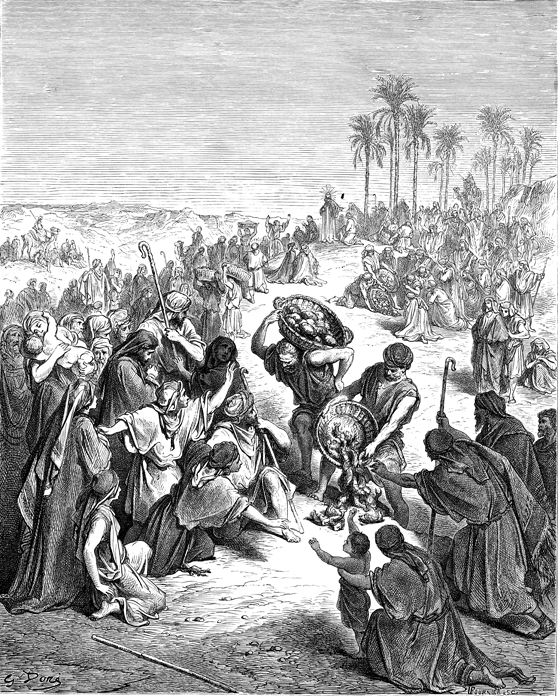
In the case of the five loaves a miracle of the same type excites our wonder. By their increase five thousand men and countless women and children are saved from hunger; the method eludes our powers of observation. Five loaves are offered and broken; while the Apostles are dividing them a succession of new-created portions passes, they cannot tell how, through their hands. The loaf which they are dividing grows no smaller, yet their hands are continually full of the pieces. The swiftness of the process baffles sight; you follow with the eye a hand full of portions, and meantime you see that the contents of the other hand are not diminished, and all the while the heap of pieces grows. The carvers are busy at their task, the eaters are hard at work; the hungry are satisfied, and the fragments fill twelve baskets. Sight or sense cannot discover the mode of so noteworthy a miracle. What was not existent is created; what we see passes our understanding. Our only resource is faith in God's omnipotence.
A commentator
Cyril of AlexandriaCommentary on the Gospel of John, Book 3 · Written before 444.
proposed
CHAPTER IV. That oftentimes the departures of Christ from Jerusalem signify the transferring of His grace to the Gentiles: wherein is also the discourse of the five barley loaves and the two little fishes. First I think it needful to tell my hearers, that the Lord evidently did not make His departures from Jerusalem without some most necessary reason. There is an economy on almost every occasion, and on the nature of things, as on a tablet, He inscribes mysteries. Of what nature then is the intent of the departure, and what is signified thereby, we will make manifest in its proper time, the chapters before us having reached their termination. For having divided every thing into sections, and interpreted what is profitable out of the Scriptures, and so set them before our readers for their understanding, we will offer the final consideration of the whole, epitomising in a summary what has been said in many portions. But I think we ought to speak first on what is now before us. After these things (saith he) Jesus departed across the sea of Tiberias. After what things, must be sought not negligently. Christ then was manifested in Jerusalem as a wondrous Physician. He had healed the man who had been thirty and eight years in his infirmity, not by giving him any medicine, not by devising any disease-repelling remedy, but rather by a word, as God, by Almighty Authority and God-befitting beck: for Arise (saith He) take up thy bed, and go unto thy house. But since it was the sabbath, the Jews are ignorantly angry, who were sick with the grossness of the letter, who more than he, were bound by the folly that was their foster brother, who were sick of the listless want of all good things alike, who were paralytic in mind and enfeebled in habit, to whom might with reason be said, Strengthen ye, ye weak hands and ye palsied knees. […]
A commentator
Cyril of AlexandriaCommentary on the Gospel of John, Book 3 · Written before 444.
proposed
[If] our enemies persecute us, it is possible for us to behave well towards them by leaving them for a time, even when there is no harm in remaining. By evading their attacks and avoiding their rage, we may find that their anger abates and thus we may undercut the boldness of their arrogance.… To do the work of love then is not necessarily enduring those who wish us evil, nor to remain among one's enemies, causing them to become even more bitter and angry because they are unable to soften our opposition. Love then, as Paul says, "does not insist on its own way," and this was [certainly true] in Christ.
Beloved, let us not contend with violent men, but learn when the doing so brings no hurt to our virtue to give place to their evil counsels; for so all their hardihood is checked. As darts when they fall upon a firm, hard, and resisting substance, rebound with great violence on those who throw them, but when the violence of the cast hath nothing to oppose it, it soon becometh weaker and ceaseth, so is it with insolent men; when we contend with them they become the fiercer, but when we yield and give ground, we easily abate all their madness. Wherefore the Lord when He knew that the Pharisees had heard "that Jesus made and baptized more disciples than John," went into Galilee, to quench their envy, and to soften by His retirement the wrath which was likely to be engendered by these reports.
The Medieval Church5 voices
In the preceding chapter the Lord showed Himself as healer; in this part He shows Himself as preserver. And because He is the preserver of bodies and of spirits, and through visible things one arrives at invisible things: first He shows Himself as preserver of …
The Evangelist has presented the teaching of Christ on the spiritual life, by which he gives life to those who are born again. He now tells us of the spiritual food by which Christ sustains those to whom he has given life. First, he describes …
Mystically, the sea signifies this tumultuous world. In the fulness of time, when Christ had entered the sea of our mortality by His birth, trodden it by His death, passed over it by His resurrection, then followed Him crowds of believers, both from the Jews and Gentiles.
This sea hath different names, from the different places with which it is connected; the sea of Galilee, from the province; the sea of Tiberias, from the city of that name. It is called a sea, though it is not salt water, that name being applied to all large pieces of water, in Hebrew. This sea our Lord often passes over, in going to preach to the people bordering on it.
The Lord, after a stern speech to the Jews which aroused envy and anger in them, calms them by withdrawing from them and goes to the other side of the Sea of Tiberias. He calls the lake a sea because Divine Scripture "called the gatherings …
The Reformation1 voice
But he does so for the express purpose of passing from them to Christ's sermon, which was delivered next day at Capernaum, because the two things were connected; and therefore this narrative, though the other three Evangelists have it in common with him, has this peculiarity, that it is directed to another object, as we shall see.
The Puritans and the Awakening1 voice
Christ did not go directly over cross this inland sea, but made a coasting voyage to another place on the same side. It is not tempting God to choose to go by water, when there is convenience for it, even to those places whither we might go by land; for Christ never tempted the Lord his God, Matt. iv.
The Nineteenth Century4 voices
A commentator
Albert Barnes1798–1870
Notes, Explanatory and Practical, on the Old and New Testaments (1832-1869)
Jesus went over - Went to the east side of the sea. The place to which he went was Bethsaida, Luk 9:10. The account of this miracle of feeding the five thousand is recorded also in Mat 14:13-21; Mar 6:32-44; Luk 9:10-17. John has added a few circumstances omitted by the other evangelists.
A commentator
J.C. Ryle1816–1900
Expository Thoughts on the Gospels: John (lightly modernized text, Grace Gems edition) (1869)
These verses describe one of our Lord's most remarkable miracles. Of all the great works that He did, none was done so publicly as this, and before so many witnesses. Of all the miracles related in the Gospels, this is the only one which all the four Gospel-writers alike record. This fact alone (like the four times repeated account of the crucifixion and resurrection) is enough to show that it is a miracle demanding special attention. We have, for one thing, in this miracle, a lesson about Christ's almighty power.
A commentator
J.C. Ryle1816–1900
Expository Thoughts on the Gospels: John (lightly modernized text, Grace Gems edition) (1869)
proposed
These verses describe one of our Lord's most remarkable miracles. Of all the great works that He did, none was done so publicly as this, and before so many witnesses. Of all the miracles related in the Gospels, this is the only one which all the four Gospel-writers alike record. This fact alone (like the four times repeated account of the crucifixion and resurrection) is enough to show that it is a miracle demanding special attention. We have, for one thing, in this miracle, a lesson about Christ's almighty power. We see our Lord feeding five thousand men with "five barley loaves and two small fish." We see clear proof that a miraculous event took place in the "twelve baskets of fragments" that remained after all had eaten. Creative power was manifestly exercised. Food was called into existence that did not exist before. In healing the sick, and raising the dead, something was amended or restored that had already existed. In feeding five thousand men with five loaves, something must have been created which before had no existence. Such a history as this ought to be specially instructive and encouraging to all who endeavor to do good to souls. It shows us the Lord Jesus "able to save to the uttermost." He is One who has all power over dead hearts. Not only can He mend that which is broken—build up that which is ruined—heal that which is sick—strengthen that which is weak. He can do even greater things than these. He can call into being that which was not before, and call it out of nothing. We must never despair of any one being saved. So long as there is life there is hope. Reason and sense may say that some poor sinner is too hardened, or too old to be converted. Faith will reply—"Our Master can create as well as renew . With a Savior who, by His Spirit, can create a new heart, nothing is impossible."
After these things - This is a sort of indefinite expression, from which me can gather nothing relative to the time in which these things happened. It refers no doubt to transactions in the preceding year. Jesus went over the sea of Galilee - Or, as some translate the words, by the side of the sea of Galilee. From Luke, Luk 9:10, we learn that this was a desert place in the vicinity of Bethsaida. The sea of Galilee, Genesaret, and Tiberias, are the same in the New Testament with the sea of Cinnereth in the Old. Tiberias was a city in Galilee, situated on the western side of the lake. See on Joh 6:22 (note).
The words behind it
12 Greek wordsEvery Greek word of this verse in the order it stands, with what it means and the door to its own study. The last column counts the times a word stands in the whole Bible: the rarer the word, the more the places it appears belong together.
| Greek | Sound | Meaning | Word study | In the Bible |
|---|---|---|---|---|
| Μετὰ | meta | After | G3326 → | 461 times |
| ταῦτα | tauta | these things | G3778 → | 1381 times |
| ἀπῆλθεν | apelthen | went away | G565 → | 115 times |
| ὁ | ho | <the> | G3588 → | 19766 times |
| Ἰησοῦς | iesous | Jesus | G2424 → | 908 times |
| πέραν | peran | over | G4008 → | 23 times |
| τῆς | tes | the | G3588 → | 19766 times |
| θαλάσσης | thalasses | Sea | G2281 → | 90 times |
| τῆς | tes | <the> | G3588 → | 19766 times |
| Γαλιλαίας | galilaias | of Galilee — | G1056 → | 61 times |
| τῆς | tes | <the> | G3588 → | 19766 times |
| Τιβεριάδος. | tiberiados | of Tiberias. | G5085 → | 3 times |
ΜετὰAfter
metaG3326 →461 times
ταῦταthese things
tautaG3778 →1381 times
ἀπῆλθενwent away
apelthenG565 →115 times
ὁ<the>
hoG3588 →19766 times
ἸησοῦςJesus
iesousG2424 →908 times
πέρανover
peranG4008 →23 times
τῆςthe
tesG3588 →19766 times
θαλάσσηςSea
thalassesG2281 →90 times
τῆς<the>
tesG3588 →19766 times
Γαλιλαίαςof Galilee —
galilaiasG1056 →61 times
τῆς<the>
tesG3588 →19766 times
Τιβεριάδος.of Tiberias.
tiberiadosG5085 →3 times
A shaded row is a word that stands 400 times or fewer in the Bible.
The walk
8 stopsEach card is a verse this one points to, and under it the verses that one points to in turn. Where several paths arrive at the same place, that place is listed first: the text keeps returning to it.
Through
Luke 5:1On one occasion, while Jesus was standing by the Lake of Gennesaret with the crowd pressing in on Him to hear the word of God,
it leads to
- Mark 1:16–20
As Jesus was walking beside the Sea of Galilee, He saw Simon and his brother Andrew. They were casting a net into the sea, for they were fishermen.
Reached by 2 separate paths from here.
- Matthew 4:18–22
As Jesus was walking beside the Sea of Galilee, He saw two brothers, Simon called Peter and his brother Andrew. They were casting a net into the sea, for they were fishermen.
- Mark 3:9
Jesus asked His disciples to have a boat ready for Him so that the crowd would not crush Him.
- Matthew 14:34
When they had crossed over, they landed at Gennesaret.
- Mark 1:16–20
Through
Matthew 4:18As Jesus was walking beside the Sea of Galilee, He saw two brothers, Simon called Peter and his brother Andrew. They were casting a net into the sea, for they were fishermen.
it leads to
- John 1:40–42
Andrew, Simon Peter’s brother, was one of the two who heard John’s testimony and followed Jesus.
- Matthew 10:2
These are the names of the twelve apostles: first Simon, called Peter, and his brother Andrew; James son of Zebedee, and his brother John;
- Luke 6:14
Simon, whom He named Peter, and his brother Andrew; James and John; Philip and Bartholomew;
- Matthew 16:18
And I tell you that you are Peter, and on this rock I will build My church, and the gates of Hades will not prevail against it.
- John 1:40–42
Where this verse is studied
On this page
Studies15
- Bread
- Eternal Life
- Eternal Security, and the Five Warnings of Hebrews
- Feeding the Five Thousand, John 6:1-15
- Why He Said He Came
- Jesus on Himself
- Manna
- Names of God
- Predestination and Election
- The Seven Signs: John's Book of Signs
- The Tabernacle
- The Bride & the Jewish Wedding
- The Father's Will
- The Seal & the Signet
- Walking on Water: Matthew 14:22-33
About John
This page draws on 19 works. Open the list of works
This page draws on Adam Clarke, Commentary on the Bible; Albert Barnes, Notes, Explanatory and Practical, on the Gospels; Albert Barnes, Notes, Explanatory and Practical, on the Old and New Testaments (1832-1869); Alcuin of York, Catena Aurea by Aquinas; Augustine of Hippo, Catena Aurea by Aquinas; Augustine of Hippo, Tractates on John 24; Bonaventure, Commentary on John, Chapter 6; Brooke Foss Westcott, The Gospel according to St. John; Cyril of Alexandria, Commentary on the Gospel of John, Book 3; Hilary of Poitiers, On the Trinity, Book 3.6; Irenaeus, Irenaeus Against Heresies Book 2; J.C. Ryle, Expository Thoughts on the Gospels: John (lightly modernized text, Grace Gems edition); John Calvin, Commentaries; John Chrysostom, Homily on the Gospel of John 42; John Gill, Exposition of the New Testament (1746-1748); Matthew Henry, Commentary on the Whole Bible; Theodore of Mopsuestia, COMMENTARY ON JOHN 3.6.1; Theophylact of Ohrid, Commentary on John and Thomas Aquinas, Commentary on John.