
John 6:5
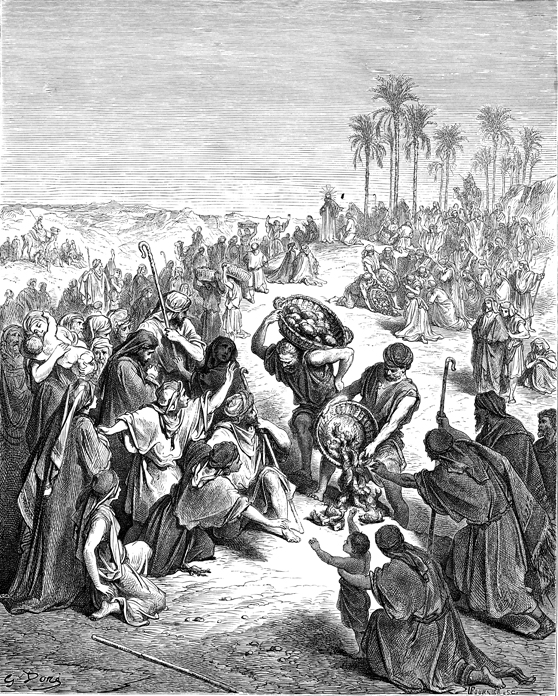
in John 6When Jesus looked up and saw a large crowd coming toward Him, He said to Philip, “Where can we buy bread for these people to eat?”
BSB
The same verse in ASV and KJV ▾
ASV
Jesus therefore lifting up his eyes, and seeing that a great multitude cometh unto him, saith unto Philip, Whence are we to buy bread, that these may eat?
KJV
When Jesus then lifted up his eyes, and saw a great company come unto him, he saith unto Philip, Whence shall we buy bread, that these may eat?
⋯
This verse in John 6
Commentary
16 notes on this verseA lesson most excellent did Christ again devise for His disciples, and fittest for the most holy men, both persuading them in utter straits to overcome cowardice in respect of hospitality, and to cast far away hesitation hereto, rather with more zealous motions to attain unto the virtue thereof. For what is there greater than this among those who know and will the things whereby it befitteth to purchase unto themselves the friendship from above?
This site's exposition
Where can we buy bread
on John 6:5-7
Jesus puts the question to Philip, Where can we buy bread, and John says that He already knew what He was about to do. The question tests Philip. Philip answers with arithmetic, two hundred denarii, about eight months of a laborer's daily pay, still short of a small piece each.
The record, by era
The Church Fathers3 voices
(de Con. Evang. l. ii. c. xlvi) But if our Lord, according to John's account, on seeing the multitude, asked Philip, tempting him, whence they could buy food for them, it is difficult at first to see how it can be true, according to the other account, that the disciples first told our Lord, to send away the multitude; and that our Lord replied, They need not depart; give ye them to eat. (Matt. 25:16) We must understand then it was after saying this, that our Lord saw the multitude, and said to Philip what John had related, which has been omitted by the rest.
Wherefore then doth He ask "Philip"? He knew which of His disciples needed most instruction; for this is he who afterwards said, "Show us the Father, and it sufficeth us", and on this account Jesus was beforehand bringing him into a proper state. For had the miracle simply been done, without any introduction, the marvel would not have seemed so great, but now He beforehand constraineth him to confess the existing want, that knowing the state of matters he might be the more exactly acquainted with the magnitude of the miracle about to take place.
"And as He lifted up His eyes, He beheld a great company." This showeth that He sat not at any time idly with the disciples, but perhaps carefully conversing with them, and making them attend and turn towards Him, a thing which peculiarly marks His tender care, and the humility and condescension of His demeanor towards them. For they sat with Him, perhaps looking at one another; then having lifted up His eyes, He beheld the multitudes coming unto Him.
The Medieval Church2 voices
He asks him this question, not for His own information, but in order to show His yet unformed disciple his dulness of mind, which he could not perceive of himself.
And the Lord's eyes are spiritual gifts, which he mercifully bestows on His Elect. He turns His eyes upon them, i. e. has compassionate respect unto them.
9 more voices on this verse
The Medieval Church4 voices
If we compare the accounts of the different Evangelists, we shall find very clearly, that there was an interval of a year between the beheading of John, and our Lord's Passion. For, since Matthew says that our Lord, on hearing of the death of John, withdrew into a desert place, where He fed the multitude; and John says that the Passover was nigh, when He fed the multitude; it is evident that John was beheaded shortly before the Passover. And at the same feast, the next year Christ suffered. It follows, When Jesus then lifted up His eyes, and saw a great company come unto Him, He saith unto Philip, Whence shall we buy bread, that these may eat? When Jesus lifted up His eyes, this is to show us, that Jesus was not generally with His eyes lifted up, looking about Him, but sitting calm and attentive, surrounded by His disciples.
Then he considers the miracle itself (v 5). First, why it was needed. Secondly, its accomplishment. We can see the need for this miracle from our Lord's question to his disciple, and the disciple's answer. First, our Lord's question is given; and then the answer …
Why is it said "Jesus, lifting up His eyes"? So that we may know that His eyes were not wandering here and there, but He was sitting with awareness and attention and concentration, conversing with the disciples about divine matters, and finally looked up with …
"When therefore Jesus had lifted up his eyes" — here is noted the third occasion, namely the lack of money to buy food with which so great a multitude might be fed; and to make this lack manifest, the Lord asks Philip about the price. …
The Puritans and the Awakening2 voices
When Jesus then lift up his eyes,.... Being before engaged in close conversation with his disciples, and looking wistly and intently on them, whilst he was discoursing with them: and saw a great company come unto him; who came on foot, over the bridge at Chammath, from Capernaum, and other cities of Galilee: he saith unto Philip; he directed his discourse to him particularly, because he was of Bethsaida, near to which place Christ now was, and therefore might be best able to answer the following question: whence shall we buy bread, that these may eat?
Philip was of Bethsaida, in the neighbourhood of which town Christ now was, and therefore he was most likely to help them to provision at the best hand; and probably much of the company was known to him, and he was concerned for them. Now Christ asked, Whence shall we buy bread, that these may eat?
The Nineteenth Century3 voices
Saw a great company - See this miracle explained at large on Mat 14:13 (note), etc.; Mar 6:31 (note), etc.; Luk 9:10 (note), etc. In speaking of the passovers, and various other matters, it does not appear that John follows any strict chronological order. From Joh 6:15, it appears that our Lord had come down from the mountain, and fed the multitudes in a plain at the foot of it. Saith unto Philip - This, with what follows, to the end of the seventh verse, is not mentioned by any of the other evangelists.
A commentator
J.C. Ryle1816–1900
Expository Thoughts on the Gospels: John (lightly modernized text, Grace Gems edition) (1869)
These verses describe one of our Lord's most remarkable miracles. Of all the great works that He did, none was done so publicly as this, and before so many witnesses. Of all the miracles related in the Gospels, this is the only one which all the four Gospel-writers alike record. This fact alone (like the four times repeated account of the crucifixion and resurrection) is enough to show that it is a miracle demanding special attention. We have, for one thing, in this miracle, a lesson about Christ's almighty power.
A commentator
J.C. Ryle1816–1900
Expository Thoughts on the Gospels: John (lightly modernized text, Grace Gems edition) (1869)
proposed
These verses describe one of our Lord's most remarkable miracles. Of all the great works that He did, none was done so publicly as this, and before so many witnesses. Of all the miracles related in the Gospels, this is the only one which all the four Gospel-writers alike record. This fact alone (like the four times repeated account of the crucifixion and resurrection) is enough to show that it is a miracle demanding special attention. We have, for one thing, in this miracle, a lesson about Christ's almighty power. We see our Lord feeding five thousand men with "five barley loaves and two small fish." We see clear proof that a miraculous event took place in the "twelve baskets of fragments" that remained after all had eaten. Creative power was manifestly exercised. Food was called into existence that did not exist before. In healing the sick, and raising the dead, something was amended or restored that had already existed. In feeding five thousand men with five loaves, something must have been created which before had no existence. Such a history as this ought to be specially instructive and encouraging to all who endeavor to do good to souls. It shows us the Lord Jesus "able to save to the uttermost." He is One who has all power over dead hearts. Not only can He mend that which is broken—build up that which is ruined—heal that which is sick—strengthen that which is weak. He can do even greater things than these. He can call into being that which was not before, and call it out of nothing. We must never despair of any one being saved. So long as there is life there is hope. Reason and sense may say that some poor sinner is too hardened, or too old to be converted. Faith will reply—"Our Master can create as well as renew . With a Savior who, by His Spirit, can create a new heart, nothing is impossible."
The words behind it
23 Greek wordsEvery Greek word of this verse in the order it stands, with what it means and the door to its own study. The last column counts the times a word stands in the whole Bible: the rarer the word, the more the places it appears belong together.
| Greek | Sound | Meaning | Word study | In the Bible |
|---|---|---|---|---|
| Ἐπάρας | eparas | Having lifted up | G1869 → | 19 times |
| οὖν | oun | then | G3767 → | 497 times |
| τοὺς | tous | the | G3588 → | 19766 times |
| ὀφθαλμοὺς | ophthalmous | eyes | G3788 → | 100 times |
| ὁ | ho | <the> | G3588 → | 19766 times |
| Ἰησοῦς | iesous | Jesus | G2424 → | 908 times |
| καὶ | kai | and | G2532 → | 9120 times |
| θεασάμενος | theasamenos | having seen | G2300 → | 20 times |
| ὅτι | hoti | that | G3754 → | 1292 times |
| πολὺς | polus | a great | G4183 → | 367 times |
| ὄχλος | ochlos | crowd | G3793 → | 175 times |
| ἔρχεται | erchetai | is coming | G2064 → | 628 times |
| πρὸς | pros | to | G4314 → | 700 times |
| αὐτὸν | auton | Him | G846 → | 5565 times |
| λέγει | legei | He says | G3004 → | 1325 times |
| πρὸς | pros | to | G4314 → | 700 times |
| Φίλιππον· | philippon | Philip; | G5376 → | 36 times |
| πόθεν | pothen | From where | G4159 → | 29 times |
| ἀγοράσωμεν | agorasomen | we may buy | G59 → | 30 times |
| ἄρτους, | artous | bread | G740 → | 97 times |
| ἵνα | ina | that | G2443 → | 668 times |
| φάγωσιν | phagosin | may eat | G5315 → | 93 times |
| οὗτοι; | houtoi | these? | G3778 → | 1381 times |
ἘπάραςHaving lifted up
eparasG1869 →19 times
οὖνthen
ounG3767 →497 times
τοὺςthe
tousG3588 →19766 times
ὀφθαλμοὺςeyes
ophthalmousG3788 →100 times
ὁ<the>
hoG3588 →19766 times
ἸησοῦςJesus
iesousG2424 →908 times
καὶand
kaiG2532 →9120 times
θεασάμενοςhaving seen
theasamenosG2300 →20 times
ὅτιthat
hotiG3754 →1292 times
πολὺςa great
polusG4183 →367 times
ὄχλοςcrowd
ochlosG3793 →175 times
ἔρχεταιis coming
erchetaiG2064 →628 times
πρὸςto
prosG4314 →700 times
αὐτὸνHim
autonG846 →5565 times
λέγειHe says
legeiG3004 →1325 times
πρὸςto
prosG4314 →700 times
Φίλιππον·Philip;
philipponG5376 →36 times
πόθενFrom where
pothenG4159 →29 times
ἀγοράσωμενwe may buy
agorasomenG59 →30 times
ἄρτους,bread
artousG740 →97 times
ἵναthat
inaG2443 →668 times
φάγωσινmay eat
phagosinG5315 →93 times
οὗτοι;these?
houtoiG3778 →1381 times
A shaded row is a word that stands 400 times or fewer in the Bible.
The walk
8 stopsEach card is a verse this one points to, and under it the verses that one points to in turn. Where several paths arrive at the same place, that place is listed first: the text keeps returning to it.
Through
John 4:35Do you not say, ‘There are still four months until the harvest’? I tell you, lift up your eyes and look at the fields, for they are ripe for harvest.
it leads to
- Luke 10:2–3
And He told them, “The harvest is plentiful, but the workers are few. Ask the Lord of the harvest, therefore, to send out workers into His harvest.
- Matthew 9:37–38
Then He said to His disciples, “The harvest is plentiful, but the workers are few.
- Luke 10:2–3
Through
John 1:43The next day Jesus decided to set out for Galilee. Finding Philip, He told him, “Follow Me.”
it leads to
- Matthew 9:9
As Jesus went on from there, He saw a man named Matthew sitting at the tax booth. “Follow Me,” He told him, and Matthew got up and followed Him.
- John 14:8
Philip said to Him, “Lord, show us the Father, and that will be enough for us.”
- Isaiah 65:1
“I revealed Myself to those who did not ask for Me; I was found by those who did not seek Me. To a nation that did not call My name, I said, ‘Here I…
- Matthew 4:18–21
As Jesus was walking beside the Sea of Galilee, He saw two brothers, Simon called Peter and his brother Andrew. They were casting a net into the sea, for they were fishermen.
- John 12:21
They came to Philip, who was from Bethsaida in Galilee, and requested of him, “Sir, we want to see Jesus.”
- Matthew 9:9
Through
Matthew 15:33The disciples replied, “Where in this desolate place could we find enough bread to feed such a large crowd?”
it leads to
- Mark 6:37
But Jesus told them, “You give them something to eat.” They asked Him, “Should we go out and spend two hundred denarii to give all of them bread to eat?”
- Mark 6:37
Where this verse is studied
On this page
Studies28
- Bread
- The Bronze Serpent
- Cut Off from Among His People
- Eternal Life
- Eternal Security, and the Five Warnings of Hebrews
- Feeding the Five Thousand, John 6:1-15
Show the next 6 titles
Show the next 6 titles
About John
Who and where
1 name in this verse with a page on the site.
This page draws on 13 works. Open the list of works
This page draws on Adam Clarke, Commentary on the Bible; Alcuin of York, Catena Aurea by Aquinas; Augustine of Hippo, Catena Aurea by Aquinas; Bede, Catena Aurea by Aquinas; Bonaventure, Commentary on John, Chapter 6; Cyril of Alexandria, Commentary on the Gospel of John, Book 3; J. C. Ryle, Expository Thoughts on the Gospels, John; J.C. Ryle, Expository Thoughts on the Gospels: John (lightly modernized text, Grace Gems edition); John Chrysostom, Homily on the Gospel of John 42; John Gill, Exposition of the New Testament (1746-1748); Matthew Henry, Commentary on the Whole Bible; Theophylact of Ohrid, Commentary on John and Thomas Aquinas, Commentary on John.