
John 6:14
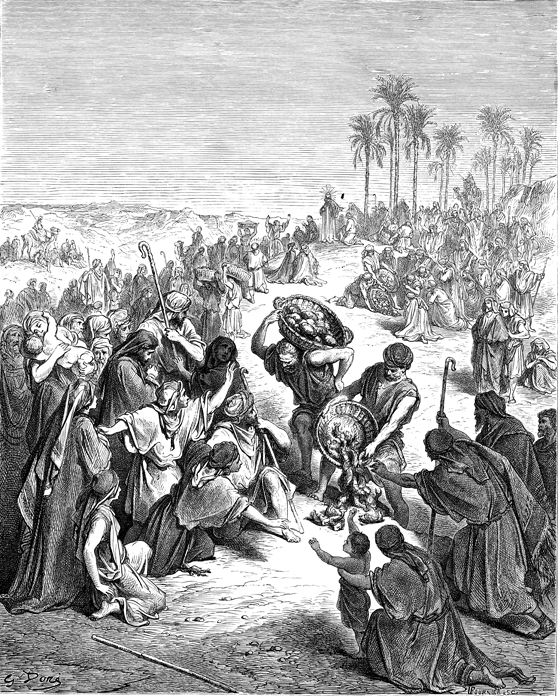
in John 6When the people saw the sign that Jesus had performed, they began to say, “Truly this is the Prophet who is to come into the world.”
BSB
The same verse in ASV and KJV ▾
ASV
When therefore the people saw the sign which he did, they said, This is of a truth the prophet that cometh into the world.
KJV
Then those men, when they had seen the miracle that Jesus did, said, This is of a truth that prophet that should come into the world.
⋯
This verse in John 6
Commentary
17 notes on this verseThis is of a truth that prophet - Spoken of, Deu 18:15, viz. the Messiah. How near were these people at this time to the kingdom of heaven!
This site's exposition
the Prophet who is to come into the world
on John 6:14-15
The Prophet who is to come is the promise of Deuteronomy 18:15, a prophet like Moses. The crowd reads the sign rightly and then moves to make Him king by force, a crown held out on their own terms. Jesus withdrew to the mountain alone.
The record, by era
The Church Fathers5 voices
(Tr. xxiv. s. 7) Christ is a Prophet, and the Lord of Prophets; as He is an Angel, and the Lord of Angels. In that He came to announce something, He was an Angel; in that He foretold the future, He was a Prophet; in that He was the Word made flesh, He was Lord both of Angels and Prophets; for none can be a Prophet without the word of God.
Now those men having seen the miracle, said, "This is truly the prophet that is coming into the world:" for perhaps this prophet was meant as one in the nature of Moses. For the Lord had said to Moses, "A prophet will I raise up to them from among their brethren like unto thee." Like, namely, in respect of the flesh, not of majesty. And, indeed, this saying of Moses will be found more fully explained in the gospel, when our Lord spoke of His own words being unbelieved: "If ye believed Moses, ye would believe me; for he wrote of me." It was then, "like unto thee:" Moses fed the people in the desert with manna: this prophet fed the people in the desert with bread; and more bread. The miracle was increased, the prophecy was approved.
Thus, when they were satisfied, they saw that he had fed them in the wilderness, as Moses [had done] with prayer, and they cried out, saying, "This is the prophet about whom it was said that he is coming into the world." They were repeating …
"And the multitudes said, that this is of a truth The Prophet." Oh, excess of gluttony! He had done ten thousand things more admirable than this, but nowhere did they make this confession, save when they had been filled. Yet hence it is evident that they expected some remarkable prophet; for those others had said (to John), "Art thou that Prophet?" while these say, "This is that Prophet."
A commentator
Cyril of AlexandriaCommentary on the Gospel of John, Book 3 · Written before 444.
proposed
They marvel at the sign who know how to approve things God-befitting, and regulate themselves by human reason rather than are diseased with unreason befitting the beasts, as were the blasphemous Jews, who, when they ought to have profited by the publicity of the things wrought, lost even the power of right judgment. For they deemed that Jesus ought now to be stoned also, because He so often appeared as a Worker of miracles.
10 more voices on this verse
The Medieval Church5 voices
Look how the people love their belly. While Jesus performed countless and most astonishing miracles, they were not amazed. But because of food they say, "This is that Prophet." They no longer accuse Him of breaking the Sabbath, they no longer seek revenge for violating …
Above were described the antecedents to the wondrous feeding and the accompanying circumstances: here are described the consequences, which are four, namely the devotion of the crowds to honor Christ; the hiding of the Lord to flee honor; the descent of the disciples to cross …
Their faith being as yet weak, they only call our Lord a Prophet, not knowing that He was God. But the miracle had produced considerable effect upon them, as it made them call our Lord that Prophet, singling Him out from the rest. They call Him a Prophet, because some of the Prophets had worked miracles; and properly, inasmuch as our Lord calls Himself a Prophet; It cannot be that a prophet perish out of Jerusalem. (Luke 13:33)
Above, the Evangelist told us of the miracle of the loaves and fishes. Now he shows the threefold effect this miracle had on the people. First, its effect on their faith; secondly, on their plans to honor Jesus; thirdly, how it led them (and the …
When the multitude saw the miracle our Lord had done, they marvelled; as they did not know yet that He was God. Then those men, the Evangelist adds, i. e. carnal men, whose understanding was carnal, when they had perceived the miracle that Jesus did, said, This is of a truth that Prophet that should come into the world.
The Puritans and the Awakening2 voices
The Pharisees despised them as not knowing the law; but, it should seem, they knew more of him that is the end of the law than the Pharisees did. The miracles which Christ wrought did clearly demonstrate that he was the Messiah promised, a teacher come from God, the great prophet, and could not but convince the amazed spectators that this was he that should come.
Then those men,....
The Nineteenth Century3 voices
A commentator
J.C. Ryle1816–1900
Expository Thoughts on the Gospels: John (lightly modernized text, Grace Gems edition) (1869)
These verses describe one of our Lord's most remarkable miracles. Of all the great works that He did, none was done so publicly as this, and before so many witnesses. Of all the miracles related in the Gospels, this is the only one which all the four Gospel-writers alike record. This fact alone (like the four times repeated account of the crucifixion and resurrection) is enough to show that it is a miracle demanding special attention. We have, for one thing, in this miracle, a lesson about Christ's almighty power.
A commentator
J.C. Ryle1816–1900
Expository Thoughts on the Gospels: John (lightly modernized text, Grace Gems edition) (1869)
proposed
These verses describe one of our Lord's most remarkable miracles. Of all the great works that He did, none was done so publicly as this, and before so many witnesses. Of all the miracles related in the Gospels, this is the only one which all the four Gospel-writers alike record. This fact alone (like the four times repeated account of the crucifixion and resurrection) is enough to show that it is a miracle demanding special attention. We have, for one thing, in this miracle, a lesson about Christ's almighty power. We see our Lord feeding five thousand men with "five barley loaves and two small fish." We see clear proof that a miraculous event took place in the "twelve baskets of fragments" that remained after all had eaten. Creative power was manifestly exercised. Food was called into existence that did not exist before. In healing the sick, and raising the dead, something was amended or restored that had already existed. In feeding five thousand men with five loaves, something must have been created which before had no existence. Such a history as this ought to be specially instructive and encouraging to all who endeavor to do good to souls. It shows us the Lord Jesus "able to save to the uttermost." He is One who has all power over dead hearts. Not only can He mend that which is broken—build up that which is ruined—heal that which is sick—strengthen that which is weak. He can do even greater things than these. He can call into being that which was not before, and call it out of nothing. We must never despair of any one being saved. So long as there is life there is hope. Reason and sense may say that some poor sinner is too hardened, or too old to be converted. Faith will reply—"Our Master can create as well as renew . With a Savior who, by His Spirit, can create a new heart, nothing is impossible."
A commentator
Albert Barnes1798–1870
Notes, Explanatory and Practical, on the Old and New Testaments (1832-1869)
proposed
That Prophet ... - The Messiah. The power to work the miracle, and the benevolence manifested in it, showed that he was the long-expected Messiah.
The words behind it
19 Greek wordsEvery Greek word of this verse in the order it stands, with what it means and the door to its own study. The last column counts the times a word stands in the whole Bible: the rarer the word, the more the places it appears belong together.
| Greek | Sound | Meaning | Word study | In the Bible |
|---|---|---|---|---|
| Οἱ | hoi | The | G3588 → | 19766 times |
| οὖν | oun | therefore | G3767 → | 497 times |
| ἄνθρωποι | anthropoi | people | G444 → | 549 times |
| ἰδόντες | idontes | having seen | G1492 → | 374 times |
| ὃ | ho | what | G3739 → | 1405 times |
| ἐποίησεν | epoiesen | He had done | G4160 → | 569 times |
| σημεῖον | semeion | sign | G4592 → | 75 times |
| ἔλεγον | elegon | were saying | G3004 → | 1325 times |
| ὅτι | hoti | that | G3754 → | 1292 times |
| οὗτός | houtos | This | G3778 → | 1381 times |
| ἐστιν | estin | is | G1510 → | 2333 times |
| ἀληθῶς | alethos | truly | G230 → | 18 times |
| ὁ | ho | the | G3588 → | 19766 times |
| προφήτης | prophetes | prophet | G4396 → | 144 times |
| ὁ | ho | who | G3588 → | 19766 times |
| ἐρχόμενος | erchomenos | is coming | G2064 → | 628 times |
| εἰς | eis | into | G1519 → | 1755 times |
| τὸν | ton | the | G3588 → | 19766 times |
| κόσμον.¶ | kosmon | world. | G2889 → | 185 times |
ΟἱThe
hoiG3588 →19766 times
οὖνtherefore
ounG3767 →497 times
ἄνθρωποιpeople
anthropoiG444 →549 times
ἰδόντεςhaving seen
idontesG1492 →374 times
ὃwhat
hoG3739 →1405 times
ἐποίησενHe had done
epoiesenG4160 →569 times
σημεῖονsign
semeionG4592 →75 times
ἔλεγονwere saying
elegonG3004 →1325 times
ὅτιthat
hotiG3754 →1292 times
οὗτόςThis
houtosG3778 →1381 times
ἐστινis
estinG1510 →2333 times
ἀληθῶςtruly
alethosG230 →18 times
ὁthe
hoG3588 →19766 times
προφήτηςprophet
prophetesG4396 →144 times
ὁwho
hoG3588 →19766 times
ἐρχόμενοςis coming
erchomenosG2064 →628 times
εἰςinto
eisG1519 →1755 times
τὸνthe
tonG3588 →19766 times
κόσμον.¶world.
kosmonG2889 →185 times
A shaded row is a word that stands 400 times or fewer in the Bible.
The walk
8 stopsEach card is a verse this one points to, and under it the verses that one points to in turn. Where several paths arrive at the same place, that place is listed first: the text keeps returning to it.
Through
Acts 7:37This is the same Moses who told the Israelites, ‘God will raise up for you a prophet like me from among your brothers.’
it leads to
- Deuteronomy 18:15–19
The LORD your God will raise up for you a prophet like me from among your brothers. You must listen to him.
Reached by 2 separate paths from here.
- Acts 3:22–23
For Moses said, ‘The Lord your God will raise up for you a prophet like me from among your brothers. You must listen to Him in everything He tells you.
- John 18:37
“Then You are a king!” Pilate said. “You say that I am a king,” Jesus answered. “For this reason I was born and have come into the world, to testify to the truth. Everyone…
- Acts 7:38
He was in the assembly in the wilderness with the angel who spoke to him on Mount Sinai, and with our fathers. And he received living words to pass on to us.
- Deuteronomy 18:15–19
Through
Matthew 21:11The crowds replied, “This is Jesus, the prophet from Nazareth in Galilee.”
it leads to
- John 7:40
On hearing these words, some of the people said, “This is truly the Prophet.”
- Luke 7:16
A sense of awe swept over all of them, and they glorified God. “A great prophet has appeared among us!” they said. “God has visited His people!”
- Acts 7:37
This is the same Moses who told the Israelites, ‘God will raise up for you a prophet like me from among your brothers.’
- Matthew 2:23
and he went and lived in a town called Nazareth. So was fulfilled what was spoken through the prophets: “He will be called a Nazarene.”
- John 7:40
Where this verse is studied
On this page
Studies15
On this verse
On this chapter
About John
This page draws on 17 works. Open the list of works
This page draws on Adam Clarke, Commentary on the Bible; Albert Barnes, Notes, Explanatory and Practical, on the Gospels; Albert Barnes, Notes, Explanatory and Practical, on the Old and New Testaments (1832-1869); Alcuin of York, Catena Aurea by Aquinas; Augustine of Hippo, Catena Aurea by Aquinas; Augustine of Hippo, Tractates on John 24; Bede, Catena Aurea by Aquinas; Bonaventure, Commentary on John, Chapter 6; Cyril of Alexandria, Commentary on the Gospel of John, Book 3; Ephrem the Syrian, COMMENTARY ON TATIAN'S DIATESSARON 12.5; J. C. Ryle, Expository Thoughts on the Gospels, John; J.C. Ryle, Expository Thoughts on the Gospels: John (lightly modernized text, Grace Gems edition); John Chrysostom, Homily on the Gospel of John 42; John Gill, Exposition of the New Testament (1746-1748); Matthew Henry, Commentary on the Whole Bible; Theophylact of Ohrid, Commentary on John and Thomas Aquinas, Commentary on John.