
John 6:48
in John 6I am the bread of life.
BSB
The same verse in ASV and KJV ▾
ASV
I am the bread of life.
KJV
I am that bread of life.
⋯
This verse in John 6
Commentary
17 notes on this verseGod by his living Word enlivens everyone and gives his Word as food and life to the saints, as the Lord declares, "I am the bread of life." … But sin, too, has its own special bread—of death, calling to those who are lovers of pleasure and lack understanding. [Sin] says, "Touch with delight secret bread and sweet waters that are stolen." For one who merely touches them has no idea that what is born from the earth perishes with [sin].
This site's exposition
he who believes has eternal life
on John 6:47-48
He who believes has eternal life puts the verb in the present tense, and the life is held from the moment faith begins. I am the bread of life stands here a second time. At verse 35 the saying answered hunger and thirst; here it is joined to eternal life and the manna.
The record, by era
The Church Fathers4 voices
Full clearly may one herein behold that which was spoken afore by the Prophet Isaiah, I was made manifest to them that seek Me not, I was found of them that asked not for Me, I said, Behold Me, unto a nation that was not called by My Name: all the day spread I out My Hands unto a rebellious and gainsaying people. For, removing the whole case from His speech, and having taken away (so to say) all that cloaked it. He at length reveals Himself unveiled to them of Israel, saying, I am the Bread of life, that they may now learn that if they would be superior to corruption, and would put off the death which from the transgression fell upon us, they must needs approach to the participation of Him who is mighty to quicken, and destroyeth corruption, and bringeth to nought death: for this verily is a work proper and most fit for that which is by Nature Life. But since they, affirming that the manna was given to their fathers in the wilderness, received not the Bread which of a truth came down from heaven, that is, the Son, He maketh a necessary comparison between the type and the truth, that so they might know that not that is the Bread which is from heaven, but He Whom the trial shows to be so by Nature. For your fathers (saith He) and ancestors by eating the manna, gave to the bodily nature its need, gaining thereby life for a season, and imparting to the flesh its daily sustenance therefrom, with difficulty effected that it should not die at once. But it will be (He says) the clearest proof of its not being the Bread which is from heaven in a truer sense, that they who partook were no way benefited thereby unto incorruption: a token again in like way that the Son is properly and truly the Bread of Life, that they who have once partaken, and been in some way immingled with Him through the communion with Him have been shown superior to the very bonds of death. […]
A commentator
Cyril of AlexandriaCommentary on the Gospel of John, Book 4 · Written before 444.
proposed
For, removing the whole case from His speech, and having taken away (so to say) all that cloaked it. He at length reveals Himself unveiled to them of Israel, saying, I am the Bread of life, that they may now learn that if they would be superior to corruption, and would put off the death which from the transgression fell upon us, they must needs approach to the participation of Him who is mighty to quicken, and destroyeth corruption, and bringeth to nought death: for this verily is a work proper and most fit for that which is by Nature Life.
He calleth Himself, "the bread of life," because He maintaineth our life both which is and which is to be, and saith, "Whosoever shall eat of this bread shall live for ever." By "bread" He meaneth here either His saving doctrines and the faith which is in Him, or His own Body; for both nerve the soul. Yet in another place He said, "If a man hear My saying, he shall never taste of death." And they were offended; here they had no such feeling perhaps, because they yet respected Him on account of the loaves which had been made.
([Nic.] Theoph.) The multitude being urgent for bodily food, and reminding Him of that which was given to their fathers, He tells them that the manna was only a type of that spiritual food which was now to be tasted in reality, I am that bread of life.
The Medieval Church1 voice
Having stated his position, he expresses it as, I am the bread of life, which gives life, as clearly follows from the above. We read of this bread: "The bread of Asher will be rich, he will furnish choice morsels," of eternal life, "to kings" …
10 more voices on this verse
The Medieval Church1 voice
"I am the bread of life"; and this for believers, because, as is said in Proverbs three, "she is a tree of life to those who lay hold of her," namely through faith: "and he who holds her fast is blessed," who holds fast through …
The Puritans and the Awakening1 voice
I am that bread of life. See Gill on Joh 6:35.
The Nineteenth Century8 voices
I am that bread of life - I alone afford, by my doctrine and Spirit, that nourishment by which the soul is saved unto life eternal.
You will observe that our Lord here speaks concerning Himself. He speaks not merely of His Words, nor of His offices, nor of His work, but of Himself. "I am that bread of life." And herein He teaches us all to fix our eyes mainly upon His blessed Person and to think of Him first and foremost. He is the center and soul of all. There is a tendency about us all to get away from Jesus and to look rather to the streams than to the Fountainhead.
A commentator
Charles Spurgeon1834–1892
The Metropolitan Tabernacle Pulpit, Sermon No. 2706: “Feeding on the Bread of Life” (lightly modernized text, CCEL edition) · Written before 1892.
OBSERVE carefully the order in which our Lord puts the two blessings He mentions—first, life through believing on Him, and then food to sustain that life. First, "he that believes on Me has everlasting life," and next to that, "I am that bread of life." Life comes first and food follows afterwards. It is impossible for a dead man to feed, or to be fed— only the living can eat and drink.
A commentator
J.C. Ryle1816–1900
Expository Thoughts on the Gospels: John (lightly modernized text, Grace Gems edition) (1869)
proposed
Jesus replied, "Do not complain about me to one another. No one can come to me unless the Father who sent me draws him, and I will raise him up at the last day. It is written in the prophets, ‘And they shall all be taught by God.’ Everyone who hears and learns from the Father comes to me. (Not that anyone has seen the Father except the one who is from God—he has seen the Father.) I tell you the solemn truth, the one who believes has eternal life. I am the bread of life.
A commentator
J.C. Ryle1816–1900
Expository Thoughts on the Gospels: John (lightly modernized text, Grace Gems edition) (1869)
proposed
Jesus replied, "Do not complain about me to one another. No one can come to me unless the Father who sent me draws him, and I will raise him up at the last day. It is written in the prophets, ‘And they shall all be taught by God.’ Everyone who hears and learns from the Father comes to me. (Not that anyone has seen the Father except the one who is from God—he has seen the Father.) I tell you the solemn truth, the one who believes has eternal life. I am the bread of life. Your ancestors ate the manna in the wilderness, and they died. This is the bread that has come down from heaven, so that a person may eat from it and not die. I am the living bread that came down from heaven. If anyone eats from this bread he will live forever. The bread that I will give for the life of the world is my flesh." Truths of the weightiest importance follow each other in rapid succession in the chapter we are now reading. There are probably very few parts of the Bible which contain so many "deep things" as the Sixth Chapter of John. Of this the passage before as is a signal example. We learn, for one thing, from this passage, that Christ's lowly condition, when He was upon earth, is a stumbling-block to the natural man. We read that "the Jews murmured, because Jesus said, I am the bread that came down from heaven. And they said, Is not this Jesus, the son of Joseph, whose father and mother we know? How is it then that he says, I came down from heaven?" Had our Lord come as a conquering king, with wealth and honors to bestow on His followers, and mighty armies in His train, they would have been willing enough to receive Him. But a poor, and lowly, and suffering Messiah was an offence to them. Their pride refused to believe that such an one was sent from God. There is nothing that need surprise us in this. It is human nature showing itself in its true colors.
You will observe that our Lord here speaks concerning Himself. He speaks not merely of His Words, nor of His offices, nor of His work, but of Himself. "I am that bread of life." And herein He teaches us all to fix our eyes mainly upon His blessed Person and to think of Him first and foremost. He is the center and soul of all. There is a tendency about us all to get away from Jesus and to look rather to the streams than to the Fountainhead. Why are we more taken up with bits of glass that sparkle in the light than with the Sun, Himself? That Tree of Life in the midst of the Paradise of God— we forget to eat of that and we wander to the borders of the garden to pluck the fruit of the forbidden Tree of the Knowledge of Good and Evil. I wish that our ministry—that mine, especially—might be tied and tethered to the Cross! I would have no other subject to set before you but Jesus, only. Moses and Elijah are well enough in their places, but when they disappear and Jesus is the better seen, we are gainers by their loss! If I might dig for copper, silver and gold, I should think it no deprivation to be obliged to find only gold. It is no loss to lose all but Jesus! You may wander from Dan to Beersheba and you may not sin, for it is all holy ground between the two places—but he is wisest who does not ramble even there, but keeps to Calvary—and is content to speak only of Jesus crucified. "God forbid," said one who was a great and a wise man—"God forbid that I should glory, save in the Cross of our Lord Jesus Christ." Paul would have considered it a terrible calamity if he had become fascinated, or even influenced by the speculations of the cultured men of His period! He felt that the atoning Sacrifice deserved all His admiration and He had none to spare for anything else.
A commentator
Charles Spurgeon1834–1892
The Metropolitan Tabernacle Pulpit, Sermon No. 2706: “Feeding on the Bread of Life” (lightly modernized text, CCEL edition) · Written before 1892.
proposed
OBSERVE carefully the order in which our Lord puts the two blessings He mentions—first, life through believing on Him, and then food to sustain that life. First, "he that believes on Me has everlasting life," and next to that, "I am that bread of life." Life comes first and food follows afterwards. It is impossible for a dead man to feed, or to be fed— only the living can eat and drink. I once went into the monastery of the Capuchins at Rome and there I saw certain of the departed brotherhood dressed in their regular habits, although they had been dead, some of them a hundred years, some fifty, and one gentleman, I think, had scarcely been dead more than a year or so. But there they sat, with their breviaries in their hands, just as if they had been alive! Yet I did not see any preparations for feeding them. It would have been as ridiculous to attempt to feed them as it was to keep them there at all! Now, when we preach the Gospel, unless you have spiritual life, you cannot feed upon it. And if you were to come to the Communion Table, unless you were truly alive unto God, you might eat the bread and drink the wine, but with real spiritual food, the body of Christ, and the blood of Christ, you could have nothing to do. We do not give food to people in order to make them live. That would be a useless experiment, but, because they are alive, they take food in order to sustain and nourish the life which is already in them. Always remember, dear Friends, that the best spiritual food in the world is useless to those who are spiritually dead. And one very essential part of the Gospel is that Truth of God which our Savior so plainly taught, "You must be born again." All attempts at feeding the soul are of no use until the new birth has been experienced! Even that precious, priceless bread of life cannot be assimilated unless the soul has been quickened by the Spirit of God.
A commentator
Albert Barnes1798–1870
Notes, Explanatory and Practical, on the Old and New Testaments (1832-1869)
proposed
I am that bread of life - My doctrines and the benefits of my mediation are that real support of spiritual life of which the manna in the wilderness was the faint emblem. See Joh 6:32-33.
The words behind it
6 Greek wordsEvery Greek word of this verse in the order it stands, with what it means and the door to its own study. The last column counts the times a word stands in the whole Bible: the rarer the word, the more the places it appears belong together.
| Greek | Sound | Meaning | Word study | In the Bible |
|---|---|---|---|---|
| ἐγώ | ego | I myself | G1473 → | 839 times |
| εἰμι | eimi | am | G1510 → | 2333 times |
| ὁ | ho | the | G3588 → | 19766 times |
| ἄρτος | artos | bread | G740 → | 97 times |
| τῆς | tes | <the> | G3588 → | 19766 times |
| ζωῆς. | zoes | of life. | G2222 → | 135 times |
ἐγώI myself
egoG1473 →839 times
εἰμιam
eimiG1510 →2333 times
ὁthe
hoG3588 →19766 times
ἄρτοςbread
artosG740 →97 times
τῆς<the>
tesG3588 →19766 times
ζωῆς.of life.
zoesG2222 →135 times
A shaded row is a word that stands 400 times or fewer in the Bible.
The walk
8 stopsEach card is a verse this one points to, and under it the verses that one points to in turn. Where several paths arrive at the same place, that place is listed first: the text keeps returning to it.
Through
John 6:51I am the living bread that came down from heaven. If anyone eats of this bread, he will live forever. And this bread, which I will give for the life of the world, is…
it leads to
- John 6:33
For the bread of God is He who comes down from heaven and gives life to the world.”
Reached by 2 separate paths from here.
- Luke 22:19
And He took the bread, gave thanks and broke it, and gave it to them, saying, “This is My body, given for you; do this in remembrance of Me.”
- Titus 2:14
He gave Himself for us to redeem us from all lawlessness and to purify for Himself a people for His own possession, zealous for good deeds.
- Hebrews 10:5–12
Therefore, when Christ came into the world, He said: “Sacrifice and offering You did not desire, but a body You prepared for Me.
- John 3:13
No one has ascended into heaven except the One who descended from heaven—the Son of Man.
- John 6:33
Through
John 6:41At this, the Jews began to grumble about Jesus because He had said, “I am the bread that came down from heaven.”
it leads to
- John 6:51–52
I am the living bread that came down from heaven. If anyone eats of this bread, he will live forever. And this bread, which I will give for the life of the world, is…
- John 6:66
From that time on many of His disciples turned back and no longer walked with Him.
- John 6:60
On hearing it, many of His disciples said, “This is a difficult teaching. Who can accept it?”
- John 6:51–52
Where this verse is studied
On this page
Studies15
On this verse
On this chapter
- Bread
- Eternal Life
- Eternal Security, and the Five Warnings of Hebrews
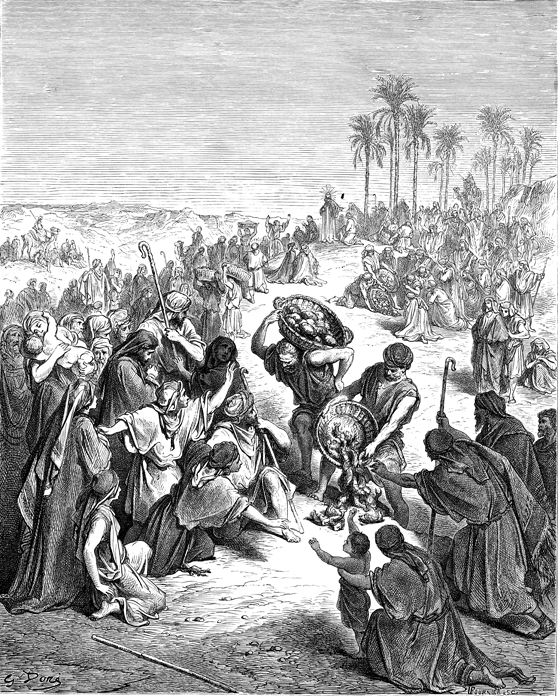
- Feeding the Five Thousand, John 6:1-15
- Why He Said He Came
- Jesus on Himself
- Names of God
- Predestination and Election
- The Seven Signs: John's Book of Signs
- The Tabernacle
- The Bride & the Jewish Wedding
- The Father's Will
- The Seal & the Signet
- Walking on Water: Matthew 14:22-33
About John
This page draws on 15 works. Open the list of works
This page draws on Adam Clarke, Commentary on the Bible; Albert Barnes, Notes, Explanatory and Practical, on the Gospels; Albert Barnes, Notes, Explanatory and Practical, on the Old and New Testaments (1832-1869); Athanasius of Alexandria, FESTAL LETTER 7.4-6; Bonaventure, Commentary on John, Chapter 6; Charles Spurgeon, The Metropolitan Tabernacle Pulpit, Sermon No. 1940: “The Best Bread” (lightly modernized text, CCEL edition); Charles Spurgeon, The Metropolitan Tabernacle Pulpit, Sermon No. 2706: “Feeding on the Bread of Life” (lightly modernized text, CCEL edition); Cyril of Alexandria, Commentary on the Gospel of John; Cyril of Alexandria, Commentary on the Gospel of John, Book 4; J. C. Ryle, Expository Thoughts on the Gospels, John; J.C. Ryle, Expository Thoughts on the Gospels: John (lightly modernized text, Grace Gems edition); John Chrysostom, Homily on the Gospel of John 46; John Chrysostom, Catena Aurea by Aquinas; John Gill, Exposition of the New Testament (1746-1748) and Thomas Aquinas, Commentary on John.