
John 6:9
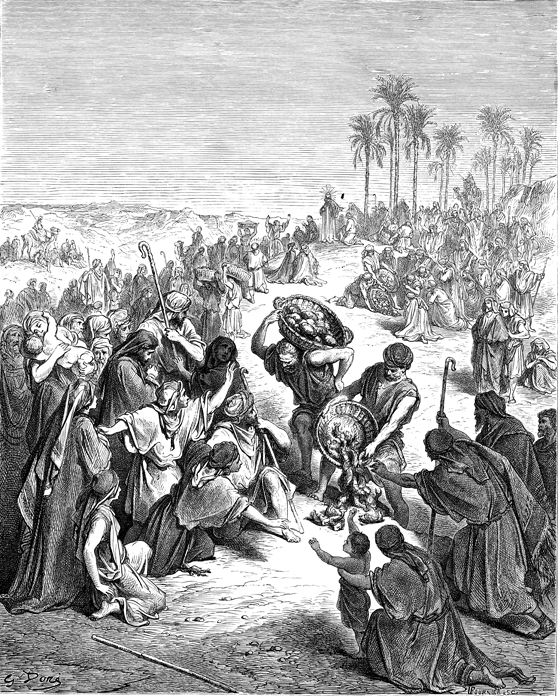
in John 6“Here is a boy with five barley loaves and two small fish. But what difference will these make among so many?”
BSB
The same verse in ASV and KJV ▾
ASV
There is a lad here, who hath five barley loaves, and two fishes: but what are these among so many?
KJV
There is a lad here, which hath five barley loaves, and two small fishes: but what are they among so many?
⋯
This verse in John 6
Commentary
24 notes on this verseBut that this point is true, that that number which is called five, which agrees in no respect with their argument, and does not harmonize with their system, nor is suitable for a typical manifestation of the things in the Pleroma, [yet has a wide prevalence,] will be proved as follows from the Scriptures. Soter is a name of five letters; Pater, too, contains five letters; Agape (love), too, consists of five letters; and our Lord, after blessing the five loaves, fed with them five thousand men.
This site's exposition
Andrew, Simon Peter's brother
on John 6:8-9
Andrew brings forward what is there, five barley loaves and two small fish from a boy. Barley was the cheap grain, the bread the poor ate. Andrew's own report ends in a question about how far so little will go among so many.
This site's exposition
five barley loaves and two small fish
Clarke notes that the Greek word for the boy may mean a little child or a servant. He and Gill both wonder whether the boy carried the disciples' food or had come to sell his loaves in the crowd. Andrew names what is there even while doubting it will help.
The record, by era
The Church Fathers5 voices
(lib. lxxxiii. Quæst. q. 61. in princ.) The five barley loaves signify the old law; either because the law was given to men not as yet spiritual, but carnal, i. e. under the dominion of the five senses, (the multitude itself consisted of five thousand:) or because the Law itself was given by Moses in five books. And the loaves being of barley is also an allusion to the Law, which concealed the soul's vital nourishment, under carnal ceremonies. For in barley the corn itself is buried under the most tenacious husk. Or, it alludes to the people who were not yet freed from the husk of carnal appetite, which cling to their heart. (lib. lxxxiv. Quæst. qu. 61) The two fishes again, that gave the pleasant taste to the bread, seem to signify the two authorities by which the people were governed, the Royal, viz. and the Priestly; both of which prefigure our Lord, who sustained both characters. (Tr. xxiv. 5) The boy who had these is perhaps the Jewish people, who, as it were, carried the loaves and fishes after a servile fashion, and did not eat them. That which they carried, while shut up, was only a burden to them; when opened became their food.
What, then, think we that five loaves signify? As far as the meaning which commends itself presents itself to my mind, the five loaves are the five books of Moses. With reason are they not wheaten, but barley loaves; because they belong to the Old Testament. And ye know that barley is so formed that we hardly get at the marrow of it; for that marrow is clothed with a coating of husk, and the husk itself is tenacious and coherent, so that it is stripped off with difficulty. Such is the letter of the Old Testament; clothed with the coverings of carnal sacraments: but yet if we get at its marrow, it feeds and satisfies.
A certain boy, then, brought five loaves and two fishes. If we inquire who this boy was, perhaps it was the people of Israel, which, in a childish sense, carried the food, and ate not. For that which they carried, was a burden to them while closed; but when opened, was food for them. Moreover, the two fishes seem to me to signify those two sublime persons of the Old Testament, who were anointed for sanctifying and ruling the people, the Priest and the King. And at length came in the mystery He who was signified by them, He who was pointed out by the marrow of the barley, He who was concealed under the barley's husk. The same came, one person sustaining the two characters, of Priest and of King.
A commentator
Romanos the MelodistKONTAKION ON THE MULTIPLICATION OF LOAVES 13.12-17 · Written before 555.
proposed
"Master, we can find only five barley loaves; No one of us brought anything into the desert, But a child is here who has them. O Lover of man, no other resource is possible for us. For an enormous and boundless number of people, O …
A commentator
Philoxenus of Mabbug13 Ascetic Discourses, Discourse 10 -- On Gluttony · Written before 523.
proposed
And therefore he would remember the passage concerning the eating of our Lord, where it is written of Him that, "He made the festival, and ate the passover;" or where it is said that, "They set before Him a piece of broiled fish and a …
16 more voices on this verse
The Church Fathers7 voices
A commentator
Cyril of AlexandriaCommentary on the Gospel of John, Book 3 · Written before 444.
proposed
And I think (and let the lover of wisdom look out for something better) that by the five barley loaves are signified the five-fold book of the all-wise Moses, that is, the whole Law, bringing in as it were coarser food, that by the letter and history. For this the barley hints at. But by the little fishes is signified the food got through the fishermen, that is, the more delicate books of the disciples of the Saviour; and these two (he says), the apostolic and Evangelic preaching, shine forth among us. And both these are draughts and spiritual writings of the fishermen. The Saviour therefore mingling the new with the old, by the Law and the teachings of the New Testament nourishes the souls of them that believe on Him, unto life, plainly eternal life.
(Hom. xlii. 2.) And let those of us, who are given to pleasure, observe the plain and abstemious eating of those great and wonderful men.
A commentator
John ChrysostomHomily on the Gospel of Matthew 49 · Written in the 5th century.
proposed
But John saith also, that they were "barley loaves," not mentioning it without object, but teaching us to trample under foot the pride of costly living. Such was the diet of the prophets also.
"Andrew, Simon's brother, said, There is a lad here, which hath five barley loaves, and two small fishes: but what are they among so many?" Andrew is higher minded than Philip, yet had not he attained to everything. Yet I do not think that he spake without an object, but as having heard of the miracles of the Prophets, and how Elisha wrought a sign with the loaves; on this account he mounted to a certain height, but could not attain to the very top.
What follows also expresses great weakness. For after saying, "hath five barley loaves," he addeth, "but what are they among so many?" He supposed that the Worker of the miracle would make less out of less, and more out of more. But this was not the case, for it was alike easy to Him to cause bread to spring forth from more and from less, since He needed no subject-matter. But in order that the creation might not seem foreign to His Wisdom, as afterwards slanderers and those affected with the disease of Marcion said, He used the creation itself as a groundwork for His marvels.
A commentator
Cyril of AlexandriaCommentary on the Gospel of John, Book 3 · Written before 444.
proposed
He both thinks and reasons akin to Philip, and is convicted of having a kindred apprehension of the Saviour Christ. For neither considering the power, nor yet led by the greatness of His preceding works unto Jesus' being able for all things, and that most easily; he points out what the lad has, but is evidently weak in faith: for what are these (he says) among so many? Albeit (for we must say it) in no unready way but resolutely rather ought he to go forth to the memory of those things which had been already miraculously wrought, and to consider that it was a work by no means strange or foreign from Him Who had transformed into wine the nature of water, had healed the palsied and driven away so great an infirmity by one word, that He, I say, should create food of that which had no being, and multiply Divinely the exceeding little that was found ready to hand. For the Authority that wrought in the one, how should it not be able to work in the other? Wherefore the pair of disciples answered more feebly than was meet. But herein we must consider this again. For those things which appear to have been little falls in the Saints, are oftentimes not without their share of profit, but have something wrapt up with them, helpful to the nature of that in regard to which is the charge of their apparent infirmity. For the above mentioned holy disciples, having considered, and openly said, one, that Two hundred pennyworth of bread is not sufficient for them that every one may take a little, the other, of the five loaves and two little fishes, that what are these among so many? raise the marvel to its height, and make the Might of the Saviour most marked, indicating by their own words the multitude that but now was to be filled, and the strength of their unbelief is converted into good testimony unto Christ. […]
(de Con. Evang. ii. c. xlvi) Andrew's suggestion about the five loaves and two fishes, is given as coming from the disciples in general, in the other Evangelists, and the plural number is used.
The Medieval Church5 voices
Andrew is in the same perplexity that Philip is; only he has rather higher notions of our Lord: There is a lad here which hath five barley loaves and two small fishes. This passage confounds the Manicheans, who say that bread and all such things were created by an evil Deity. The Son of the good God, Jesus Christ, multiplied the loaves. Therefore they could not have been naturally evil; a good God would never have multiplied what was evil.
(Hom. in Luc. c. vi.) Barley is the food of cattle and slaves: and the old law was given to slaves and cattle, i. e. to carnal men. Or, by the two fishes are meant the saying or writings of the Prophets, and the Psalmist. And whereas the number five refers to the five senses, a thousand stands for perfection. But those who strive to obtain the perfect government of their five senses, are called men, in consequence of their superior powers: they have no womanly weaknesses; but by a sober and chaste life, earn the sweet refreshment of heavenly wisdom. (Aug. xxiv. 5) And well is it said, But what are these among so many? The Law was of little avail, till He took it into His hand, i. e. fulfilled it, and gave it a spiritual meaning. The Law made nothing perfect. (Heb. 7:19)
Andrew, however, seems to sense that a miracle is going to take place. Perhaps he recalled the miracle performed by Elisha with the barley loaves, when he fed a hundred men with twenty loaves (2 Kgs 4:42). And so he says, There is a boy …
Having tested Philip as to whether he had faith, and having discovered that he was not yet free from human weakness, He finds Andrew to be the same, although his understanding was somewhat higher than Philip's. Philip said that "two hundred denarii worth of bread …
"There is a boy here who has five barley loaves and two fish": so many loaves, he says, we have, but they are not sufficient; therefore he says: "But what are these among so many?" In this is noted the remarkable poverty of the Lord …
The Puritans and the Awakening1 voice
There is a lad here,.... Who either belonged to Christ and his disciples, and was employed to carry their provisions for them; which, if so, shows how meanly Christ and his disciples lived; or he belonged to some in the multitude; or rather he came here to sell what he had got: which hath five barley loaves.
The Nineteenth Century3 voices
There is a lad here - Παιδαριον, a little boy, or servant, probably one who carried the apostles’ provisions, or who came on purpose to sell his bread and fish. Five barley loaves - Barley scarcely bore one-third of the value of wheat in the east: see Rev 6:6. That it was a very mean fare appears from Eze 13:19, where the false prophetesses are said to pollute the name of God for handfuls of barley, i.e. for the meanest reward.
A commentator
J.C. Ryle1816–1900
Expository Thoughts on the Gospels: John (lightly modernized text, Grace Gems edition) (1869)
These verses describe one of our Lord's most remarkable miracles. Of all the great works that He did, none was done so publicly as this, and before so many witnesses. Of all the miracles related in the Gospels, this is the only one which all the four Gospel-writers alike record. This fact alone (like the four times repeated account of the crucifixion and resurrection) is enough to show that it is a miracle demanding special attention. We have, for one thing, in this miracle, a lesson about Christ's almighty power.
A commentator
J.C. Ryle1816–1900
Expository Thoughts on the Gospels: John (lightly modernized text, Grace Gems edition) (1869)
proposed
These verses describe one of our Lord's most remarkable miracles. Of all the great works that He did, none was done so publicly as this, and before so many witnesses. Of all the miracles related in the Gospels, this is the only one which all the four Gospel-writers alike record. This fact alone (like the four times repeated account of the crucifixion and resurrection) is enough to show that it is a miracle demanding special attention. We have, for one thing, in this miracle, a lesson about Christ's almighty power. We see our Lord feeding five thousand men with "five barley loaves and two small fish." We see clear proof that a miraculous event took place in the "twelve baskets of fragments" that remained after all had eaten. Creative power was manifestly exercised. Food was called into existence that did not exist before. In healing the sick, and raising the dead, something was amended or restored that had already existed. In feeding five thousand men with five loaves, something must have been created which before had no existence. Such a history as this ought to be specially instructive and encouraging to all who endeavor to do good to souls. It shows us the Lord Jesus "able to save to the uttermost." He is One who has all power over dead hearts. Not only can He mend that which is broken—build up that which is ruined—heal that which is sick—strengthen that which is weak. He can do even greater things than these. He can call into being that which was not before, and call it out of nothing. We must never despair of any one being saved. So long as there is life there is hope. Reason and sense may say that some poor sinner is too hardened, or too old to be converted. Faith will reply—"Our Master can create as well as renew . With a Savior who, by His Spirit, can create a new heart, nothing is impossible."
The words behind it
17 Greek wordsEvery Greek word of this verse in the order it stands, with what it means and the door to its own study. The last column counts the times a word stands in the whole Bible: the rarer the word, the more the places it appears belong together.
| Greek | Sound | Meaning | Word study | In the Bible |
|---|---|---|---|---|
| ἔστιν | estin | Is | G1510 → | 2333 times |
| παιδάριον | paidarion | a little boy | G3808 → | |
| ὧδε | hode | here | G5602 → | 61 times |
| ὃς | hos | who | G3739 → | 1405 times |
| ἔχει | echei | has | G2192 → | 707 times |
| πέντε | pente | five | G4002 → | 38 times |
| ἄρτους | artous | loaves | G740 → | 97 times |
| κριθίνους | krithinous | barley | G2916 → | |
| καὶ | kai | and | G2532 → | 9120 times |
| δύο | duo | two | G1417 → | 133 times |
| ὀψάρια· | opsaria | small fish; | G3795 → | 5 times |
| ἀλλὰ | alla | but | G235 → | 635 times |
| ταῦτα | tauta | these | G3778 → | 1381 times |
| τί | ti | what | G5101 → | 563 times |
| ἐστιν | estin | are | G1510 → | 2333 times |
| εἰς | eis | for | G1519 → | 1755 times |
| τοσούτους; | tosoutous | so many? | G5118 → | 20 times |
ἔστινIs
estinG1510 →2333 times
παιδάριονa little boy
paidarionG3808 →
ὧδεhere
hodeG5602 →61 times
ὃςwho
hosG3739 →1405 times
ἔχειhas
echeiG2192 →707 times
πέντεfive
penteG4002 →38 times
ἄρτουςloaves
artousG740 →97 times
κριθίνουςbarley
krithinousG2916 →
καὶand
kaiG2532 →9120 times
δύοtwo
duoG1417 →133 times
ὀψάρια·small fish;
opsariaG3795 →5 times
ἀλλὰbut
allaG235 →635 times
ταῦταthese
tautaG3778 →1381 times
τίwhat
tiG5101 →563 times
ἐστινare
estinG1510 →2333 times
εἰςfor
eisG1519 →1755 times
τοσούτους;so many?
tosoutousG5118 →20 times
A shaded row is a word that stands 400 times or fewer in the Bible.
The walk
8 stopsEach card is a verse this one points to, and under it the verses that one points to in turn. Where several paths arrive at the same place, that place is listed first: the text keeps returning to it.
Through
Luke 9:13But Jesus told them, “You give them something to eat.” “We have only five loaves of bread and two fish,” they answered, “unless we go and buy food for all these people.”
it leads to
- John 6:5–9
When Jesus looked up and saw a large crowd coming toward Him, He said to Philip, “Where can we buy bread for these people to eat?”
Reached by 2 separate paths from here.
- Proverbs 11:24–25
One gives freely, yet gains even more; another withholds what is right, only to become poor.
- 2 Kings 4:42–43
Now a man from Baal-shalishah came to the man of God with a sack of twenty loaves of barley bread from the first ripe grain. “Give it to the people to eat,” said Elisha.
- John 6:5–9
Through
Matthew 14:17“We have here only five loaves of bread and two fish,” they answered.
it leads to
- Luke 9:13
But Jesus told them, “You give them something to eat.” “We have only five loaves of bread and two fish,” they answered, “unless we go and buy food for all these people.”
Reached by 2 separate paths from here.
- Mark 6:37–38
But Jesus told them, “You give them something to eat.” They asked Him, “Should we go out and spend two hundred denarii to give all of them bread to eat?”
Reached by 2 separate paths from here.
- Luke 9:13
Through
Psalms 78:19They spoke against God, saying, “Can God really prepare a table in the wilderness?
it leads to
- Numbers 21:5
and spoke against God and against Moses: “Why have you led us up out of Egypt to die in the wilderness? There is no bread or water, and we detest this wretched food!”
- Numbers 21:5
Through
Mark 6:38“Go and see how many loaves you have,” He told them. And after checking, they said, “Five—and two fish.”
it leads to
- Matthew 15:34
“How many loaves do you have?” Jesus asked. “Seven,” they replied, “and a few small fish.”
- Mark 8:5
“How many loaves do you have?” Jesus asked. “Seven,” they replied.
- Matthew 15:34
Where this verse is studied
On this page
Studies15
On this verse
On this chapter
About John
This page draws on 19 works. Open the list of works
This page draws on Adam Clarke, Commentary on the Bible; Alexander Maclaren, Expositions of Holy Scripture, John; Augustine of Hippo, Catena Aurea by Aquinas; Augustine of Hippo, Tractates on John 24; Bede, Catena Aurea by Aquinas; Bonaventure, Commentary on John, Chapter 6; Cyril of Alexandria, Commentary on the Gospel of John, Book 3; Irenaeus, AGAINST HERESIES 2.24.4; J.C. Ryle, Expository Thoughts on the Gospels: John (lightly modernized text, Grace Gems edition); John Chrysostom, Catena Aurea by Aquinas; John Chrysostom, Homily on the Gospel of Matthew 49; John Chrysostom, Homily on the Gospel of John 42; John Gill, Exposition of the New Testament; John Gill, Exposition of the New Testament (1746-1748); Philoxenus of Mabbug, 13 Ascetic Discourses, Discourse 10 -- On Gluttony; Romanos the Melodist, KONTAKION ON THE MULTIPLICATION OF LOAVES 13.12-17; Theophylact of Ohrid, Catena Aurea by Aquinas; Theophylact of Ohrid, Commentary on John and Thomas Aquinas, Commentary on John.