
John 6:13
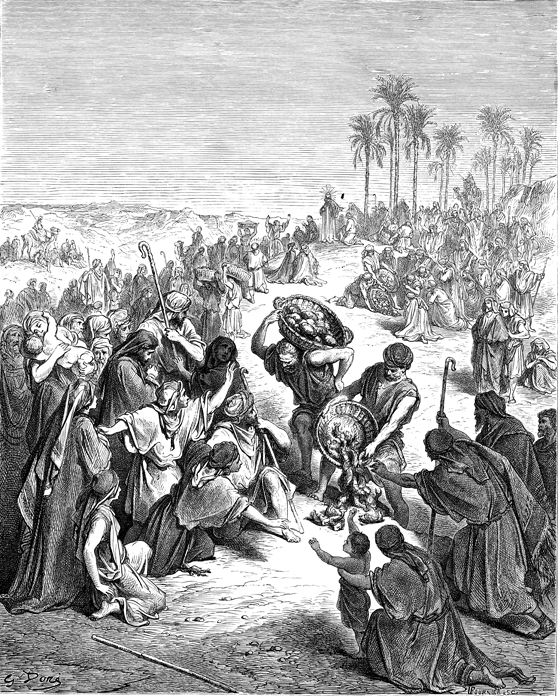
in John 6So they collected them and filled twelve baskets with the pieces of the five barley loaves left over by those who had eaten.
BSB
The same verse in ASV and KJV ▾
ASV
So they gathered them up, and filled twelve baskets with broken pieces from the five barley loaves, which remained over unto them that had eaten.
KJV
Therefore they gathered them together, and filled twelve baskets with the fragments of the five barley loaves, which remained over and above unto them that had eaten.
⋯
This verse in John 6
Commentary
18 notes on this verseBut greater yet and more noteworthy, and of exceeding profit to us, is this: consider how by this miracle He makes us most zealous in our desire to exercise hospitality most gladly, wellnigh calling aloud to us by the things that were done, that the things of God shall not fail him that is ready to communicate, and rejoiceth in habit of neighbourly love, and readily fulfilleth what is written, Break thy bread to the hungry.
This site's exposition
plenty of grass in that place
on John 6:10-13
Plenty of grass in that place marks the spring, the season of the Passover just named. Jesus gave thanks over the loaves and had them handed out until everyone was full, and the leftovers fill twelve baskets. He orders them gathered so nothing is wasted.
This site's exposition
filled twelve baskets
More is left over than was there at the start. Gill counts a full basket for each disciple, and he leaves open whether the bread multiplied in the hands of those serving or those eating. Cyril draws a lesson for hospitality: the things of God will not fail the one who is ready to share.
The record, by era
The Church Fathers5 voices
(Tr. xxiv. s. 6) And what are the fragments, but the parts which the people could not eat? An intimation, that those deeper truths, which the multitude cannot take in, should be entrusted to those who are capable of receiving them, and afterwards teaching them to others; as were the Apostles. For which reason twelve baskets were filled with them.
And what are the fragments, but things which the multitude could not eat? Some secret meanings, then, are to be understood, which the multitude cannot receive; what remains but that they be entrusted to those who are able also to teach others, as were the apostles? For which reason, twelve baskets were filled. A wonderful thing was wrought, and a mighty deed; but if one intently consider it, it is as the works of God. He who out of a few grains multiplies the harvests, multiplied the five loaves in His hands.
In the Psalms it is written of Joseph, "His hands had served in baskets." And the disciples of Jesus, the Twelve, I believe, gathered up twelve baskets of the remainder of the broken bread. These baskets were not half filled but full. And with the disciples of Jesus, as the teachers of the multitudes, now and until the end of the world, remain the twelve baskets of fragments of the living Bread that the multitudes could not eat.
A commentator
Cyril of AlexandriaCommentary on the Gospel of John, Book 3 · Written before 444.
proposed
And these things shall be said for profit from the narrative. But since we taking what has been said in a spiritual sense (for so we ought, and not otherwise) said that by the five barley loaves the book of Moses was hinted at, and by the two little fishes, the wise writings of the holy Apostles: in the gathering together of the fragments too, I suppose we ought to perceive some mystical and spiritual conception, agreeing with the order of the account. The Saviour then commanded the multitudes to sit down, and having blessed, He distributed the bread and the fishes, i. e., through the ministry of the disciples: but when they that had eaten were miraculously filled, He commands them to gather together the fragments, and twelve baskets are filled, one (it seems) for each of the disciples: for so many were they too. What then shall we understand from thence, save surely this, and truly, that Christ is the President of them that believe on Him, and nourishes them that come to Him with Divine and heavenly food? doctrines plainly of the Law and Prophets, Evangelic and Apostolic. But He does not altogether Himself appear as the Worker of these things, but the disciples minister to us the grace from above (for it is not they that speak, as it is written, but the Spirit of the Father which speaketh in them) yet not without reward to the holy Apostles shall be their labour therein. For they having dispensed to us the spiritual food, and ministered the good things of our Saviour, will receive richest recompense and obtain the fullest grace of bounty from God. For this and nothing else, I think, is the meaning of the gathering together of a basketful by each at the commandment of Christ, after their toils and the service expended upon the feasters. But there is no doubt, that after them the things typically signified will pass also to the rulers of the holy Churches.
And that these things were done for their instruction is plain from what is said afterwards, when He reminded them, saying, "Do ye not yet understand-how many baskets ye took up?" And for the same reason it was that the baskets of fragments were equal in number to the disciples; afterwards, when they were instructed, they took not up so many, but only "seven baskets." And I marvel not only at the quantity of loaves created, but besides the quantity, at the exactness of the surplus, that He caused the superabundance to be neither more nor less than just so much as He willed, foreseeing how much they would consume; a thing which marked unspeakable power.
10 more voices on this verse
The Church Fathers2 voices
The fragments then confirmed the matter, showing both these points; that what had taken place was no illusion, and that these were from the loaves by which the people had been fed. As to the fishes, they at this time were produced from those already subsisting, but at a later period, after the Resurrection, they were not made from subsisting matter. "Wherefore?" That thou mayest understand that even now He employed matter, not from necessity, nor as needing any base to work upon, but to stop the mouths of heretics.
Such was the greatness of his miracle that he willed the slender supply of food not only to be enough but even to prove superabundant. Here he followed ancient precedent. For in the same way during the famine in Elijah's time, the scanty and final meal of the widow of Zarephath was multiplied by the blessing of the prophet through-out the period of the famine.… O Christ, even in your novelties you are old!
The Medieval Church4 voices
Baskets are used for servile work. The baskets here are the Apostles and their followers, who, though despised in this present life, are within filled with the riches of spiritual sacraments. The Apostles too are represented as baskets, because, that through them, the doctrine of the Trinity was to be preached in the four parts of the world.
His disciples obeyed him faithfully; hence he says, They therefore gathered and filled twelve baskets with the leftovers. Here we should note that the amount of food that remained was not left to chance, but was according to plan: for as much as Christ willed …
One must marvel not only at the fact that there was a remainder, but also at the number of the remainder. He arranged it so that the baskets of leftovers were neither more nor less, but equal to the number of the disciples, so that …
"They gathered therefore and filled twelve baskets": behold, a measure and a full measure. Chrysostom: "I admire not only the multiplication of the loaves, but the certainty of that which was left over, and that the baskets were equal in number to the Apostles, signifying …
The Puritans and the Awakening2 voices
Therefore they gathered them together,.... The several broken bits of bread, which lay about upon the grass, which the people had left, after they had been sufficiently refreshed: and filled twelve baskets; every disciple had a basket filled: with the fragments of the five barley loaves; and it may be of the fishes also: which remained over and above unto them that had eaten; such a marvellous increase was there, through the power of Christ going along with them; insomuch that they multiplied to such a degree, either in the hands of the distributors, or of the eaters.
): They filled twelve baskets with the fragments, which was an evidence not only of the truth of the miracle, that they were fed, not with fancy, but with real food (witness those remains), but of the greatness of it; they were not only filled, but there was all this over and above.
quarantine:debris (2026-07-29) — leading-punctuation+unbalanced-parens
The Nineteenth Century2 voices
A commentator
J.C. Ryle1816–1900
Expository Thoughts on the Gospels: John (lightly modernized text, Grace Gems edition) (1869)
These verses describe one of our Lord's most remarkable miracles. Of all the great works that He did, none was done so publicly as this, and before so many witnesses. Of all the miracles related in the Gospels, this is the only one which all the four Gospel-writers alike record. This fact alone (like the four times repeated account of the crucifixion and resurrection) is enough to show that it is a miracle demanding special attention. We have, for one thing, in this miracle, a lesson about Christ's almighty power.
A commentator
J.C. Ryle1816–1900
Expository Thoughts on the Gospels: John (lightly modernized text, Grace Gems edition) (1869)
proposed
These verses describe one of our Lord's most remarkable miracles. Of all the great works that He did, none was done so publicly as this, and before so many witnesses. Of all the miracles related in the Gospels, this is the only one which all the four Gospel-writers alike record. This fact alone (like the four times repeated account of the crucifixion and resurrection) is enough to show that it is a miracle demanding special attention. We have, for one thing, in this miracle, a lesson about Christ's almighty power. We see our Lord feeding five thousand men with "five barley loaves and two small fish." We see clear proof that a miraculous event took place in the "twelve baskets of fragments" that remained after all had eaten. Creative power was manifestly exercised. Food was called into existence that did not exist before. In healing the sick, and raising the dead, something was amended or restored that had already existed. In feeding five thousand men with five loaves, something must have been created which before had no existence. Such a history as this ought to be specially instructive and encouraging to all who endeavor to do good to souls. It shows us the Lord Jesus "able to save to the uttermost." He is One who has all power over dead hearts. Not only can He mend that which is broken—build up that which is ruined—heal that which is sick—strengthen that which is weak. He can do even greater things than these. He can call into being that which was not before, and call it out of nothing. We must never despair of any one being saved. So long as there is life there is hope. Reason and sense may say that some poor sinner is too hardened, or too old to be converted. Faith will reply—"Our Master can create as well as renew . With a Savior who, by His Spirit, can create a new heart, nothing is impossible."
The words behind it
17 Greek wordsEvery Greek word of this verse in the order it stands, with what it means and the door to its own study. The last column counts the times a word stands in the whole Bible: the rarer the word, the more the places it appears belong together.
| Greek | Sound | Meaning | Word study | In the Bible |
|---|---|---|---|---|
| συνήγαγον | sunegagon | They gathered together | G4863 → | 59 times |
| οὖν | oun | therefore | G3767 → | 497 times |
| καὶ | kai | and | G2532 → | 9120 times |
| ἐγέμισαν | egemisan | filled | G1072 → | 8 times |
| δώδεκα | dodeka | twelve | G1427 → | 75 times |
| κοφίνους | kophinous | hand-baskets | G2894 → | |
| κλασμάτων | klasmaton | of fragments | G2801 → | |
| ἐκ | ek | from | G1537 → | 911 times |
| τῶν | ton | the | G3588 → | 19766 times |
| πέντε | pente | five | G4002 → | 38 times |
| ἄρτων | arton | loaves | G740 → | 97 times |
| τῶν | ton | <the> | G3588 → | 19766 times |
| κριθίνων | krithinon | barley | G2916 → | |
| ἃ | ha | which | G3739 → | 1405 times |
| ἐπερίσσευσαν | eperisseusan | exceeded | G4052 → | |
| τοῖς | tois | to those | G3588 → | 19766 times |
| βεβρωκόσιν.¶ | bebrokosin | having eaten. | G977 → |
συνήγαγονThey gathered together
sunegagonG4863 →59 times
οὖνtherefore
ounG3767 →497 times
καὶand
kaiG2532 →9120 times
ἐγέμισανfilled
egemisanG1072 →8 times
δώδεκαtwelve
dodekaG1427 →75 times
κοφίνουςhand-baskets
kophinousG2894 →
κλασμάτωνof fragments
klasmatonG2801 →
ἐκfrom
ekG1537 →911 times
τῶνthe
tonG3588 →19766 times
πέντεfive
penteG4002 →38 times
ἄρτωνloaves
artonG740 →97 times
τῶν<the>
tonG3588 →19766 times
κριθίνωνbarley
krithinonG2916 →
ἃwhich
haG3739 →1405 times
ἐπερίσσευσανexceeded
eperisseusanG4052 →
τοῖςto those
toisG3588 →19766 times
βεβρωκόσιν.¶having eaten.
bebrokosinG977 →
A shaded row is a word that stands 400 times or fewer in the Bible.
The walk
2 stopsEach card is a verse this one points to, and under it the verses that one points to in turn. Where several paths arrive at the same place, that place is listed first: the text keeps returning to it.
Through
2 Chronicles 25:9Amaziah asked the man of God, “What should I do about the hundred talents I have given to the army of Israel?” And the man of God replied, “The LORD is able to give…
it leads to
- Proverbs 10:22
The blessing of the LORD enriches, and He adds no sorrow to it.
- Deuteronomy 8:18
But remember that it is the LORD your God who gives you the power to gain wealth, in order to confirm His covenant that He swore to your fathers even to this day.
- Proverbs 10:22
Where this verse is studied
On this page
Studies15
On this verse
On this chapter
About John
This page draws on 14 works. Open the list of works
This page draws on Alcuin of York, Catena Aurea by Aquinas; Augustine of Hippo, Catena Aurea by Aquinas; Augustine of Hippo, Tractates on John 24; Bonaventure, Commentary on John, Chapter 6; Cyril of Alexandria, Commentary on the Gospel of John, Book 3; J.C. Ryle, Expository Thoughts on the Gospels: John (lightly modernized text, Grace Gems edition); Jamieson, Fausset & Brown, Commentary Critical and Explanatory on the Whole Bible; John Chrysostom, Homily on the Gospel of John 42; John Gill, Exposition of the New Testament (1746-1748); Matthew Henry, Commentary on the Whole Bible; Origen of Alexandria, COMMENTARY ON MATTHEW 11.2; Tertullian, AGAINST MARCION 4.21; Theophylact of Ohrid, Commentary on John and Thomas Aquinas, Commentary on John.