
John 6:70
in John 6Jesus answered them, “Have I not chosen you, the Twelve? Yet one of you is a devil!”
BSB
The same verse in ASV and KJV ▾
ASV
Jesus answered them, Did not I choose you the twelve, and one of you is a devil?
KJV
Jesus answered them, Have not I chosen you twelve, and one of you is a devil?
⋯
This verse in John 6
Commentary
21 notes on this verseHe continues His reproach, and clenches them with severer words, cutting off that which is slack and fallen into negligence in their desire to be wise. For He almost seems to say somewhat of this sort, "O My disciples, this is the time for heed and wit and a mind braced unto the desire of salvation. For most slippery is the way of perdition, which drags downwards not only the feeble mind, but also that which already thinketh it standeth fast.
The record, by era
The Church Fathers5 voices
Then said the Lord Jesus: "Have not I chosen you twelve, and one of you is a devil?" Therefore, should He have said, "I have chosen eleven:" or is a devil also chosen, and among the elect? Persons are wont to be called "elect" by way of praise: or was man elected because some great good was done by him, without his will and knowledge? This belongs peculiarly to God; the contrary is characteristic of the wicked. For as wicked men make a bad use of the good works of God; so, on the contrary, God makes a good use of the evil works of wicked men. How good it is that the members of the body are, as they can be disposed only by God, their author and framer! Nevertheless what evil use doth wantonness make of the eyes? What ill use doth falsehood make of the tongue? Does not the false witness first both slay his own soul with his tongue, and then, after he has destroyed himself, endeavor to injure another? He makes an ill use of the tongue, but the tongue is not therefore an evil thing; the tongue is God's work, but iniquity makes an ill use of that good work of God. How do they use their feet who run into crimes? How do murderers employ their hands? And what ill use do wicked men make of those good creatures of God that lie outside of them? With gold they corrupt judgment and oppress the innocent. Bad men make a bad use of the very light; for by evil living they employ even the very light with which they see into the service of their villanies. A bad man, when going to do a bad deed, wishes the light to shine for him, lest he stumble; he who has already stumbled and fallen within; that which he is afraid of in his body has already befallen him in his heart. Hence, to avoid the tediousness of running through them separately, a bad man makes a bad use of all the good creatures of God: a good man, on the contrary, makes a good use of the evil deeds of wicked men. […]
(Tr. xxvii. s. 10) He was elected to be an involuntary and unconscious instrument of producing the greatest good. For as the wicked turn the good works of God to an evil use, so reversely God turns the evil works of man to good. What can be worse than what Judas did? Yet our Lord made a good use of his wickedness; allowing Himself to be betrayed, that He might redeem us. In, Have I not chosen you twelve, twelve seems to be a sacred number used in the case of those, who were to spread the doctrine of the Trinity through the four quarters of the world. Nor was the virtue of that number impaired, by one perishing; inasmuch as another was substituted in his room.
First, He was clad in "sordid attire," that is, in the indignity of passible and mortal flesh, when the devil, withal, was opposing himself to Him-the instigator, to wit, of Judas the traitor -who even after His baptism had tempted Him.
A commentator
Ignatius of AntiochEpistle of Pseudo-Ignatius to the Antiochians · Written before 108.
proposed
Whosoever, therefore, declares that there is but one God, only so as to take away the divinity of Christ, is a devil, and an enemy of all righteousness. He also that confesseth Christ, yet not as the Son of the Maker of the world, but of some other unknown being, different from Him whom the law and the prophets have proclaimed, this man is an instrument of the devil. And he that rejects the incarnation, and is ashamed of the cross for which I am in bonds, this man is antichrist. Moreover, he who affirms Christ to be a mere man is accursed, according to the [declaration of the] prophet, since he puts not his trust in God, but in man. Wherefore also he is unfruitful, like the wild myrtle-tree.
"Have not I chosen you twelve, and one of you is a devil?" For since Peter said, "We believe," Jesus excepteth Judas from the band. In the other place Peter made no mention of the disciples; but when Christ said, "Whom say ye that I am?" he replied, "Thou art the Christ, the Son of the living God"; but here, since he said, "We believe," Christ with reason admitteth not Judas into that band. And this He did afar off, and long before the time, to check the wickedness of the traitor, knowing that He should avail nothing, yet doing His own part.
15 more voices on this verse
The Church Fathers2 voices
And remark His wisdom. He made not the traitor manifest, yet allowed him not to be hidden; that on the one hand he might not lose all shame, and become more contentious; and on the other, that he might not, thinking to be unperceived, work his wicked deed without fear. Therefore by degrees He bringeth plainer reproofs against him. First, He numbered him too among the others, when He said, "There are some of you that believe not," (for that He counted the traitor the Evangelist hath declared, saying, "For He knew from the beginning who they were that believed not, and who should betray Him;") but when he yet remained such, He brought against him a more severe rebuke, "One of you is a devil," yet made the fear common to them all, wishing to conceal him. And here it is worth while to enquire, why the disciples at this time said nothing, but afterwards were afraid and doubted, looking one upon another, and asking, "Lord, is it I?", when Peter beckoned to John to find out the traitor, by enquiring of their Teacher which was he. What is the reason? Peter had not yet heard, "Get thee behind me, Satan," wherefore he had no fear at all; but when he had been rebuked, and though he spoke through strong affection, instead of being approved of, had even been called "Satan," he afterwards with reason feared when he heard, "One of you shall betray Me." Besides, He saith not even now, "One of you shall betray Me," but, "One of you is a devil"; wherefore they understood not what was spoken, but thought that He was only reflecting upon their wickedness.
But wherefore said He, "I have chosen you twelve, and one of you is a devil"? It was to show that His teaching was entirely free from flattery. For that they might not think that He would flatter them, because when all had left Him they alone remained, and confessed by Peter that He was the Christ, He leadeth them away from such a suspicion. And what He saith is of this kind. "Nothing abasheth Me from rebuking the bad; think not that because ye have remained I shall choose to flatter you, or that because ye have followed Me I shall not rebuke the wicked. For neither doth another circumstance abash Me, which is much more powerful than this to abash a teacher. For he that remaineth affordeth a proof of his affection, while one that hath been chosen by a teacher, being rejected, attacheth to him a character for folly among senseless persons. Still neither doth this cause Me to refrain from My reproofs." This at least even now the heathen frigidly and senselessly urge against Christ. For God is not wont to make men good by compulsion and force, neither is His election and choice compulsory on those who are called, but persuasive. And that thou mayest learn that the calling compelleth not, consider how many of these who have been called have come to perdition, so that it is clear that it lieth in our own will also to be saved, or to perish.
The Medieval Church5 voices
(Moral. 1. xiii. c. xxxiv.) One of you is a devil: the bodyb is here named after its head.
Or we must say, that He elected the eleven for one purpose, the twelfth for another: the eleven to fill the place of Apostles, and persevere in it unto the end; the twelfth to the service of betraying Him, which was the means of saving the human race.
Here the discernment of those who remained is noted. The Lord shows that even though none of the twelve departed, nevertheless not all remained faithful: on account of which he says: "Jesus answered," the confession of Peter, which he had spoken on behalf of all: …
What then does Christ say? Does He approve Peter, as He did on another occasion (Matt. 16:17)? Not at all, so as not to appear to be flattering him for having remained with Him. What then does He say to Peter? "I chose you twelve, …
He professed his faith when he said, We have come to believe and to know that you are the Christ, the Son of God. For in our faith there are two things above all that must be believed: the mystery of the Trinity, and the …
The Puritans and the Awakening3 voices
Jesus answered them,.... The disciples, taking Peter's answer to his question, as delivered in the name of them all, and as expressing their mind and sense: have not I chosen you twelve; not to grace and glory, to holiness and happiness; though this was true of eleven of them, but to be apostles: and one of you is a devil? or like to one, is a deceiver, a liar, and a murderer, as the devil is from the beginning; all which Judas was, and appeared to be, in the betraying of his master.
Jesus answered the - And yet even ye have not all acted suitable to this knowledge. Have I not chosen or elected you twelve? - But they might fall even from that election. Yet one of you - On this gracious warning, Judas ought to have repented; is a devil - Is now influenced by one.
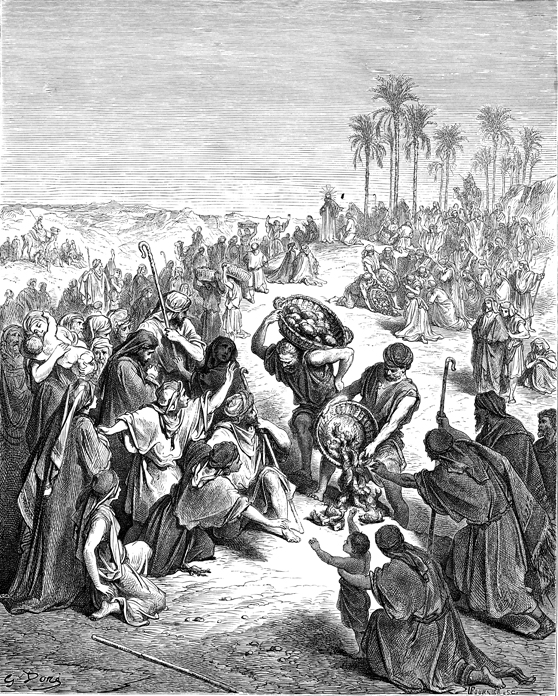
The place and time where and when this miracle was wrought, which are noted for the greater evidence of the truth of the story; it is not said that it was done once upon a time, nobody knows where, but the circumstances are specified, that the fact might be enquired into. The country that Christ was in (
quarantine:debris (2026-07-29) — unbalanced-parens
The Nineteenth Century5 voices
Have not I chosen you twelve - Have I not, in an especial manner, called you to believe in my name, and chosen you to be my disciples and the propagators of my doctrine! Nevertheless, one of you is a devil, or accuser, enlisted on the side of Satan, who was a murderer from the beginning.
A commentator
J.C. Ryle1816–1900
Expository Thoughts on the Gospels: John (lightly modernized text, Grace Gems edition) (1869)
These verses form a sorrowful conclusion to the famous discourse of Christ which occupies the greater part of the sixth chapter. They supply a melancholy proof of the hardness and corruption of man's heart. Even when the Son of God was the preacher, many seem to have heard in vain. Let us mark in this passage what an old sin apostasy is. We read that when our Lord had explained what He meant by "eating and drinking his flesh and blood,"—"After this, many of his disciples quit following him and did not accompany him any longer."
A commentator
Jamieson, Fausset & Brown1802–1910
Commentary Critical and Explanatory on the Whole Bible (1871)
Have not I chosen . . . and one of you is a devil:--"Well said, Simon Bar-jonas, but that 'we' embraces not so wide a circle as in the simplicity of thine heart thou thinkest; for though I have chosen you but twelve, one even of these is a 'devil'" (the temple, the tool of that wicked one).
A commentator
J.C. Ryle1816–1900
Expository Thoughts on the Gospels: John (lightly modernized text, Grace Gems edition) (1869)
proposed
These verses form a sorrowful conclusion to the famous discourse of Christ which occupies the greater part of the sixth chapter. They supply a melancholy proof of the hardness and corruption of man's heart. Even when the Son of God was the preacher, many seem to have heard in vain. Let us mark in this passage what an old sin apostasy is. We read that when our Lord had explained what He meant by "eating and drinking his flesh and blood,"—"After this, many of his disciples quit following him and did not accompany him any longer." The true grace of God no doubt is an everlasting possession. From this men never fall away entirely, when they have once received it. "The foundation of God stands sure." "My sheep shall never perish." (2 Tim. 2:19; John 10:28.) But there is counterfeit grace and unreal religion in the Church, wherever there is true; and from counterfeit grace thousands may, and do, fall away. Like the stony ground hearers, in the parable of the sower, many "have no root in themselves, and so in time of trial fall away." All is not gold that glitters. All blossoms do not come to fruit. All are not Israel which are called Israel. Men may have feelings, desires, convictions, resolutions, hopes, joys, sorrows in religion, and yet never have the grace of God. They may run well for a season, and bid fair to reach heaven, and yet break down entirely after a time, go back to the world, and end like Demas, Judas Iscariot, and Lot's wife. It must never surprise us to see and hear of such cases in our own days. If it happened in our Lord's time and under our Lord's teaching, much more may we expect it to happen now. Above all, it must never shake our faith and discourage us in our course. On the contrary, we must make up our minds that there will be apostasy in the Church as long as the world stands.
A commentator
Albert Barnes1798–1870
Notes, Explanatory and Practical, on the Old and New Testaments (1832-1869)
proposed
Have not I chosen you twelve? - There is much emphasis in these words. Have not I - I, the Saviour, the Messiah, chosen you in mercy and in love, and therefore it will be a greater sin to betray me? Chosen. Chosen to the apostolic office; conferred on you marks of special favor, and treason is therefore the greater sin. You twelve. So small a number. Out of such a multitude as follow for the loaves and fishes, it is to be expected there should be apostates; but when the number is so small, chosen in such a manner, then it becomes every one, however confident he may be, to be on his guard and examine his heart. Is a devil - Has the spirit, the envy, the malice, and the treasonable designs of a devil. The word “devil” here is used in the sense of an enemy, or one hostile to him.
The words behind it
16 Greek wordsEvery Greek word of this verse in the order it stands, with what it means and the door to its own study. The last column counts the times a word stands in the whole Bible: the rarer the word, the more the places it appears belong together.
| Greek | Sound | Meaning | Word study | In the Bible |
|---|---|---|---|---|
| ἀπεκρίθη | apekrithe | Answered | G611 → | 231 times |
| αὐτοῖς | autois | them | G846 → | 5565 times |
| ὁ | ho | <the> | G3588 → | 19766 times |
| Ἰησοῦς· | iesous | Jesus; | G2424 → | 908 times |
| οὐκ | ouk | Not | G3756 → | 1664 times |
| ἐγὼ | ego | I myself | G1473 → | 839 times |
| ὑμᾶς | humas | you | G4771 → | 2973 times |
| τοὺς | tous | the | G3588 → | 19766 times |
| δώδεκα | dodeka | Twelve | G1427 → | 75 times |
| ἐξελεξάμην, | exelexamen | did choose, | G1586 → | 22 times |
| καὶ | kai | and | G2532 → | 9120 times |
| ἐξ | ex | of | G1537 → | 911 times |
| ὑμῶν | humon | you | G4771 → | 2973 times |
| εἷς | heis | one | G1520 → | 343 times |
| διάβολός | diabolos | a devil | G1228 → | 37 times |
| ἐστιν; | estin | is? | G1510 → | 2333 times |
ἀπεκρίθηAnswered
apekritheG611 →231 times
αὐτοῖςthem
autoisG846 →5565 times
ὁ<the>
hoG3588 →19766 times
Ἰησοῦς·Jesus;
iesousG2424 →908 times
οὐκNot
oukG3756 →1664 times
ἐγὼI myself
egoG1473 →839 times
ὑμᾶςyou
humasG4771 →2973 times
τοὺςthe
tousG3588 →19766 times
δώδεκαTwelve
dodekaG1427 →75 times
ἐξελεξάμην,did choose,
exelexamenG1586 →22 times
καὶand
kaiG2532 →9120 times
ἐξof
exG1537 →911 times
ὑμῶνyou
humonG4771 →2973 times
εἷςone
heisG1520 →343 times
διάβολόςa devil
diabolosG1228 →37 times
ἐστιν;is?
estinG1510 →2333 times
A shaded row is a word that stands 400 times or fewer in the Bible.
The walk
8 stopsEach card is a verse this one points to, and under it the verses that one points to in turn. Where several paths arrive at the same place, that place is listed first: the text keeps returning to it.
Through
John 17:12While I was with them, I protected and preserved them by Your name, the name You gave Me. Not one of them has been lost, except the son of destruction, so that the Scripture…
it leads to
- Psalms 109:6–19
Set over him a wicked man; let an accuser stand at his right hand.
- John 10:27–28
My sheep listen to My voice; I know them, and they follow Me.
- John 18:9
This was to fulfill the word He had spoken: “I have not lost one of those You have given Me.”
- John 13:18
I am not speaking about all of you; I know whom I have chosen. But this is to fulfill the Scripture: ‘The one who shares My bread has lifted up his heel against Me.’
- John 6:37
Everyone the Father gives Me will come to Me, and the one who comes to Me I will never drive away.
- Psalms 109:6–19
Through
John 13:27And when Judas had taken the morsel, Satan entered into him. Then Jesus said to Judas, “What you are about to do, do quickly.”
it leads to
- Luke 22:3
Then Satan entered Judas Iscariot, who was one of the Twelve.
Reached by 2 separate paths from here.
- Luke 22:3
Through
John 13:2The evening meal was underway, and the devil had already put into the heart of Judas, the son of Simon Iscariot, to betray Jesus.
it leads to
- Acts 5:3
Then Peter said, “Ananias, how is it that Satan has filled your heart to lie to the Holy Spirit and withhold some of the proceeds from the land?
Reached by 2 separate paths from here.
- James 1:13–17
When tempted, no one should say, “God is tempting me.” For God cannot be tempted by evil, nor does He tempt anyone.
- Acts 5:3
Where this verse is studied
On this page
Studies28
- Bread
- The Bronze Serpent
- Cut Off from Among His People
- Eternal Life
- Eternal Security, and the Five Warnings of Hebrews
- Feeding the Five Thousand, John 6:1-15
Show the next 6 titles
Show the next 6 titles
About John
This page draws on 18 works. Open the list of works
This page draws on Adam Clarke, Commentary on the Bible; Albert Barnes, Notes, Explanatory and Practical, on the Old and New Testaments (1832-1869); Augustine of Hippo, Tractates on John 27; Augustine of Hippo, Catena Aurea by Aquinas; Bede, Catena Aurea by Aquinas; Bonaventure, Commentary on John, Chapter 6; Cyril of Alexandria, Commentary on the Gospel of John, Book 4; Gregory the Dialogist, Catena Aurea by Aquinas; Ignatius of Antioch, Epistle of Pseudo-Ignatius to the Antiochians; J.C. Ryle, Expository Thoughts on the Gospels: John (lightly modernized text, Grace Gems edition); Jamieson, Fausset & Brown, Commentary Critical and Explanatory on the Whole Bible; John Chrysostom, Homily on the Gospel of John 47; John Gill, Exposition of the New Testament (1746-1748); John Wesley, Explanatory Notes upon the New Testament; Matthew Henry, Commentary on the Whole Bible; Tertullian, An Answer to the Jews; Theophylact of Ohrid, Commentary on John and Thomas Aquinas, Commentary on John.