
John 6:10
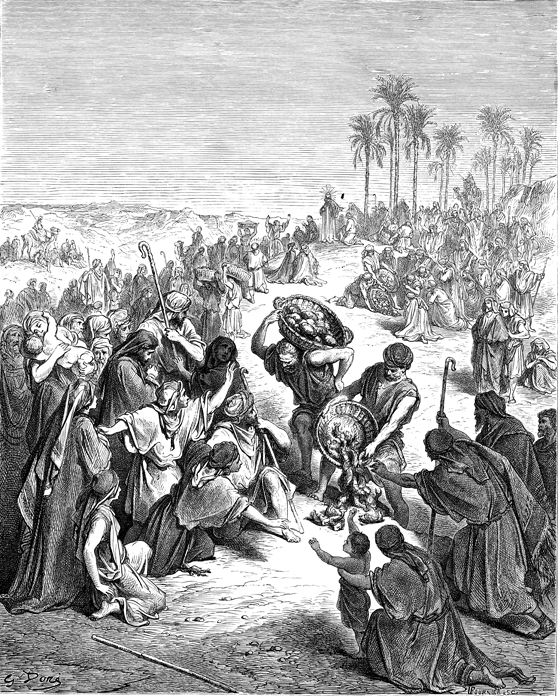
in John 6“Have the people sit down,” Jesus said. Now there was plenty of grass in that place, so the men sat down, about five thousand of them.
BSB
The same verse in ASV and KJV ▾
ASV
Jesus said, Make the people sit down. Now there was much grass in the place. So the men sat down, in number about five thousand.
KJV
And Jesus said, Make the men sit down. Now there was much grass in the place. So the men sat down, in number about five thousand.
⋯
This verse in John 6
Commentary
17 notes on this verseThe Saviour practised His accustomed gentleness, and takes away the sharpness of His reproaches. For He doth not rebuke bitterly His disciples, albeit they were deeply slumbering in respect of their faintheartedness and littleness of faith in Him: but rather He leads them by His Deeds to the apprehension of the things which as yet they believe not.
This site's exposition
plenty of grass in that place
on John 6:10-13
Plenty of grass in that place marks the spring, the season of the Passover just named. Jesus gave thanks over the loaves and had them handed out until everyone was full, and the leftovers fill twelve baskets. He orders them gathered so nothing is wasted.
The record, by era
The Church Fathers5 voices
"Now there was a great deal of grass in the place," and therefore the place where they sat down was pleasing, and the weather was good. It was Nisan (more or less April), when the earth usually becomes adorned with growing weeds, especially in those …
(Tr. xxiv. s. 5) Our Lord's question proved the ignorance of His disciples, i. e. the people's ignorance of the Law. They lay on the grass, i. e. were carnally minded, rested in carnal things, for all flesh is grass. (Isa. 40:6) Men are filled with the loaves, when what they hear with the ear, they fulfil in practice.
And so, taking the loaves and fishes, the Lord looked up to heaven, then blessed and broke them, giving thanks to the Father that, after the law and the prophets, he has himself become the evangelical bread. And when he had commanded the people to sit down on the grass, not to lie prone on the earth, but to sit upheld by the law, each one spread his own good works, like the grass of the earth, under him. The bread is also given to the apostles, because it is through them the gifts of the divine grace are to be given. Then the people ate of the five loaves and two fishes and were filled. And of the fragments of the bread and of the fishes, after all who had sat down were satisfied, there remained over enough to fill twelve baskets: that is, the hunger of the multitude is satisfied by the word of God coming to them from the teaching of the law and the prophets. And the abundance of the divine goodness, kept in reserve for the people of the Gentiles, has overflowed from the source of eternal food unto the filling of the twelve apostles.And the number of those who ate is, we find, the same as that of those who were to believe. For, as we learn from the book of the Acts, out of the numbers of the people of Israel five thousand believed. For, the miracle of these things extends even to the measure of the reason that underlies them. The bread together with the fishes broken for the feeding of the people increased to the need of the number of people who believed, and to the number of apostles chosen to be filled with heavenly graces. The quantity conformed to the number, and the number to the quantity.
He made the men sit down before the loaves appeared, to teach us that with Him, things that are not are as things that are; as Paul says, Who calleth those things that be not, as though they were. (Rom. 4:17.) The passage proceeds then: And Jesus said, Make the men sit down.
When both the disciples had owned themselves at a loss, then He wrought the miracle; for thus they profited the more, having first confessed the difficulty of the matter, that when it should come to pass, they might understand the power of God. And because a miracle was about to be wrought, which had also been performed by the Prophets, although not in an equal degree, and because He would do it after first giving thanks, lest they should fall into any suspicion of weakness on His part, observe how by the very manner of His working He entirely raiseth their thoughts of it and showeth them the difference between Himself and others.
10 more voices on this verse
The Medieval Church5 voices
After the antecedents to the wondrous feeding have been determined, here the concomitants are noted, which are three: first, the seating of those reclining; second, the multiplication of the loaves; third, the collection of the fragments. First therefore the seating of those reclining at Christ's …
Next (v 10), the miracle is presented. First, we see the people arranged; secondly, the miracle itself; and thirdly, the gathering of the leftovers. He does two things about the first. First, he shows Christ directing the disciples to have the people recline; secondly, why …
Sit down, i. e. lie down, as the ancient custom was, which they could do, as there was much grass in the place.
i. e. green grass. It was the time of the Passover, which was kept the first month of the spring. So the men sat down in number about five thousand. The Evangelist only counts the men, following the direction in the law. Moses numbered the people from twenty years old and upwards, making no mention of the women; to signify that the manly and juvenile character is especially honourable in God's eyes. And Jesus took the loaves; and when He had given thanks, He distributed to them that were sat down: and likewise of the fishes as much as they would. We learn too from this miracle, not to be pusillanimous in the greatest straits of poverty.
He commands them to recline at once, as though the table were already prepared. The disciples did not believe before, yet now they readily arrange the people to recline. There was "grass," indicating it was springtime. "For it was," he says, "Passover"; and it was …
The Puritans and the Awakening2 voices
6 ), and, considering what Christ says of the grass of the field ( Matt. vi. 29, 30 ), these beds excelled those of Ahasuerus: nature's pomp is the most glorious. (2.) The number of the guests: About five thousand: a great entertainment, representing that of the gospel, which is a feast for all nations ( Isa. xxv.
quarantine:debris (2026-07-29) — leading-citation-number
Jesus said, make the men sit down,....
The Nineteenth Century3 voices
There was much grass in the place - Perhaps newly mown grass, or hay, is meant, (so the Vulgate faenum), and this circumstance marks out more particularly that the passover was at hand. In Palestine the grass is ready for mowing in March; and this miracle seems to have been wrought only a few days before the commencement of that festival: see Joh 6:4.
A commentator
J.C. Ryle1816–1900
Expository Thoughts on the Gospels: John (lightly modernized text, Grace Gems edition) (1869)
These verses describe one of our Lord's most remarkable miracles. Of all the great works that He did, none was done so publicly as this, and before so many witnesses. Of all the miracles related in the Gospels, this is the only one which all the four Gospel-writers alike record. This fact alone (like the four times repeated account of the crucifixion and resurrection) is enough to show that it is a miracle demanding special attention. We have, for one thing, in this miracle, a lesson about Christ's almighty power.
A commentator
J.C. Ryle1816–1900
Expository Thoughts on the Gospels: John (lightly modernized text, Grace Gems edition) (1869)
proposed
These verses describe one of our Lord's most remarkable miracles. Of all the great works that He did, none was done so publicly as this, and before so many witnesses. Of all the miracles related in the Gospels, this is the only one which all the four Gospel-writers alike record. This fact alone (like the four times repeated account of the crucifixion and resurrection) is enough to show that it is a miracle demanding special attention. We have, for one thing, in this miracle, a lesson about Christ's almighty power. We see our Lord feeding five thousand men with "five barley loaves and two small fish." We see clear proof that a miraculous event took place in the "twelve baskets of fragments" that remained after all had eaten. Creative power was manifestly exercised. Food was called into existence that did not exist before. In healing the sick, and raising the dead, something was amended or restored that had already existed. In feeding five thousand men with five loaves, something must have been created which before had no existence. Such a history as this ought to be specially instructive and encouraging to all who endeavor to do good to souls. It shows us the Lord Jesus "able to save to the uttermost." He is One who has all power over dead hearts. Not only can He mend that which is broken—build up that which is ruined—heal that which is sick—strengthen that which is weak. He can do even greater things than these. He can call into being that which was not before, and call it out of nothing. We must never despair of any one being saved. So long as there is life there is hope. Reason and sense may say that some poor sinner is too hardened, or too old to be converted. Faith will reply—"Our Master can create as well as renew . With a Savior who, by His Spirit, can create a new heart, nothing is impossible."
The words behind it
22 Greek wordsEvery Greek word of this verse in the order it stands, with what it means and the door to its own study. The last column counts the times a word stands in the whole Bible: the rarer the word, the more the places it appears belong together.
| Greek | Sound | Meaning | Word study | In the Bible |
|---|---|---|---|---|
| εἶπεν | eipen | Said | G2036 → | 925 times |
| ὁ | ho | <the> | G3588 → | 19766 times |
| Ἰησοῦς· | iesous | Jesus; | G2424 → | 908 times |
| ποιήσατε | poiesate | do make | G4160 → | 569 times |
| τοὺς | tous | the | G3588 → | 19766 times |
| ἀνθρώπους | anthropous | men | G444 → | 549 times |
| ἀναπεσεῖν. | anapesein | to recline. | G377 → | 12 times |
| ἦν | en | There was | G1510 → | 2333 times |
| δὲ | de | now | G1161 → | 2765 times |
| χόρτος | chortos | grass | G5528 → | |
| πολὺς | polus | much | G4183 → | 367 times |
| ἐν | en | in | G1722 → | 2738 times |
| τῷ | to | the | G3588 → | 19766 times |
| τόπῳ. | topo | place. | G5117 → | 94 times |
| ἀνέπεσαν | anepesan | Reclined | G377 → | 12 times |
| οὖν | oun | therefore | G3767 → | 497 times |
| οἱ | hoi | the | G3588 → | 19766 times |
| ἄνδρες | andres | men | G435 → | 216 times |
| τὸν | ton | the | G3588 → | 19766 times |
| ἀριθμὸν | arithmon | number | G706 → | |
| ὡς | hos | about | G5613 → | 500 times |
| πεντακισχίλιοι. | pentakischilioi | five thousand. | G4000 → |
εἶπενSaid
eipenG2036 →925 times
ὁ<the>
hoG3588 →19766 times
Ἰησοῦς·Jesus;
iesousG2424 →908 times
ποιήσατεdo make
poiesateG4160 →569 times
τοὺςthe
tousG3588 →19766 times
ἀνθρώπουςmen
anthropousG444 →549 times
ἀναπεσεῖν.to recline.
anapeseinG377 →12 times
ἦνThere was
enG1510 →2333 times
δὲnow
deG1161 →2765 times
χόρτοςgrass
chortosG5528 →
πολὺςmuch
polusG4183 →367 times
ἐνin
enG1722 →2738 times
τῷthe
toG3588 →19766 times
τόπῳ.place.
topoG5117 →94 times
ἀνέπεσανReclined
anepesanG377 →12 times
οὖνtherefore
ounG3767 →497 times
οἱthe
hoiG3588 →19766 times
ἄνδρεςmen
andresG435 →216 times
τὸνthe
tonG3588 →19766 times
ἀριθμὸνnumber
arithmonG706 →
ὡςabout
hosG5613 →500 times
πεντακισχίλιοι.five thousand.
pentakischilioiG4000 →
A shaded row is a word that stands 400 times or fewer in the Bible.
Where this verse is studied
On this page
Studies15
On this verse
On this chapter
About John
This page draws on 16 works. Open the list of works
This page draws on Adam Clarke, Commentary on the Bible; Alcuin of York, Catena Aurea by Aquinas; Augustine of Hippo, Catena Aurea by Aquinas; Bonaventure, Commentary on John, Chapter 6; Cyril of Alexandria, Commentary on the Gospel of John, Book 3; Hilary of Poitiers, Commentary on Matthew 14.11; J.C. Ryle, Expository Thoughts on the Gospels: John (lightly modernized text, Grace Gems edition); Jamieson, Fausset & Brown, Commentary Critical and Explanatory on the Whole Bible; John Chrysostom, Catena Aurea by Aquinas; John Chrysostom, Homily on the Gospel of John 42; John Gill, Exposition of the New Testament (1746-1748); Matthew Henry, Commentary on the Whole Bible; Theodore of Mopsuestia, COMMENTARY ON JOHN 3.6.10; Theophylact of Ohrid, Catena Aurea by Aquinas; Theophylact of Ohrid, Commentary on John and Thomas Aquinas, Commentary on John.