
John 6:42
in John 6They were asking, “Is this not Jesus, the son of Joseph, whose father and mother we know? How then can He say, ‘I have come down from heaven?’”
BSB
The same verse in ASV and KJV ▾
ASV
And they said, Is not this Jesus, the son of Joseph, whose father and mother we know? how doth he now say, I am come down out of heaven?
KJV
And they said, Is not this Jesus, the son of Joseph, whose father and mother we know? how is it then that he saith, I came down from heaven?
⋯
This verse in John 6
Commentary
9 notes on this verseThe record, by era
The Church Fathers2 voices
When He gave them bread, and filled their bellies, they said that He was a Prophet, and sought to make Him a King: but when He taught them concerning spiritual food, concerning eternal life, when He led them away from objects of sense, and spake to them of a resurrection, and raised their thoughts to higher matters, when most they ought to have admired, they murmur and start away. And yet, if He was that Prophet as they before asserted, declaring that he it was of whom Moses had said, "A Prophet shall the Lord your God raise up unto you of your brethren like unto me, unto Him shall ye hearken"; they ought to have hearkened to Him when He said, "I came down from heaven"; yet they hearkened not, but murmured. They still reverenced Him, because the miracle of the loaves was recent, and therefore they did not openly gainsay Him, but by murmuring expressed their displeasure, that He did not give them the meal which they desired. And murmuring they said, "Is not this the son of Joseph?" Whence it is plain, that as yet they knew not of His strange and marvelous Generation. And so they still say that He is the son of Joseph, and are not rebuked; and He saith not to them, "I am not the Son of Joseph"; not because He was his son, but because they were not as yet able to hear of that marvelous Birth. And if they could not bear to hear in plain terms of His birth according to the flesh, much less could they hear of that ineffable Birth which is from above. If He revealed not that which was lower to them, much less would He commit to them the other.
A commentator
Cyril of AlexandriaCommentary on the Gospel of John, Book 4 · Written before 444.
proposed
O deep unlearning, and understanding darkened with unmixed strong drink: the heart of this people is waxen fat, as it is written. For indeed they perceive not a whit of those things which they ought clearly to understand, and both think and speak things worthy of laughter.
The Medieval Church3 voices
Looking at what was visible and not understanding that He is also God, they murmured as though the Lord were deceiving them, and said, "Is not this the son of Joseph?" But the Savior Himself does not answer them, "I am not the son of …
"And they said: Is this not the son of Joseph?" Luke three: "He was beginning to be about thirty years old, as was supposed, the son of Joseph"; "whose father and mother we know," from the earth, not from heaven; Matthew thirteen: "Is this not …
931 He says those who complained said: Is he not the son of Joseph? For since they were earthly minded, they only considered Christ's physical generation, which hindered them from recognizing his spiritual and eternal generation. And so we see them speaking only of earthly …
4 more voices on this verse
The Puritans and the Awakening1 voice
And they said, is not this Jesus the son of Joseph?....
The Nineteenth Century3 voices
A commentator
Jamieson, Fausset & Brown1802–1910
Commentary Critical and Explanatory on the Whole Bible (1871)
proposed
Jews murmured--muttered, not in our Lord's hearing, but He knew it (Joh 6:43; Joh 2:25). he said, I am the bread, &c.--Missing the sense and glory of this, and having no relish for such sublimities, they harp upon the "Bread from heaven." "What can this mean? Do we not know all about Him--where, when, and of whom He was born?
quarantine:debris (2026-07-29) — odd-straight-quotes
A commentator
J.C. Ryle1816–1900
Expository Thoughts on the Gospels: John (lightly modernized text, Grace Gems edition) (1869)
proposed
Jesus replied, "Do not complain about me to one another. No one can come to me unless the Father who sent me draws him, and I will raise him up at the last day. It is written in the prophets, ‘And they shall all be taught by God.’ Everyone who hears and learns from the Father comes to me. (Not that anyone has seen the Father except the one who is from God—he has seen the Father.) I tell you the solemn truth, the one who believes has eternal life. I am the bread of life.
A commentator
J.C. Ryle1816–1900
Expository Thoughts on the Gospels: John (lightly modernized text, Grace Gems edition) (1869)
proposed
Jesus replied, "Do not complain about me to one another. No one can come to me unless the Father who sent me draws him, and I will raise him up at the last day. It is written in the prophets, ‘And they shall all be taught by God.’ Everyone who hears and learns from the Father comes to me. (Not that anyone has seen the Father except the one who is from God—he has seen the Father.) I tell you the solemn truth, the one who believes has eternal life. I am the bread of life. Your ancestors ate the manna in the wilderness, and they died. This is the bread that has come down from heaven, so that a person may eat from it and not die. I am the living bread that came down from heaven. If anyone eats from this bread he will live forever. The bread that I will give for the life of the world is my flesh." Truths of the weightiest importance follow each other in rapid succession in the chapter we are now reading. There are probably very few parts of the Bible which contain so many "deep things" as the Sixth Chapter of John. Of this the passage before as is a signal example. We learn, for one thing, from this passage, that Christ's lowly condition, when He was upon earth, is a stumbling-block to the natural man. We read that "the Jews murmured, because Jesus said, I am the bread that came down from heaven. And they said, Is not this Jesus, the son of Joseph, whose father and mother we know? How is it then that he says, I came down from heaven?" Had our Lord come as a conquering king, with wealth and honors to bestow on His followers, and mighty armies in His train, they would have been willing enough to receive Him. But a poor, and lowly, and suffering Messiah was an offence to them. Their pride refused to believe that such an one was sent from God. There is nothing that need surprise us in this. It is human nature showing itself in its true colors.
The words behind it
25 Greek wordsEvery Greek word of this verse in the order it stands, with what it means and the door to its own study. The last column counts the times a word stands in the whole Bible: the rarer the word, the more the places it appears belong together.
| Greek | Sound | Meaning | Word study | In the Bible |
|---|---|---|---|---|
| καὶ | kai | And | G2532 → | 9120 times |
| ἔλεγον· | elegon | they were saying; | G3004 → | 1325 times |
| οὐχ | ouch | Surely | G3756 → | 1664 times |
| οὗτός | houtos | this | G3778 → | 1381 times |
| ἐστιν | estin | is | G1510 → | 2333 times |
| Ἰησοῦς | iesous | Jesus | G2424 → | 908 times |
| ὁ | ho | the | G3588 → | 19766 times |
| υἱὸς | huios | son | G5207 → | 377 times |
| Ἰωσήφ, | ioseph | of Joseph, | G2501 → | 35 times |
| οὗ | hou | of whom | G3739 → | 1405 times |
| ἡμεῖς | hemeis | we ourselves | G3165 → | 1936 times |
| οἴδαμεν | oidamen | know | ||
| τὸν | ton | the | G3588 → | 19766 times |
| πατέρα | patera | father | G3962 → | 410 times |
| καὶ | kai | and | G2532 → | 9120 times |
| τὴν | ten | the | G3588 → | 19766 times |
| μητέρα; | metera | mother? | G3384 → | 83 times |
| πῶς | pos | How | G4459 → | 103 times |
| νῦν | nun | then | G3568 → | 145 times |
| λέγει | legei | says He | G3004 → | 1325 times |
| ὅτι | hoti | that | G3754 → | 1292 times |
| ἐκ | ek | From | G1537 → | 911 times |
| τοῦ | tou | <the> | G3588 → | 19766 times |
| οὐρανοῦ | ouranou | heaven | G3772 → | 272 times |
| καταβέβηκα;¶ | katabebeka | I have come down? | G2597 → | 81 times |
καὶAnd
kaiG2532 →9120 times
ἔλεγον·they were saying;
elegonG3004 →1325 times
οὐχSurely
ouchG3756 →1664 times
οὗτόςthis
houtosG3778 →1381 times
ἐστινis
estinG1510 →2333 times
ἸησοῦςJesus
iesousG2424 →908 times
ὁthe
hoG3588 →19766 times
υἱὸςson
huiosG5207 →377 times
Ἰωσήφ,of Joseph,
iosephG2501 →35 times
οὗof whom
houG3739 →1405 times
ἡμεῖςwe ourselves
hemeisG3165 →1936 times
οἴδαμενknow
oidamen
τὸνthe
tonG3588 →19766 times
πατέραfather
pateraG3962 →410 times
καὶand
kaiG2532 →9120 times
τὴνthe
tenG3588 →19766 times
μητέρα;mother?
meteraG3384 →83 times
πῶςHow
posG4459 →103 times
νῦνthen
nunG3568 →145 times
λέγειsays He
legeiG3004 →1325 times
ὅτιthat
hotiG3754 →1292 times
ἐκFrom
ekG1537 →911 times
τοῦ<the>
touG3588 →19766 times
οὐρανοῦheaven
ouranouG3772 →272 times
καταβέβηκα;¶I have come down?
katabebekaG2597 →81 times
A shaded row is a word that stands 400 times or fewer in the Bible.
The walk
8 stopsEach card is a verse this one points to, and under it the verses that one points to in turn. Where several paths arrive at the same place, that place is listed first: the text keeps returning to it.
Through
1 Corinthians 15:47The first man was of the dust of the earth, the second man from heaven.
it leads to
- John 3:31
The One who comes from above is above all. The one who is from the earth belongs to the earth and speaks as one from the earth. The One who comes from heaven is…
- Genesis 2:7
Then the LORD God formed man from the dust of the ground and breathed the breath of life into his nostrils, and the man became a living being.
- John 3:31
Through
Mark 6:3Isn’t this the carpenter, the son of Mary and the brother of James, Joses, Judas, and Simon? Aren’t His sisters here with us as well?” And they took offense at Him.
it leads to
- Matthew 12:46
While Jesus was still speaking to the crowds, His mother and brothers stood outside, wanting to speak to Him.
- Matthew 13:55–57
“Isn’t this the carpenter’s son? Isn’t His mother’s name Mary, and aren’t His brothers James, Joseph, Simon, and Judas?
- Matthew 11:6
Blessed is the one who does not fall away on account of Me.”
- Jude 1:1
Jude, a servant of Jesus Christ and a brother of James, To those who are called, loved by God the Father, and kept in Jesus Christ:
- Matthew 12:46
Through
Luke 4:22All spoke well of Him and marveled at the gracious words that came from His lips. “Isn’t this the son of Joseph?” they asked.
it leads to
- Matthew 13:54–56
Coming to His hometown, He taught the people in their synagogue, and they were astonished. “Where did this man get such wisdom and miraculous powers?” they asked.
- Psalms 45:2
You are the most handsome of men; grace has anointed your lips, since God has blessed you forever.
- Matthew 13:54–56
Where this verse is studied
On this page
Studies28
- Bread
- The Bronze Serpent
- Cut Off from Among His People
- Eternal Life
- Eternal Security, and the Five Warnings of Hebrews
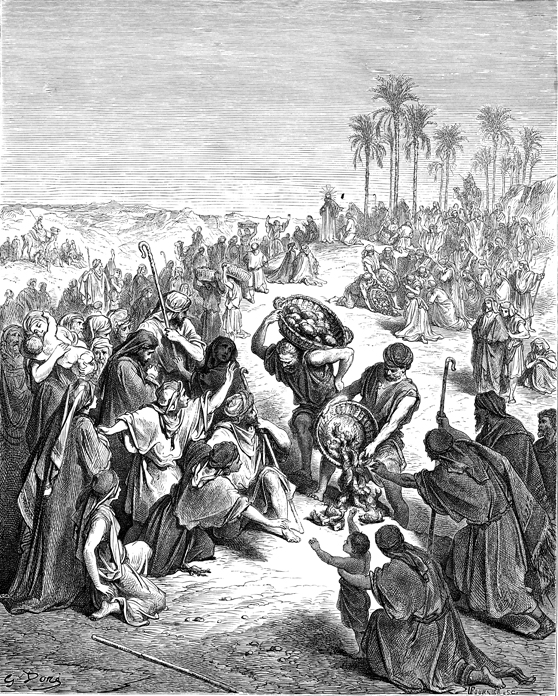
- Feeding the Five Thousand, John 6:1-15
Show the next 6 titles
Show the next 6 titles
About John
Who and where
1 name in this verse with a page on the site.
This page draws on Bonaventure, Commentary on John, Chapter 6; Cyril of Alexandria, Commentary on the Gospel of John, Book 4; J.C. Ryle, Expository Thoughts on the Gospels: John (lightly modernized text, Grace Gems edition); Jamieson, Fausset & Brown, Commentary Critical and Explanatory on the Whole Bible; John Chrysostom, Homily on the Gospel of John 46; John Gill, Exposition of the New Testament (1746-1748); Theophylact of Ohrid, Commentary on John and Thomas Aquinas, Commentary on John, Chapter 6, Lecture 5.