
John 6:12
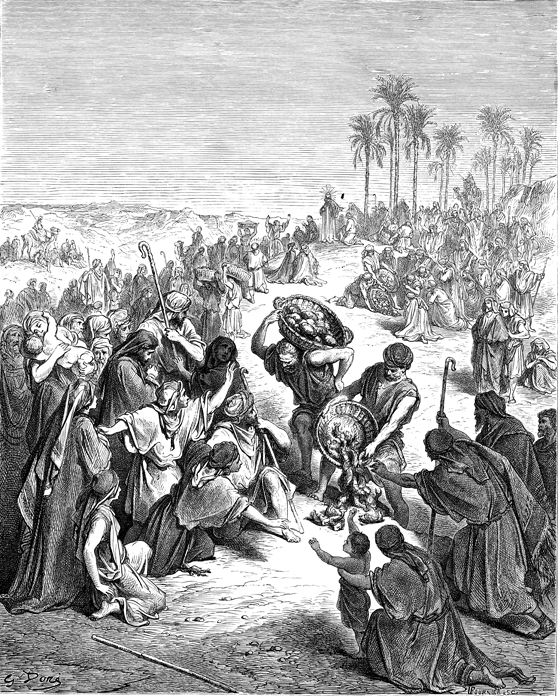
in John 6And when everyone was full, He said to His disciples, “Gather the pieces that are left over, so that nothing will be wasted.”
BSB
The same verse in ASV and KJV ▾
ASV
And when they were filled, he saith unto his disciples, Gather up the broken pieces which remain over, that nothing be lost.
KJV
When they were filled, he said unto his disciples, Gather up the fragments that remain, that nothing be lost.
⋯
This verse in John 6
Commentary
17 notes on this verseTo some one Christ may seem out of sparing of the fragments to have bidden His disciples to gather them together. Yet (I think) every one will fitly imagine, that Christ would not endure to descend to such littleness: and why say I Christ? not even one of us would do so: for what would be supposed to be the remnant of five barley loaves? But the verse has a great economy, and makes the miracle evident to the hearers.
This site's exposition
plenty of grass in that place
on John 6:10-13
Plenty of grass in that place marks the spring, the season of the Passover just named. Jesus gave thanks over the loaves and had them handed out until everyone was full, and the leftovers fill twelve baskets. He orders them gathered so nothing is wasted.
This site's exposition
so that nothing will be wasted
Cyril asks why the Lord would trouble over the scraps of five barley loaves, and he answers that the gathering makes the miracle plain to all who hear of it. Gill gives two reasons, proof of the miracle and a lesson in thrift amid plenty. Clarke cites a Jewish warning against wasting crumbs.
The record, by era
The Church Fathers5 voices
(Tr. xxiv. s. 6) And what are the fragments, but the parts which the people could not eat? An intimation, that those deeper truths, which the multitude cannot take in, should be entrusted to those who are capable of receiving them, and afterwards teaching them to others; as were the Apostles. For which reason twelve baskets were filled with them.
And what are the fragments, but things which the multitude could not eat? Some secret meanings, then, are to be understood, which the multitude cannot receive; what remains but that they be entrusted to those who are able also to teach others, as were the apostles? For which reason, twelve baskets were filled. A wonderful thing was wrought, and a mighty deed; but if one intently consider it, it is as the works of God. He who out of a few grains multiplies the harvests, multiplied the five loaves in His hands.
But it was not because he had the ability to multiply it [the loaves of bread and the fish] that he did thus multiply them, but rather because there would then be enough food for those who would eat them. His miracle, therefore, was not …
Now concerning the Thanksgiving (Eucharist), thus give thanks. First, concerning the cup: We thank thee, our Father, for the holy vine of David Thy servant, which Thou madest known to us through Jesus Thy Servant; to Thee be the glory for ever. And concerning the broken bread: We thank Thee, our Father, for the life and knowledge which Thou modest known to us through Jesus Thy Servant; to Thee be the glory for ever. Even as this broken bread was scattered over the hills, and was gathered together and became one, so let Thy Church be gathered together from the ends of the earth into Thy kingdom; for Thine is the glory and the power through Jesus Christ for ever.
"And He said unto His disciples, Gather up the fragments which remain;-and they gathered them together, and filled twelve baskets." This was not a superfluous show, but in order that the matter might not be deemed a mere illusion; and for this reason He createth from matter already subsisting. "But why gave He not the bread to the multitudes to bear, but only to His disciples?" Because He was most desirous to instruct these who were to be the teachers of the world. The multitude would not as yet reap any great fruit from the miracles, (at least they straightway forgot this one and asked for another,) while these would gain no common profit. And what took place was moreover no ordinary condemnation of Judas, who bore a basket.
9 more voices on this verse
The Medieval Church3 voices
The Lord allows a surplus to remain from the loaves not to make a display of Himself, no, but so that the feeding of the men would not be taken as an illusion, and all would see clearly that they were truly satisfied, so much …
Now we see the leftovers collected (v 12). First, Christ gives the order; secondly, his disciples obey. The Evangelist says that after the people had eaten their fill, Christ said to his disciples: Gather up the fragments that are left over. This was not pretentious …
"When they were filled," that is, satisfied, "he said to his disciples: Gather up the fragments that remain, lest they perish." For since bread was made for the use of men, fragments perish when they are not taken up for the use of men; Psalm: …
The Puritans and the Awakening2 voices
When they were filled,.... Had not only eaten, but had made a full meal, and were thoroughly satisfied, having eaten as much as they could, or chose to eat: he said unto his disciples, gather up the fragments that remain, that nothing be lost; this he said, partly that the truth, reality, and greatness of the miracle might be clearly discerned; and partly, to teach frugality, that, in the midst of abundance, care be taken that nothing be lost of the good things which God gives; and which may be useful to other persons, or at another time.
Christ did not order the broken meat to be gathered up till all were filled; we must not begin to hoard and lay up till all is laid out that ought to be, for that is withholding more than is meet. Mr. Baxter notes here, "How much less should we lose God's word, or helps, or our time, or such greater mercies!" (2.) The observance of these orders (
quarantine:debris (2026-07-29) — unbalanced-parens
The Nineteenth Century4 voices
Gather up the fragments - “Great will be the punishment of those who waste the crumbs of food, scatter seed, and neglect the law.” Synops Sohar. Among the Jews the פאה peah, or residue after a meal, was the property of the servitors.
A commentator
J.C. Ryle1816–1900
Expository Thoughts on the Gospels: John (lightly modernized text, Grace Gems edition) (1869)
These verses describe one of our Lord's most remarkable miracles. Of all the great works that He did, none was done so publicly as this, and before so many witnesses. Of all the miracles related in the Gospels, this is the only one which all the four Gospel-writers alike record. This fact alone (like the four times repeated account of the crucifixion and resurrection) is enough to show that it is a miracle demanding special attention. We have, for one thing, in this miracle, a lesson about Christ's almighty power.
A commentator
J.C. Ryle1816–1900
Expository Thoughts on the Gospels: John (lightly modernized text, Grace Gems edition) (1869)
proposed
These verses describe one of our Lord's most remarkable miracles. Of all the great works that He did, none was done so publicly as this, and before so many witnesses. Of all the miracles related in the Gospels, this is the only one which all the four Gospel-writers alike record. This fact alone (like the four times repeated account of the crucifixion and resurrection) is enough to show that it is a miracle demanding special attention. We have, for one thing, in this miracle, a lesson about Christ's almighty power. We see our Lord feeding five thousand men with "five barley loaves and two small fish." We see clear proof that a miraculous event took place in the "twelve baskets of fragments" that remained after all had eaten. Creative power was manifestly exercised. Food was called into existence that did not exist before. In healing the sick, and raising the dead, something was amended or restored that had already existed. In feeding five thousand men with five loaves, something must have been created which before had no existence. Such a history as this ought to be specially instructive and encouraging to all who endeavor to do good to souls. It shows us the Lord Jesus "able to save to the uttermost." He is One who has all power over dead hearts. Not only can He mend that which is broken—build up that which is ruined—heal that which is sick—strengthen that which is weak. He can do even greater things than these. He can call into being that which was not before, and call it out of nothing. We must never despair of any one being saved. So long as there is life there is hope. Reason and sense may say that some poor sinner is too hardened, or too old to be converted. Faith will reply—"Our Master can create as well as renew . With a Savior who, by His Spirit, can create a new heart, nothing is impossible."
A commentator
Albert Barnes1798–1870
Notes, Explanatory and Practical, on the Old and New Testaments (1832-1869)
proposed
Gather up the fragments - This command is omitted by the other evangelists. It shows the care of Jesus that there should be no waste. Though he had power to provide any quantity of food, yet he has here taught us that the bounties of Providence are not to be squandered. In all things the Saviour set us an example of frugality, though he had an infinite supply at his disposal; he was himself economical, though he was Lord of all. If he was thus saving, it becomes us dependent creatures not to waste the bounties of a beneficent Providence. And it especially becomes the rich not to squander the bounties of Providence. They often feel that they are rich. They have enough. They have no fear of want, and they do not feel the necessity of studying economy. Yet let them remember that what they have is the gift of God - just as certainly as the loaves and fishes created by the Saviour were his gift. It is not given them to waste, nor to spend in riot, nor to be the means of injuring their health or of shortening life. It is given to sustain life, to excite gratitude, to fit for the active service of God. Everything should be applied to its appropriate end, and nothing should be squandered or lost.
The words behind it
15 Greek wordsEvery Greek word of this verse in the order it stands, with what it means and the door to its own study. The last column counts the times a word stands in the whole Bible: the rarer the word, the more the places it appears belong together.
| Greek | Sound | Meaning | Word study | In the Bible |
|---|---|---|---|---|
| ὡς | hos | When | G5613 → | 500 times |
| δὲ | de | now | G1161 → | 2765 times |
| ἐνεπλήσθησαν | eneplesthesan | they were filled | G1705 → | |
| λέγει | legei | He says | G3004 → | 1325 times |
| τοῖς | tois | to the | G3588 → | 19766 times |
| μαθηταῖς | mathetais | disciples | G3101 → | 260 times |
| αὐτοῦ· | autou | of Him; | G846 → | 5565 times |
| συναγάγετε | sunagagete | do gather together | G4863 → | 59 times |
| τὰ | ta | the | G3588 → | 19766 times |
| περισσεύσαντα | perisseusanta | having been over and above | G4052 → | |
| κλάσματα | klasmata | fragments | G2801 → | |
| ἵνα | ina | so that | G2443 → | 668 times |
| μή | me | nothing | G3361 → | 1066 times |
| τι | ti | anything | G5100 → | 528 times |
| ἀπόληται. | apoletai | may be lost. | G622 → | 90 times |
ὡςWhen
hosG5613 →500 times
δὲnow
deG1161 →2765 times
ἐνεπλήσθησανthey were filled
eneplesthesanG1705 →
λέγειHe says
legeiG3004 →1325 times
τοῖςto the
toisG3588 →19766 times
μαθηταῖςdisciples
mathetaisG3101 →260 times
αὐτοῦ·of Him;
autouG846 →5565 times
συναγάγετεdo gather together
sunagageteG4863 →59 times
τὰthe
taG3588 →19766 times
περισσεύσανταhaving been over and above
perisseusantaG4052 →
κλάσματαfragments
klasmataG2801 →
ἵναso that
inaG2443 →668 times
μήnothing
meG3361 →1066 times
τιanything
tiG5100 →528 times
ἀπόληται.may be lost.
apoletaiG622 →90 times
A shaded row is a word that stands 400 times or fewer in the Bible.
The walk
8 stopsEach card is a verse this one points to, and under it the verses that one points to in turn. Where several paths arrive at the same place, that place is listed first: the text keeps returning to it.
Through
Nehemiah 8:10Then Nehemiah told them, “Go and eat what is rich, drink what is sweet, and send out portions to those who have nothing prepared, since today is holy to our Lord. Do not grieve,…
it leads to
- Psalms 28:7–8
The LORD is my strength and my shield; my heart trusts in Him, and I am helped. Therefore my heart rejoices, and I give thanks to Him with my song.
- Proverbs 17:22
A joyful heart is good medicine, but a broken spirit dries up the bones.
- 2 Corinthians 12:8–9
Three times I pleaded with the Lord to take it away from me.
- Ecclesiastes 9:7
Go, eat your bread with joy, and drink your wine with a cheerful heart, for God has already approved your works:
- Isaiah 12:1–3
In that day you will say: “O LORD, I will praise You. Although You were angry with me, Your anger has turned away, and You have comforted me.
- Psalms 28:7–8
Through
Luke 1:53He has filled the hungry with good things, but has sent the rich away empty.
it leads to
- Psalms 107:8–9
Let them give thanks to the LORD for His loving devotion and His wonders to the sons of men.
- Luke 6:21
Blessed are you who hunger now, for you will be filled. Blessed are you who weep now, for you will laugh.
- Psalms 34:10
Young lions go lacking and hungry, but those who seek the LORD lack no good thing.
- Psalms 107:8–9
Where this verse is studied
On this page
Studies15
On this verse
On this chapter
About John
This page draws on 15 works. Open the list of works
This page draws on Adam Clarke, Commentary on the Bible; Albert Barnes, Notes, Explanatory and Practical, on the Old and New Testaments (1832-1869); Augustine of Hippo, Catena Aurea by Aquinas; Augustine of Hippo, Tractates on John 24; Bonaventure, Commentary on John, Chapter 6; Cyril of Alexandria, Commentary on the Gospel of John, Book 3; Didache, The Didache, Chapter 9; Ephrem the Syrian, COMMENTARY ON TATIAN'S DIATESSARON 12.4; J.C. Ryle, Expository Thoughts on the Gospels: John (lightly modernized text, Grace Gems edition); Jamieson, Fausset & Brown, Commentary Critical and Explanatory on the Whole Bible; John Chrysostom, Homily on the Gospel of John 42; John Gill, Exposition of the New Testament (1746-1748); Matthew Henry, Commentary on the Whole Bible; Theophylact of Ohrid, Commentary on John and Thomas Aquinas, Commentary on John.